Key takeaways
- AI search visibility matters for service businesses because potential clients use ChatGPT, Perplexity, and Claude to research providers before ever visiting your website
- Traditional product-focused tracking metrics don't translate well to services -- you need to monitor expertise signals, case study citations, and problem-solution mapping instead
- The technical reality: AI tools produce inconsistent results, making "ranking" less meaningful than understanding citation patterns and content gaps
- Start with crawler log analysis and citation tracking before investing in expensive monitoring platforms -- many service businesses can get actionable insights from simpler approaches
The service business dilemma: invisible in the AI era
Your potential clients aren't Googling "best [your service] near me" anymore. They're asking ChatGPT "how do I solve [specific problem]" or telling Claude "I need help with [business challenge]." The AI responds with a detailed answer, maybe mentions a few companies, maybe doesn't mention yours at all.
You never see the conversation. You never get the traffic. The lead goes to a competitor who showed up in that AI response.
This is the new reality for service businesses. Unlike e-commerce brands that can track product recommendations in ChatGPT Shopping or monitor when their items appear in AI-generated buying guides, service businesses face a murkier challenge. When someone asks an AI about accounting services, legal help, or marketing agencies, there's no product card to track. Just paragraphs of advice that may or may not include your name.
So does tracking AI visibility even make sense?
The short answer: yes, but not the way most tools are selling it.
Why traditional AI tracking falls short for services
Most AI visibility platforms were built with e-commerce in mind. They track whether your product appears in shopping recommendations, count how many times your brand gets mentioned, and show you "rankings" across different AI models.
For a service business, this approach has three fundamental problems.
Problem one: AI responses are wildly inconsistent
Research from SparkToro tested this directly. They asked the same AI tools the same questions repeatedly and got dramatically different answers each time. When ChatGPT recommends brands or services, the list changes with every prompt.
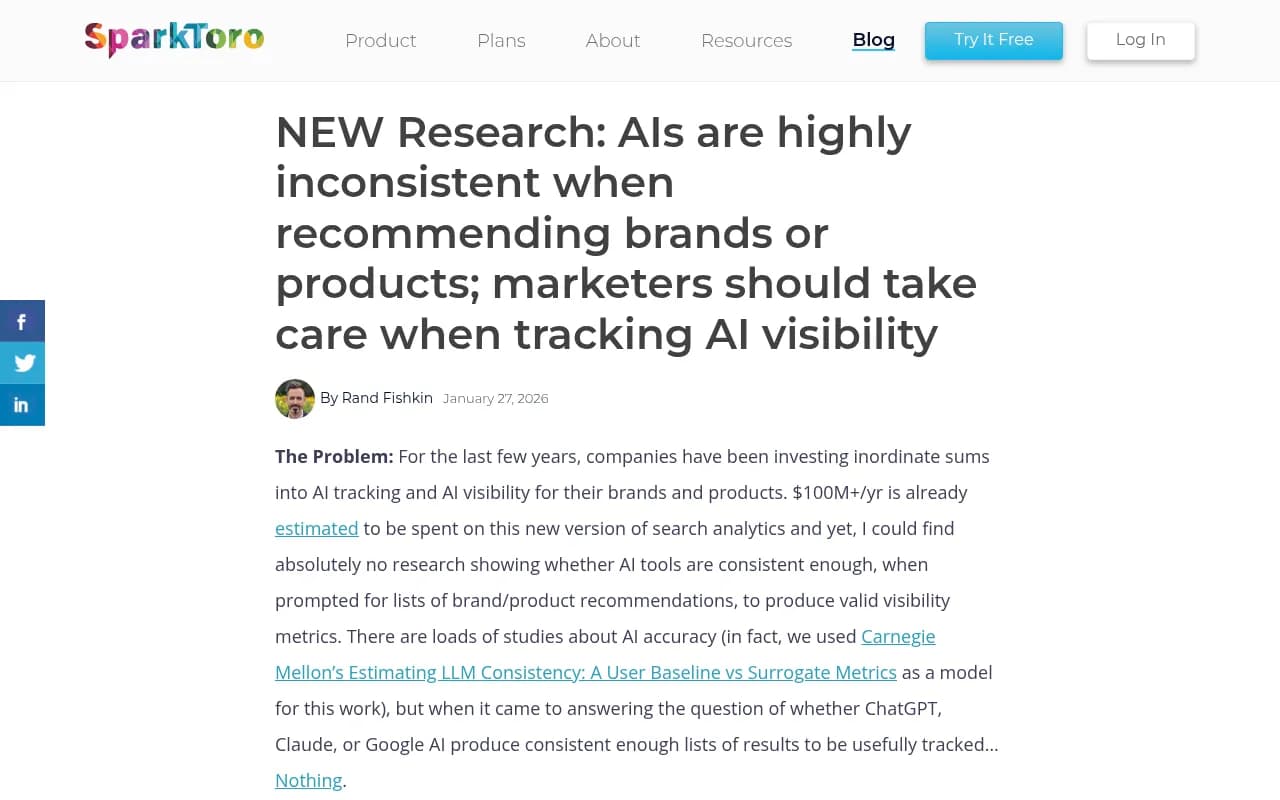
This isn't a bug. It's how these systems work. Unlike Google, which has a relatively stable index and ranking algorithm, AI models generate responses probabilistically. The same question asked twice can produce entirely different recommendations.
For service businesses, this means a "ranking" is almost meaningless. You might be mentioned in response to a prompt on Monday and completely absent on Tuesday, even though nothing about your business or content changed.
Problem two: prompts are infinitely variable
When someone searches Google for "marketing agency Chicago," you know what they searched for. You can track your position for that exact query.
When someone asks an AI for help, they might phrase it as:
- "I need a marketing agency in Chicago"
- "What's the best way to find a good marketing firm near me"
- "My company needs help with digital marketing, we're based in Chicago, any recommendations"
- "I'm looking for someone who can handle our social media and paid ads, Chicago area preferred"
Each of these prompts could produce completely different responses, even though they're all expressing the same underlying need. There's no finite set of "keywords" to track. The prompt space is infinite.
Problem three: most tracking tools can't actually see what they claim to track
Here's the uncomfortable truth that most AI visibility vendors won't tell you: they can't directly monitor what AI tools are saying about your brand in real user conversations.
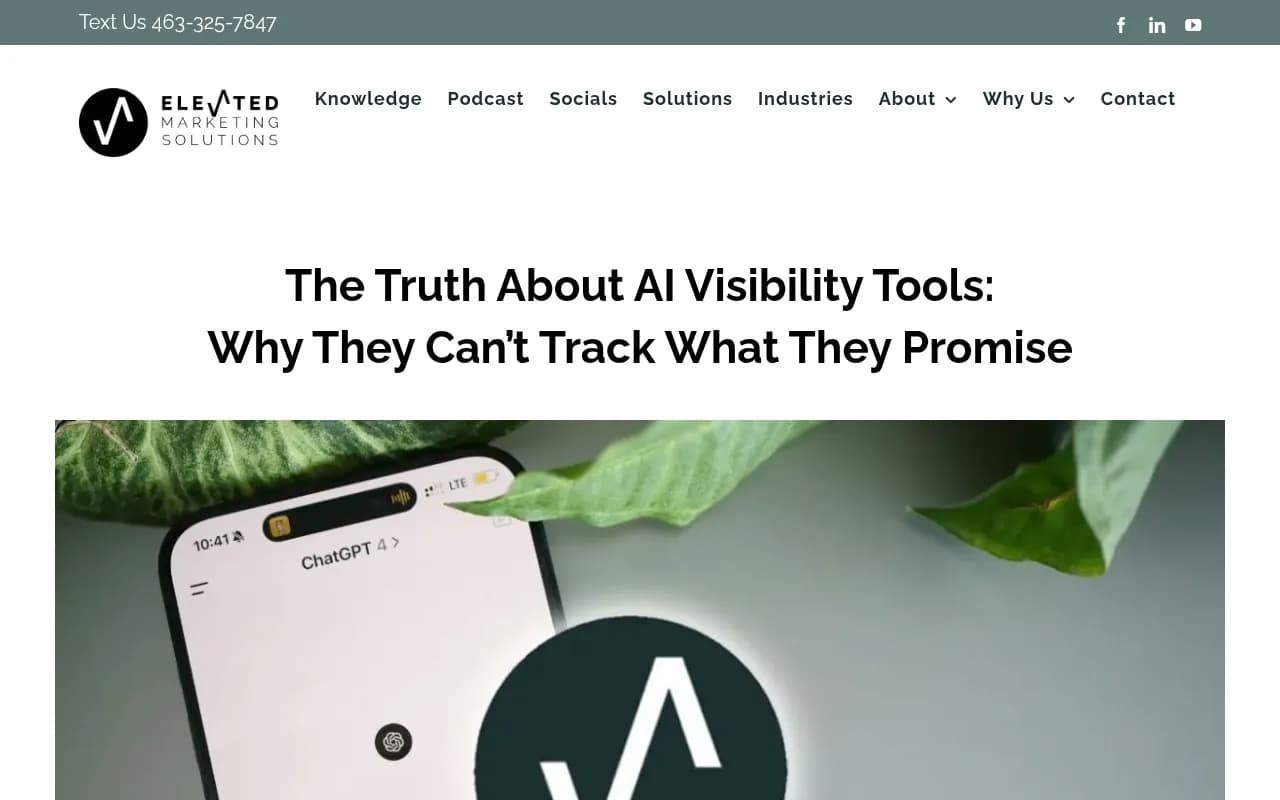
AI tools don't publish their outputs. There's no feed of responses that a tracker can monitor. What these platforms actually do is run their own prompts and record the responses they get. They're sampling the possibility space, not tracking real user interactions.
For product recommendations, this sampling approach can still provide useful directional data. For service businesses, where the prompt space is more complex and the responses more varied, the gap between what these tools measure and what actually matters to your business gets wider.
What service businesses should track instead
If traditional "ranking" metrics don't work, what should you measure?
The answer depends on understanding what AI visibility actually means for a service business. It's not about being mentioned by name in every response. It's about being discoverable when potential clients are researching their problems and evaluating solutions.
Here are the metrics that actually matter.
Citation patterns and content gaps
Instead of tracking whether you're "ranked" for specific prompts, focus on understanding which of your content assets AI models cite and which topics you're missing entirely.
Promptwatch approaches this differently than most tracking tools. Rather than just showing you mention counts, it identifies content gaps -- the specific questions and topics where competitors are being cited but you're not. For service businesses, this is far more actionable than a visibility score.

The platform analyzes over 880 million citations to show you exactly what content your website needs to create. Not generic SEO topics, but the specific angles and questions that AI models are looking for when they generate responses about your service category.
AI crawler activity on your website
Before an AI model can cite your content, it needs to discover and index it. Most service businesses have no idea whether AI crawlers are even visiting their site, let alone which pages they're reading.
Crawler log analysis tells you:
- Which AI models are accessing your site (ChatGPT, Claude, Perplexity, etc.)
- Which pages they're reading most frequently
- Whether they're encountering errors or access issues
- How often they return to check for updates
This is foundational data. If AI crawlers aren't successfully indexing your service pages, case studies, and expertise content, you won't show up in responses no matter how good your content is.
Promptwatch includes real-time crawler logs as part of its platform, showing exactly when AI models hit your site and what they accessed. Most competing tools (Otterly.AI, Peec.ai, AthenaHQ) don't offer this capability at all.
Expertise signals and authority markers
AI models don't just cite content randomly. They look for signals of expertise and authority, especially when answering questions about professional services.
For service businesses, this means tracking:
- Whether your team members are being cited as experts
- If your case studies and client results appear in responses
- How often your methodology or frameworks are referenced
- Whether industry publications that mention you are being cited
These aren't simple "mention counts." They're qualitative signals about whether AI models view your business as an authoritative source in your domain.
Problem-solution mapping
Service businesses get hired to solve problems. The most valuable AI visibility metric is whether you appear when potential clients describe their specific problems.
This requires tracking:
- Which pain points and challenges trigger mentions of your business
- What problem descriptions lead to competitor citations instead
- How AI models frame the solutions you offer
- Whether your content addresses the problems people actually describe in prompts
This is harder to measure than product rankings, but it's what actually drives leads for service businesses.
The practical approach: start simple, scale strategically
Most service businesses don't need to spend thousands per month on AI visibility tracking. At least not yet.
Here's a more practical approach.
Stage one: understand if AI matters for your business
Before investing in tracking tools, validate whether AI search is actually influencing your buyer journey.
Talk to recent clients and ask:
- Did you use ChatGPT, Claude, or other AI tools when researching solutions?
- What questions did you ask?
- Did any service providers or companies come up in the responses?
- How did those AI interactions influence your decision process?
If your clients aren't using AI tools to research services like yours, visibility tracking might not be your priority yet. If they are, you need to understand the specific prompts and use cases driving their research.
Stage two: audit your AI discoverability
Before tracking visibility, make sure AI models can actually find and understand your content.
Basic discoverability audit:
- Check if AI crawlers are visiting your site (server logs or a tool like DarkVisitors can show this)
- Test whether your robots.txt or other technical barriers are blocking AI crawlers
- Verify that your service pages, case studies, and expertise content are accessible
- Run manual tests: ask ChatGPT, Claude, and Perplexity questions about your service category and see what they cite
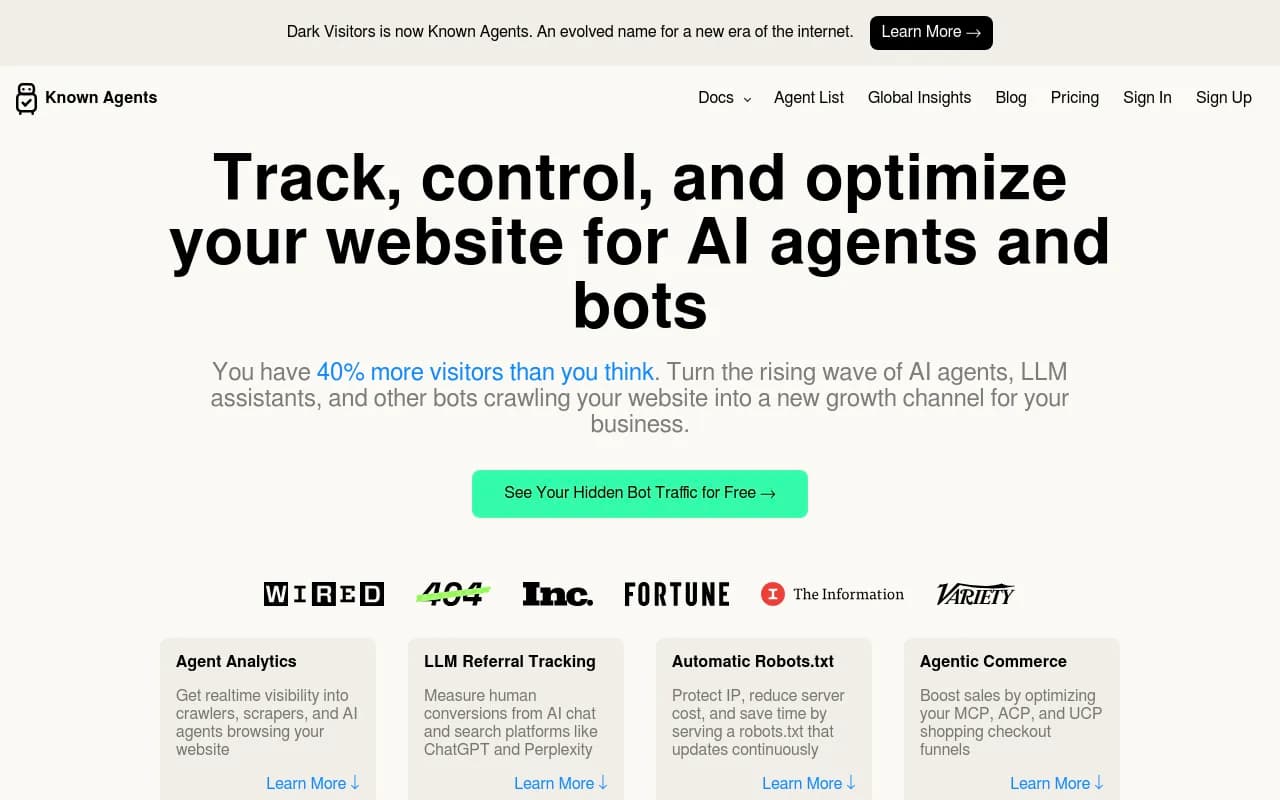
If AI crawlers aren't accessing your site or your content isn't being indexed, tracking visibility is premature. Fix the discoverability issues first.
Stage three: identify your content gaps
This is where most service businesses should invest their effort and budget.
Use a platform that shows you:
- Which prompts and questions your competitors are being cited for
- What content topics you're missing
- Which expertise areas AI models can't find on your site
- What types of content (case studies, how-to guides, frameworks) perform best in your category
Promptwatch's Answer Gap Analysis does exactly this. Instead of just showing you visibility scores, it tells you what content to create and why. The platform's AI writing agent can then generate articles, case studies, and guides grounded in real citation data and competitor analysis.
For service businesses, this action-oriented approach makes more sense than passive monitoring. You're not just tracking whether you show up -- you're actively closing the gaps that keep you invisible.
Stage four: track the outcomes that matter
Once you're creating content to improve AI visibility, track the metrics that connect to business results:
- Traffic from AI referrals (Promptwatch offers code snippet, Google Search Console integration, or server log analysis to attribute traffic)
- Engagement with pages that AI models cite frequently
- Lead form submissions or contact requests from visitors who came through AI channels
- Changes in the types of questions prospects ask (indicating they've done AI-assisted research)
These outcome metrics matter more than visibility scores. A service business that gets 10 high-quality leads per month from AI-referred traffic is winning, even if their "AI visibility score" is lower than a competitor who gets mentioned more often but generates no actual business.
The monitoring vs optimization distinction
This is the fundamental difference between AI visibility tools that work for service businesses and those that don't.
Monitoring-only platforms show you data but leave you stuck. You see that competitors are being mentioned more often, but you don't know why or what to do about it. Tools like Otterly.AI, Peec.ai, and AthenaHQ fall into this category -- they track mentions and visibility scores but don't help you improve.
Optimization platforms close the loop. They show you what's missing, help you create content to fill the gaps, and track whether your visibility improves as a result.
Promptwatch is built around this action loop:
- Find the gaps: Answer Gap Analysis shows which prompts competitors are visible for but you're not
- Create content that ranks: The AI writing agent generates articles and case studies engineered to get cited
- Track the results: See your visibility improve and connect it to actual traffic and leads
For service businesses with limited marketing budgets, this approach makes more sense than paying for passive monitoring.
When tracking makes sense (and when it doesn't)
Not every service business needs AI visibility tracking right now. Here's how to decide.
You should invest in tracking if:
- Your clients are tech-savvy and likely to use AI tools for research
- You operate in a competitive service category where AI recommendations could swing decisions
- You're already creating content regularly and want to optimize it for AI visibility
- You have the resources to act on the insights (create new content, fix technical issues, etc.)
- You're seeing competitors mentioned in AI responses when you test manually
You can probably wait if:
- Your clients are in industries or demographics that haven't adopted AI tools yet
- You're a local service business where proximity and personal referrals drive most decisions
- You don't have the bandwidth to create new content or optimize existing content
- Your website has fundamental SEO or technical issues that need fixing first
- You're not seeing any evidence that AI search is influencing your buyer journey
Comparison: AI visibility platforms for service businesses
If you've decided tracking makes sense, here's how the major platforms compare for service business use cases.
| Platform | Best for | Content gap analysis | AI writing tools | Crawler logs | Starting price |
|---|---|---|---|---|---|
| Promptwatch | Service businesses that want to take action, not just monitor | Yes | Yes | Yes | $99/mo |
| Profound | Agencies managing multiple service clients | Limited | No | No | $299/mo |
| Otterly.AI | Basic monitoring on a budget | No | No | No | $49/mo |
| AthenaHQ | Monitoring across many AI models | No | No | No | $199/mo |
| Peec.ai | Multi-language service businesses | No | No | No | $149/mo |
For service businesses specifically, the key differentiator is whether the platform helps you improve your visibility or just measures it. Promptwatch is the only platform in the "Leader" category that combines monitoring with content gap analysis and AI-powered content generation.
The bigger question: is AI visibility a priority at all?
Here's the uncomfortable truth: for many service businesses, improving traditional SEO, fixing your website's conversion rate, or investing in referral programs might deliver better ROI than AI visibility tracking.
AI search is important and growing. But it's not the only channel, and for some service categories, it's not even the primary channel yet.
Before spending money on AI tracking tools, ask yourself:
- Do we have evidence that potential clients are using AI tools to research our service category?
- Are we losing deals to competitors who show up in AI responses?
- Do we have the content foundation and technical infrastructure for AI models to discover us?
- Can we commit to creating new content and optimizing existing content based on what we learn?
If you can't answer yes to most of these questions, you might not be ready for AI visibility tracking yet. And that's okay.
What to do next
If you've decided AI visibility matters for your service business, here's your action plan:
-
Audit your current discoverability: Check if AI crawlers are accessing your site and whether your content is being indexed. Use server logs or a tool like DarkVisitors to see crawler activity.
-
Run manual tests: Ask ChatGPT, Claude, and Perplexity questions about your service category. See who gets mentioned and why. Document the patterns.
-
Identify your biggest content gaps: What questions are potential clients asking that your website doesn't answer? What expertise signals are missing? What case studies or proof points do you need?
-
Choose a tracking approach: If you want to monitor and optimize, consider Promptwatch. If you just want basic monitoring, Otterly.AI or Peec.ai might be enough. If you're not ready to invest in a platform yet, manual testing and crawler log analysis can get you started.
-
Create content strategically: Don't just write more blog posts. Create the specific content that AI models need to cite you as an expert -- detailed how-to guides, case studies with results, frameworks and methodologies, answers to specific questions.
-
Track outcomes, not just visibility: Connect your AI visibility efforts to actual business results. Traffic, leads, and revenue matter more than mention counts.
AI search is reshaping how potential clients discover and evaluate service providers. But the path forward isn't about chasing rankings or obsessing over mention counts. It's about understanding what AI models need to see before they'll recommend you, creating that content, and measuring whether it drives actual business results.
For service businesses, that's a very different game than tracking product recommendations. The tools and tactics need to match the reality of how services are researched and purchased. Get that right, and AI visibility becomes a genuine competitive advantage. Get it wrong, and you're just paying for dashboards that don't drive decisions.