Key takeaways
- AI search engines like ChatGPT, Perplexity, and Google AI Overviews now answer questions directly instead of sending users to websites -- if your brand isn't mentioned in those answers, you're invisible to a growing segment of potential customers
- Non-technical marketers can track AI visibility using no-code platforms that require nothing more than entering your brand name and a few competitor names
- The core workflow is simple: pick a tool, add your prompts (the questions customers ask), monitor which AI engines mention your brand, then use the data to guide content creation
- Most platforms offer free trials, so you can test before committing -- expect to spend $50-250/month for a basic setup that covers 50-150 prompts across multiple AI engines
- The goal isn't perfection -- it's knowing where you stand today and making incremental improvements by creating content that answers the questions AI engines are looking for
Why AI visibility matters in 2026 (and why you can't ignore it)
Search behavior changed faster than most marketing teams realized. In 2025, over one-third of people across OECD countries used generative AI tools regularly. By early 2026, 42% of consumers reported using AI to research Valentine's Day gifts -- a highly personal purchase decision that traditionally relied on browsing and word-of-mouth.
The shift is structural. When someone asks ChatGPT "what's the best project management tool for remote teams," they get an answer with specific recommendations. They don't click through to ten blog posts. They don't scroll past ads. They read the response, maybe follow one or two links if they're curious, and make a decision.
If your brand isn't in that answer, you don't exist for that buyer.
Traditional SEO still works for driving traffic, but AI search is about something different: being the recommendation when a potential customer asks a question. You're not competing for clicks anymore. You're competing for mentions, for citations, for being the name that shows up when an AI engine synthesizes an answer.
The good news: tracking this doesn't require a data science degree or a development team. The platforms built for this are designed for marketers who want answers, not dashboards full of metrics they don't understand.
What you're actually tracking (and what it means)
Before you pick a tool, it helps to know what you're measuring. AI visibility tracking breaks down into a few core metrics:
Brand mentions: Does your brand appear in the AI's response at all? This is the baseline. If you're not mentioned, nothing else matters.
Citation frequency: How often does the AI cite your website or content when answering relevant questions? Some tools track this as a percentage -- if 100 prompts are tested and your brand appears in 30 responses, you have 30% visibility for that prompt set.
Positioning: Where do you appear in the response? First mention carries more weight than being listed fifth in a bulleted list. Some platforms track this explicitly; others leave it to you to read the responses and judge.
Competitor comparison: How does your visibility compare to direct competitors? If three competitors are mentioned 60% of the time and you're at 15%, you know where you stand.
AI engine coverage: Different AI models pull from different sources and have different biases. ChatGPT might cite Reddit threads heavily, while Perplexity leans on authoritative publications. Tracking across multiple engines shows you where you're strong and where you're absent.
Sentiment and context: Some tools analyze how your brand is described -- positive, neutral, negative. This matters more for reputation management than pure visibility, but it's worth knowing if the mentions you're getting are helpful or harmful.
You don't need to track all of this on day one. Start with brand mentions and competitor comparison. The rest can wait.
Choosing a no-code AI visibility tool
The market for AI visibility tracking exploded in 2025. By early 2026, there are dozens of platforms, most of them built specifically for non-technical users. Here's how to narrow it down.
What to look for
Ease of setup: Can you create an account, add your brand name, and start tracking in under 10 minutes? If the onboarding process involves API keys, technical documentation, or "contact sales for setup," move on.
Prompt library or templates: Good platforms come with pre-built prompt sets for common industries (SaaS, ecommerce, B2B services, etc.). You shouldn't have to brainstorm 100 questions from scratch.
Multi-engine coverage: At minimum, you want ChatGPT, Perplexity, and Google AI Overviews. Bonus points for Claude, Gemini, and others.
Competitor tracking: The ability to add 3-5 competitor brands and see side-by-side comparisons is essential. Visibility in a vacuum doesn't tell you much.
Clear reporting: Dashboards should show you what matters (mentions, trends, gaps) without requiring you to export data and build your own charts.
Affordable pricing: For a single brand tracking 50-150 prompts, expect $50-250/month. Anything significantly higher is overkill unless you're an enterprise.
Recommended platforms for non-technical marketers
Here are platforms that meet the criteria above and are designed for marketers, not data analysts.
Promptwatch is built around a simple loop: find gaps in your AI visibility, generate content to fill those gaps, then track the results. The platform shows you which prompts competitors rank for but you don't, then uses an AI writing agent to create articles optimized for AI citation. You're not just monitoring -- you're taking action. It tracks 10 AI engines (ChatGPT, Perplexity, Claude, Gemini, Google AI Overviews, and more), includes crawler logs so you can see when AI bots visit your site, and offers prompt volume estimates so you know which questions are worth targeting. Pricing starts at $99/month for 50 prompts and 1 site.

Otterly.AI is one of the most affordable options at $29/month. It focuses on automated prompt testing and GEO (Generative Engine Optimization) audits. The interface is straightforward: add your brand, pick your prompts, and see where you appear. It's lighter on features than some competitors but gets the job done if you're just starting out.

Peec AI offers a simple dashboard with competitor benchmarks and multi-language support. It's designed for SaaS, B2B, and ecommerce teams who want visibility data without complexity. Pricing starts at €89/month.

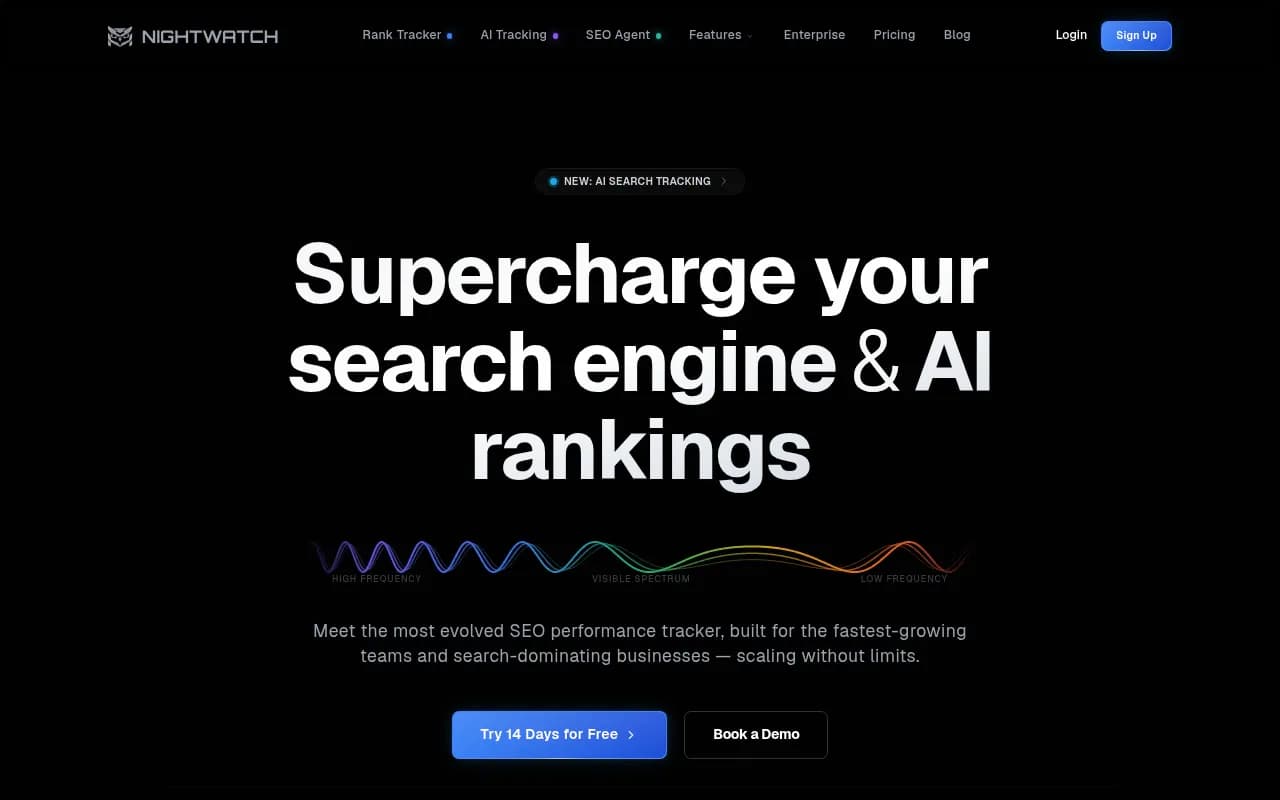
Nightwatch combines traditional SEO tracking with AI visibility monitoring. If you're already tracking keyword rankings and want to add AI search to the mix, this is a natural fit. The AI add-on costs extra on top of the base $39/month plan, but the geo-level data (tracking by city or state) is unusually precise.
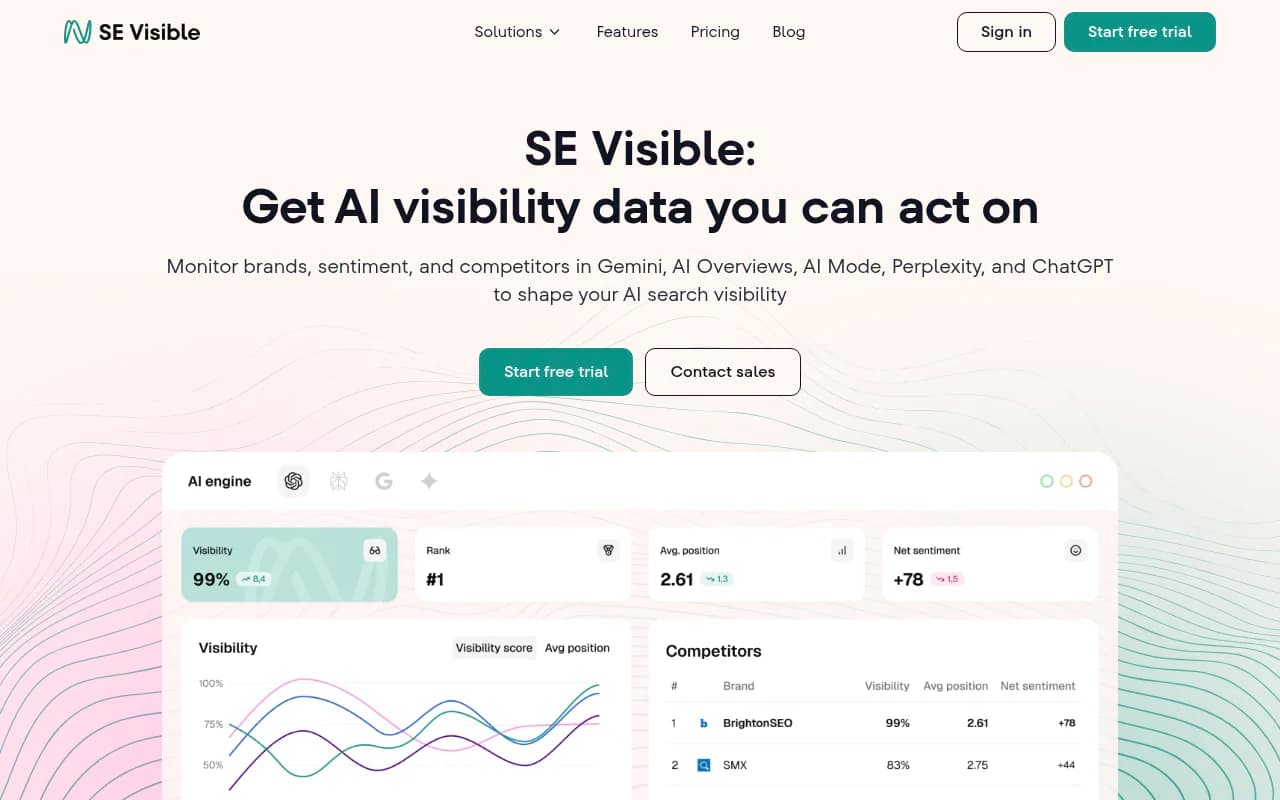
SE Visible is part of the SE Ranking suite and focuses on AI Mode visibility (Google's AI-generated answers). It also monitors ChatGPT, Perplexity, and AI Overviews. The interface is user-friendly, and the platform is designed for agencies and SEO teams who want a clear view of AI visibility without data overload. Pricing starts at $189/month.
Comparison table
| Tool | Best for | AI engines covered | Starting price | Key strength |
|---|---|---|---|---|
| Promptwatch | Marketers who want to act on data | 10 (ChatGPT, Perplexity, Claude, Gemini, etc.) | $99/mo | Content gap analysis + AI writing agent |
| Otterly.AI | Budget-conscious teams | ChatGPT, Perplexity, Claude | $29/mo | Affordable automated prompt testing |
| Peec AI | Multi-language tracking | ChatGPT, Perplexity, Gemini | €89/mo | Simple dashboard with competitor benchmarks |
| Nightwatch | SEO teams adding AI tracking | ChatGPT, Perplexity, AI Overviews | $39/mo + add-on | Geo-level precision |
| SE Visible | Agencies and SEO pros | ChatGPT, Perplexity, AI Overviews, AI Mode | $189/mo | User-friendly AI Mode tracking |
Setting up your first AI visibility tracker (step-by-step)
Once you've picked a platform, the setup process is similar across tools. Here's the walkthrough using a generic example.
Step 1: Create an account and add your brand
Sign up, confirm your email, and log in. The first screen will ask for your brand name and website URL. Enter both. Some platforms also ask for your industry or category -- this helps them suggest relevant prompts.
Step 2: Add competitors
Most tools let you add 3-5 competitor brands. Pick direct competitors whose visibility you want to benchmark against. If you're a project management tool, add Asana, Monday, and ClickUp. If you're a B2B SaaS company, add whoever shows up in the same buyer conversations.
Step 3: Choose or create prompts
This is where non-technical marketers sometimes freeze. "What questions should I track?"
Start with the obvious ones:
- "What is the best [your product category]?"
- "[Your product category] for [specific use case]"
- "[Competitor name] alternatives"
- "How to [solve problem your product solves]"
Most platforms offer prompt templates or libraries. Browse those first. If your tool has a prompt suggestion feature, use it -- it will pull common queries related to your industry.
Aim for 20-50 prompts to start. You can always add more later.
Step 4: Run your first scan
Hit the "scan" or "track" button. The platform will query each AI engine with your prompts and record the responses. This can take a few minutes to an hour depending on how many prompts you're tracking and how many engines you've selected.
Step 5: Review the results
Once the scan completes, you'll see a dashboard showing:
- Which prompts mentioned your brand
- Which prompts mentioned competitors but not you
- Your overall visibility percentage
- Positioning (if the tool tracks it)
This is your baseline. Don't panic if your visibility is low. Most brands start at 10-30% for a broad set of prompts.
Step 6: Set up recurring scans
Most platforms let you schedule weekly or monthly scans. Turn this on. AI responses change as new content gets published and indexed, so tracking over time shows you whether your efforts are working.
Interpreting the data (what to do with the numbers)
You've got your first report. Now what?
Focus on the gaps
The most actionable data is the list of prompts where competitors appear but you don't. This is your content roadmap. If "best CRM for small teams" mentions three competitors but not you, that's a signal: you need content that answers that question better than what's currently indexed.
Some platforms (like Promptwatch) explicitly surface these gaps and show you what's missing from your website. Others require you to manually compare the results.
Look for patterns
If you're consistently invisible for a certain type of prompt (e.g., "how to" questions vs. "best of" lists), that tells you where your content strategy has holes. Maybe you have product pages but no educational guides. Maybe you have blog posts but no comparison pages.
Don't obsess over individual prompts
One prompt showing zero visibility isn't a crisis. Ten prompts in the same category showing zero visibility is a problem. Look at clusters, not outliers.
Track trends, not snapshots
Your visibility score will fluctuate week to week as AI models update their training data and re-index the web. What matters is the trend over 3-6 months. Are you moving up? Staying flat? Declining?
Compare yourself to competitors, not perfection
If your top competitor has 45% visibility and you have 20%, closing that gap is a realistic goal. Aiming for 100% visibility across all prompts is not.
Creating content that gets cited by AI engines
Tracking is only useful if you act on it. The whole point of knowing where you're invisible is to fix it.
Answer the question directly
AI engines prioritize content that gives clear, direct answers. If the prompt is "what is the best email marketing tool for ecommerce," your content should have a section with that exact heading and a straightforward answer in the first paragraph.
Don't bury the answer in the third subheading. Don't make the AI parse five paragraphs of context before it finds the information. Lead with the answer.
Use structured data and clear formatting
Bulleted lists, numbered steps, comparison tables, and clear headings make your content easier for AI models to parse. They're looking for information they can extract and reformat into a response.
If you're writing a comparison, use a table. If you're listing features, use bullets. If you're explaining a process, use numbered steps.
Be specific and factual
Vague marketing copy doesn't get cited. "Our platform empowers teams to streamline workflows" is useless to an AI engine. "Our platform lets teams assign tasks, set deadlines, and track progress in a shared dashboard" is concrete.
AI models prefer content that includes numbers, examples, and specific details.
Cover the full question, not just your product
If the prompt is "best project management tools for remote teams," don't write an article that only talks about your product. Cover the category. Mention competitors. Explain the criteria buyers should consider. Then position your product as one of the options.
AI engines cite content that's genuinely helpful, not content that's a thinly disguised sales pitch.
Optimize for Reddit and YouTube (if relevant)
ChatGPT and Perplexity both cite Reddit threads and YouTube videos frequently. If your audience hangs out on Reddit, participate in relevant discussions. If video content makes sense for your product, create it and upload it to YouTube with clear titles and descriptions.
This isn't traditional SEO, but it's part of the AI visibility game.
Use AI writing tools (carefully)
Some platforms (like Promptwatch) include AI writing agents that generate content specifically optimized for AI citation. These tools analyze what's currently being cited, identify gaps, and draft articles designed to fill those gaps.
This can save time, but don't publish AI-generated content without editing it. The draft is a starting point, not a finished product. Add your expertise, examples, and voice.
Common mistakes non-technical marketers make
Tracking too many prompts too soon
Start small. 20-50 prompts is enough to get useful data. Tracking 500 prompts on day one will overwhelm you and make it harder to spot patterns.
Ignoring competitor data
Your visibility score in isolation doesn't mean much. 25% visibility sounds low, but if your competitors are at 20%, you're winning. If they're at 60%, you're behind.
Expecting instant results
AI models don't re-index the web daily. It can take weeks or months for new content to get picked up and cited. Track trends over quarters, not weeks.
Focusing only on branded prompts
Tracking "[your brand name] review" or "[your brand name] vs [competitor]" is useful, but those prompts only matter if people already know your brand exists. The bigger opportunity is non-branded prompts like "best [category] for [use case]" where buyers are still researching options.
Not connecting visibility to business outcomes
AI visibility is a means to an end. The end is traffic, leads, and revenue. If your visibility is climbing but you're not seeing an uptick in branded searches, direct traffic, or conversions, something's broken. Either the prompts you're tracking aren't the ones buyers actually use, or the content you're creating isn't compelling enough to drive action.
Some platforms (like Promptwatch) offer traffic attribution tools that connect AI visibility to actual website visits. Use them.
Advanced tips (once you've got the basics down)
Segment prompts by buyer journey stage
Not all prompts are equal. "What is [product category]" is top-of-funnel awareness. "[Product A] vs [Product B]" is bottom-of-funnel comparison. Track both, but prioritize the prompts that align with where your buyers are.
Test different content formats
If listicles aren't getting cited, try how-to guides. If how-to guides aren't working, try comparison pages. AI engines have preferences, and those preferences vary by topic.
Monitor AI crawler logs
Some platforms (like Promptwatch) show you when AI crawlers (ChatGPT, Claude, Perplexity bots) visit your website. This tells you which pages AI engines are reading and how often they're checking for updates. If a page isn't being crawled, it won't get cited.
Use personas to refine prompts
Most tools let you customize prompts with personas ("as a small business owner" or "as a developer"). This helps you track visibility for specific audience segments and tailor content accordingly.
Integrate with your existing SEO workflow
AI visibility isn't separate from SEO -- it's an extension of it. The content that ranks well in Google often gets cited by AI engines too. Use your keyword research, search console data, and existing content calendar to inform your AI visibility strategy.
Pricing and budget expectations
Here's what you should expect to spend:
Starter tier ($29-99/month): 1 brand, 50-100 prompts, 3-5 AI engines, basic reporting. Good for small businesses or solo marketers testing the waters.
Professional tier ($99-250/month): 1-2 brands, 100-200 prompts, 5-10 AI engines, competitor tracking, crawler logs, content gap analysis. This is the sweet spot for most marketing teams.
Business tier ($250-600/month): Multiple brands, 300+ prompts, full AI engine coverage, advanced analytics, API access. Designed for agencies or larger companies tracking multiple products.
Enterprise (custom pricing): Unlimited brands, unlimited prompts, white-label reporting, dedicated support. Only necessary if you're managing dozens of clients or tracking at scale.
Most platforms offer free trials (7-14 days). Take advantage of them. Run a scan, review the data, and decide if the insights are worth the cost before committing.
Final thoughts
AI visibility tracking isn't complicated. You don't need to be technical. You don't need a data team. You need a tool, a list of prompts, and a willingness to create content that answers real questions.
The marketers who win in 2026 are the ones who understand that search is no longer about ranking on page one of Google. It's about being the name that shows up when someone asks ChatGPT, Perplexity, or Claude for a recommendation.
Start small. Pick a tool, track 20 prompts, and see where you stand. Then create one piece of content designed to fill a gap. Track it for a month. See if it moves the needle.
That's the loop. Find gaps, create content, track results. Repeat.
You don't need to be perfect. You just need to be present.