Key takeaways
- Single-prompt checks are close to worthless statistically. You need roughly 57 prompts per topic for a directional read, 228 for something you'd call a commercial-grade number, and thousands for anything close to precision.
- Engine behavior is not stable. ChatGPT's citation count per response dropped about 27% after the GPT-5.3 rollout in March 2026, and Reddit's share of ChatGPT citations fell from 4% to 0.5% in a single day in August. Track the platform, not just the client.
- Client-facing reporting needs white-labeling and multi-workspace management as table stakes, not a nice-to-have. Several popular tools, Otterly.AI among them, still don't offer native white-label dashboards.
- Pricing for agency tiers ranges wildly, from Otterly's $29/mo entry point to Profound's murky $399-plus-per-client-workspace model to uSERP's $10,000/month enterprise contracts. Map spend to how many clients you're actually running, not the sales page.
- The technical layer (robots.txt, CDN rules, crawler access) matters as much as the content layer. If a client's site blocks AI crawlers, no amount of prompt optimization fixes that.
Why this is a different job than social listening
Agencies have run brand monitoring retainers for years: Mentionlytics, Awario, Brand24, that whole category. Someone mentions your client on a forum or in a news article, the tool catches it, you report on volume and sentiment. AI brand mention monitoring is not that, even though it gets sold with the same vocabulary.
When someone asks ChatGPT "what's the best project management tool for a 10-person agency," there's no page to crawl afterward. The answer gets generated, cited sources get pulled in real time, and the whole thing can look completely different five minutes later if you ask again. You're not watching for a mention to appear somewhere on the web. You're watching an answer that gets rebuilt, on the fly, for a category question your client cares about.
That difference is the whole reason this became its own tooling category, and it's why running it for five or ten clients at once breaks a lot of naive setups.
The math nobody tells you about prompt volume
Here's the part most agencies skip past. LLM outputs are probabilistic. Ask the same question twice and you can get different brand lists, different order, different framing. Research on prompt-tracking methodology (via Obsero's breakdown) puts real numbers on this: a single prompt tracked daily across three models produces about 21 readings a week, which works out to a margin of error around plus or minus 16 percentage points. That's not a metric you can put in a client deck with a straight face.
The usable thresholds look like this:
| Precision level | Prompts needed | Use case |
|---|---|---|
| Broadly directional | ~57 | Early signal, spot big swings |
| Commercial standard | ~228 | What you'd actually report to a client |
| Academic precision | ~5,682 | Overkill for almost every agency retainer |
Profound's own guidance lands in the same neighborhood, telling users to start with 100 prompts and scale toward the low thousands depending on category breadth. SE Ranking splits the mix by funnel stage: 10-20 awareness prompts, 20-30 consideration prompts, and 5-10 brand-evaluation prompts tracked as their own bucket rather than lumped in with category questions.
The practical fix, if 228 prompts per client sounds unaffordable, is to group prompts into topics and read the topic-level trend over 30 days rather than trusting any single day's number. A worked example from that same methodology: 100 prompts across 3 models, grouped into 5 topics of 20 prompts each, gives you 420 weekly readings per topic and a margin of error around 3.7 percentage points weekly, tightening to under 2 points over a month. That's the kind of number you can defend on a client call.
Engine behavior isn't stable, and that changes how you report
This is the part agencies get burned on most often: a client's visibility drops, they panic, you go digging for a content problem, and it turns out the platform itself changed.
Average citations per ChatGPT response fell from around 6.4 to roughly 4.7-4.9 in the weeks after the GPT-5.3 rollout on March 4, 2026, according to Promptwatch's citation data, and it never bounced back. That's a 27% reduction in citation slots across the entire platform, hitting every ChatGPT model at once, not a single client's problem. If you don't have a baseline for "how many sources does ChatGPT cite on average this month," you can't separate that from your client actually losing ground.
Reddit is another one. For a long stretch, Reddit was treated as the channel to chase for AI citations. Then on August 14, 2026, reddit.com's share of ChatGPT Search citations collapsed from roughly 4% to 0.5% overnight, per Promptwatch's Reddit citation tracking. Google AI Overviews and AI Mode saw the same decline, just more gradually. Agencies still weighting Reddit heavily in a content strategy built six months ago are optimizing for a channel that's shrinking fast.
Source inventory also varies a lot by engine, and that changes how hard each citation slot is to win. Promptwatch's average-sources-per-response data puts ChatGPT at around 5 sources per web-search-enabled response, the smallest inventory of the major engines, while Google AI Overviews sits near 10 and Perplexity holds almost exactly 10 day after day. Microsoft Copilot is the wildcard, swinging from under 2 sources to nearly 17 within weeks as Microsoft reworks its retrieval. If a client is fighting for a ChatGPT citation, they're fighting for one of maybe five slots. On AI Overviews, they've got twice the room.
Query structure changed too. Average query length ChatGPT uses for its fan-out searches dropped from around 117 characters in December to about 53 characters by April 2026, per Promptwatch's query fan-out data. That's less than half the original length. ChatGPT is searching more like someone typing keywords than pasting a full sentence, which means client content should have headings that read like search queries ("best CRM for small agencies 2026") instead of conversational FAQ phrasing.
Personalization is the pitfall almost nobody accounts for
Here's something that will quietly wreck a monitoring setup if you don't build around it: ChatGPT's memory means two people asking the identical question can get different brand recommendations depending on what the model already knows about them. One research write-up found nearly 60% of memory-only ChatGPT answers about running shoes returned the same top three brands in the same order, but the moment web search kicked in, that consistency fell apart.
For agency reporting, this means you need to separate "cold visibility" (what a fresh, logged-out account sees) from "personalized visibility" (what a returning user with history sees). Run your tracked prompts from clean accounts for the number you report to clients. If you're testing personalized visibility too, that's a separate panel with its own methodology, not something you can average into the same score.
The technical check most agencies forget
Before any content optimization work, confirm the client's site is actually reachable by AI crawlers. This sounds obvious and gets skipped constantly. OpenAI's crawlers accounted for 79.8% of verified AI crawler requests in early September 2026, down from 94.8% in June, per Promptwatch's AI crawler traffic data meaning Anthropic, Google, Perplexity, and Mistral crawlers are picking up real share. A robots.txt rule or WAF setting that felt harmless a year ago might now be blocking a meaningfully larger slice of AI traffic than it used to.
Claude specifically is worth a quick check. Its citation crawler grew over 100x between December 2025 and April 2026, per Promptwatch's Claude crawler data, though it still represents under half a percent of total tracked crawler traffic overall. Treat it as a channel to unblock and monitor, not one to spend optimization budget chasing yet.
What agencies actually need from a monitoring tool
Running this for one brand is manageable with a spreadsheet and some manual prompting. Running it for ten or twenty client accounts requires a different set of features entirely:
- Multi-workspace management that doesn't require rebuilding prompt sets from scratch per client
- White-label reporting with your agency's branding, not the vendor's
- Daily refresh cycles, since weekly-only tracking misses platform shifts like the ones above until a client already noticed
- A way to distinguish platform-wide changes from client-specific ones, ideally baked into the dashboard
- Coverage across the engines your clients' buyers actually use, not just ChatGPT
Promptwatch fits this brief for agencies that want the monitoring tied to actual optimization work rather than just a dashboard. It tracks ChatGPT, Claude, Gemini, Perplexity, Grok, DeepSeek, Copilot, Mistral, Meta Llama, Google AI Overviews and AI Mode, with prompt volumes, difficulty scores, and citation rates per prompt so you're not guessing at sample size. The AI crawler logs (Agent Analytics) show exactly which pages of a client's site got crawled and whether anything errored out, which answers the "is this a content problem or a crawler-access problem" question directly instead of leaving you to dig through server logs manually. Agencies like Monks use its Answer Gap Report and Visibility Score to build content roadmaps across enterprise clients, and the platform has a white-label dashboard and client portal built specifically for agency use.

Comparing agency-tier options
| Tool | Agency pricing | Engine coverage | White-label | Notes |
|---|---|---|---|---|
| Promptwatch | Kick-off $199/mo, Growth $399/mo, Scale $799/mo, unlimited projects | ChatGPT, Claude, Gemini, Perplexity, Grok, DeepSeek, Copilot, Mistral, Meta Llama, AI Overviews, AI Mode | Yes, dashboard and client portal | Adds crawler logs, content agents, and CMS publishing on top of tracking |
| Profound | Starter $99/mo (ChatGPT only), Growth $399/mo, Agency workspace add-ons at $399/mo each | Up to 9-10 engines on Enterprise | Limited, agency pricing is inconsistent across its own materials | Strong for enterprise-scale citation-source analysis |
| Otterly.AI | $29 to $489/mo, custom above that | Multiple, Claude/Gemini/AI Mode are paid add-ons | No native white-label | Cheapest entry point, agencies work around branding with Looker Studio |
| SE Ranking | From $103.20/mo | ChatGPT, AI Overviews, AI Mode, Perplexity | Yes | Good if you already run traditional rank tracking in the same platform |
| Mentionova | Competitive, not fully public | ChatGPT, Perplexity, Claude, Gemini, AI Overviews, Reddit | Yes | Positioned specifically around agency multi-client workflows |
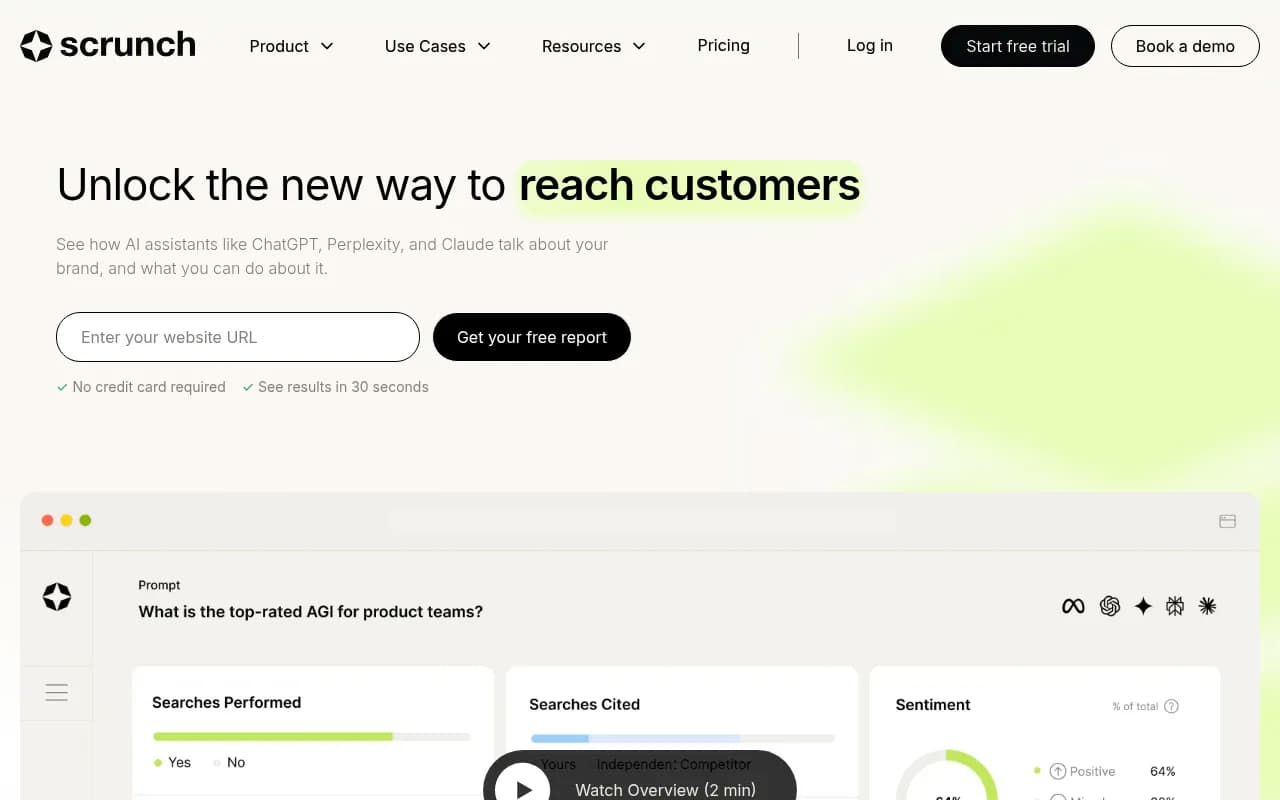
A few other names worth knowing if your client mix has specific needs: Scrunch and AthenaHQ both offer month-to-month agency access with wider engine counts; Hall AI and Peec AI are cleaner report-only options if you don't need the content-generation side.


Building the retainer without overpromising
A few things worth setting in the contract before you start billing this as a service:
Be explicit about what "visibility improved" means. If you're reporting a single week's number against last week's, you're comparing two numbers that each carry roughly a five-point margin of error, so the swing looks bigger than it is. Report trend lines over 30 days, and say so in the report itself.
Separate platform-wide shifts from client-specific wins or losses in every report. When ChatGPT's citation count drops across the board, or Reddit's share collapses like it did in August, that's context the client needs, not a footnote.
Decide upfront how many prompts you're tracking per client and why. "We track 100 prompts across 5 topics, refreshed daily" is a sentence a client can understand and a number you can defend if they ask why it costs what it costs.
Finally, don't sell monitoring as the whole service. A dashboard that tells a client they're invisible in AI Overviews without a plan to fix it is a liability, not a deliverable. If your monitoring tool doesn't connect citation gaps to actual content work, either budget for a separate production step or pick a platform that does both.
If you're building this out as a standing service line, the GEO software directory at bestgeosoftware.com and the AI rank tracking directory at ai-rank-tools.com are both worth a browse for narrower options depending on client size and budget. For agencies specifically weighing whether to build this in-house or hand it to a specialist, 1001 SEO Media runs GEO and AI visibility work as part of its service mix and can speak to what a realistic retainer scope looks like.