Key takeaways
- Ahrefs Brand Radar is a solid AI visibility add-on for teams already paying for Ahrefs Enterprise, but it costs an extra $699/month on top of an already expensive subscription.
- Brand Radar covers monitoring well -- 210M+ prompts, 6 AI indexes, custom prompt tracking -- but stops there. There's no content generation, no crawler logs, and no AI traffic attribution.
- Promptwatch is built as a full optimization loop: find gaps, generate content, track results. It's not just a monitor.
- If your goal is to understand your AI visibility, Brand Radar can work. If your goal is to improve it, you'll need more than Brand Radar offers.
- Pricing matters: Promptwatch starts at $99/month for a standalone plan. Brand Radar requires an Ahrefs Enterprise seat to unlock, making the real cost much higher.
Ahrefs Brand Radar is generating $1M in ARR every two weeks, according to Ahrefs CMO Tim Soulo. That's a remarkable number for a product that didn't exist two years ago. It tells you something real about demand -- marketing teams are scrambling to understand what AI search engines say about their brands, and Ahrefs got there fast.
But "fast-growing" and "best tool for the job" are different things. The question worth asking in 2026 isn't whether Brand Radar is impressive. It's whether bolting AI visibility onto a traditional SEO platform is the right architecture for what you actually need to do.
This guide breaks down what Brand Radar does, where it falls short, and how it compares to Promptwatch -- a platform built specifically around AI search visibility and optimization.

What Ahrefs Brand Radar actually does
Brand Radar is Ahrefs' answer to the AI search visibility problem. It monitors how your brand appears across AI platforms -- ChatGPT, Perplexity, Google AI Mode, and others -- using a database of 210M+ search-backed prompts. You can also add custom prompts to track specific queries relevant to your brand.

The core features:
- Prompt monitoring across 6+ AI indexes
- Custom prompt tracking (added in January 2026)
- Brand mention tracking across YouTube, TikTok, and Reddit
- Competitor visibility comparisons
- Integration with Ahrefs' existing SEO data
The pitch is appealing: if you're already in Ahrefs every day for keyword research and backlink analysis, having AI visibility data in the same dashboard feels efficient. One login, one workflow.
And for pure monitoring, Brand Radar is genuinely capable. The prompt database is large, the coverage is broad, and the custom prompt feature -- which lets you track specific questions your customers are actually asking -- is a real improvement over the original fixed-prompt approach.
Where Brand Radar starts to show its limits
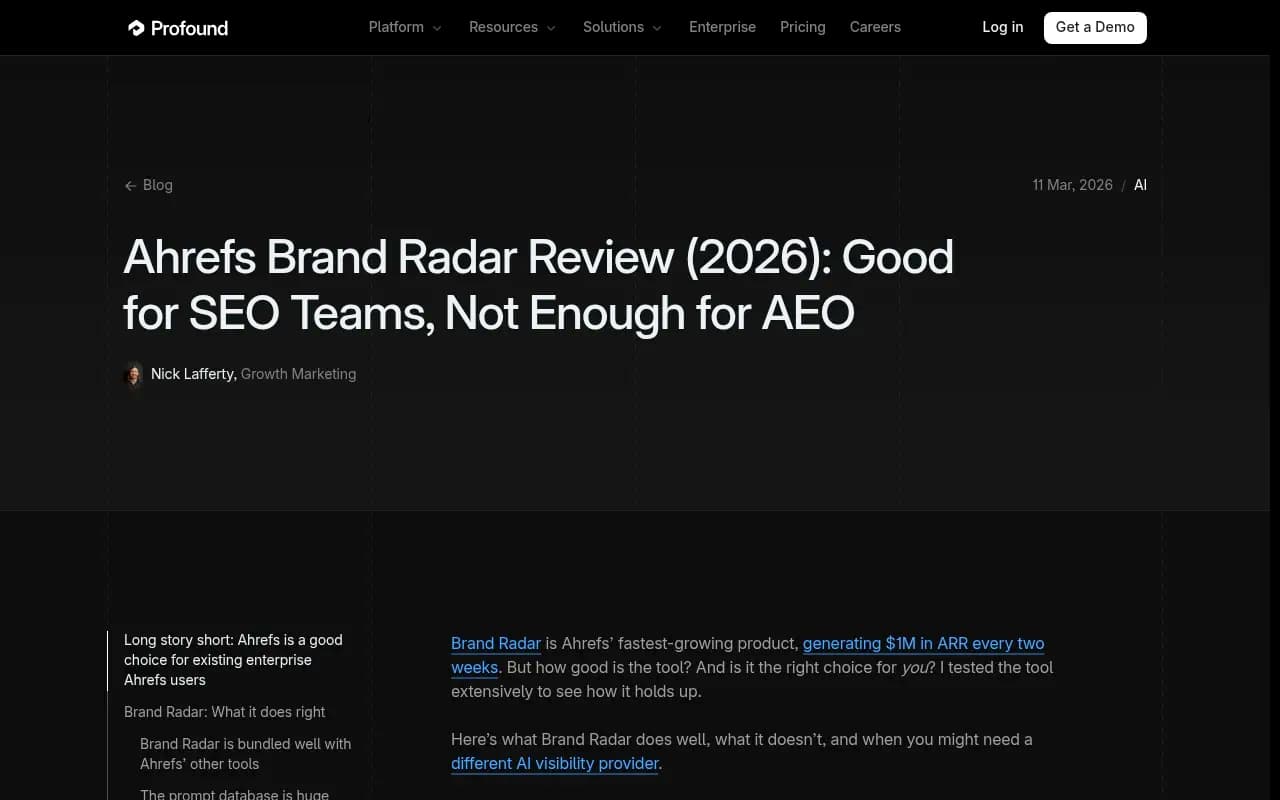
The honest assessment from people who've tested it extensively: Brand Radar is good at telling you where you stand. It's not built to help you change where you stand.
A few specific gaps:
No content generation or optimization
Brand Radar shows you which prompts competitors appear in that you don't. That's useful data. But it doesn't help you do anything about it. There's no content brief generation, no AI-assisted writing, no workflow that takes a visibility gap and turns it into a publishable article. You see the problem; you're on your own to fix it.
No crawler logs or agent analytics
This is a significant missing piece. When AI crawlers like GPTBot, ClaudeBot, or Perplexity's crawler visit your site, you want to know which pages they're reading, how often they return, and whether they're encountering errors. That data is how you understand whether your content is actually being indexed by AI engines -- and it's the early signal that tells you whether a newly published page is on its way to being cited.
Brand Radar doesn't surface this. You're monitoring AI outputs but flying blind on what's happening at the crawl level.
Fixed and limited AI traffic attribution
Brand Radar doesn't connect AI visibility to actual website traffic or revenue. You can see that you're mentioned in AI responses, but you can't trace that back to clicks, sessions, or conversions. For a marketing team that needs to justify spend, that's a real problem.
Pricing structure creates a high floor
Brand Radar isn't a standalone product. It requires an Ahrefs Enterprise subscription, which starts at $699/month just for Brand Radar access -- on top of whatever you're already paying for Ahrefs. For teams that don't need the full Ahrefs suite, that's a lot of money to get to AI visibility features.
Head-to-head comparison
Here's how the two platforms stack up across the features that matter most for AI search visibility:
| Feature | Ahrefs Brand Radar | Promptwatch |
|---|---|---|
| AI models monitored | 6+ (ChatGPT, Perplexity, Google AI Mode, etc.) | 10 (ChatGPT, Claude, Gemini, Perplexity, Grok, DeepSeek, Copilot, Meta AI, Google AI Overviews, Google AI Mode) |
| Custom prompt tracking | Yes | Yes |
| Prompt volume & difficulty scoring | No | Yes |
| Content gap analysis | No | Yes |
| AI content generation | No | Yes (Content Agents) |
| Crawler logs / agent analytics | No | Yes |
| AI traffic attribution | No | Yes |
| ChatGPT Shopping tracking | No | Yes |
| Reddit & YouTube insights | Yes (basic) | Yes (deeper integration) |
| Competitor heatmaps | Yes | Yes |
| Multi-language / multi-region | Limited | Yes |
| Standalone pricing | No (requires Enterprise) | Yes, from $99/month |
| Free trial | No | Yes |
The table tells a clear story. Brand Radar and Promptwatch overlap on monitoring. They diverge completely on everything that happens after monitoring.
The bolt-on problem
There's a broader issue here that goes beyond feature lists. Ahrefs built its reputation on traditional SEO: backlinks, keyword rankings, site audits. Brand Radar is an extension of that -- a new module added to an existing platform that was designed for a different purpose.
That's not inherently bad. But AI search visibility has different requirements than traditional SEO. The questions you're trying to answer are different:
- Which prompts are AI models using to surface competitors but not me?
- What content do I need to create to close those gaps?
- Are AI crawlers actually reading my new pages?
- Is my AI visibility translating into traffic?
Brand Radar answers the first question reasonably well. It doesn't really engage with the others.
Promptwatch was built to answer all four. The core workflow -- find gaps, generate content, track results -- is the product, not a feature added to something else. That architectural difference matters when you're trying to move the needle rather than just measure it.
When Brand Radar makes sense
To be fair about this: there are real scenarios where Brand Radar is the right call.
If you're already an Ahrefs Enterprise customer and you're primarily interested in a high-level view of your AI visibility alongside your traditional SEO data, Brand Radar is a reasonable addition. The incremental cost is lower if you're already paying for Enterprise, and the convenience of having everything in one platform has genuine value.
It also makes sense if your team's primary workflow is SEO and AI visibility is a secondary concern -- something you want to keep an eye on without building a separate process around it. Brand Radar fits that use case.
Where it doesn't fit: teams that have made AI search a strategic priority and need to actively improve their visibility, not just monitor it. At that point, the monitoring-only approach runs out of road quickly.
When you need more than monitoring
The GEO space in 2026 has a clear dividing line between tools that show you data and tools that help you act on it. Most platforms -- including Brand Radar -- sit on the monitoring side of that line.
Promptwatch sits on the other side. The Content Agents feature generates articles, listicles, and comparison pages grounded in real prompt data, citation patterns, and competitor analysis. The crawler log dashboard shows you exactly which AI bots are visiting which pages and when. The answer gap analysis surfaces the specific prompts where competitors are visible and you're not.
That combination -- visibility data plus content generation plus crawl intelligence -- is what makes it an optimization platform rather than a tracker.
For teams that are serious about AI search, the question isn't really "Brand Radar or Promptwatch." It's "do I want to monitor my AI visibility or improve it?" The answer to that question determines which tool you need.
Other tools worth knowing
If you're evaluating this space more broadly, a few other platforms are worth a look depending on your needs:

Profound is another strong option for teams focused on answer engine optimization, with good prompt volume data and agent analytics. It's positioned more toward enterprise and tends to be priced accordingly.

Otterly.AI is a lighter-weight monitoring tool that's more affordable than Brand Radar for teams that just want basic AI visibility tracking without the Ahrefs overhead.
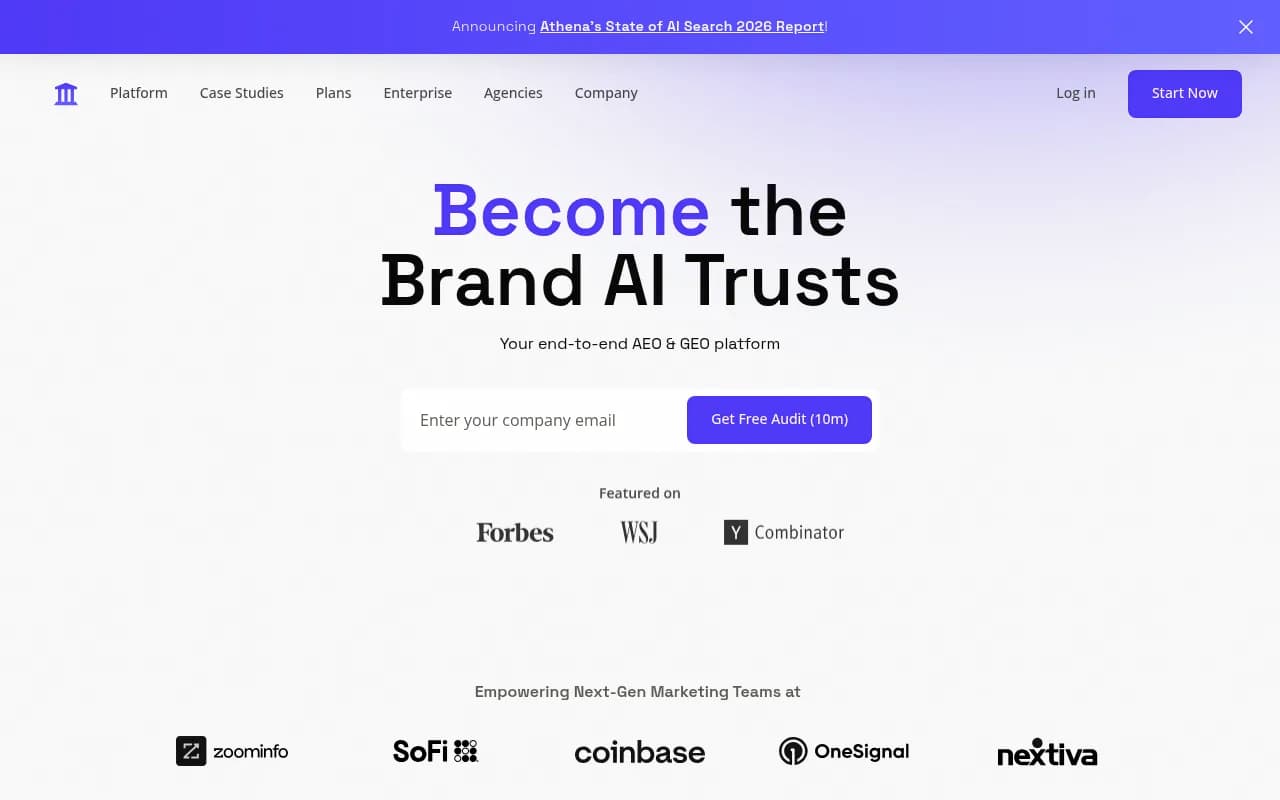
AthenaHQ covers monitoring across 8+ AI engines and is worth considering for teams that want broad coverage, though like Brand Radar it's primarily a monitoring tool without content generation.

Peec.ai is a good option if multi-language tracking is a priority -- it handles non-English markets better than most tools in this category.
The bottom line
Ahrefs Brand Radar is a well-built monitoring tool that makes sense as an add-on for existing Ahrefs Enterprise customers. It has real breadth -- 210M+ prompts, custom tracking, competitor comparisons -- and it's improving fast.
But it's a bolt-on feature on a platform designed for traditional SEO. It shows you where you stand in AI search. It doesn't help you move.
If AI search visibility is a strategic priority for your team in 2026, you need a platform built around the full optimization loop: finding gaps, creating content to fill them, and tracking whether that content actually gets cited. That's what Promptwatch is built to do -- and it's why monitoring-only tools, however capable, eventually hit a ceiling.
The question isn't whether Brand Radar is good. It is. The question is whether good monitoring is enough for what you're trying to accomplish.