
Key takeaways
- Most AEO platforms monitor. Fewer help you fix what they find, and fewer still check whether the fix worked. Decide which of those three jobs you are buying.
- Ask where the data comes from. Real interface monitoring and API calls can return different answers and different citations.
- Citation behavior shifts fast, so insist on daily tracking, annotations for model changes, and fanout capture.
- Check exports, API, MCP access, and security before the demo gets you excited about dashboards.
- Score every vendor on the same 18 questions, including the one you already like.
Why a checklist beats a demo
Every AEO demo looks good. The dashboard shows a visibility score, a competitor chart, and a list of sources. Then you sign, and three months later you realize nobody can tell you what to publish, whether your pages are even being crawled, or why the number dropped last Tuesday.
The market is crowded. Our catalog of AI visibility tools runs to well over a hundred entries, and many look nearly identical on a landing page. A fixed list of questions is the only reliable way to separate them. If you want a wider look at what exists, the GEO software directory at bestgeosoftware.com is a decent place to browse before you build a shortlist.
A note on sources. Several public buyer guides exist, and some are written by vendors. Nick Lafferty's guide, for example, is useful, but he discloses he works at Profound, and a lot of its criteria map to features that one vendor ships. I borrowed the good structure and added what it skips: engine coverage, data collection method, fanouts, export, and pricing.
How to use this checklist
Copy the 18 questions into a spreadsheet. Score each vendor 0 (no), 1 (partly), or 2 (yes, and they showed me). Weight the sections by what you actually need. A solo SEO at a mid-size SaaS company cares less about SSO than an enterprise security team does, and an agency cares more about multi-client reporting than a single brand does.
Ask vendors to show you the answer live in the product. A slide is not evidence.
Section 1: data you can trust
1. Where does the response data come from?
This is the most important question and the one vendors dodge. Some platforms query model APIs. Others monitor the real user interfaces of ChatGPT, Google AI Overviews, Gemini, and Perplexity. The outputs differ. User-facing answers, citations, and shopping recommendations can look different from what an API returns, because the interface adds retrieval, personalization, and formatting.
Both methods have a place. API models show what a model believes from training data. Real-UI collection shows what a buyer actually sees. You want to know which one each number on the dashboard is built from.
2. Which engines are covered, and are they all included in the price?
Ask for the exact list: ChatGPT, Google AI Overviews, Google AI Mode, Gemini, Perplexity, Copilot, Claude, Meta AI, and so on. Then ask whether each one costs extra. Some vendors sell engine coverage as add-ons, which changes the real price by a lot.
3. How often do prompts run, and what happens when an engine changes?
Daily should be the floor. Citation patterns move quickly. Promptwatch Data reports that reddit.com's share of ChatGPT citations fell from roughly 4% to 0.5% on August 14, 2026, and that ChatGPT citations per response dropped around the GPT-5.3 rollout on March 4, 2026. If your vendor only samples weekly, you will not know whether a dip is your content or the engine.
So ask: does the platform annotate known model changes, and can it re-baseline afterward?
4. Are citations reported per engine?
Engines behave differently. Promptwatch's average sources per response report found ChatGPT cites about 5 sources per web-search answer, AI Overviews about 10, and Perplexity almost exactly 10, while Copilot swung from under 2 to nearly 17 within weeks. That report is dated September 2025, so treat the exact figures as a snapshot. The point stands: a blended average hides which engine moved.
5. Does it capture query fanouts?
A single prompt can trigger several separate web searches. Those sub-queries are what your content has to match. Promptwatch's query fanout data shows a single prompt can trigger 3 to 8 or more searches, and that average query length and fanout count shifted noticeably between December 2025 and April 2026. More recently, ChatGPT began using the site: operator at scale on August 8, 2026, jumping from about 0.4% to about 17% of fanout queries. Prompt-level tracking alone misses all of this.
6. Where do prompt volumes come from?
Tracking 200 prompts is pointless if you picked them by guessing. Ask how volume and difficulty estimates are produced and whether the platform suggests prompts from Search Console, People Also Ask, or your own pages. If the answer is "we use a proprietary score" with no method, mark it down.
Section 2: from insight to action
7. Does it tell you what to do, in priority order?
A score is not a plan. Look for a prioritized to-do list tied to evidence: content gaps, weak sentiment, missing third-party mentions, crawl problems. Ask the vendor to open a real account and show the top five suggested actions and the data behind each.
8. Can it create and publish content, or does it stop at reports?
This is where platforms split. Monitoring-only tools hand you a gap list. Others write the page, push it to your CMS as a draft or live, and keep working from there. Check which CMSs are supported, whether a review step exists, and whether the writer follows your brand voice and facts. Ask whether it links internally and structures answers so assistants can quote them.
If you do not want a platform writing anything, fine. But then you need to be sure you have the production capacity to act on every gap it finds.
9. Can it show you what AI claims about your brand, and whether that is true?
Citations are half the story. The other half is what the answers say. Look for claim-level analysis ("affordable for small teams", "lacks a mobile app"), grouped by theme, and some way to trace a wrong claim back to the page it came from. This matters most for regulated industries and any brand with a pricing or product perception problem.
10. Does it segment by persona, country, and language?
Buyers do not all ask the same way. Ask whether you can prompt as different roles, and whether monitors are fixed to a country and language so markets do not mix. For local businesses, ask about city-level or coordinate-level tracking.
Section 3: measurement and attribution
11. Can it show whether AI bots can actually read your site?
This is the most underrated item. If GPTBot, ClaudeBot, or PerplexityBot cannot fetch your pages, no amount of content work helps. Ask for IP-verified crawler logs, not user-agent guessing, with page-level errors and a crawl-to-citation view. Crawler behavior also changes: Meta-WebIndexer grew from about 2% to nearly 38% of tracked AI crawler requests between mid-July and August 9, 2026. Your logs should show that kind of shift to you directly.
12. Does it measure traffic and conversions from AI?
Visibility without revenue is a vanity metric. Ask how AI-referred visits are identified, since some assistants strip referrers. A good vendor can explain its attribution approach, including UTM handling. The Promptwatch academy guide on attributing AI traffic is a good reference for what the method should look like.
13. Does it connect AI data to Google and Bing performance?
The useful question is "which pages rank in Google but never get cited by AI?" That needs Search Console and Bing Webmaster data next to citation data, at page level.
Section 4: integration, security, and cost
14. What can you export, and is there an API or MCP server?
Own your data. Ask for CSV and Excel exports of prompts, responses, citations, and crawler data. Then ask about a REST API, rate limits, and documentation. An MCP server is now a reasonable expectation if your team works in Claude, ChatGPT, or Cursor. If the vendor says exports cost extra, add that to the price.
15. What are the security and privacy credentials?
Ask for ISO/IEC 27001 certification, GDPR compliance, where data is processed, role-based access, SSO, and an audit log. Check that encryption at rest and in transit, regular penetration tests, and backups are in writing, not just on a sales call.
16. How is it priced, and what is the real cost per response?
Headline price means little. Normalize it. Divide the monthly price by tracked responses, then add any engine add-ons, seat fees, extra-project fees, and content credits. Ask what happens when you go over the prompt or response cap.
17. How fast does the product ship, and who supports you?
AI search changes monthly. Ask to see a changelog and count the releases over the last quarter. Then ask who answers your questions: a ticket queue, or a named strategist with real analysis experience? For agencies, ask whether there is a white-label option and how many client projects are included.
18. Can you test it on your own data before committing?
A free trial on your actual brand beats any demo account. Run your real prompts, check them against what you see manually in ChatGPT, and see whether the suggested actions make sense for your site. If a vendor refuses a trial and insists on an annual contract first, that tells you something.
Scoring table
| Area | Questions | What a 2 looks like |
|---|---|---|
| Data quality | 1 to 6 | Real-UI collection, daily runs, per-engine citations, fanouts, documented volume method |
| Action | 7 to 10 | Prioritized actions, content creation and CMS publishing, claim-level fact checks, personas and locations |
| Measurement | 11 to 13 | IP-verified crawler logs, AI traffic attribution, Search Console and Bing overlay |
| Operations | 14 to 18 | Full exports, API and MCP, ISO 27001, normalized pricing, trial on your data |
How the main options stack up
This is a rough orientation, not a verdict. Always verify against the current vendor pages and run the 18 questions yourself.
| Vendor | Monitoring | Content and publishing | Crawler logs | Typical fit |
|---|---|---|---|---|
| Promptwatch | Real-UI, many engines | Content Agent, CMS publishing | Yes, IP-verified | Teams that want to fix gaps, not just see them |
| Profound | Strong, enterprise focus | Agents and documents | Agent analytics | Large enterprises |
| Peec AI | Prompt tracking | Limited | No | Smaller teams that need basic tracking |
| Otterly.AI | Prompt tracking | No | No | Budget monitoring |
| Semrush One | Bolted onto SEO suite | Existing SEO tools | No | Teams already in Semrush |
Promptwatch is the one I would put through the checklist first, because it covers the action and measurement sections most completely: it monitors the real interfaces of ChatGPT, Google AI Overviews, Google AI Mode, Gemini, Perplexity, Copilot, Meta AI, and others, and the Content Agent writes and publishes pages to WordPress, Webflow, or Framer, while IP-verified crawler logs and visitor analytics show whether the pages worked. It is ISO/IEC 27001 certified, and the free Explore plan plus a 7-day trial on paid plans cover question 18. See the pricing page to confirm current plans.

Profound is the other serious enterprise option, and its buyer guide is worth reading even with the bias in mind.

Peec AI and Otterly.AI sit at the lighter end. They track prompts well enough, but expect to ask hard questions about crawler logs, traffic attribution, and content workflows.


If your team already lives in an SEO suite, Semrush One is the path of least resistance, though fixed prompt sets and shallower AI-specific data are common trade-offs in that category.
For head-to-head detail, Promptwatch publishes comparisons such as Promptwatch vs Profound and Promptwatch vs Peec, and a broader 2026 platform comparison. Those are written by a vendor, so apply the same skepticism. For more rank-tracking options, the AI rank tools directory covers the lighter end of the market.
Red flags during the sales process
- The vendor cannot say whether data comes from real interfaces or APIs.
- Screenshots instead of live product.
- A single blended "AI visibility score" with no per-engine breakdown.
- No answer on crawler access. If bots cannot read your site, the rest is academic.
- Annual contract required before any trial.
- Pricing that excludes engines you care about.
- Every recommendation is "publish more content" with no evidence of which gap or why.
What if you want a person, not a platform?
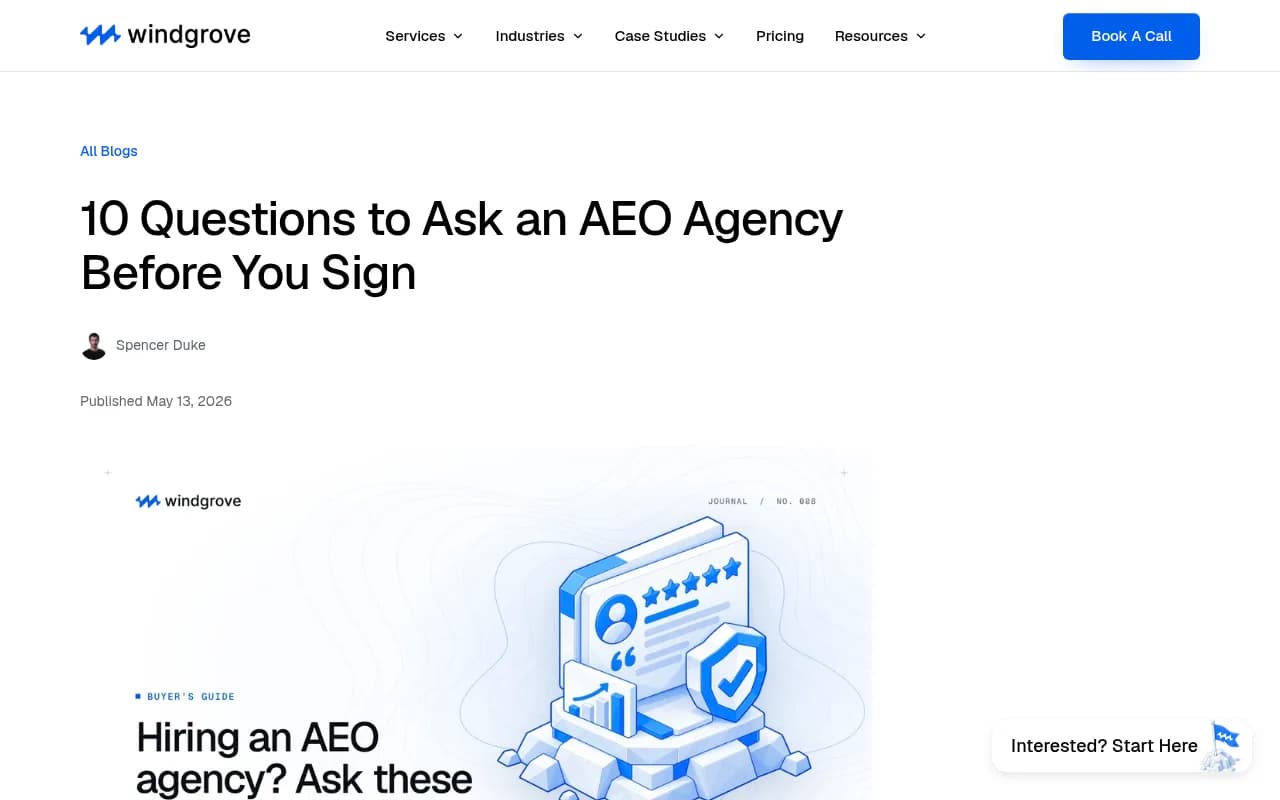
Some teams would rather hire help than learn another tool. Agencies have their own vetting problem. One public guide to hiring an AEO agency suggests asking for a live demonstration of a client being cited in ChatGPT, Perplexity, or AI Overviews, not a screenshot or a PDF. That is good advice, and it pairs well with the checklist above: ask the agency which platform it uses and run the same data questions against it.
If you want an agency that works this way, 1001 SEO Media combines technical SEO, content, digital PR, and generative engine optimization, and it uses Promptwatch for AI visibility work. No long-term contracts, and senior specialists only. Treat us like any other vendor: ask the questions.
A practical two-week evaluation plan
- Days 1 to 2: shortlist three vendors. Pick one monitoring-first, one action-first, one from your existing suite if you have one.
- Days 3 to 4: send all three the 18 questions in writing and ask for written answers.
- Days 5 to 10: run trials on the same 30 to 50 prompts. Cover brand, competitor comparison, and buying-stage prompts. Check the output manually in the real assistants.
- Days 11 to 12: connect crawler logs or ask each vendor to simulate. Look at what they surface about your own site.
- Days 13 to 14: score, normalize pricing, pick. Put the trial results in writing so next year's renewal has a baseline.
If you are not sure what to track in the first place, Promptwatch's free AI visibility report gives a quick baseline with no login, which helps you write better trial prompts.
FAQ
How many prompts do I need to track?
Start with 50 to 150 prompts across brand, category, and competitor comparisons. More is not better if the prompts are guesses. Pick them from Search Console queries, sales calls, and People Also Ask.
Is real-UI monitoring always better than API collection?
For what buyers see, yes. For what a model believes without browsing, APIs are the right source. The best platforms use both and label them.
Do I need a platform or can I do this manually?
Manually checking five prompts works for a week. It does not scale across engines, countries, and daily changes. Once citations and crawlers matter to revenue, you need a platform.
Which question matters most?
Question 1, data source, and question 11, crawler access. Bad data poisons everything downstream, and an unreadable site makes content work pointless.