Key takeaways
- Promptwatch and Cometly are not competing tools -- they solve fundamentally different problems. Promptwatch is for AI search visibility; Cometly is for paid ad attribution.
- If your question is "how does my brand appear in ChatGPT or Perplexity?", Promptwatch answers it. If your question is "which Facebook ad drove this sale?", Cometly answers it.
- Promptwatch starts cheaper at $99/mo vs Cometly's $199/mo entry point, but Cometly's pricing scales with revenue volume rather than features, which can get expensive fast for high-revenue businesses.
- Cometly has no meaningful AI search visibility features. Promptwatch has no paid ad attribution. There's almost no feature overlap between them.
- For most marketing teams, these tools are complementary, not alternatives. The comparison only makes sense if you're deciding where to allocate a limited budget.
- Promptwatch is the stronger pick for organic/AI search growth; Cometly wins for paid channel optimization and cross-platform ad attribution.
Overview
Promptwatch

Promptwatch is an AI search visibility platform used by 8,000+ brands to track how they appear in ChatGPT, Claude, Gemini, Perplexity, Grok, DeepSeek, and other AI engines. The core idea is that AI search is becoming a major traffic channel, and most brands have no idea whether they're being cited or ignored. Promptwatch fixes that -- and goes further by helping you create content that actually gets cited.
It's not just a monitoring dashboard. The platform includes content gap analysis (which prompts are competitors winning that you're not?), an AI writing agent that generates citation-optimized articles, real-time AI crawler logs, and traffic attribution to connect AI visibility to actual revenue. Rated 4.7/5 on G2.
Cometly
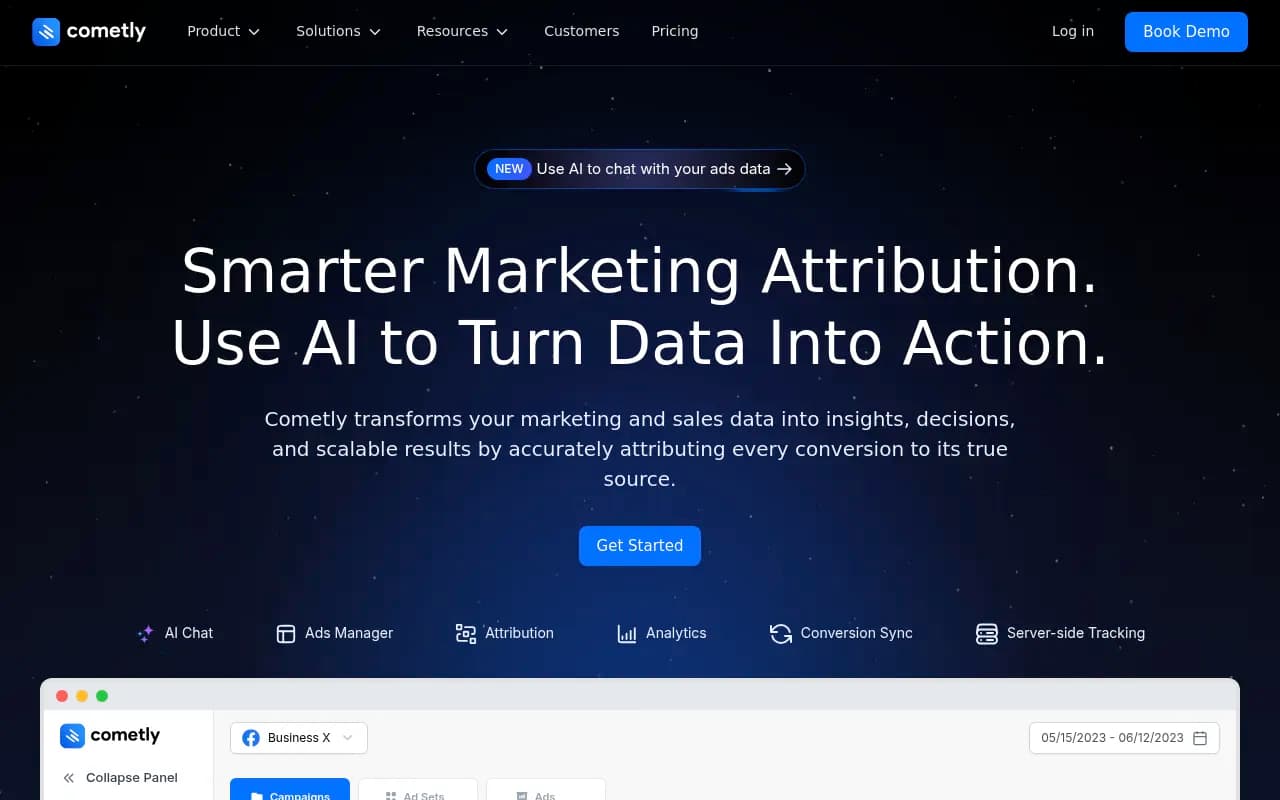
Cometly is a marketing attribution platform built for performance marketers running paid campaigns. Its core job is solving the attribution problem: in a world of iOS privacy changes, cross-device journeys, and multi-platform ad spend, which touchpoints actually drove a conversion? Cometly tracks every click and event, connects them to CRM data, and uses AI to surface budget recommendations.
It's trusted by brands like ClickFunnels, Trainual, and Instantly. The platform has earned multiple G2 badges including High Performer, Momentum Leader, and Easiest to Do Business With. The focus is squarely on paid advertising ROI -- not organic search, not AI visibility.
Side-by-side comparison
| Feature | Promptwatch | Cometly |
|---|---|---|
| Primary use case | AI search visibility & GEO | Paid ad attribution |
| AI model monitoring | 10+ (ChatGPT, Claude, Gemini, Perplexity, Grok, etc.) | None |
| Content gap analysis | Yes | No |
| AI content generation | Yes (built-in writing agent) | No |
| AI crawler logs | Yes (real-time) | No |
| Paid ad tracking | No | Yes (multi-platform) |
| Revenue attribution | AI traffic to revenue | Ad spend to revenue |
| Competitor analysis | Yes (AI visibility heatmaps) | Limited |
| Reddit/YouTube tracking | Yes | No |
| ChatGPT Shopping tracking | Yes | No |
| Free tier | No (7-day trial) | No (14-day trial) |
| Starting price | $99/mo | $199/mo |
| G2 rating | 4.7/5 | Multiple badges (High Performer) |
| API access | Yes | Yes |
| Target user | SEO/marketing teams, agencies | Performance marketers, media buyers |
Head-to-head feature deep-dive
Core purpose and philosophy
This is where the two tools diverge completely. Promptwatch is built around the idea that AI search engines (ChatGPT, Perplexity, etc.) are becoming a primary discovery channel, and brands need to understand and optimize their presence there. The whole platform is structured around a loop: find where you're invisible, create content to fix it, track whether it worked.
Cometly is built around a different problem: paid advertising attribution is broken. iOS changes, cookie deprecation, and multi-platform journeys mean last-click attribution lies to you constantly. Cometly's job is to give you accurate data on which ads, campaigns, and channels actually drive revenue.
These are genuinely different jobs. Comparing them is a bit like comparing a content analytics tool to a CRM -- they can both be part of a marketing stack, but they don't compete for the same workflow.
Verdict: No winner here -- they're solving different problems. The right question is which problem matters more to you right now.
AI search visibility
Promptwatch covers this comprehensively. You track specific prompts (e.g. "best CRM for startups"), see whether your brand appears in AI responses across 10+ models, get a visibility score, and see how that score changes over time. The platform shows you which competitors are winning prompts you're losing, and exactly what content you'd need to create to compete.
The AI crawler logs are a genuinely useful feature -- you can see in real time when ChatGPT or Perplexity's crawlers visit your site, which pages they read, and whether they hit any errors. Most brands have no idea this data exists.
Cometly has no AI search visibility features. It doesn't track brand mentions in AI responses, doesn't monitor LLM citations, and doesn't have anything resembling prompt tracking or GEO analysis.
Verdict: Promptwatch wins by default. Cometly doesn't play in this space.
Paid advertising attribution
Cometly is built for this. It connects ad clicks across Facebook, Google, TikTok, and other platforms to actual conversions and revenue, even when platform-native attribution is unreliable. The AI layer surfaces recommendations on where to shift budget and which creatives are performing. The ClickFunnels CMO quote on their homepage -- "we know exactly what's working" -- captures the core value proposition well.
Promptwatch has no paid ad attribution. It tracks AI-driven traffic through a code snippet, GSC integration, or server log analysis, but that's about organic AI search traffic, not paid campaigns.
Verdict: Cometly wins by default. Promptwatch doesn't touch paid attribution.
Content optimization
Promptwatch has a built-in AI writing agent that generates articles, listicles, and comparison pages based on real citation data. The content isn't generic -- it's grounded in which prompts have high volume, what competitors are being cited for, and what AI models seem to want when answering specific questions. The output is designed to get cited, not just to rank in Google.
Cometly has no content creation or optimization features. It's a data and attribution platform, not a content tool.
Verdict: Promptwatch wins. Content optimization is a core part of its platform; Cometly doesn't offer it.
Competitor analysis
Promptwatch shows competitor visibility heatmaps -- which brands are winning for which prompts across which AI models. You can see exactly where a competitor is outperforming you and why, down to the specific content they're being cited for.
Cometly's competitor analysis is limited to ad intelligence features (seeing competitor ad strategies), which is a different kind of competitive insight.
Verdict: Depends on what you mean by "competitor analysis." For AI search competitive intelligence, Promptwatch. For paid ad competitive intelligence, Cometly.
Integrations and data export
Promptwatch integrates with Google Search Console, Cloudflare, Fastly, Vercel, and Looker Studio. It has an API for custom workflows. The traffic attribution can be set up via a code snippet or server log analysis.
Cometly integrates with major ad platforms (Facebook Ads, Google Ads, TikTok Ads, etc.) and CRM systems. The integration depth on the paid advertising side is more extensive, which makes sense given that's its core job.
Verdict: Tie, but in different domains. Promptwatch integrates better with SEO/content tools; Cometly integrates better with ad platforms and CRMs.
Ease of use and setup
Both tools have learning curves, but for different reasons. Promptwatch requires you to define the prompts you want to track and understand what AI visibility metrics mean -- there's some conceptual onboarding involved. Once set up, the dashboard is straightforward.
Cometly's setup involves installing tracking pixels, connecting ad accounts, and potentially integrating with your CRM. For teams already running paid campaigns, this is familiar territory. For teams new to attribution tooling, it can feel complex.
Verdict: Roughly equal, but the complexity is in different places. Promptwatch is conceptually new for most users; Cometly is technically involved to set up.
Pricing comparison
| Plan | Promptwatch | Cometly |
|---|---|---|
| Entry plan | $99/mo (Essential: 1 site, 50 prompts, 5 articles) | $199/mo (up to $50k tracked revenue) |
| Mid-tier | $249/mo (Professional: 2 sites, 150 prompts, 15 articles, crawler logs) | ~$499/mo (up to $200k tracked revenue) |
| Higher tier | $579/mo (Business: 5 sites, 350 prompts, 30 articles) | $999+/mo (up to $500k tracked revenue) |
| Enterprise | Custom pricing | Custom pricing ($1M+ revenue) |
| Free trial | 7 days | 14 days |
| Pricing model | Feature-based tiers | Revenue volume-based |
One important difference in how these tools price: Promptwatch charges based on features and usage (number of sites, prompts, articles). Cometly charges based on the revenue volume it tracks. This means Cometly can get significantly more expensive as your business scales, even if you're not using more features. A business tracking $500k/month in revenue is paying $999+/mo regardless of how many campaigns they run.
Pros and cons
Promptwatch
Pros:
- Covers the full AI visibility loop: monitor, analyze gaps, create content, track results
- Real-time AI crawler logs are genuinely rare -- most competitors don't have this
- Starts at $99/mo, which is accessible for smaller teams
- Monitors 10+ AI models including ChatGPT, Claude, Perplexity, Gemini, Grok, DeepSeek
- Reddit and YouTube citation tracking gives insight into where AI models source their answers
- Built-in content generation means you don't need a separate tool to act on the data
Cons:
- No paid advertising attribution -- if that's your main need, look elsewhere
- The concept of GEO/AI visibility is still new, so there's a learning curve for teams unfamiliar with it
- 7-day trial is shorter than Cometly's 14 days
- Pricing scales by site and prompt count, which can feel limiting on lower tiers
Cometly
Pros:
- Solves a real and painful problem: accurate attribution in a post-iOS world
- AI-powered budget recommendations are genuinely useful for media buyers
- Multiple G2 badges suggest strong user satisfaction
- 14-day free trial gives more time to evaluate
- Integrates with major ad platforms and CRMs
Cons:
- No AI search visibility features at all
- Pricing scales with revenue volume, which can get expensive fast for high-revenue businesses
- Starts at $199/mo, which is higher than Promptwatch's entry point
- Limited value for teams focused on organic or AI-driven traffic rather than paid campaigns
- No content optimization or creation capabilities
Who should pick which tool
Pick Promptwatch if:
- You want to know how your brand appears in ChatGPT, Perplexity, Claude, or other AI search engines
- You're investing in content marketing and want that content to get cited by AI models
- You're an SEO team, content team, or digital agency working on organic visibility
- You want to understand which AI crawlers are visiting your site and what they're reading
- You need to track competitors' AI search visibility and find gaps to exploit
- You're building a GEO strategy and need both monitoring and content creation in one platform
Pick Cometly if:
- You run paid advertising campaigns and need accurate attribution across platforms
- iOS privacy changes have made your Facebook or Google attribution unreliable
- You want AI-powered recommendations on where to shift ad budget
- You're a performance marketer or media buyer who lives in ad dashboards
- Revenue attribution from paid channels is your primary measurement challenge
Use both if:
- You have a significant paid advertising budget AND care about organic AI search visibility
- You want to understand the full picture: which ads drive revenue (Cometly) AND how your brand appears in AI search (Promptwatch)
- You're a larger marketing team with separate paid and organic functions
Final verdict
These two tools don't really compete. Promptwatch owns the AI search visibility space -- it's the platform to use if you want to understand, track, and improve how your brand appears in ChatGPT, Perplexity, and other AI engines. Cometly owns paid ad attribution -- it's the platform to use if you need accurate data on which campaigns and creatives are actually driving revenue.
If someone is genuinely choosing between these two, the decision comes down to where their biggest pain point is: invisible in AI search, or flying blind on paid attribution. Most teams with budget for both should run them in parallel -- they cover different parts of the marketing stack and the data from each doesn't overlap.
For teams that can only pick one: if you're running paid campaigns and attribution is broken, Cometly solves a more immediate revenue problem. If you're building organic presence and AI search is a growing channel for you, Promptwatch is the better long-term investment.