Key takeaways
- These tools solve completely different problems. Promptwatch tracks and improves how your brand appears in AI search engines (ChatGPT, Claude, Perplexity, etc.). Amplitude tracks how users behave inside your product or website.
- If your goal is to rank in AI search or understand your GEO (Generative Engine Optimization) performance, Amplitude can't help you -- it has no LLM monitoring, no citation analysis, and no AI content tools.
- If your goal is to understand user funnels, run A/B tests, or analyze retention inside your app, Promptwatch isn't the right tool either.
- Amplitude has a free tier (up to 10K monthly tracked users). Promptwatch starts at $99/mo with a 7-day free trial.
- The two tools can work well together: Amplitude for in-product behavior, Promptwatch for top-of-funnel AI search visibility.
- Comparing them head-to-head is a bit like comparing a telescope to a microscope -- both are "analytics," but they're looking at entirely different things.
Overview
Promptwatch

Promptwatch is an AI search visibility and GEO platform. The core idea: as more people use ChatGPT, Perplexity, Claude, and Gemini to find products and services, your brand's presence in those AI responses matters as much as your Google rankings. Promptwatch monitors 10+ AI models, tracks which pages AI crawlers are reading, identifies content gaps where competitors are visible and you're not, and includes a built-in AI writing agent to help you create content that actually gets cited.
It's used by 8,000+ brands including Booking.com, Duolingo, Typeform, and Yelp. The platform sits at the intersection of SEO, content marketing, and AI -- and it's genuinely one of the few tools that goes beyond monitoring to help you take action.
Amplitude
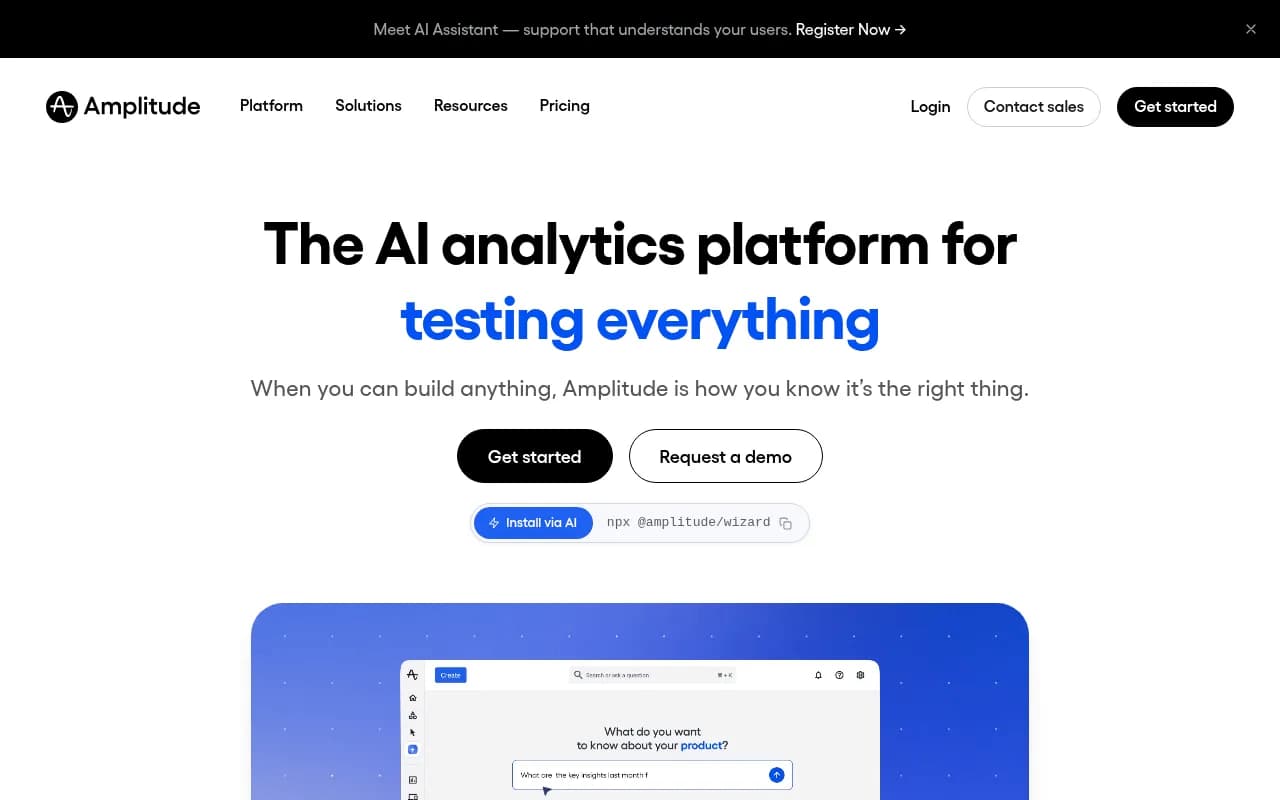
Amplitude is a product analytics platform. It's been around since 2012 and is one of the most established names in the space, trusted by companies like Walmart, Atlassian, and NBC. The platform combines event-based analytics, funnel analysis, retention tracking, session replay, A/B experimentation, and more recently, AI-powered analysis features.
The target user is a product manager or growth engineer who wants to understand what users do inside their app -- where they drop off, which features drive retention, which experiments move the needle. It's not an SEO tool, not a brand monitoring tool, and not an AI search tool.
Side-by-side comparison
| Feature | Promptwatch | Amplitude |
|---|---|---|
| Primary use case | AI search visibility & GEO | Product analytics & experimentation |
| Target user | Marketing, SEO, content teams | Product managers, growth engineers |
| AI search monitoring | Yes (10+ models) | No |
| LLM citation tracking | Yes | No |
| AI crawler logs | Yes (real-time) | No |
| Content gap analysis | Yes | No |
| AI content generation | Yes (built-in writing agent) | No |
| User behavior analytics | No | Yes (events, funnels, retention) |
| Session replay | No | Yes |
| A/B experimentation | No | Yes |
| Free tier | No (7-day trial) | Yes (up to 10K MTUs) |
| Starting price | $99/mo | $49/mo (Plus) |
| G2 rating | 4.7/5 | 4.5/5 |
| Reddit/YouTube tracking | Yes | No |
| Traffic attribution | Yes (GSC, snippet, server logs) | Yes (in-product attribution) |
| API access | Yes | Yes |
| Looker Studio integration | Yes | No (native) |
Head-to-head feature deep-dive
AI search visibility
This is where the comparison is most lopsided -- in Promptwatch's favor, obviously, since it's literally what the platform is built for.
Promptwatch monitors how 10 AI engines (ChatGPT, Claude, Gemini, Perplexity, Grok, DeepSeek, Copilot, Meta AI, Mistral, Google AI Overviews) respond to prompts relevant to your brand. You set up the prompts you care about, and the platform tracks whether you're mentioned, how often, what sentiment the AI uses, and which competitors are getting cited instead of you.
The Answer Gap Analysis is the standout feature here: it shows you the specific prompts where competitors appear and you don't, then tells you what content you're missing. The built-in writing agent can then generate that content -- articles, listicles, comparison pages -- grounded in real citation data from 880M+ analyzed citations.
Amplitude has no equivalent. It doesn't track AI search responses, doesn't monitor LLM citations, and has no concept of "prompt visibility." If you searched Amplitude's feature list for anything related to ChatGPT or Perplexity rankings, you'd come up empty.
Verdict: Promptwatch wins this category by default. It's the entire product.
Product analytics and user behavior
Flip it around, and Amplitude dominates.
Amplitude's core strength is event-based analytics. You instrument your app or website to send events (button clicks, page views, purchases, etc.), and Amplitude lets you slice and dice that data in powerful ways: funnel analysis to see where users drop off, retention charts to see who comes back, cohort analysis to compare user segments, and behavioral flows to map the paths users take through your product.
The session replay feature lets you watch actual user sessions -- useful for debugging UX issues or understanding why a funnel step has high drop-off. The A/B experimentation module (Amplitude Experiment) lets you run controlled tests and measure statistical significance properly.
Promptwatch doesn't do any of this. It tracks AI search visibility, not in-product user behavior.
Verdict: Amplitude wins this category by default. It's the entire product.
Content and SEO tools
Promptwatch has a built-in AI writing agent that generates content specifically designed to be cited by AI search engines. It uses real citation data, prompt volumes, competitor analysis, and persona targeting to produce articles that aren't just generic SEO filler. This is a meaningful differentiator -- most competitors in the GEO space are monitoring-only dashboards.
Amplitude has no content creation tools. It's not an SEO platform and doesn't pretend to be.
Verdict: Promptwatch wins.
Traffic attribution
Both tools do some form of traffic attribution, but they're measuring different things.
Promptwatch connects AI search visibility to actual website traffic. You can use a JavaScript snippet, Google Search Console integration, or server log analysis to see which AI-driven visits are landing on your site and converting. This closes the loop between "we're being cited in ChatGPT" and "that citation drove X sessions."
Amplitude measures in-product attribution -- which acquisition channels drove users who then converted, retained, or churned. It's excellent at connecting marketing spend to downstream product behavior, but it's measuring traffic that's already arrived, not the AI search layer upstream.
Verdict: Different scopes, both useful. If you want to know whether your AI search visibility is driving revenue, Promptwatch. If you want to know whether those visitors then convert inside your product, Amplitude.
Pricing and accessibility
Amplitude's free tier is genuinely useful -- 10,000 monthly tracked users with access to core analytics features. For small startups or indie developers, that's enough to get real value without paying anything.
Promptwatch has a 7-day free trial and a free "Explore" plan that lets you track 10 prompts with ChatGPT. There's no permanent free tier for serious monitoring.
| Plan | Promptwatch | Amplitude |
|---|---|---|
| Free | Explore (10 prompts, ChatGPT only) | Yes (up to 10K MTUs) |
| Entry paid | $99/mo (Essential) | $49/mo (Plus) |
| Mid-tier | $249/mo (Professional) | Custom (Growth) |
| Upper tier | $579/mo (Business) | Custom (Enterprise) |
| Agency/Enterprise | Custom | Custom |
Amplitude is cheaper to start. Promptwatch is more expensive but solves a problem Amplitude doesn't touch.
Integrations and ecosystem
Amplitude has a mature integration ecosystem built up over 13+ years: Segment, Salesforce, HubSpot, Braze, Snowflake, BigQuery, and dozens more. It's designed to sit in the middle of a modern data stack.
Promptwatch integrates with Google Search Console, Cloudflare, Fastly, Looker Studio, and has an API for custom workflows. It's a newer platform (the GEO category itself is new), so the integration list is shorter -- but the core integrations for its use case are there.
Verdict: Amplitude has a broader integration ecosystem. Promptwatch has the integrations that matter for AI search visibility.
Ease of use
Amplitude has a learning curve. The event taxonomy, instrumentation setup, and query builder take time to master. Most teams need a data engineer or technical PM to get the most out of it. The UI is powerful but not simple.
Promptwatch is more accessible for non-technical users. You set up prompts, connect your domain, and the platform does the monitoring. The content agent is guided. That said, getting deep value from the Answer Gap Analysis and citation tracking still requires some strategic thinking about which prompts matter for your business.
Verdict: Promptwatch is easier to get started with. Amplitude has a steeper curve but more analytical depth once you're in.
Pros and cons
Promptwatch
Pros:
- The only platform that monitors AI search visibility AND helps you act on it (content generation, gap analysis)
- Real-time AI crawler logs show exactly which pages AI engines are reading
- Covers 10+ AI models including ChatGPT, Claude, Perplexity, Gemini, Grok, DeepSeek
- Reddit and YouTube citation tracking -- a channel most competitors ignore
- ChatGPT Shopping tracking for e-commerce brands
- Traffic attribution connects AI visibility to actual revenue
- 4.7/5 on G2
Cons:
- No permanent free tier (just a 7-day trial and a limited Explore plan)
- Starts at $99/mo, which is steep for small businesses
- Not useful for in-product analytics or user behavior tracking
- The GEO category is still maturing, so some prompt volume data is estimates
Amplitude
Pros:
- Genuinely useful free tier (10K MTUs)
- Best-in-class funnel, retention, and cohort analysis
- Session replay for qualitative UX insights
- A/B experimentation built in (Amplitude Experiment)
- Mature integration ecosystem (13+ years of partnerships)
- AI-powered analysis features for faster insights
- 4.5/5 on G2 with 2,500+ reviews
Cons:
- No AI search visibility monitoring whatsoever
- Steep learning curve for non-technical users
- Instrumentation setup requires engineering time
- Growth and Enterprise pricing is custom (can get expensive)
- Not designed for content teams or SEO workflows
Who should pick which tool
Pick Promptwatch if:
- You want to know how your brand appears when someone asks ChatGPT, Claude, or Perplexity for a recommendation in your category
- You're running a GEO or AI SEO strategy and need data to back it up
- You want to identify content gaps where competitors are visible in AI search and you're not
- You need to generate content that's specifically engineered to get cited by AI models
- You're a marketing, SEO, or content team at a brand that cares about AI search traffic
Pick Amplitude if:
- You want to understand how users behave inside your product or website
- You need funnel analysis, retention tracking, or cohort comparisons
- You're running A/B experiments and need proper statistical analysis
- You're a product manager, growth engineer, or data analyst
- You want a free tier to get started without a credit card
Use both if:
- You're a growth-focused company that wants to win top-of-funnel AI search traffic (Promptwatch) AND understand what those visitors do once they arrive (Amplitude). The two tools don't overlap -- they cover different parts of the same funnel.
Final verdict
This isn't really a "which is better" comparison -- it's a "which one solves your actual problem" comparison. Promptwatch and Amplitude are analytics tools in the same loose sense that a cardiologist and a dermatologist are both doctors.
If AI search visibility is your problem -- you want to show up when people ask ChatGPT who the best option in your category is -- Promptwatch is the answer. It's the most complete platform in the GEO space, and the content generation angle genuinely separates it from monitoring-only competitors.
If in-product user behavior is your problem -- you want to know why users churn, which features drive retention, or whether your new onboarding flow converts better -- Amplitude is the answer. It's one of the best product analytics platforms available.
The only scenario where you'd genuinely be choosing between them is if you have a very limited budget and need to pick one analytics investment. In that case, ask yourself: is my biggest gap "I don't know how my users behave inside my product" or "I don't know how AI search engines talk about my brand"? That question answers itself.