Key Takeaways
- LLMrefs tracks 2x more AI engines (10+ vs 6) and offers keyword-focused monitoring starting at $79/mo for 50 keywords
- Otterly.AI is cheaper for small teams at $29/mo but caps you at just 15 prompts -- LLMrefs gives you 50 keywords at $79/mo
- LLMrefs auto-generates prompt variations from real conversations, while Otterly requires manual prompt entry
- Otterly includes a GEO audit tool analyzing 25+ on-page factors; LLMrefs focuses purely on tracking and benchmarking
- Both are monitoring-only platforms -- neither helps you create optimized content or close visibility gaps
- For enterprise clients (eBay, NVIDIA, Shopify), LLMrefs is the clear winner with better scale and client roster
Overview
Otterly.AI

Otterly.AI positions itself as an affordable entry point into AI search monitoring. It tracks brand mentions and citations across ChatGPT, Google AI Overviews, Perplexity, Google AI Mode, Gemini, and Copilot. The platform's main hook is its GEO audit feature, which analyzes your website's on-page factors to identify what's blocking you from earning more citations. Pricing starts at $29/mo for 15 prompts, making it one of the cheapest options on the market.
The interface is straightforward -- you enter prompts manually, Otterly runs them across the supported AI engines, and you see where your brand shows up. The audit tool gives you a checklist of technical fixes, but you're on your own to implement them.
LLMrefs
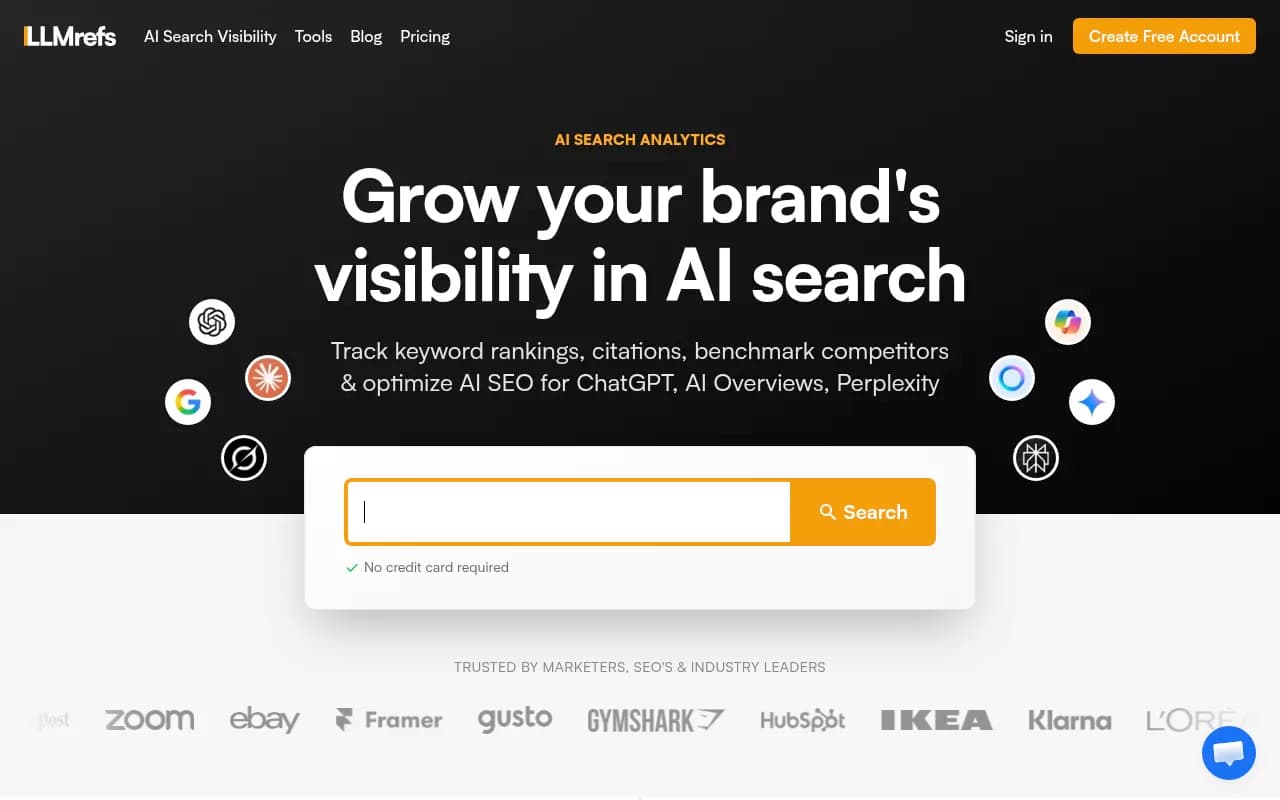
LLMrefs takes a keyword-centric approach to AI search analytics. Instead of manually entering prompts, it automatically generates variations based on how people actually phrase questions in conversations. It tracks rankings, citations, and brand visibility across 10+ AI engines including ChatGPT, Claude, Gemini, Perplexity, AI Overviews, Copilot, Grok, and Meta AI.
The client list tells you something: eBay, NVIDIA, Shopify, HubSpot, IKEA, Gymshark. These aren't small businesses testing the waters -- they're enterprise brands that need reliable data at scale. Pricing starts at $79/mo, and the platform is built for SEO teams and agencies managing multiple clients or large keyword portfolios.
Side-by-Side Comparison
| Feature | Otterly.AI | LLMrefs |
|---|---|---|
| Starting price | $29/mo (15 prompts) | $79/mo (50 keywords) |
| AI engines tracked | 6 (ChatGPT, Perplexity, AI Overviews, AI Mode, Gemini, Copilot) | 10+ (adds Claude, Grok, Meta AI, more) |
| Prompt generation | Manual entry only | Auto-generates variations from real conversations |
| Keyword tracking | Prompt-based | Keyword-based with variations |
| GEO audit tool | Yes (25+ on-page factors) | No |
| Competitor benchmarking | Basic | Advanced |
| Citation tracking | Yes | Yes |
| Brand monitoring | Yes | Yes |
| Free trial | 14 days | Not specified |
| Target audience | Small teams, solopreneurs | SEO teams, agencies, enterprise |
| Enterprise clients | Not disclosed | eBay, NVIDIA, Shopify, HubSpot, IKEA |
| Content optimization | No | No |
AI engine coverage
LLMrefs monitors 10+ AI engines. Otterly covers 6. That gap matters more than it sounds.
Otterly tracks the big names: ChatGPT, Perplexity, Google AI Overviews, Google AI Mode, Gemini, and Copilot. For most brands, that's the core set. But LLMrefs adds Claude (Anthropic's model, increasingly popular with developers), Grok (X's AI, relevant for brands active on Twitter), and Meta AI (Facebook/Instagram's engine, critical for social-first brands).
If your audience uses Claude or Grok, Otterly leaves you blind. LLMrefs doesn't.
Verdict: LLMrefs wins on coverage breadth. Otterly covers the essentials but misses emerging platforms.
Keyword tracking and prompt management
This is where the platforms diverge philosophically.
Otterly uses a prompt-based model. You manually enter the exact questions you want to track -- "best CRM for small business", "how to choose accounting software", etc. Otterly runs those prompts verbatim across its 6 AI engines and shows you the results. Simple, but limited. If you miss a variation ("top CRM tools for startups" vs "best CRM for small business"), you don't track it.
LLMrefs uses a keyword-based model with automatic variation generation. You enter a seed keyword like "CRM software" and LLMrefs generates dozens of conversational variations based on how real users phrase questions. It pulls from actual conversation patterns, not guesses. You track the keyword universe, not individual prompts.
Example: You want to track "project management tools". Otterly requires you to manually list every variation: "best project management software", "top PM tools for remote teams", "project management apps for startups", etc. LLMrefs generates those automatically.
Verdict: LLMrefs saves hours of manual work and catches variations you'd miss. Otterly's manual approach only works if you have a tiny keyword set.
GEO audit and optimization features
Otterly's standout feature is its GEO audit tool. It analyzes 25+ on-page factors -- structured data, content depth, internal linking, entity optimization, etc. -- and gives you a checklist of what's holding your site back from earning more AI citations. Think of it as a technical SEO audit tailored for AI search.
The audit is useful if you're starting from scratch and need to know what to fix. But it's a diagnostic tool, not a solution. Otterly tells you "your content lacks depth" or "you're missing schema markup" but doesn't help you fix it. You still need to write better content, implement schema, build links, etc.
LLMrefs doesn't include an audit tool. It's purely analytics: track rankings, benchmark competitors, see who's getting cited. No optimization guidance.
Verdict: Otterly wins if you need a technical audit. But the audit alone doesn't improve your visibility -- it just tells you what's broken. For teams that already know what to fix and just need tracking, LLMrefs is cleaner.
Competitor benchmarking
Both platforms let you track competitors, but LLMrefs goes deeper.
Otterly shows you which brands appear in AI responses for your tracked prompts. You see share of voice and citation frequency. Basic but functional.
LLMrefs offers more granular competitor analysis: ranking position by keyword, citation frequency by AI engine, head-to-head comparisons across your entire keyword portfolio. You can see exactly where competitors are beating you and by how much.
For agencies managing multiple clients, LLMrefs' benchmarking is more actionable. You can show a client "Competitor X ranks #1 for 23 of your target keywords" and build a strategy around closing those gaps.
Verdict: LLMrefs delivers better competitive intelligence. Otterly's competitor tracking is surface-level.
Pricing comparison
| Plan | Otterly.AI | LLMrefs |
|---|---|---|
| Entry tier | $29/mo (15 prompts) | $79/mo (50 keywords) |
| Mid tier | $189/mo (100 prompts) | Not disclosed |
| Enterprise | Custom (unlimited prompts) | Custom |
| Free trial | 14 days | Not specified |
Otterly is cheaper at the low end. $29/mo for 15 prompts is the lowest entry price in the AI monitoring space. But 15 prompts is extremely limiting -- you'll burn through that tracking a single product category.
LLMrefs starts at $79/mo for 50 keywords. That's 3.3x more expensive than Otterly's entry tier, but you get 3.3x more keywords plus automatic variation generation. The effective cost per keyword is similar, but LLMrefs gives you more coverage.
Otterly's $189/mo tier (100 prompts) is competitive with LLMrefs' $79/mo tier when you factor in prompt variations. If LLMrefs generates 2-3 variations per keyword, 50 keywords = 100-150 tracked prompts.
Verdict: Otterly is cheaper for tiny teams tracking <20 prompts. LLMrefs is better value for anyone tracking 50+ keywords because of automatic variation generation.
Who should pick Otterly.AI
Otterly makes sense if:
- You're a solopreneur or tiny team with a small keyword set (<20 prompts)
- You need a technical audit to identify on-page issues blocking AI citations
- You only care about the 6 major AI engines (ChatGPT, Perplexity, AI Overviews, Gemini, Copilot, AI Mode)
- Budget is tight and you can't justify $79/mo
- You're comfortable manually entering and managing prompts
Otterly is a good starting point for brands new to AI search monitoring. The audit tool gives you a roadmap, and the low entry price makes it easy to test. But you'll outgrow it quickly if your keyword portfolio expands or you need deeper analytics.
Who should pick LLMrefs
LLMrefs is the better choice if:
- You're tracking 50+ keywords and need automatic variation generation
- You need coverage across 10+ AI engines including Claude, Grok, and Meta AI
- You're an SEO team or agency managing multiple clients
- You need granular competitor benchmarking and ranking data
- You want a platform built for scale (enterprise clients like eBay and NVIDIA use it)
- You prefer keyword-based tracking over manual prompt entry
LLMrefs is the professional-grade option. It's what you pick when AI search monitoring is a core part of your strategy, not a side experiment.
What both platforms are missing
Neither Otterly nor LLMrefs helps you create content that ranks in AI search. They're monitoring-only tools. They show you where you're invisible, but they don't help you fix it.
Otterly's audit tells you what's broken. LLMrefs shows you where competitors are winning. But both leave you stuck at the "now what?" stage. You still need to:
- Figure out what content to create
- Write articles optimized for AI citations
- Track whether your new content actually improves visibility
For teams serious about AI search optimization, tools like Promptwatch fill that gap by combining monitoring with content gap analysis and AI-powered content generation. But if you just need visibility tracking, both Otterly and LLMrefs do that job.

Pros and cons
Otterly.AI pros
- Cheapest entry price in the market ($29/mo)
- GEO audit tool identifies technical issues
- Clean, simple interface
- 14-day free trial
- Good for small teams testing AI monitoring
Otterly.AI cons
- Only 6 AI engines (misses Claude, Grok, Meta AI)
- Manual prompt entry is tedious at scale
- 15-prompt limit on entry tier is extremely restrictive
- No content optimization features
- Competitor benchmarking is basic
- Audit tool is diagnostic only -- doesn't help you fix issues
LLMrefs pros
- Tracks 10+ AI engines including Claude, Grok, Meta AI
- Auto-generates prompt variations from real conversations
- Keyword-based tracking scales better than manual prompts
- Enterprise client roster (eBay, NVIDIA, Shopify, HubSpot)
- Advanced competitor benchmarking
- Built for SEO teams and agencies
LLMrefs cons
- Higher entry price ($79/mo vs $29/mo)
- No GEO audit tool
- No content optimization features
- Free trial not clearly advertised
- Overkill for tiny teams tracking <20 keywords
Final verdict
LLMrefs is the better platform for most teams. It tracks more AI engines, auto-generates prompt variations, and delivers better competitive intelligence. The $79/mo price point is justified by the time savings and broader coverage.
Otterly.AI works if you're a solopreneur on a tight budget tracking a handful of prompts. The GEO audit is useful for identifying technical issues, but the platform's limitations (6 AI engines, manual prompt entry, restrictive prompt caps) make it hard to scale.
For agencies and SEO teams, LLMrefs is the obvious choice. For tiny teams just starting out, Otterly is a cheap way to dip your toes in. But plan to upgrade once you realize how limiting 15 prompts actually is.