Key takeaways
- Bear AI and Brandlight.ai both track brand visibility in AI search, but they're built for different buyers: Bear AI targets growth and marketing teams at SMBs and scale-ups; Brandlight.ai is explicitly enterprise-first, with Fortune 500 logos and a $30M Series A to match.
- Brandlight.ai has a free tier; Bear AI starts at $199/mo with no free option. If you're testing the waters, Brandlight is the lower-risk entry point.
- Bear AI's entry plan covers only 2 AI models -- you need enterprise pricing to get 6+. Brandlight.ai covers ChatGPT, Perplexity, Claude, Gemini, and others across all plans.
- Bear AI's differentiator is lead generation: it tries to identify high-intent visitors from AI sources and convert them, not just count them. Brandlight stops at measurement.
- Neither tool offers the kind of content gap analysis or AI-optimized content generation that a full GEO platform provides -- they're both primarily monitoring tools with different audience targets.
- If you're a Fortune 500 brand that needs sentiment tracking, competitive benchmarking, and enterprise SLAs, Brandlight is the more mature choice. If you're a growth team that wants to tie AI visibility to pipeline, Bear AI's framing is closer to what you need.
Overview
Bear AI
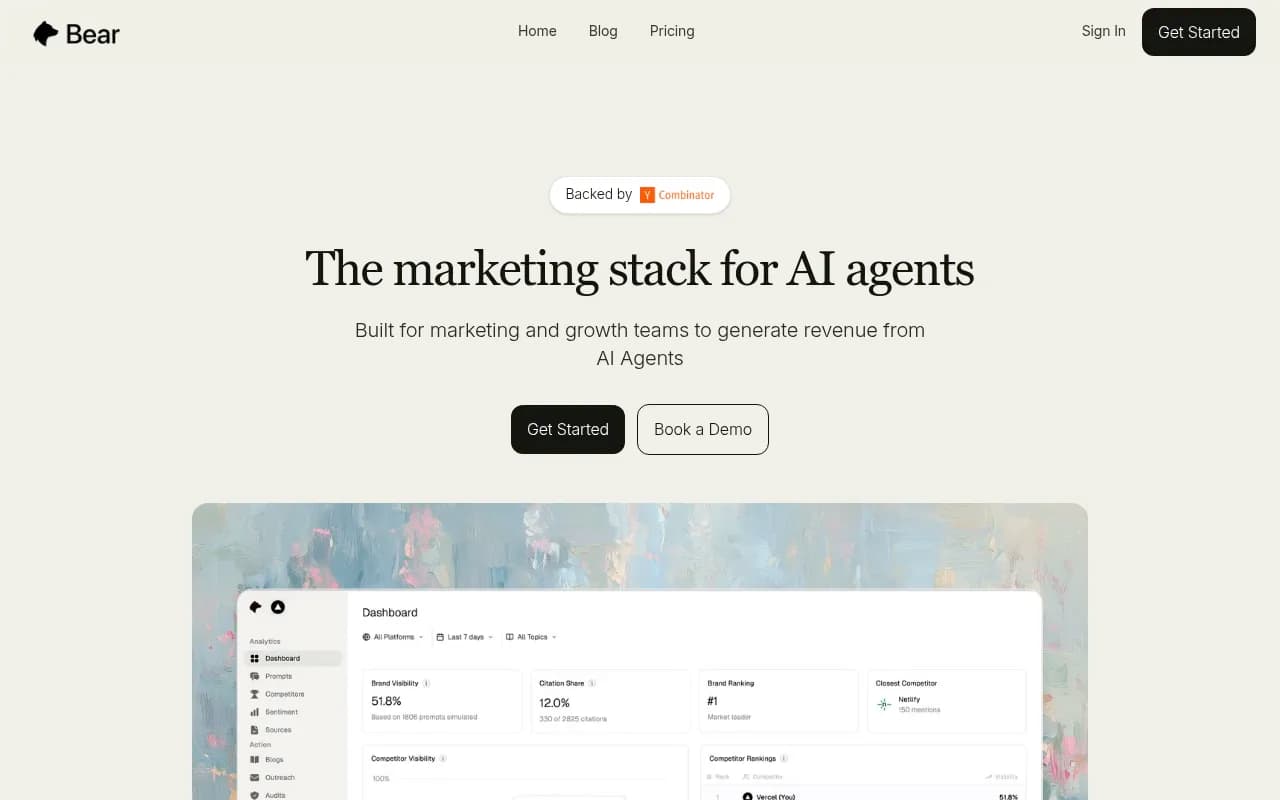
Bear AI is a YC-backed startup positioning itself as "the marketing stack for AI agents." The pitch is simple: AI models are sending traffic to websites, and most marketing teams have no idea it's happening or how to act on it. Bear AI tracks which prompts trigger recommendations of your brand, which AI models are sending visitors, and -- its main differentiator -- tries to identify those visitors and convert them into leads. It's a relatively young product, but the framing is sharp: this isn't just about visibility, it's about revenue.
Customers include Peerspace, Wispr Flow, and Groww. The product is early-stage by enterprise standards, but the YC backing signals it's moving fast.
Brandlight.ai
Brandlight.ai is an enterprise AI visibility platform that raised $30M in Series A funding. It's built for large marketing and brand teams at companies like Humana, Aetna, Estee Lauder, and Mastercard. The focus is measurement and competitive intelligence: how does your brand appear across AI search engines, how does sentiment shift over time, and how do you compare to competitors?
Brandlight has a free tier, which is unusual in this space, and its paid plans go up to $750/mo before custom enterprise pricing kicks in. The product is more mature and more narrowly focused on monitoring than Bear AI -- there's no lead generation layer, and content creation isn't part of the offering.
Side-by-side comparison
| Feature | Bear AI | Brandlight.ai |
|---|---|---|
| Starting price | $199/mo | Free tier available; paid from $199/mo |
| Free plan | No | Yes |
| AI models covered (entry plan) | 2 | Multiple (ChatGPT, Perplexity, Claude, Gemini) |
| AI models covered (max) | 6+ (enterprise) | Multiple across all plans |
| Prompt tracking | 75/mo (basic) | Available across plans |
| Content generation | 2 blogs/mo (basic) | Not available |
| Lead generation / visitor ID | Yes (enterprise) | No |
| Brand sentiment tracking | Basic | Yes, detailed |
| Competitive benchmarking | Limited | Yes |
| Enterprise SLAs | Custom | Yes |
| Target customer | SMB / growth teams | Fortune 500 / enterprise |
| Funding / maturity | YC-backed, early stage | $30M Series A, more mature |
| Free trial | Not listed | Free tier available |
Head-to-head feature deep-dive
AI model coverage
Bear AI's basic plan covers just 2 AI models. That's a real limitation if you care about how your brand appears across ChatGPT, Claude, Perplexity, and Gemini simultaneously -- you'd need to upgrade to enterprise to get 6+. Brandlight.ai covers the major models (ChatGPT, Perplexity, Claude, Gemini) across its plans without gating model breadth behind a top-tier price.
Verdict: Brandlight wins on model breadth at comparable price points.
Prompt and visibility tracking
Both tools track how AI models respond to prompts related to your brand and category. Bear AI tracks "trending prompts" and shows when and how AI agents recommend your brand. Brandlight tracks brand mentions, citation frequency, and sentiment shifts over time.
The key difference is depth vs. action. Brandlight gives you richer historical data and competitive context. Bear AI gives you fewer data points but tries to connect them to traffic and conversion.
Verdict: Brandlight for depth of monitoring data; Bear AI for connecting visibility to downstream actions.
Lead generation and revenue attribution
This is Bear AI's clearest differentiator. The platform tries to identify high-intent visitors arriving from AI sources and surface them as leads. That's a genuinely different capability -- most AI visibility tools stop at "you were mentioned X times." Bear AI asks "who came to your site because of that mention, and can we capture them?"
Brandlight has no equivalent feature. It measures brand visibility but doesn't try to connect that to individual visitor behavior or lead capture.
Verdict: Bear AI, clearly. If revenue attribution from AI traffic is your priority, Brandlight can't compete here.
Content generation
Bear AI includes blog generation -- 2 posts per month on the basic plan. It's a modest number, but it signals the product is trying to close the loop between "you're not visible for this prompt" and "here's content that might help."
Brandlight doesn't offer content generation at all. It's a monitoring platform, full stop.
Worth noting: if content generation for AI search is a core need, neither tool goes deep enough. A platform like Promptwatch generates articles grounded in 880M+ citation data points, with prompt volume scoring and competitor analysis built in -- that's a different level of sophistication than 2 blogs/mo.

Verdict: Bear AI has it; Brandlight doesn't. But neither is a serious content optimization platform.
Brand sentiment and competitive intelligence
Brandlight is stronger here. It tracks not just whether your brand is mentioned, but how it's described -- sentiment, context, and positioning relative to competitors. For a Fortune 500 brand team that needs to report on AI brand health to a CMO, that kind of structured data matters.
Bear AI tracks visibility and traffic but doesn't appear to offer the same depth of sentiment analysis or competitive benchmarking.
Verdict: Brandlight, by a significant margin.
Enterprise readiness
Brandlight raised $30M and counts Humana, Aetna, and Mastercard as customers. It has the infrastructure, support, and compliance posture that large enterprises expect. Bear AI is YC-backed and early-stage -- great for a growth team that wants to move fast, less proven for a procurement process at a Fortune 500.
Verdict: Brandlight for enterprise. Bear AI for teams that want to move quickly without a lengthy sales cycle.
Pricing and accessibility
| Plan | Bear AI | Brandlight.ai |
|---|---|---|
| Free | Not available | Yes (basic monitoring) |
| Entry paid | $199/mo (75 prompts, 2 models, 2 blogs) | $199/mo (monitoring focused) |
| Mid-tier | Not publicly listed | $750/mo (activation plan) |
| Enterprise | Custom (unlimited prompts, 6+ models, lead gen) | Custom (multi-brand) |
Both tools start at $199/mo for paid plans, but Brandlight's free tier makes it easier to evaluate before committing. Bear AI's entry plan is limited to 2 AI models, which feels restrictive at that price. Brandlight's $750/mo plan is expensive for what's still primarily a monitoring tool.
Verdict: Brandlight wins on entry-level accessibility (free tier). Bear AI's pricing makes more sense if you're specifically buying the lead generation capability.
Pros and cons
Bear AI
Pros:
- Lead generation and visitor identification from AI traffic -- genuinely unique
- Revenue-focused framing that resonates with growth and marketing teams
- YC-backed, moving fast
- Blog content generation included (basic)
- Clean, focused product without enterprise bloat
Cons:
- Only 2 AI models on the entry plan -- a real gap
- No free tier to evaluate before buying
- Early-stage product; less proven at scale
- Limited sentiment analysis and competitive benchmarking
- Prompt volume is capped at 75/mo on basic -- tight for any serious monitoring
Brandlight.ai
Pros:
- Free tier available -- low barrier to try
- Covers major AI models across all plans
- Strong sentiment tracking and competitive intelligence
- Enterprise-grade infrastructure and support
- $30M Series A means it's not going anywhere soon
- Trusted by large, recognizable brands
Cons:
- No content generation -- purely a monitoring tool
- No lead generation or visitor identification
- $750/mo mid-tier is expensive for monitoring-only
- Enterprise focus means the product may feel heavy for smaller teams
- No clear path from "you're invisible for this prompt" to "here's how to fix it"
Who should pick which tool
Pick Bear AI if:
- You're a growth or marketing team at an SMB or scale-up
- You want to connect AI visibility to actual leads and revenue, not just impressions
- You're comfortable with an early-stage product and want to move fast
- You only need to track a handful of AI models to start
- Content generation (even basic) is a nice-to-have in the same platform
Pick Brandlight.ai if:
- You're at a large enterprise or Fortune 500 brand
- Brand sentiment, competitive positioning, and executive reporting are the priority
- You want to evaluate the tool before paying (free tier)
- You need broad AI model coverage from day one
- Your team needs enterprise SLAs, compliance, and a mature support structure
Final verdict
These two tools are less direct competitors than they appear. Bear AI is a revenue-focused tool for growth teams that want to act on AI traffic. Brandlight.ai is an enterprise monitoring platform for brand teams that need to measure and report on AI visibility at scale.
If you're a startup or scale-up trying to turn AI search into pipeline, Bear AI's framing is closer to what you need -- just go in knowing the entry plan is limited. If you're a Fortune 500 brand team that needs deep measurement and competitive intelligence, Brandlight is the more mature, better-resourced choice. Neither tool is a full GEO optimization platform -- they both show you what's happening, but neither takes you all the way to fixing it.