Key Takeaways
- LLM Pulse costs €49-299/month with a 14-day free trial. AthenaHQ starts at $295/month with no trial -- 6x more expensive at entry level.
- AthenaHQ covers 8+ AI models and positions itself as an "end-to-end GEO platform" with content optimization features. LLM Pulse tracks 10+ models but focuses purely on monitoring and analytics.
- LLM Pulse includes citation analysis and source tracking in all plans. AthenaHQ emphasizes automated content recommendations and ROI tracking for executives.
- Neither platform offers content generation or gap analysis tools -- both stop at showing you the data. If you need to actually create content that ranks in AI search, Promptwatch fills that gap with AI-powered content generation grounded in 880M+ citations.
- For small teams or solo marketers testing AI visibility: LLM Pulse's €49 starter plan is the clear winner. For enterprises with dedicated GEO teams and budget: AthenaHQ's executive dashboards and workflow tools justify the premium.
- Both lack AI crawler log monitoring, which means you won't see how often ChatGPT or Perplexity actually visit your site to index content.
Overview
AthenaHQ

AthenaHQ is a Y Combinator-backed GEO platform that raised $2.2 million and positions itself as the "command center" for AI search optimization. It tracks how your brand appears across ChatGPT, Perplexity, Google AI Overviews, Claude, Gemini, and other LLMs. The platform targets marketing teams at mid-to-large companies (ZoomInfo, Coinbase, Volkswagen) who need executive-level reporting and cross-functional workflows. Featured in Forbes and WSJ. No free trial. Pricing starts at $295/month self-serve or $95/month annual.
LLM Pulse
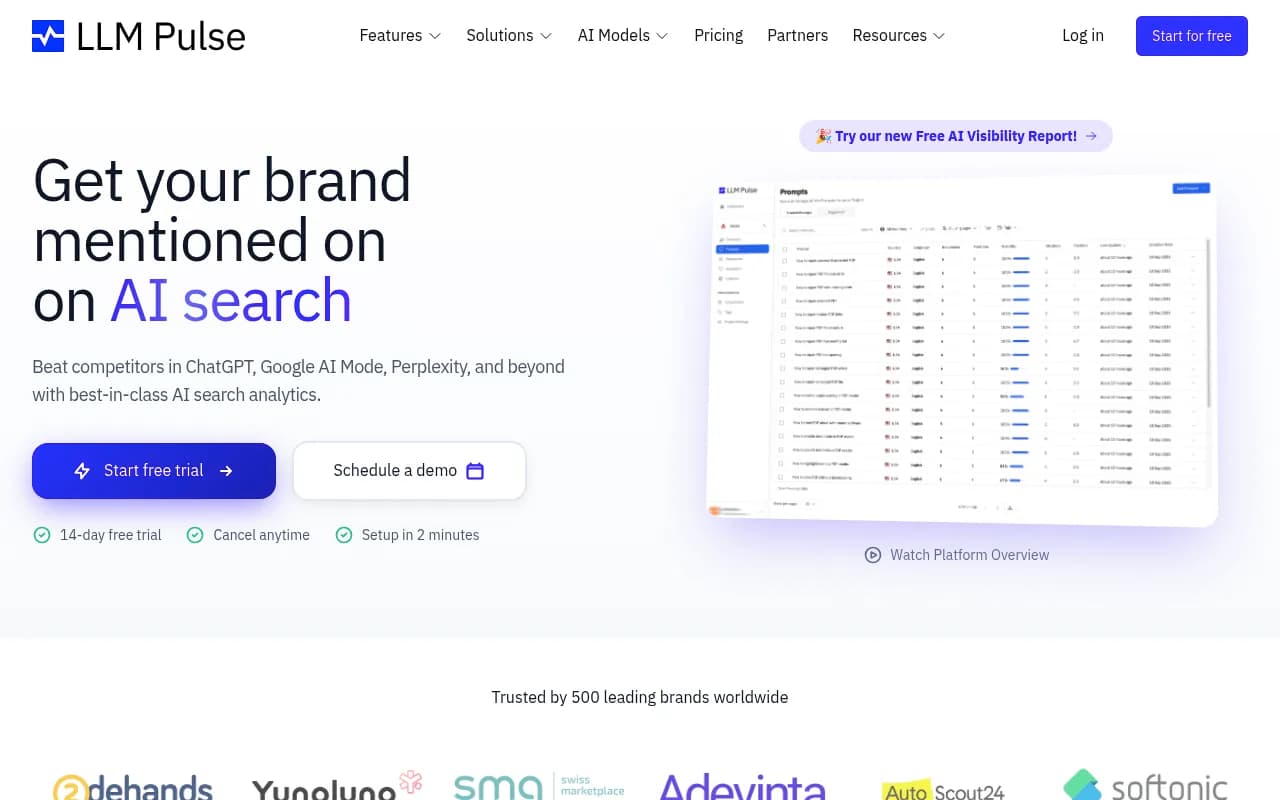
LLM Pulse is a straightforward AI visibility tracker built for brands that want to monitor what ChatGPT, Perplexity, Gemini, and Google AI Mode say about them. It tracks 10+ AI models, measures citation rates and sentiment, and shows which sources AI trusts in your space. Used by 500+ brands. The focus is analytics and monitoring -- not content creation or optimization workflows. Pricing starts at €49/month with a 14-day free trial. European company with annual billing discounts.
Side-by-Side Comparison
| Feature | AthenaHQ | LLM Pulse |
|---|---|---|
| Starting price | $295/mo (self-serve) or $95/mo annual | €49/mo (~$52) |
| Free trial | No | 14 days |
| AI models tracked | 8+ (ChatGPT, Perplexity, Google AI, Claude, Gemini, etc.) | 10+ (ChatGPT, Perplexity, Gemini, Google AI Mode, DeepSeek, Grok, Claude, Copilot, Meta AI) |
| Citation analysis | Yes | Yes |
| Competitor benchmarking | Yes | Yes |
| Content optimization | Automated recommendations | AI-powered recommendations |
| Executive dashboards | Yes (ROI tracking, strategic insights) | Basic analytics |
| Prompt tracking | Yes | Yes (weekly tracking) |
| Sentiment analysis | Yes | Yes |
| Source analysis | Yes | Yes (which sources AI cites) |
| Multi-user workflows | Yes | Not emphasized |
| Setup time | Not specified | 2 minutes |
| Target audience | Enterprise marketing teams, dedicated GEO managers | SMBs, solo marketers, agencies |
| Annual discount | Available | 17% off |
Pricing
The price gap is the first thing you'll notice.
| Plan | AthenaHQ | LLM Pulse |
|---|---|---|
| Entry tier | $295/mo (self-serve) | €49/mo (~$52) |
| Mid tier | Not disclosed | €99/mo (100 prompts) |
| High tier | Enterprise custom | €299/mo (300 prompts) |
| Annual option | $95/mo (annual only) | 17% discount |
| Free trial | None | 14 days |
AthenaHQ's $295/month starting point assumes you're a company with real budget. The $95/month annual option exists but requires paying upfront for a year -- not realistic if you're just testing AI visibility tracking. LLM Pulse's €49 starter plan is accessible for small teams or solo marketers who want to dip their toes in.
LLM Pulse's pricing scales with prompt volume (40 prompts at €49, 100 at €99, 300 at €299). AthenaHQ doesn't publicly disclose prompt limits or feature breakdowns for the self-serve tier, which suggests you're expected to book a demo and negotiate.
AI model coverage
Both platforms track the major players: ChatGPT, Perplexity, Google AI (Overviews and AI Mode), Gemini, Claude. LLM Pulse explicitly lists 10+ models including DeepSeek, Grok, Copilot, and Meta AI. AthenaHQ says "8+" but doesn't break down the full list on their homepage.
In practice, this difference probably doesn't matter much. The core models that drive most AI search traffic (ChatGPT, Perplexity, Google AI) are covered by both. DeepSeek and Grok are nice-to-haves but not make-or-break for most brands in 2026.
What's missing from both: real-time AI crawler logs. Neither platform shows you when ChatGPT's crawler hits your site, which pages it reads, or errors it encounters. That's a blind spot if you're trying to understand why your content isn't getting indexed by AI models.
Features and workflows
Monitoring and analytics
Both platforms handle the basics: track specific prompts over time, measure visibility scores, analyze sentiment, benchmark against competitors. LLM Pulse emphasizes "detailed responses" -- you see the exact words AI uses to describe your brand. AthenaHQ highlights "cross-platform AI visibility tracking" and "citation source analysis."
The core loop is the same: you define prompts that matter to your business ("best CRM software", "top project management tools"), the platform queries AI models weekly, and you get a dashboard showing whether you're mentioned, how often, and in what context.
LLM Pulse's interface looks cleaner and simpler based on their screenshots. AthenaHQ's screenshots show more complex dashboards with multiple data layers -- which could be a plus if you need depth or a minus if you want quick answers.
Content optimization
This is where the platforms diverge in positioning, though the actual gap is narrower than the marketing suggests.
AthenaHQ talks about "automated content optimization recommendations" and an "end-to-end GEO workflow." LLM Pulse mentions "AI-powered content recommendations to improve how you appear in LLM responses." Both are essentially saying: we'll tell you what's wrong and suggest fixes.
Neither platform generates content for you. Neither does gap analysis to show you which prompts competitors rank for but you don't. You're getting diagnostic insights and suggestions, not a content creation engine. If you need to actually produce articles or pages that rank in AI search, you'll need a separate tool.
Executive and team features
AthenaHQ leans hard into the "command center" narrative. They emphasize ROI tracking, executive dashboards, and cross-functional workflows. The target user is a GEO manager or CMO who needs to justify AI search investment to leadership and coordinate across SEO, content, and PR teams.
LLM Pulse doesn't talk about team workflows or executive reporting. The pitch is simpler: track your prompts, see what AI says, get recommendations. It's built for individual marketers or small teams who want visibility without the overhead of a multi-user platform.
If you're a solo marketer or a 3-person team, AthenaHQ's enterprise features are overkill. If you're a 50-person marketing org with a dedicated GEO function, LLM Pulse might feel too lightweight.
Ease of use and setup
LLM Pulse claims "setup in 2 minutes" and offers a 14-day free trial. You can test the platform risk-free and see if it fits your workflow. The interface looks straightforward based on their homepage screenshots.
AthenaHQ has no free trial. The self-serve option exists but the homepage pushes you toward "Get Free Audit (10m)" and "Schedule a demo." This suggests a sales-led process where you talk to their team before getting access. That's fine if you're an enterprise buyer used to vendor demos, but friction if you just want to poke around.
The lack of a trial from AthenaHQ is a real barrier. You're committing $295/month (or $1,140 upfront for annual) without seeing the product. LLM Pulse's 14-day trial removes that risk.
What's missing from both
Neither platform solves the full AI visibility problem. They show you where you're invisible but don't help you fix it.
- No content generation: You get recommendations but no AI writing tools to actually create the articles or pages that will rank.
- No gap analysis: You can't see which prompts competitors rank for that you don't. You're limited to tracking prompts you already know about.
- No crawler logs: You don't see when AI models visit your site, which pages they index, or technical issues preventing them from reading your content.
- No traffic attribution: Neither platform connects AI visibility to actual website traffic or conversions.
If you're serious about AI search optimization, you'll need to supplement either platform with other tools. Worth noting that Promptwatch covers the content generation and gap analysis angles -- it shows you what's missing from your site, then helps you create content that ranks in AI search.

Pros and cons
AthenaHQ pros
- Y Combinator pedigree and $2.2M in funding suggests long-term viability
- Executive dashboards and ROI tracking for leadership buy-in
- Multi-user workflows for larger marketing teams
- Featured in Forbes and WSJ, used by recognizable brands (Coinbase, Volkswagen)
- Positioned as "end-to-end" platform with optimization features
AthenaHQ cons
- No free trial -- you're buying blind or going through a sales process
- $295/month starting price is 6x more expensive than LLM Pulse's entry tier
- Pricing and feature details not transparent on homepage
- "End-to-end" claims are overstated -- still just monitoring + recommendations, not content creation
- Setup and onboarding process unclear
LLM Pulse pros
- €49/month entry price is accessible for small teams and solo marketers
- 14-day free trial lets you test before committing
- Clean, simple interface based on screenshots
- Setup in 2 minutes (their claim)
- Tracks 10+ AI models including newer ones like DeepSeek
- 17% discount on annual billing
- Used by 500+ brands
LLM Pulse cons
- Less emphasis on team workflows and executive reporting
- No mention of multi-user features or role-based access
- Fewer high-profile client logos compared to AthenaHQ
- Content recommendations appear less developed than AthenaHQ's optimization features
- European pricing (euros) might complicate budgeting for US companies
Who should pick which tool
Pick LLM Pulse if:
- You're a small team (1-5 people) or solo marketer testing AI visibility for the first time
- Budget is tight and you need to prove ROI before scaling up
- You want a free trial to evaluate the platform risk-free
- Simple dashboards and quick setup matter more than enterprise features
- You're tracking 40-300 prompts and don't need complex workflows
- You're comfortable with a monitoring-focused tool and will handle content optimization separately
Pick AthenaHQ if:
- You're a mid-to-large company with dedicated GEO or AI search resources
- You need executive dashboards and ROI tracking to justify AI search investment to leadership
- Multi-user workflows and cross-functional coordination are important
- You have budget ($295+/month) and are willing to go through a sales process
- Brand credibility matters and you want a Y Combinator-backed vendor with recognizable clients
- You're looking for a platform that positions itself as "end-to-end" even if the content creation piece is still recommendations, not generation
Pick neither (or supplement with other tools) if:
- You need actual content generation, not just recommendations
- Gap analysis is critical -- you want to see which prompts competitors rank for that you don't
- AI crawler logs matter -- you need to understand how AI models are indexing your site
- Traffic attribution is essential -- you want to connect AI visibility to revenue
Final verdict
LLM Pulse wins on accessibility. The €49 entry price and 14-day free trial make it the obvious choice for small teams or anyone testing AI visibility tracking for the first time. The interface looks cleaner and setup is faster. For most readers of this comparison, LLM Pulse is the smarter starting point.
AthenaHQ wins on enterprise positioning. If you're a larger company with real budget and you need executive buy-in, the Y Combinator pedigree, recognizable client logos, and ROI-focused dashboards justify the premium. But you're paying 6x more for features that matter mainly if you have a dedicated GEO team.
The honest take: both platforms are monitoring tools that stop short of solving the full problem. They'll show you where you're invisible in AI search, but you're still on your own to create the content that fixes it. If your goal is to actually rank in ChatGPT and Perplexity, not just track your current visibility, you'll need to pair either platform with content creation tools or do the writing yourself.