Key Takeaways
- AccuRanker starts at $109/mo (1,000 keywords) while LLMrefs starts at $79/mo -- LLMrefs is cheaper for small teams, but AccuRanker's pricing includes unlimited domains and users
- LLMrefs tracks 11 AI engines (ChatGPT, Claude, Gemini, Perplexity, AI Overviews, AI Mode, Grok, Copilot, Meta AI, Mistral, DeepSeek) vs AccuRanker's 4 (ChatGPT, Perplexity, AI Overviews, AI Mode) -- if you need comprehensive LLM coverage, LLMrefs wins
- AccuRanker is a mature rank tracker (since 2013) that added AI search monitoring as a secondary feature (AccuLLM), while LLMrefs is built specifically for AI search analytics from the ground up
- LLMrefs auto-generates prompt variations from real conversations and offers deeper citation analysis -- AccuRanker focuses on visibility scores and sentiment tracking
- AccuRanker excels at traditional SERP tracking with real-time updates and agency workflows -- if you need both traditional SEO and AI search in one platform, AccuRanker makes sense
- For pure AI search optimization and competitor benchmarking across the widest range of LLMs, LLMrefs is the specialist choice
Overview: Two different approaches to AI search tracking
AccuRanker: Traditional rank tracker expanding into AI
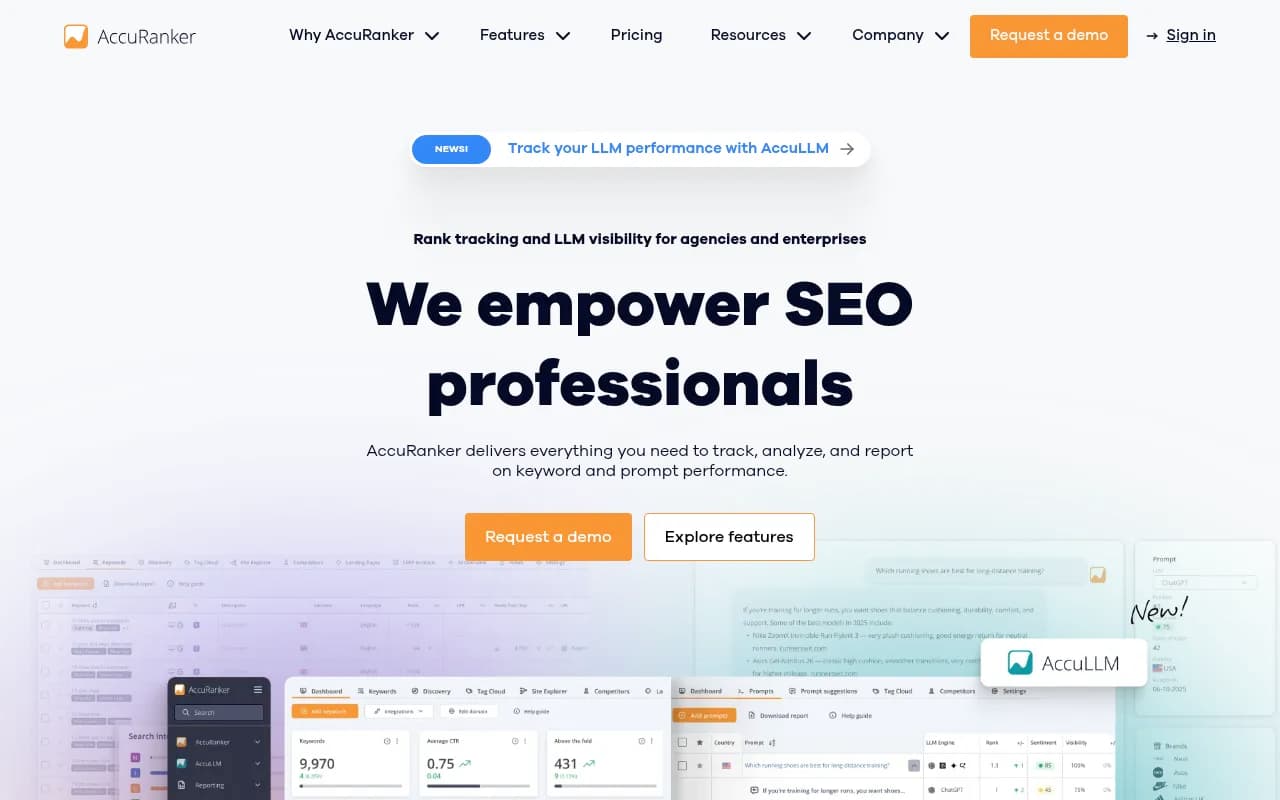
AccuRanker has been a go-to rank tracking platform since 2013, known for speed and accuracy in traditional SERP tracking. In 2024-2025, they launched AccuLLM to add AI search monitoring on top of their core keyword tracking. The pitch: track both traditional Google rankings and AI engine visibility in one platform. AccuRanker monitors ChatGPT, Perplexity, Google AI Overviews, and Google AI Mode. You get visibility scores, sentiment analysis, source citations, and competitor comparisons. The interface is clean and agency-friendly, with unlimited users and domains on all plans.
AccuRanker's strength is integration -- if you're already tracking thousands of keywords for traditional SEO, adding AI search monitoring feels like a natural extension. The weakness: AI search is clearly a secondary feature. Coverage is limited to 4 engines, and the analytics don't go as deep as platforms built specifically for LLM optimization.
LLMrefs: Built for AI search from day one

LLMrefs is a specialist AI search analytics platform that tracks brand visibility, rankings, and citations across 11 AI engines: ChatGPT, Claude, Gemini, Perplexity, AI Overviews, AI Mode, Grok, Copilot, Meta AI, Mistral, and DeepSeek. The platform automatically generates prompt variations from real user conversations, which means you're not just tracking a static list of keywords -- you're seeing how people actually query AI engines and where your brand shows up (or doesn't).
LLMrefs focuses on citation analysis, competitor benchmarking, and optimization insights. The interface is built around understanding why you're visible or invisible for specific prompts, not just showing you a score. The trade-off: LLMrefs doesn't do traditional SERP tracking at all. It's purely for AI search. If you need both, you'll need a second tool.
Side-by-side comparison
| Feature | AccuRanker | LLMrefs |
|---|---|---|
| Starting price | $109/mo (1,000 keywords) | $79/mo |
| AI engines tracked | 4 (ChatGPT, Perplexity, AI Overviews, AI Mode) | 11 (ChatGPT, Claude, Gemini, Perplexity, AI Overviews, AI Mode, Grok, Copilot, Meta AI, Mistral, DeepSeek) |
| Traditional SERP tracking | Yes (core feature) | No |
| Prompt generation | Manual | Auto-generated from real conversations |
| Citation analysis | Basic (sources cited) | Deep (citation tracking, source benchmarking) |
| Competitor tracking | Yes | Yes |
| Sentiment analysis | Yes | Limited |
| Multi-domain tracking | Unlimited domains | Varies by plan |
| Users per account | Unlimited | Varies by plan |
| API access | Unlimited on all plans | Available |
| Free trial | Yes | Yes (no credit card) |
| Best for | Agencies tracking both traditional SEO and AI search | Teams focused purely on AI search optimization |
AI engine coverage: LLMrefs wins on breadth
AccuRanker tracks 4 AI engines: ChatGPT, Perplexity, Google AI Overviews, and Google AI Mode. That covers the biggest players, but it's a narrow slice of the AI search landscape. If your audience uses Claude, Gemini, or Grok, you're flying blind.
LLMrefs tracks 11 engines, including all of AccuRanker's 4 plus Claude, Gemini, Grok, Copilot, Meta AI, Mistral, and DeepSeek. That's nearly 3x the coverage. For brands that need to understand visibility across the full spectrum of AI search engines -- especially if you're in B2B or tech where Claude and Gemini usage is high -- LLMrefs is the only real option here.
Verdict: LLMrefs by a wide margin. AccuRanker's 4-engine coverage is fine for basic monitoring, but LLMrefs gives you the full picture.
Prompt intelligence: LLMrefs auto-generates, AccuRanker requires manual input
AccuRanker's AccuLLM feature lets you add prompts manually. You type in a prompt, it tracks visibility across the 4 engines, and you see results. Simple, but it puts the burden on you to figure out what prompts matter. If you're not already deep in AI search behavior, you're guessing.
LLMrefs automatically generates prompt variations from real user conversations. The platform analyzes how people actually query AI engines and surfaces the prompts that matter for your niche. You're not starting from scratch -- you're working from data. This is a huge time-saver and means you're tracking prompts that reflect real user behavior, not just what you think people are asking.
Verdict: LLMrefs. Auto-generation is a massive advantage. AccuRanker's manual approach works if you already know your prompts, but most teams don't.
Citation and source analysis
Both platforms show you which sources AI engines cite when they mention your brand. AccuRanker displays the sources in a list format -- you can see which URLs were cited, but the analysis is surface-level. It's enough to know that you were cited, but not much more.
LLMrefs goes deeper. You get citation tracking over time, source benchmarking (which domains are cited most often for your prompts), and competitor citation analysis (which sources your competitors are getting cited from). This matters because understanding why a competitor is visible often comes down to which authoritative sources link to them or mention them. LLMrefs surfaces that.
Verdict: LLMrefs. AccuRanker's citation tracking is functional but basic. LLMrefs treats citations as a core optimization signal.
Traditional SERP tracking: AccuRanker is the specialist
AccuRanker's core product is traditional rank tracking, and it's excellent at it. Real-time updates, unlimited API calls, multi-location tracking, SERP feature tracking, and integrations with Google Search Console, Google Analytics, and Google Data Studio. If you're managing SEO campaigns that include both traditional search and AI search, AccuRanker lets you do it all in one platform.
LLMrefs doesn't track traditional SERPs at all. It's purely for AI search. If you need traditional rank tracking, you'll need a second tool (or you'll need to keep using whatever you're already using).
Verdict: AccuRanker. This isn't even a contest -- LLMrefs doesn't play in this space.
Competitor benchmarking
AccuRanker's competitor tracking shows you how your visibility compares to competitors across the 4 AI engines it monitors. You can see sentiment differences and citation overlaps. It's solid for basic competitive analysis.
LLMrefs offers more granular competitor benchmarking. You can see which prompts competitors rank for that you don't, which sources they're getting cited from, and how their visibility trends over time across all 11 engines. The depth here is better for identifying gaps and opportunities.
Verdict: LLMrefs edges ahead. Both platforms do competitor tracking, but LLMrefs gives you more actionable insights.
Pricing comparison
| Plan | AccuRanker | LLMrefs |
|---|---|---|
| Entry tier | $109/mo (1,000 keywords, unlimited domains/users) | $79/mo |
| Mid tier | $579/mo (10,000 keywords) | Not publicly listed |
| High tier | $1,929/mo (50,000 keywords) | Not publicly listed |
| Enterprise | Custom (100,000+ keywords) | Custom |
| Annual discount | 10% | Not specified |
| Free trial | Yes | Yes (no credit card) |
AccuRanker's pricing is transparent and scales with keyword volume. The value prop: unlimited domains and users on all plans, plus unlimited API calls. If you're an agency managing multiple clients, that's a big deal. The downside: $109/mo is steep if you only need AI search tracking and don't care about traditional SERPs.
LLMrefs starts at $79/mo, which is $30 cheaper than AccuRanker's entry tier. Pricing beyond the starter tier isn't publicly listed, which is frustrating. Based on the feature set, it's likely competitive with AccuRanker's mid-tier pricing, but you'll need to contact sales to confirm.
Verdict: LLMrefs is cheaper at the entry level. AccuRanker's pricing makes sense if you're using the full platform (traditional + AI search), but it's expensive if you only want AI search monitoring.
User interface and workflow
AccuRanker's interface is polished and agency-ready. The dashboard is clean, reporting is flexible, and the platform integrates with tools you're already using (GSC, GA, Data Studio). If you're managing clients, the white-label reporting and unlimited users make life easier. The AI search features (AccuLLM) feel like an add-on -- they're there, but they don't dominate the interface.
LLMrefs is built around AI search workflows. The interface prioritizes prompt discovery, citation analysis, and competitor benchmarking. It's less polished than AccuRanker (the platform is newer), but the workflows are more focused on optimization. You're not just looking at data -- you're being guided toward actions (which prompts to target, which sources to build relationships with, which competitors to study).
Verdict: Tie. AccuRanker is more polished and agency-friendly. LLMrefs is more focused on AI search optimization. Pick based on your workflow needs.
Integrations and API access
AccuRanker offers unlimited API calls on all plans, plus integrations with Google Search Console, Google Analytics, Google Data Studio, and various third-party SEO tools. If you're building custom dashboards or automating workflows, AccuRanker's API is robust.
LLMrefs has API access, but details on integrations and API limits aren't as transparent. Based on the platform's focus, it's likely the API is geared toward exporting AI search data for custom analysis, but you'll need to confirm specifics with their team.
Verdict: AccuRanker. The unlimited API access and established integrations give it an edge here.
Pros and cons
AccuRanker pros
- Combines traditional SERP tracking and AI search monitoring in one platform
- Unlimited domains, users, and API calls on all plans
- Polished interface with strong agency features (white-label reporting, client management)
- Real-time rank updates for traditional SEO
- Established platform with 10+ years of reliability
AccuRanker cons
- Only tracks 4 AI engines (ChatGPT, Perplexity, AI Overviews, AI Mode)
- AI search features feel like an add-on, not the core focus
- Manual prompt input -- no auto-generation from real conversations
- Higher starting price ($109/mo) if you only need AI search tracking
- Citation analysis is basic compared to specialist platforms
LLMrefs pros
- Tracks 11 AI engines -- widest coverage available
- Auto-generates prompts from real user conversations
- Deep citation analysis and competitor benchmarking
- Lower starting price ($79/mo)
- Built specifically for AI search optimization, not bolted on
LLMrefs cons
- No traditional SERP tracking -- you'll need a second tool for that
- Pricing beyond the starter tier isn't transparent
- Newer platform, less polished interface
- Fewer integrations and less clarity on API limits
- Not ideal for agencies managing multiple clients (unclear multi-user/domain support)
Who should pick AccuRanker?
Pick AccuRanker if you need both traditional SERP tracking and AI search monitoring in one platform. It's the right choice for agencies managing multiple clients, teams that want unlimited users and domains, and anyone who values a polished, established platform with strong integrations. AccuRanker makes sense if AI search is important but not your primary focus -- you want visibility into ChatGPT and Perplexity, but you're not obsessing over every LLM.
AccuRanker is also the better pick if you're already invested in traditional SEO workflows and want to add AI search monitoring without switching platforms. The real-time updates, API access, and reporting features are built for SEO professionals who live in rank tracking tools.
Who should pick LLMrefs?
Pick LLMrefs if AI search optimization is your primary goal and you need comprehensive coverage across all major LLMs. It's the right choice for brands that want to understand visibility across ChatGPT, Claude, Gemini, Perplexity, and the rest of the AI search landscape. LLMrefs is built for teams that need deep citation analysis, competitor benchmarking, and prompt intelligence -- not just a visibility score.
LLMrefs makes sense if you're willing to use a separate tool for traditional SERP tracking (or you don't care about traditional SEO at all). The auto-generated prompts and citation insights are valuable if you're serious about optimizing for AI search, not just monitoring it.
If you're also looking to track how your brand shows up in AI search results and want tools that help you close visibility gaps with content generation and optimization, Promptwatch covers that angle with 880M+ citations analyzed, crawler logs, and an AI writing agent that creates content designed to get cited by LLMs.

Final verdict
AccuRanker and LLMrefs solve different problems. AccuRanker is a traditional rank tracker that added AI search monitoring -- it's the right pick if you need both in one platform and value polish, integrations, and agency features. LLMrefs is a specialist AI search platform that goes deeper on LLM coverage, citation analysis, and prompt intelligence -- it's the right pick if AI search optimization is your primary focus and you're willing to use a separate tool for traditional SEO.
The decision comes down to this: Do you need traditional SERP tracking? If yes, AccuRanker. If no, LLMrefs gives you better AI search coverage and deeper insights for less money. Neither platform is a bad choice -- they're just built for different workflows.