Key Takeaways
- AccuRanker costs 2.2x more than LLM Pulse at the entry level ($109/mo vs €49/mo) but includes traditional rank tracking alongside AI monitoring
- LLM Pulse tracks 10 AI models on all plans; AccuRanker's AccuLLM feature tracks 4 models (ChatGPT, Perplexity, AI Overviews, AI Mode)
- AccuRanker gives you unlimited domains and users on every plan -- LLM Pulse limits you to tracking one brand per subscription
- LLM Pulse provides AI-powered content recommendations to improve your citations; AccuRanker focuses on monitoring without optimization guidance
- If you need both traditional SEO rank tracking and AI visibility in one platform, AccuRanker is the obvious choice. If you only care about AI search, LLM Pulse offers better value and deeper AI-specific features.
- Neither platform offers crawler log analysis or traffic attribution -- if you need to connect AI visibility to actual revenue, Promptwatch covers that angle with visitor analytics and server log tracking.
Overview
AccuRanker: Traditional rank tracker expanding into AI
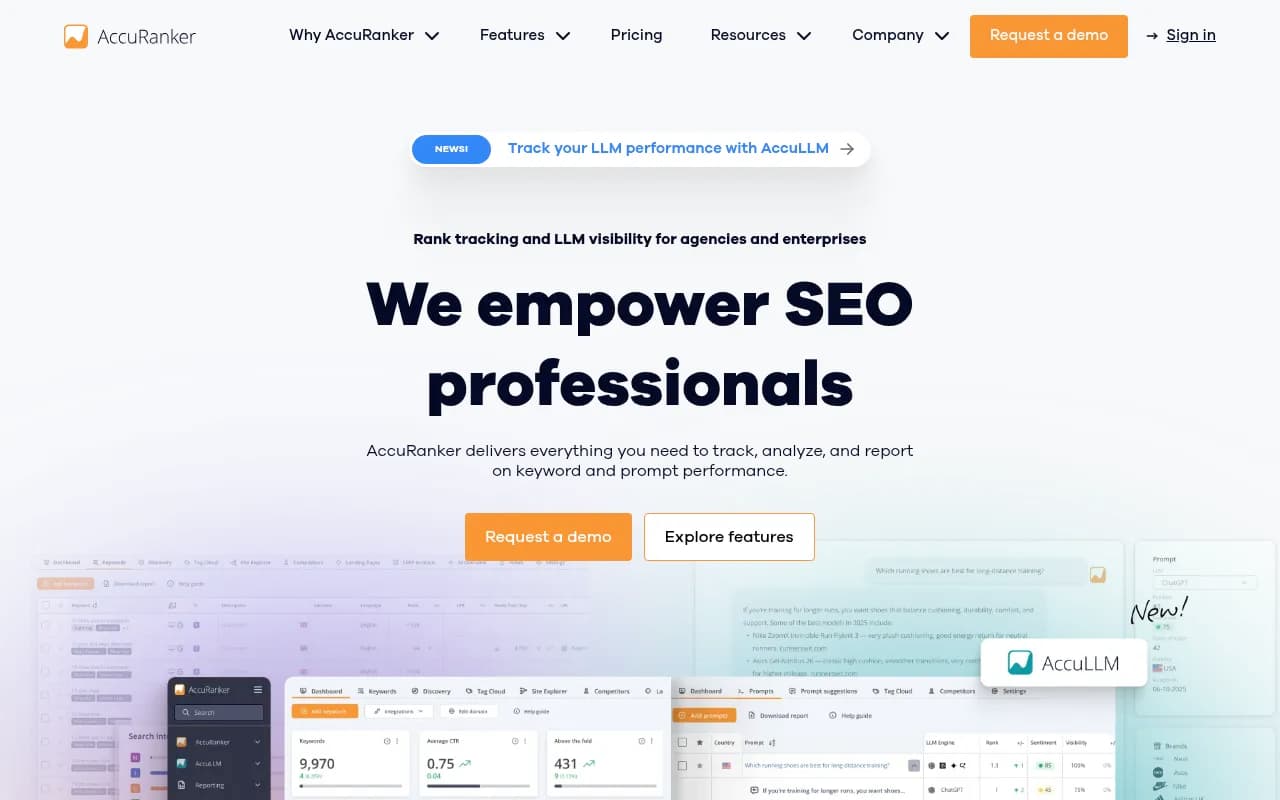
AccuRanker has been a staple in the SEO world since 2013, known for fast, accurate keyword rank tracking. In 2024, they launched AccuLLM as an add-on feature to monitor brand mentions in AI search engines. The pitch is simple: if you're already tracking Google rankings with AccuRanker, you can now track ChatGPT and Perplexity too without switching tools.
The platform is built for agencies and enterprises managing multiple clients. Unlimited users, unlimited domains, unlimited API calls on every plan. The rank tracking side is mature and polished. The AI monitoring side is newer and more limited in scope.
LLM Pulse: Purpose-built for AI search visibility
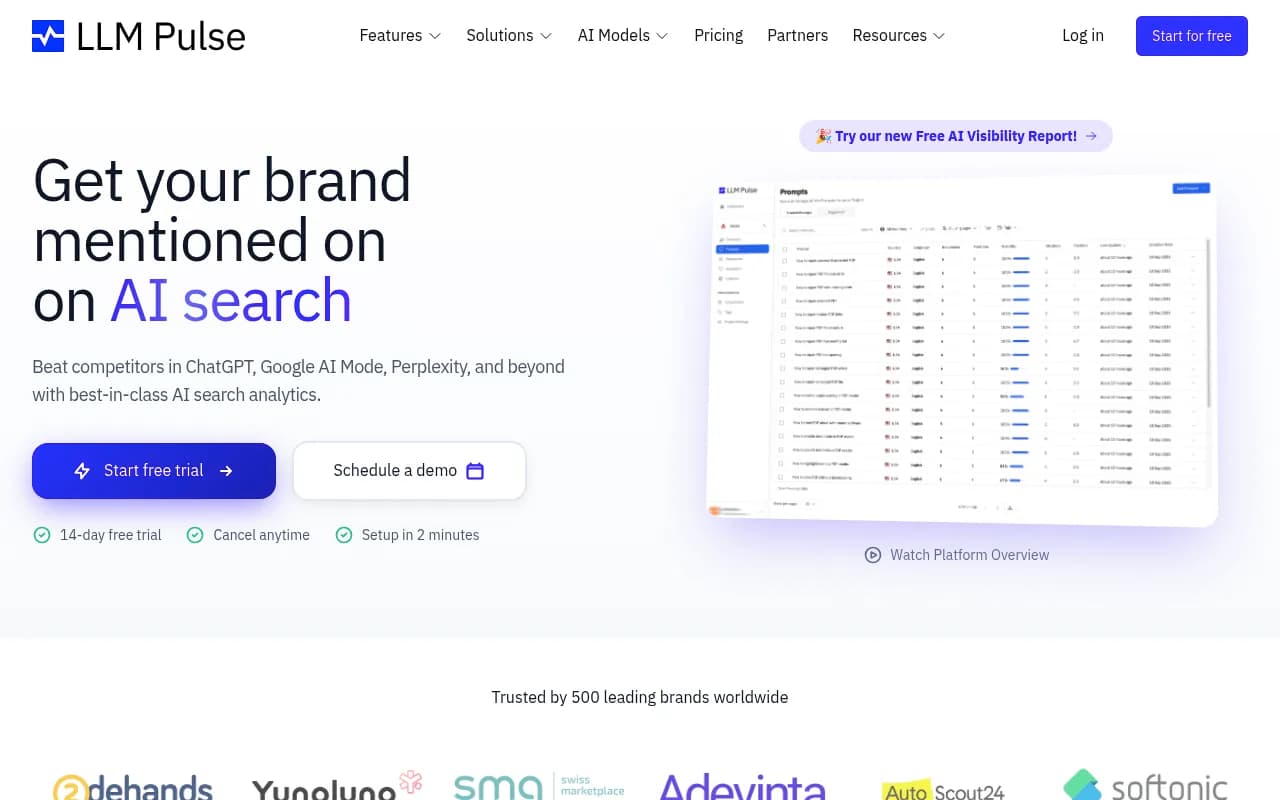
LLM Pulse launched in 2024 as a dedicated AI visibility tracker. It doesn't do traditional SEO rank tracking at all -- the entire platform is designed around one question: what are AI models saying about your brand?
You track prompts (questions people ask AI), see which sources get cited, measure your visibility score and sentiment, and get content recommendations to improve how you appear. It's narrower in scope than AccuRanker but goes deeper on AI-specific features. The interface feels more modern, and the optimization angle (not just monitoring) is baked into the product from day one.
Side-by-side comparison
| Feature | AccuRanker | LLM Pulse |
|---|---|---|
| Starting price | $109/mo (1,000 keywords) | €49/mo (40 prompts) |
| AI models tracked | 4 (ChatGPT, Perplexity, AI Overviews, AI Mode) | 10 (ChatGPT, Perplexity, Gemini, AI Mode, AI Overviews, DeepSeek, Grok, Claude, Copilot, Meta AI) |
| Traditional rank tracking | ✓ Core feature | ✗ Not included |
| Domains per plan | Unlimited | 1 brand per subscription |
| Users per plan | Unlimited | Not specified (appears limited) |
| Content optimization | ✗ Monitoring only | ✓ AI-powered recommendations |
| Citation analysis | ✓ Basic | ✓ Detailed with source breakdown |
| Sentiment tracking | ✓ | ✓ |
| Competitor benchmarking | ✓ | ✓ Share of voice analysis |
| API access | ✓ Unlimited on all plans | Not mentioned |
| Free trial | ✓ Available | ✓ 14 days |
| Annual discount | 10% | 17% |
Pricing comparison
| Plan | AccuRanker | LLM Pulse |
|---|---|---|
| Entry tier | $109/mo (1,000 keywords) | €49/mo (40 prompts) |
| Mid tier | $579/mo (10,000 keywords) | €99/mo (100 prompts) |
| High tier | $1,929/mo (50,000 keywords) | €299/mo (300 prompts) |
| Enterprise | Custom (100,000+ keywords) | Not offered |
| What's included | Unlimited domains, users, API calls | 1 brand, weekly tracking, 10 AI models |
The pricing structures don't map cleanly because they're measuring different things. AccuRanker charges per keyword tracked in traditional search. LLM Pulse charges per prompt tracked in AI models. A "keyword" and a "prompt" aren't equivalent -- prompts are typically longer, more conversational queries.
For a small brand tracking 40-50 important prompts in AI search, LLM Pulse is dramatically cheaper. For an agency managing dozens of client sites and needing both traditional and AI tracking, AccuRanker's unlimited domains make more sense despite the higher base price.
AI model coverage
This is where the platforms diverge most sharply.
AccuRanker's AccuLLM tracks four AI models: ChatGPT, Perplexity, Google AI Overviews, and Google AI Mode. That's it. These are the biggest players, but it's a limited set. If your audience uses Claude, Gemini, or Grok, you're flying blind.
LLM Pulse tracks ten models on all plans: ChatGPT, Perplexity, Gemini, Google AI Mode, Google AI Overviews, DeepSeek, Grok, Claude, Copilot, and Meta AI. The last five (DeepSeek through Meta AI) are marked as "Enterprise" features on their site, which suggests they might require a higher-tier plan or custom pricing, but the base coverage is still broader.
For comprehensive AI visibility, LLM Pulse wins this category. AccuRanker's limited model support feels like a feature that was bolted on rather than built from the ground up.
Tracking and monitoring capabilities
AccuRanker's strength is speed and scale. The platform was built to handle massive keyword lists with daily or on-demand updates. When they added AccuLLM, they brought that same infrastructure to AI monitoring. You can track prompts across locations and see how responses change over time. The interface integrates AI tracking into the existing dashboard, so if you're already an AccuRanker user, the learning curve is minimal.
But the AI tracking feels basic. You see whether your brand was mentioned, which sources were cited, and sentiment. That's useful, but it doesn't go much deeper.
LLM Pulse was designed for AI tracking from scratch, and it shows. You get a visibility score (how often you appear), citation rate (how often you're sourced), sentiment analysis, and share of voice against competitors. The prompt tracking includes weekly updates, and you can see the exact wording AI uses to describe you. The citations analysis breaks down which specific pages, domains, or third-party sources AI models are pulling from.
The detail level matters. If you're trying to understand why ChatGPT recommends a competitor over you, LLM Pulse gives you the raw material to figure it out. AccuRanker gives you the high-level numbers but less diagnostic depth.
Content optimization and recommendations
This is the biggest functional difference.
AccuRanker doesn't help you improve your AI visibility. It shows you the data, and you're on your own to figure out what to do about it. If your brand isn't appearing in ChatGPT responses, AccuRanker will tell you that's happening, but it won't suggest how to fix it.
LLM Pulse includes AI-powered content recommendations as a core feature. The platform analyzes which sources are getting cited, identifies gaps in your content, and suggests topics or angles to cover. It's not a full content generation tool (you still have to write the articles), but it points you in the right direction.
This is a meaningful difference if you're trying to actively improve your AI search presence rather than just monitor it. LLM Pulse closes the loop between tracking and action. AccuRanker leaves you stuck at the tracking stage.
Worth noting that Promptwatch takes this even further with built-in content generation -- it doesn't just recommend topics, it writes the articles for you based on citation data and competitor analysis.

Traditional SEO rank tracking
AccuRanker's core business is traditional rank tracking, and it's excellent at it. You get daily updates, unlimited keywords (depending on your plan tier), location-based tracking, device-specific rankings, and SERP feature monitoring. The API is robust, the data is accurate, and the platform is fast.
If you need to track both traditional Google rankings and AI visibility, AccuRanker is the only option here. LLM Pulse doesn't touch traditional SEO at all.
For agencies managing client SEO campaigns, this is a big deal. You can consolidate tools instead of paying for separate rank tracking and AI monitoring subscriptions. The question is whether AccuRanker's AI monitoring is good enough to justify using it over a dedicated AI tool.
Multi-domain and user management
AccuRanker's unlimited domains and unlimited users on all plans is a huge advantage for agencies. You can track as many client sites as you want, give every team member access, and the price doesn't change. This is rare in the SEO tool space and makes AccuRanker's pricing more reasonable than it looks at first glance.
LLM Pulse limits you to one brand per subscription. If you're an agency tracking five clients, you need five separate subscriptions at €49-€299 each. That adds up fast. The pricing page doesn't mention user limits, but the single-brand restriction suggests it's designed for in-house teams, not agencies.
For solo consultants or single-brand companies, this doesn't matter. For agencies, it's a dealbreaker unless LLM Pulse offers volume discounts (which aren't advertised).
API and integrations
AccuRanker provides unlimited API calls on all plans. You can pull rank data into custom dashboards, automate reporting, or build integrations with other tools. The API documentation is solid, and the lack of rate limits is generous.
LLM Pulse doesn't mention API access anywhere on their site. For most users, this won't matter -- the dashboard is the product. But if you're building custom workflows or need to pipe AI visibility data into a data warehouse, the lack of API access is a problem.
Reporting and analytics
Both platforms offer standard reporting features: track changes over time, compare against competitors, export data.
AccuRanker's reporting is more mature because the platform has been around longer. You can create white-label reports for clients, schedule automated email reports, and customize dashboards. The interface is functional but feels a bit dated.
LLM Pulse's interface is cleaner and more modern. The visualizations are easier to read, and the focus on AI-specific metrics (visibility score, citation rate, sentiment) makes the data more actionable. But the reporting features are less developed -- no white-labeling, no automated scheduling.
For agencies presenting to clients, AccuRanker's reporting edge matters. For in-house teams, LLM Pulse's cleaner interface is more pleasant to use day-to-day.
Pros and cons
AccuRanker pros
- Combines traditional rank tracking and AI monitoring in one platform
- Unlimited domains and users on all plans (huge for agencies)
- Mature platform with 13 years of development
- Unlimited API access
- Fast, accurate rank tracking with daily updates
- White-label reporting for client presentations
AccuRanker cons
- Only tracks 4 AI models (limited compared to competitors)
- No content optimization or recommendations
- Higher starting price ($109/mo vs €49/mo)
- AI monitoring feels like a bolt-on feature, not core functionality
- Doesn't help you improve AI visibility, just monitors it
LLM Pulse pros
- Tracks 10 AI models (more comprehensive coverage)
- AI-powered content recommendations to improve visibility
- Much cheaper entry price (€49/mo for 40 prompts)
- Purpose-built for AI search (deeper features, better UX)
- Detailed citation analysis and source breakdown
- Modern, clean interface
LLM Pulse cons
- No traditional SEO rank tracking
- Limited to 1 brand per subscription (expensive for agencies)
- No API access mentioned
- Less mature platform (newer, fewer integrations)
- Fewer reporting and white-label options
Who should pick AccuRanker
Pick AccuRanker if:
- You need both traditional rank tracking and AI monitoring in one tool
- You're an agency managing multiple client sites (unlimited domains is a game-changer)
- You already use AccuRanker for SEO and want to add AI tracking without switching platforms
- You need robust API access and white-label reporting
- You're tracking hundreds or thousands of keywords and need a platform that can handle scale
AccuRanker makes sense when AI monitoring is a secondary concern and traditional SEO is still your primary focus. The platform is overkill if you only care about AI search, but it's the right choice if you need both.
Who should pick LLM Pulse
Pick LLM Pulse if:
- AI search visibility is your primary concern and you don't need traditional rank tracking
- You want content recommendations to actively improve your AI presence, not just monitor it
- You're tracking a single brand (not an agency with multiple clients)
- You need comprehensive AI model coverage (10 models vs 4)
- You want a modern, purpose-built tool with a clean interface
- Budget is tight and €49/mo is more realistic than $109/mo
LLM Pulse is the better choice for companies that have already accepted AI search as a primary channel and want a dedicated tool to own it. The optimization features and broader model coverage make it more useful for actually improving your AI visibility rather than just watching it.
Final verdict
These tools serve different audiences. AccuRanker is a traditional SEO platform adding AI monitoring as a feature. LLM Pulse is an AI-first platform that doesn't touch traditional SEO at all.
If you need both traditional and AI tracking, AccuRanker is the only option here. If you only care about AI search, LLM Pulse is better -- cheaper, more comprehensive model coverage, and it actually helps you improve instead of just showing you numbers.
For agencies, AccuRanker's unlimited domains make it the practical choice despite the higher price. For single-brand companies, LLM Pulse offers better value and deeper AI-specific features.
The real question is whether monitoring alone is enough. Both platforms will tell you what's happening, but neither gives you the full action loop -- LLM Pulse gets closest with content recommendations, but you're still on your own to create and optimize the content. If you want a platform that closes the entire loop from tracking to content creation to traffic attribution, that's a different category of tool entirely.