Key takeaways
- Searchable is a monitoring tool. It tells you where you're invisible in AI search but doesn't help you do anything about it.
- Promptwatch closes the loop: find gaps, generate content engineered for AI citation, then track whether it worked.
- The built-in AI writing agent, Answer Gap Analysis, and crawler logs are features Searchable doesn't offer.
- Traffic attribution (via code snippet, GSC, or server logs) connects AI visibility to actual revenue -- something most tools skip entirely.
- For teams that need to show ROI from GEO efforts, the difference between a monitoring dashboard and an optimization platform matters a lot.
There's a moment every marketing team hits with AI visibility tools. You've set up your prompts, you're watching your brand mentions across ChatGPT and Perplexity, and the dashboard looks great. Then someone in the room asks: "So what do we do about it?"
That's where a lot of tools go quiet.
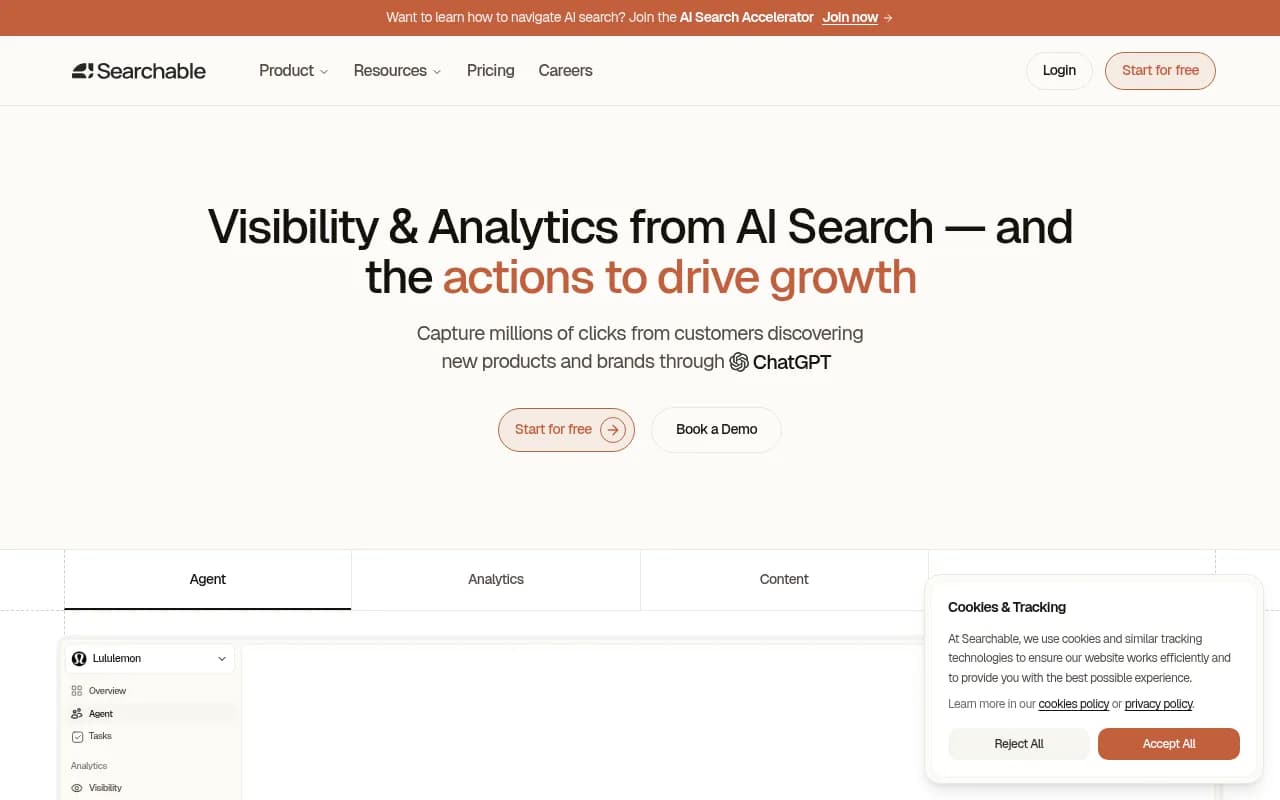
Searchable is a reasonable AI visibility platform. It covers the basics -- tracking brand mentions across AI engines, monitoring sentiment, watching competitors. For teams just getting started with GEO (Generative Engine Optimization), it's not a bad entry point.
But "not bad" isn't enough when AI search is actively eating into your organic traffic and your competitors are showing up in ChatGPT answers while you're not. Marketing teams in 2026 need more than a dashboard. They need a system.
That's why teams are moving to Promptwatch.

Here are the five reasons that keep coming up.
1. Searchable shows you the problem. Promptwatch helps you fix it.
This is the core difference, and it's worth being blunt about it.
Searchable tells you your brand isn't appearing in AI responses for certain prompts. That's useful information. But it stops there. You get the data, you close the tab, and then you're on your own figuring out what content to create, how to structure it, and whether it'll actually get cited.
Promptwatch is built around what happens after you see the gap.
The Answer Gap Analysis shows you exactly which prompts your competitors are visible for but you're not. Not in a vague "you're missing coverage in this topic cluster" way -- it shows you the specific questions AI models are answering where your content isn't being cited. You see what's missing, and then the platform helps you fix it.
The built-in AI writing agent generates articles, listicles, and comparisons grounded in real citation data. It's not generic SEO filler. The content is built around what AI models actually want to cite -- trained on 880M+ citations analyzed across 10 AI engines. That's a meaningful difference from asking ChatGPT to "write a blog post about X."
For marketing teams that need to show output, not just insight, this matters enormously.
2. Crawler logs tell you how AI engines actually see your site
Most AI visibility tools -- Searchable included -- focus on outputs: what AI models say in their responses. That's important. But it's only half the picture.
The other half is inputs: how AI crawlers are reading your website in the first place.
Promptwatch's AI Crawler Logs give you real-time visibility into which AI crawlers (ChatGPT, Claude, Perplexity, and others) are hitting your site, which pages they're reading, how often they return, and what errors they're encountering. If an AI crawler can't access a page, or keeps hitting a 404, or is being blocked by your robots.txt, you'll never appear in that model's responses for relevant prompts -- no matter how good your content is.
This is a feature most competitors lack entirely. Searchable doesn't offer it. Neither do most of the monitoring-only tools in this space.
For technical SEO teams and anyone serious about AI indexing, crawler logs are the kind of data that turns "why aren't we appearing?" from a mystery into a solvable problem.
3. Prompt intelligence that goes beyond basic tracking
Searchable lets you monitor a set of prompts. Promptwatch lets you understand them.
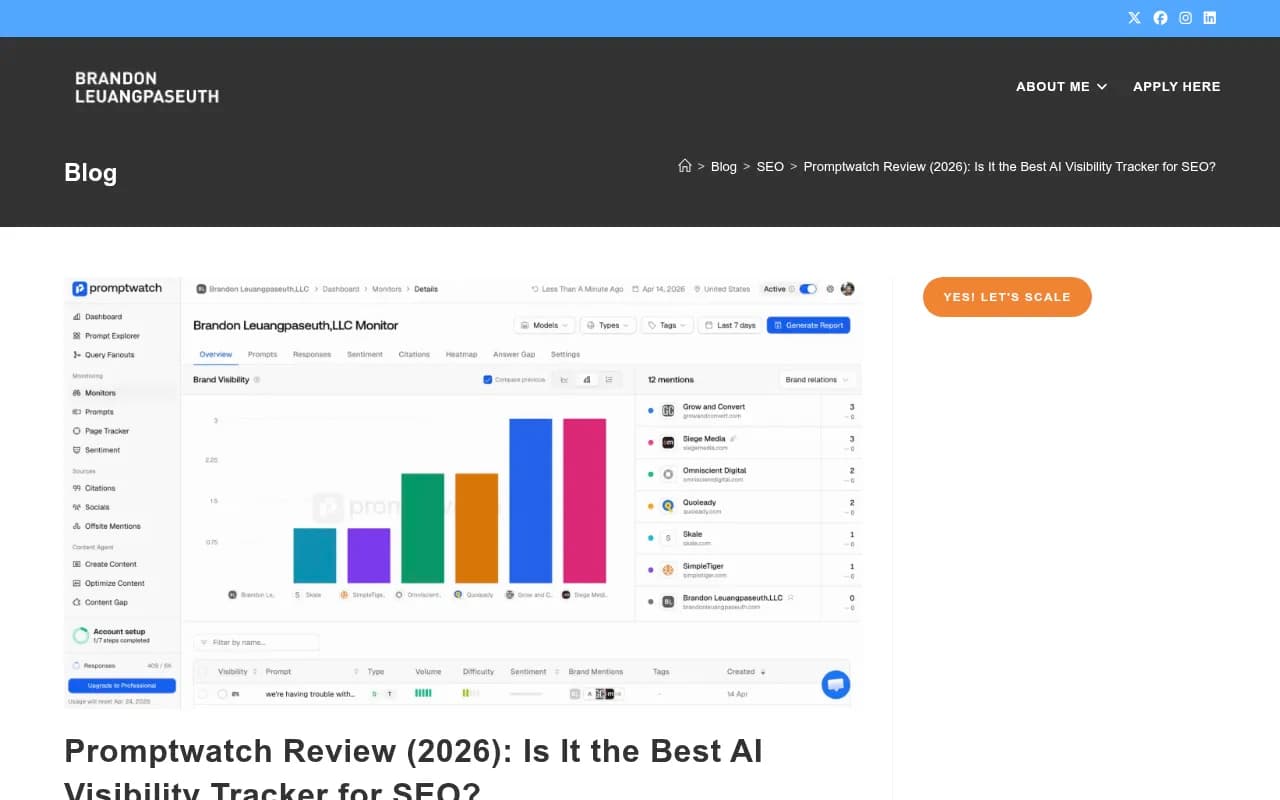
There's a real difference between knowing "we're not visible for this prompt" and knowing "this prompt gets high volume, has medium difficulty, and fans out into these eight sub-queries that we're also missing."
Promptwatch's Prompt Intelligence layer gives you volume estimates and difficulty scores for each prompt you're tracking. More usefully, the query fan-out feature shows how a single prompt branches into related sub-queries -- the follow-up questions AI models ask themselves when generating a response. If you're only optimizing for the top-level prompt, you're probably missing the sub-queries that actually determine whether your content gets cited.
This kind of prioritization is what separates teams that are guessing from teams that are working a system. You can focus on high-value, winnable prompts instead of spreading effort across everything.
For agencies managing multiple clients, this is especially valuable. You can show clients exactly why you're targeting specific content gaps, backed by data, rather than intuition.
4. Reddit, YouTube, and ChatGPT Shopping -- channels Searchable ignores
AI models don't just cite brand websites. They cite Reddit threads, YouTube videos, forum posts, and product listings. If you're only monitoring your own domain's citations, you're missing a significant chunk of how AI recommendations actually get formed.
Promptwatch surfaces Reddit discussions and YouTube content that directly influence AI recommendations. If a Reddit thread is driving ChatGPT to recommend a competitor over you, you want to know about it -- and you want to know what angle that thread is taking so you can address it.
The ChatGPT Shopping tracker is another capability that's genuinely hard to find elsewhere. If your products are (or aren't) appearing in ChatGPT's product recommendations and shopping carousels, that's revenue-relevant data. Searchable doesn't track this. Most tools don't.
For e-commerce and D2C brands especially, this is a meaningful gap in what Searchable can tell you.
5. Traffic attribution closes the loop from visibility to revenue
Here's the question every marketing leader eventually asks: "Is any of this actually driving traffic and revenue?"
With Searchable, you can see your AI visibility scores. What you can't easily do is connect those scores to actual website visits or conversions.
Promptwatch has three ways to do this: a code snippet you add to your site, a Google Search Console integration, or server log analysis. Each method lets you attribute traffic from AI search engines back to specific pages, so you can see which content is being cited, how often, and whether those citations are translating into visits.
This is the part of the picture that most GEO tools skip. Monitoring your brand mentions in ChatGPT is interesting. Knowing that your ChatGPT visibility drove 3,400 visits last month and contributed to 47 conversions is actionable.
For teams that need to justify GEO investment to leadership, this attribution layer is often the deciding factor.
How the tools compare
| Feature | Searchable | Promptwatch |
|---|---|---|
| AI engine monitoring | Yes | Yes (10 engines) |
| Answer Gap Analysis | Limited | Yes -- full gap analysis |
| Built-in content generation | No | Yes (AI writing agent) |
| AI Crawler Logs | No | Yes |
| Prompt volume & difficulty scores | No | Yes |
| Query fan-outs | No | Yes |
| Reddit & YouTube tracking | No | Yes |
| ChatGPT Shopping tracking | No | Yes |
| Traffic attribution | No | Yes (3 methods) |
| Competitor heatmaps | Basic | Yes |
| Multi-language / multi-region | Limited | Yes |
| Pricing (entry) | -- | $99/mo |
Who should actually consider switching
Not every team needs to switch. If you're in the early stages of understanding AI visibility -- just trying to get a baseline of where your brand stands -- a monitoring tool might be enough for now.
But if you're past that stage, if you've been tracking your AI visibility for a few months and you're now asking "what do we actually do with this data," then Promptwatch is the more honest answer to that question.
The teams that get the most out of it tend to be:
- Marketing teams that need to show content ROI and can't afford to publish content that doesn't move metrics
- SEO teams that are already tracking organic rankings and want to extend that rigor into AI search
- Agencies managing multiple clients who need to prioritize effort and report results
- E-commerce brands that want to know if their products are appearing in ChatGPT Shopping
The pricing is straightforward: Essential at $99/month covers one site and 50 prompts. Professional at $249/month adds crawler logs, state/city tracking, and 150 prompts across two sites. Business at $579/month scales to five sites and 350 prompts. There's a free trial if you want to test it before committing.
The bottom line
Searchable is a monitoring tool. That's not a criticism -- monitoring is a legitimate and necessary part of GEO. But monitoring alone doesn't improve your AI visibility. It just tells you how bad the problem is.
Promptwatch is built around the full cycle: find the gaps, create content that gets cited, track whether it worked. That cycle is what makes it an optimization platform rather than a dashboard.
If your team is at the point where you need to move from "we know we have an AI visibility problem" to "we're systematically fixing it," that's the switch worth making.