Key takeaways
- Brandlight is a genuinely capable enterprise platform: seven product modules, SOC 2 Type II compliance, and customers like Kimberly-Clark, Humana, Estée Lauder, and Charter.
- Its biggest strength is breadth: visibility, content, technical crawler analysis, partnerships, and agentic commerce in one cockpit.
- The five real gaps are no self-serve pricing, execution that stops at "drafts and briefs" rather than publishing, attribution still marked "coming soon," no organic SEO overlay, and module overload for teams with a narrower question.
- G2 reviewers praise the dashboards and the Technical Analysis module but flag the same problem twice: it's hard to know what to actually do with the insights.
- If you need fast execution or a lower price point, alternatives like Profound, AthenaHQ, and Promptwatch close different parts of that gap.
Why Brandlight became the default enterprise pick
Brandlight came out of stealth in April 2025 with a $5.75M seed, then raised a $30M Series A in February 2026 led by Pelion Venture Partners, with Cardumen Capital and G20 Ventures joining. That's roughly $35.75M in under two years, which tells you something about how fast enterprise buyers decided AI visibility deserved its own budget line separate from SEO.
The pitch is straightforward: one cockpit for everything related to how your brand shows up in ChatGPT, Gemini, AI Overviews, Perplexity, and Copilot, instead of five disconnected tools. The homepage logo wall backs that up with names like Kimberly-Clark, LG, The Hartford, Estée Lauder, Verifone, Humana, Aetna, and Charter, which is not a small feat for a company founded in October 2024.
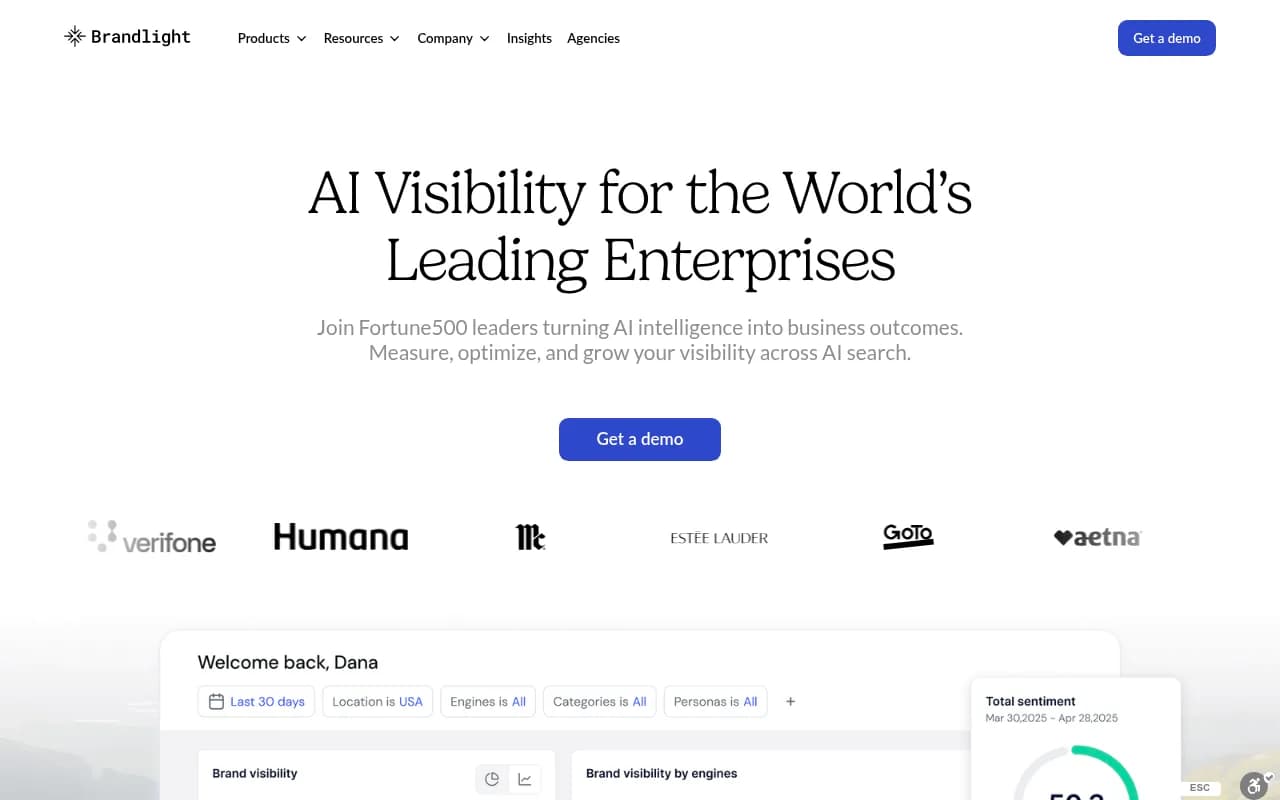
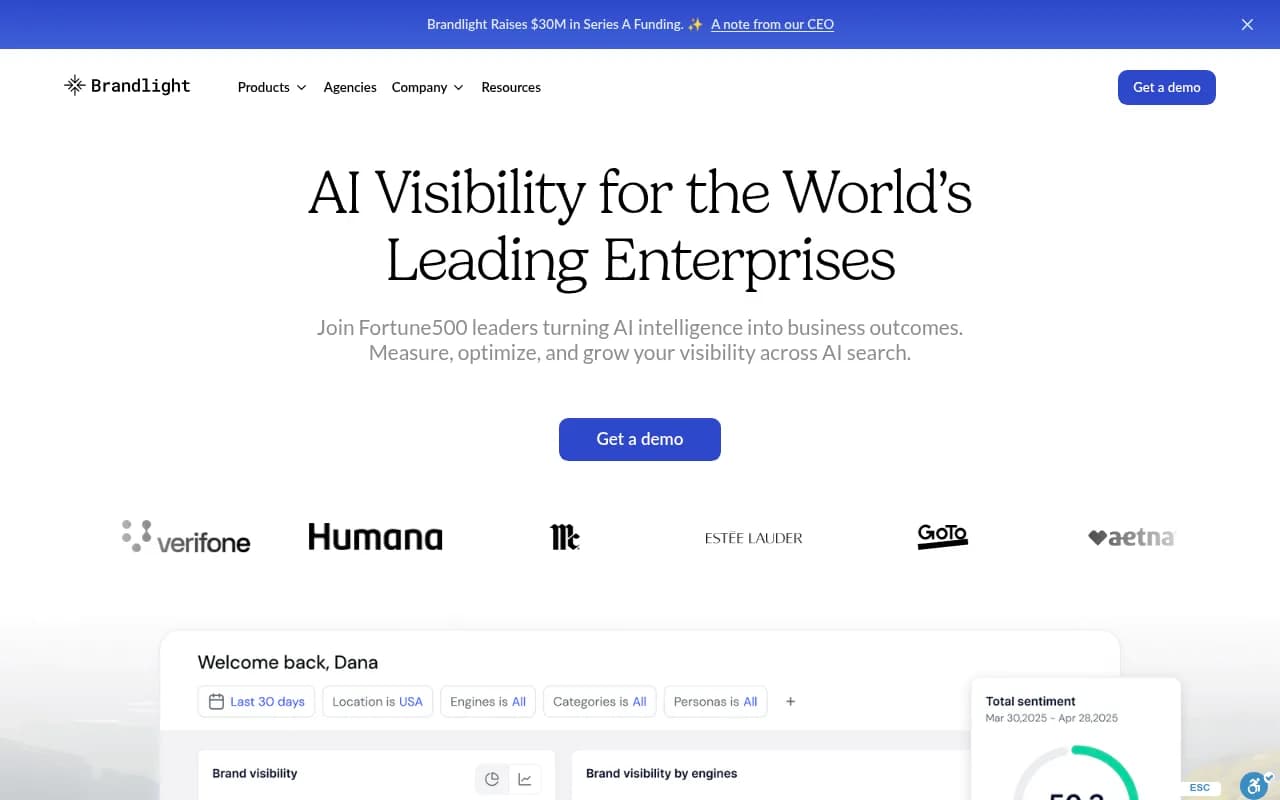
Here's what I think Brandlight actually gets right, before we get to the gaps.
It covers more surface area than almost anyone else
Most AI visibility tools track prompts and citations and stop there. Brandlight ships seven modules: Visibility & Insights, Content optimization, Technical Analysis (AI crawler and server-log data), Publisher Performance Intelligence for partnerships, Agentic Commerce/AI Shopping, AI Ads measurement, and Attribution (still labeled "coming soon"). For a Fortune 500 brand with separate SEO, PR, and commerce teams, that's a real reason to consolidate vendors rather than run five subscriptions.
G2 reviewers back this up on specific modules. Daniel P. calls out the Technical Analysis module for surfacing AI crawler visibility that most tools don't touch. Ciaran L. says Publisher Performance Intelligence is genuinely useful for PR outreach. Gisley S. likes the Content module for editorial teams. That's not marketing copy, that's people using the product day to day.
The security and governance story is built for procurement, not just marketing
Brandlight runs closed-network processing, meaning your data isn't shipped back to the model providers you're tracking. It pairs that with deterministic brand and legal guardrails on generated content, source-tied explainable recommendations, and SOC 2 Type II compliance plus SSO and RBAC. For a healthcare or financial services brand, that's not a nice-to-have, it's the difference between getting past legal review and not.
Dashboards that people actually enjoy using
Multiple G2 reviewers (Lauren C., Nicolas F.) specifically praise the dashboard usability and exportability. That sounds minor until you've sat through a vendor demo where the data is right but nobody on the team wants to open the tool.
The five gaps that show up once you actually try to buy it
This is where the enthusiasm cools. I went through G2 reviews, third-party comparison pieces, and Brandlight's own documentation, and the same five issues keep surfacing.
1. There's no pricing page, and the entry point is a paid pilot
Visit brandlight.ai/pricing or /plans and you get a 404. Every deal starts with a demo request, and buyer's guides report that Brandlight typically opens engagements with a paid three-month pilot rather than a self-serve trial. Third-party trackers throw out wildly different numbers, anywhere from a couple hundred dollars a month to $25,000+/month for enterprise tiers, which tells you these are estimates, not confirmed figures.
This isn't unusual for enterprise software, but it does mean mid-market teams and anyone who wants to try before committing budget approval will bounce off immediately. Compare that to Profound's free 7-day trial, AthenaHQ's free Essential tier, or Peec AI's €89/month self-serve plan, and Brandlight's model clearly targets a specific buyer: someone with procurement authority and patience for a multi-week sales cycle.
2. It diagnoses well but executes less than you'd expect at this price
Third-party comparisons describe Brandlight's model as "done-with-you" rather than fully automated. One competitor comparison ranks it at "rung 4 of 7" on an execution-depth scale, meaning it drafts and briefs content rather than publishing directly to your CMS. Brandlight's own partnership with the consultancy Demand Spring, announced in December 2025, is basically an admission of this: the joint offering pairs Brandlight's data with Demand Spring's execution and coaching to close the gap between insight and action.
That gap shows up directly in G2 reviews. Nicolas F., an SVP of Performance & Search, writes that "the part that's most difficult is to discern what actions to take from the insights" and that it's "hard to figure out what actions we can take to influence AI." Andrea M., a VP of Marketing Ops, cites limited internal bandwidth to act on the recommendations Brandlight surfaces. When two separate enterprise buyers flag the same friction point, that's not noise.
This matters more than it might seem, because the citation landscape rewards speed right now. Promptwatch's data shows ChatGPT's citation content mix shifted fast in a single month in 2026: how-tos more than doubled their share, documentation nearly doubled, and social posts collapsed from 4.4% to under 1% after August 14. If your platform tells you what changed but you need weeks to ship a fix, you're chasing a moving target with a diagnosis and no execution engine.
3. Attribution to revenue is still marked "coming soon"
Brandlight's own product materials list Attribution as a future module, and the company explicitly disclaims that "no tool can promise AI citations." That's an honest thing to say, but it also means the module enterprise buyers care about most, connecting AI visibility work to pipeline or revenue, isn't shipped yet. ROI measurement is the exact thing G2 reviewers flag as the hardest part of using the platform today, including Chris C. wanting deeper page-level attribution tracking.
4. AI visibility and organic SEO live in separate silos
Brandlight treats AI visibility as a wholly distinct discipline from traditional Google ranking. Several head-to-head comparisons note it doesn't report organic ranking changes alongside AI answer changes, so teams still need a second tool to see whether a technical fix moved both Google rankings and AI citations. Given how much AI Overviews and AI Mode citation behavior tracks the same content signals that drive organic rankings, that's a real blind spot for teams trying to run one unified content strategy instead of two.
5. Seven modules is a lot of platform for a narrow question
If your actual question is "does ChatGPT mention us when people ask about our category," paying for partnership intelligence, agentic commerce tracking, and ad measurement modules you'll never touch is expensive. One competitor review calls this bluntly "an expensive way" to answer a narrow question. Andrea M.'s G2 review backs this up from the buyer side: the volume of insights across all those modules requires internal bandwidth most marketing teams don't have to spare.
A quick note on the numbers you'll see elsewhere
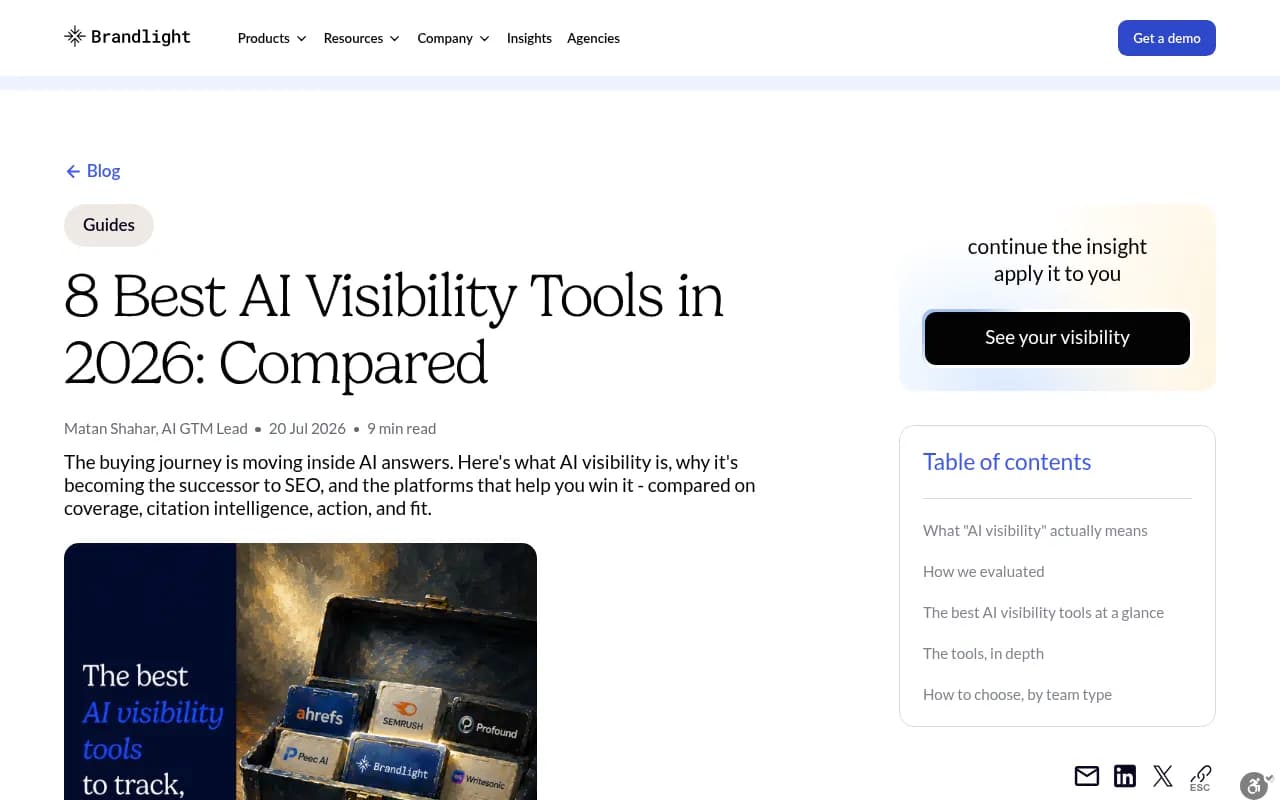
Brandlight's homepage displays an unsourced "Market Leader" quadrant chart with no named analyst or report attached. When one AI search engine was asked to verify the claim, it cited Brandlight's own homepage as its only source, which is a good illustration of why you should treat vendor-authored comparison content, including Brandlight's own "8 Best AI Visibility Tools" post that ranks itself #1, with some skepticism. The same caveat applies to competitor-authored "Brandlight alternatives" articles from Amadora AI, Dageno, and Mentionova; they're useful for feature detail but they're not neutral.
How Brandlight stacks up against the alternatives
| Platform | Entry pricing | Self-serve trial | Direct CMS publishing | Notable gap addressed |
|---|---|---|---|---|
| Brandlight | No public pricing, demo-only, paid pilot | No | No (drafts/briefs) | Breadth of modules, enterprise governance |
| Profound | $99/mo Starter | Yes (7-day free trial) | Limited | Lower entry cost, faster start |
| AthenaHQ | $295/mo Starter, free credit tier | Yes | Yes, six CMSs | Direct execution to CMS |
| Evertune | $800/mo Pro | No | Partial (articles) | Volume content generation |
| Promptwatch | $95/mo Essential | Yes (7-day free trial) | Yes, Webflow/Framer/WordPress | Crawler logs, content agents, offsite mentions |
Where Promptwatch fits if execution speed is your priority
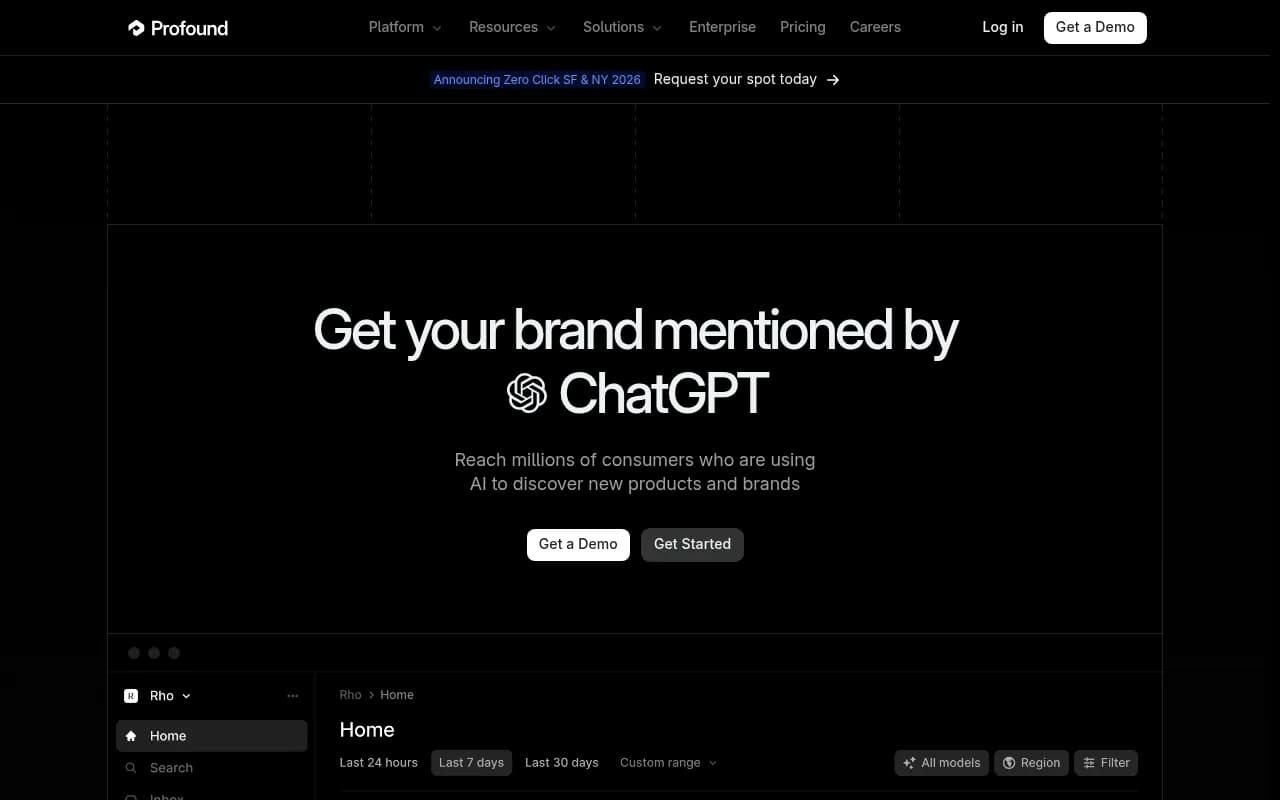
If the core frustration with Brandlight is what G2 reviewers already named, insight without a clear path to action, it's worth looking at platforms built around closing that loop automatically rather than handing you a brief. Promptwatch approaches this from the opposite direction: instead of a cockpit of monitoring modules plus a services layer to execute, its Content Agents plan, write, and publish GEO-optimized content directly to Webflow, Framer, or WordPress on a schedule, with a review inbox if you want a human checkpoint.
It also covers ground Brandlight's module list doesn't fully reach: AI crawler logs showing exactly when ChatGPTBot, ClaudeBot, and PerplexityBot hit your pages and whether they error out, dedicated Reddit and YouTube citation tracking, and ChatGPT Shopping and Ads Radar for tracking product recommendations and competitor ad spend inside AI answers. Pricing starts at $95/month for the Essential plan with a 7-day free trial, a sharp contrast to Brandlight's demo-only, paid-pilot model.

That said, Promptwatch and Brandlight aren't solving the exact same problem. Brandlight's closed-network processing and deterministic brand guardrails matter a lot to a healthcare or financial services legal team. If your procurement process demands that level of governance and you have budget for a multi-month pilot, Brandlight's enterprise posture is real and earned. If you need to move fast on a smaller budget and want the platform to actually ship content rather than just brief it, that's a different buying decision.
Who should actually buy Brandlight
Brandlight makes sense if you're a Fortune 500 or large enterprise brand with dedicated teams across SEO, content, PR, and commerce who need one governed system of record, and you have the internal bandwidth (or a partner like Demand Spring) to turn its insights into shipped work. It makes less sense if you're a mid-market or growth-stage company that wants self-serve access, fast execution, or a lower monthly cost, and it makes less sense if you specifically need unified Google and AI visibility reporting or hard attribution numbers today rather than "coming soon."
For teams still mapping out the wider category, the GEO software directory at bestgeosoftware.com is a reasonable place to browse the full field of monitoring and execution platforms before committing to a demo cycle with any single vendor.