Key takeaways
- 2025 saw AI visibility platforms split into two distinct camps: monitoring-only dashboards and full optimization platforms
- Profound targeted enterprise buyers with deep analytics; Peec.ai won mid-market teams with speed and simplicity; Otterly.AI captured budget-conscious users with low-cost monitoring
- Most platforms stopped at "showing you the problem" -- very few helped you fix it
- Promptwatch emerged as the only platform rated a "Leader" across all evaluation categories in 2026, largely because it closed the loop between gap analysis, content creation, and traffic attribution
- The market is still maturing -- brands that moved early on optimization (not just tracking) built compounding advantages heading into 2026
2025 was the year the AI visibility category stopped being a curiosity and became a budget line item. Somewhere between Gartner predicting a 25% decline in traditional search volume by 2026 and NP Digital documenting a 47% drop in organic leads for B2B companies, marketing teams stopped asking "should we track AI visibility?" and started asking "which platform do we use?"
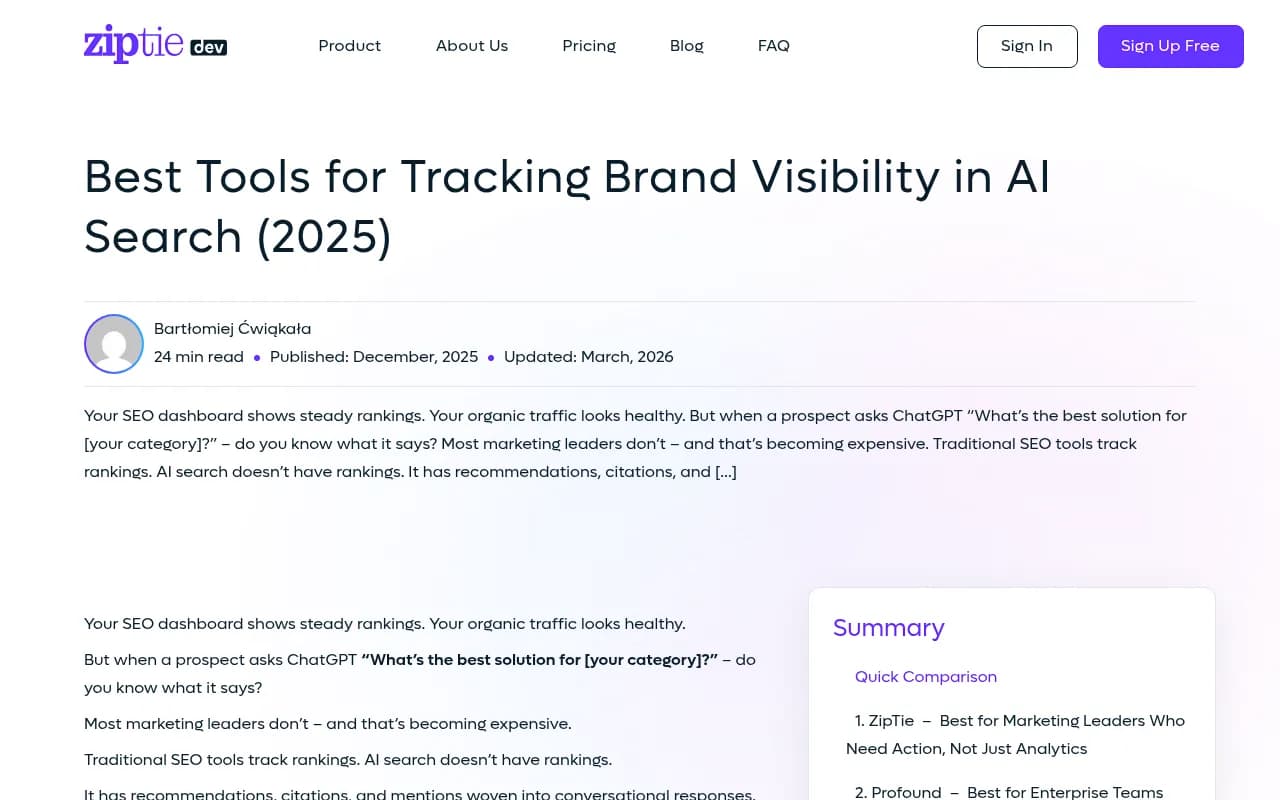
Four names kept coming up in that conversation: Promptwatch, Profound, Peec.ai, and Otterly.AI. Each took a different bet on what the market needed. Understanding those bets -- and which ones paid off -- tells you a lot about where GEO (Generative Engine Optimization) is heading.
Why 2025 forced the issue
The shift wasn't gradual. A few things happened in quick succession that made AI visibility impossible to ignore.
ChatGPT's user base crossed 200 million weekly active users. Perplexity became a default research tool for a meaningful slice of knowledge workers. Google's AI Overviews started appearing on roughly 47% of searches in certain verticals. And perhaps most telling: research from Magenta Associates found that 66% of UK senior B2B decision-makers were using AI tools to research suppliers, with 90% trusting those recommendations.
Traditional rank trackers had nothing useful to say about any of this. Your Ahrefs dashboard could tell you you ranked #3 for a keyword. It couldn't tell you whether ChatGPT mentioned your brand when someone asked "what's the best [your category] tool?" -- which was increasingly the question that mattered.
That gap created the market. And four platforms moved fastest to fill it.
The four platforms that defined the year
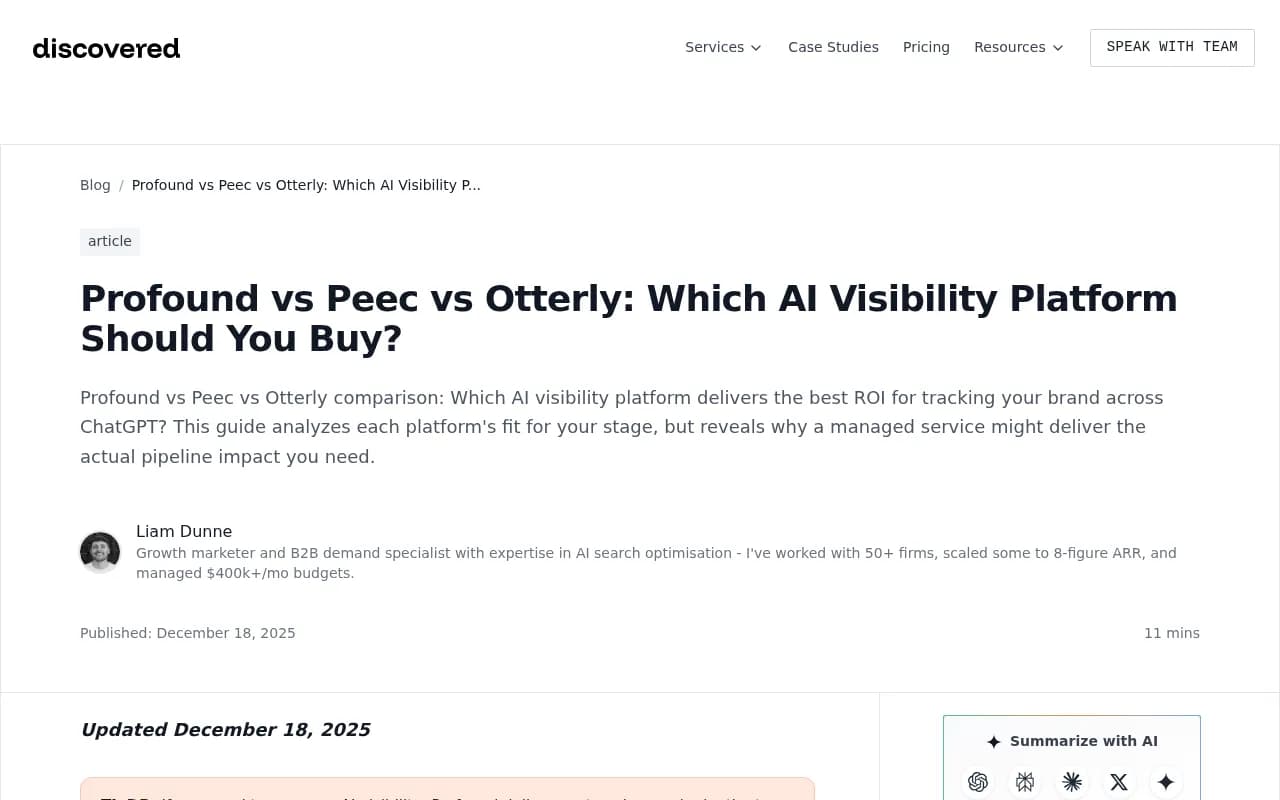
Profound: enterprise depth, enterprise price
Profound positioned itself squarely at the enterprise end of the market. Its pitch was comprehensive coverage, technical depth, and the kind of reporting infrastructure that satisfies a CMO's quarterly review.
At $499/month, it wasn't cheap. But for large brands with complex competitive landscapes and multiple product lines, the depth was genuinely useful. Profound tracked citations across ChatGPT, Perplexity, and other major AI engines with granular breakdowns -- which models mentioned you, in what context, alongside which competitors.
The honest critique: Profound was (and largely remains) a diagnostic tool. It showed you the problem with impressive precision. What to do about it was still your problem. For enterprise teams with dedicated content and SEO resources, that's fine. For everyone else, it meant paying a lot for a dashboard that generated anxiety without providing relief.

Peec.ai: mid-market speed and simplicity
Peec.ai took a different approach. Starting at €89/month, it targeted marketing teams that needed answers fast without a procurement process. The interface was cleaner, the onboarding faster, and the focus tighter: track your brand mentions across AI models, see how you compare to competitors, move on with your day.
Reddit discussions from 2025 (particularly in r/seogrowth) show teams switching from Peec.ai to other platforms specifically when they needed more structured prompt tracking and cross-model variance analysis. That's not a knock on Peec.ai -- it's a sign the platform was doing its job well enough that users outgrew it and needed more.
The multi-language support was a genuine differentiator for European brands, and the pricing made it accessible to companies that couldn't justify Profound's rates. For a mid-market team that just needed to know "are we showing up?" Peec.ai was a reasonable answer.

Otterly.AI: making monitoring accessible
Otterly.AI went furthest down the accessibility path. With plans starting at $29/month, it brought AI visibility monitoring within reach of small businesses, solo consultants, and agencies managing multiple clients on tight margins.
The platform published its own research in 2025 -- analyzing 100,000 websites across three major AI search platforms -- which gave it credibility as a thought leader in the space, not just a tool vendor. That research showed, among other things, that only 11% of sites get cited by both ChatGPT and Perplexity, which is a useful data point for anyone trying to understand how hard this problem actually is.
Otterly's limitation was the same as Profound's, just at a lower price point: it monitored. It didn't optimize. You could see your visibility score. You couldn't easily improve it from within the platform.

Promptwatch: closing the loop
Promptwatch took a different architectural bet. Rather than building a better monitoring dashboard, it built around the question "what do you do after you see the data?"
The answer it built was a complete loop: find the gaps, generate content to fill them, track whether that content gets cited. Each step feeds the next.
The Answer Gap Analysis showed exactly which prompts competitors were visible for that you weren't -- not as an abstract score, but as specific questions and topics your site wasn't answering. The built-in AI writing agent then generated articles, listicles, and comparisons grounded in citation data from 880M+ analyzed citations, with prompt volumes and competitor context baked in. Then page-level tracking showed whether the new content actually started getting cited, with traffic attribution connecting visibility to revenue.
That loop -- find gaps, create content, track results -- is what separated Promptwatch from the monitoring-only category. A 2026 comparative analysis of 12 GEO platforms rated it the only "Leader" across all evaluation categories.
Promptwatch also added capabilities that most competitors hadn't thought to build: real-time AI crawler logs showing which pages ChatGPT and Perplexity were actually reading, Reddit and YouTube insights surfacing discussions that directly influenced AI recommendations, ChatGPT Shopping tracking for e-commerce brands, and query fan-outs showing how one prompt branches into sub-queries.

How the platforms compared
Here's a direct feature comparison across the four platforms that defined 2025:
| Feature | Promptwatch | Profound | Peec.ai | Otterly.AI |
|---|---|---|---|---|
| AI model coverage | 10+ models | 5-6 models | 4-5 models | 3-4 models |
| Prompt tracking | Yes, with volume + difficulty | Yes | Basic | Basic |
| Content gap analysis | Yes (Answer Gap Analysis) | Limited | No | No |
| Built-in content generation | Yes (AI writing agent) | No | No | No |
| AI crawler logs | Yes | No | No | No |
| Reddit/YouTube insights | Yes | No | No | No |
| ChatGPT Shopping tracking | Yes | No | No | No |
| Traffic attribution | Yes (snippet, GSC, server logs) | Limited | No | No |
| Multi-language/region | Yes | Yes | Yes | Limited |
| Starting price | $99/mo | $499/mo | €89/mo | $29/mo |
| Best for | Teams wanting to optimize, not just monitor | Enterprise analytics | Mid-market monitoring | Budget monitoring |
The table tells the story pretty clearly. Profound wins on depth at the enterprise tier. Peec.ai and Otterly.AI win on accessibility. Promptwatch wins on the question that actually matters for most marketing teams: "what do I do with this information?"
The monitoring-only trap
One pattern that emerged clearly in 2025: teams that invested in monitoring-only platforms often found themselves with more anxiety and no more leverage. You could see that Competitor X was being cited 3x more than you in ChatGPT responses. You couldn't easily do anything about it from within the platform.
This isn't a criticism unique to any one tool -- it's a structural limitation of the monitoring-only model. The data is valuable. But data without a path to action is just a more detailed way of knowing you have a problem.
The platforms that started adding optimization features mid-year -- content recommendations, gap analysis, even basic guidance on what to write -- were responding to exactly this feedback. Users didn't just want dashboards. They wanted to move the needle.
What the market learned about AI citations
A few things became clearer in 2025 about how AI models actually decide what to cite:
The 11% overlap figure from Otterly.AI's research is worth sitting with. Only 11% of sites that get cited by ChatGPT also get cited by Perplexity. That means optimizing for one model doesn't automatically transfer to others -- you need to understand each model's citation patterns separately.
Citation is heavily influenced by the structure and specificity of your content. AI models tend to cite sources that directly answer the question being asked, with clear attribution, specific data, and a format that's easy to extract. Generic brand content doesn't get cited. Specific, question-answering content does.
Reddit and YouTube matter more than most brands realized. AI models pull from a much wider source set than just indexed web pages. Discussions on Reddit, video transcripts on YouTube, and forum threads all feed into AI responses. Brands that only optimized their own website were missing a significant part of the picture.
Crawler behavior is a real variable. Which pages AI crawlers actually visit -- and how often -- directly affects what gets cited. If your most important pages have crawl errors or aren't being indexed by AI crawlers, no amount of content optimization will help.
The competitive landscape beyond the big four
While Promptwatch, Profound, Peec.ai, and Otterly.AI dominated the conversation, 2025 also saw a wave of adjacent tools trying to carve out niches.
AthenaHQ built a solid monitoring product for teams tracking 8+ AI engines, though it stayed firmly in the monitoring camp. Search Party took an agency-oriented approach, useful for managing multiple client accounts but limited on prompt metrics. Semrush and Ahrefs both added AI visibility features to their existing platforms -- Semrush's implementation used fixed prompts, Ahrefs Brand Radar had fixed prompts and no AI traffic attribution, which limited their usefulness for teams that needed custom prompt tracking.

The broader pattern: established SEO tools added AI visibility as a feature. Purpose-built AI visibility tools added depth and optimization. The question for buyers was whether they wanted a comprehensive SEO platform with AI visibility bolted on, or a dedicated platform built around AI search from the ground up.
What separated winners from also-rans
Looking back at 2025, a few things separated the platforms that built lasting market positions from those that stayed niche:
Prompt intelligence mattered more than raw coverage. Knowing you're mentioned in AI responses is table stakes. Knowing which prompts drive the most volume, which ones you could realistically win, and how queries fan out into sub-queries -- that's the information that drives strategy. Platforms that built this layer had much stickier products.
Action beats monitoring every time. The platforms with the highest retention were the ones where users could see a direct line from "I used this tool" to "my visibility improved." That required more than dashboards -- it required content tools, optimization guidance, and attribution.
Data quality over model quantity. Several platforms rushed to add more AI models to their coverage list. The ones that built trust were the ones where the data was reliable and consistent, even if the model list was shorter.
Reddit and YouTube were the sleeper insight of the year. Brands that started tracking which Reddit threads and YouTube videos were influencing AI recommendations found a whole new content strategy opening up. Most platforms ignored this channel entirely.
Where things stand heading into 2026
The AI visibility platform market is consolidating around a clearer set of buyer needs. Monitoring is now table stakes -- if your platform can't tell you where you appear in AI responses, you're not in the game. The differentiation is happening at the optimization layer.
Teams that treated 2025 as a learning year -- picking a monitoring tool, understanding the landscape, building internal knowledge -- are now in a position to move fast on optimization. Teams that are still debating whether AI visibility matters are watching competitors build compounding advantages.
The platforms that will define 2026 are the ones that can show a direct line from their product to improved AI citations to measurable traffic and revenue. That's a harder problem than building a dashboard, but it's the right problem to solve.
For most marketing teams evaluating tools right now, the practical question is: do you need to understand the problem, or do you need to fix it? If you're still in discovery mode, any of the monitoring platforms covered here will give you useful data. If you're ready to act on it, you need a platform built around optimization -- and in 2026, that's a shorter list.