Key takeaways
- Most GEO tools launched in 2024-2025 were built to monitor AI visibility, not improve it. Brands that treated monitoring as a strategy are still stuck.
- Platforms like Searchable and Profound give you data on where you're invisible. They don't help you fix it.
- The core mistake: confusing "I can see the problem" with "I'm solving the problem."
- Effective GEO in 2026 requires a closed loop: find gaps, create content engineered for AI citation, track what changes.
- Brands actively optimizing for AI search see citation rates 2x to 3x higher than those relying on passive monitoring alone.
The GEO tool gold rush of 2025 left a lot of brands stranded
2025 was the year GEO went from niche experiment to boardroom priority. AI Overviews started eating organic traffic. ChatGPT became a product discovery engine. Perplexity started sending (some) referral traffic. E-commerce sites reported a 22% drop in search traffic attributable to AI-generated answers replacing traditional clicks.
Naturally, a wave of tools emerged to help brands figure out what was happening. Monitoring dashboards, citation trackers, share-of-voice reports. Vendors promised visibility into the black box. Brands signed up.
Here's the problem: most of those tools stopped at "here's what's happening." They never got to "here's how to change it."
Now it's 2026, and a lot of marketing teams are sitting on months of data showing they're invisible in ChatGPT, underrepresented in Perplexity, and getting beaten by smaller competitors in Google AI Overviews. They know the problem. They just don't have a path to fixing it.
This guide is about understanding exactly where those tools fell short, which mistakes are still being made, and what a real GEO strategy looks like now.
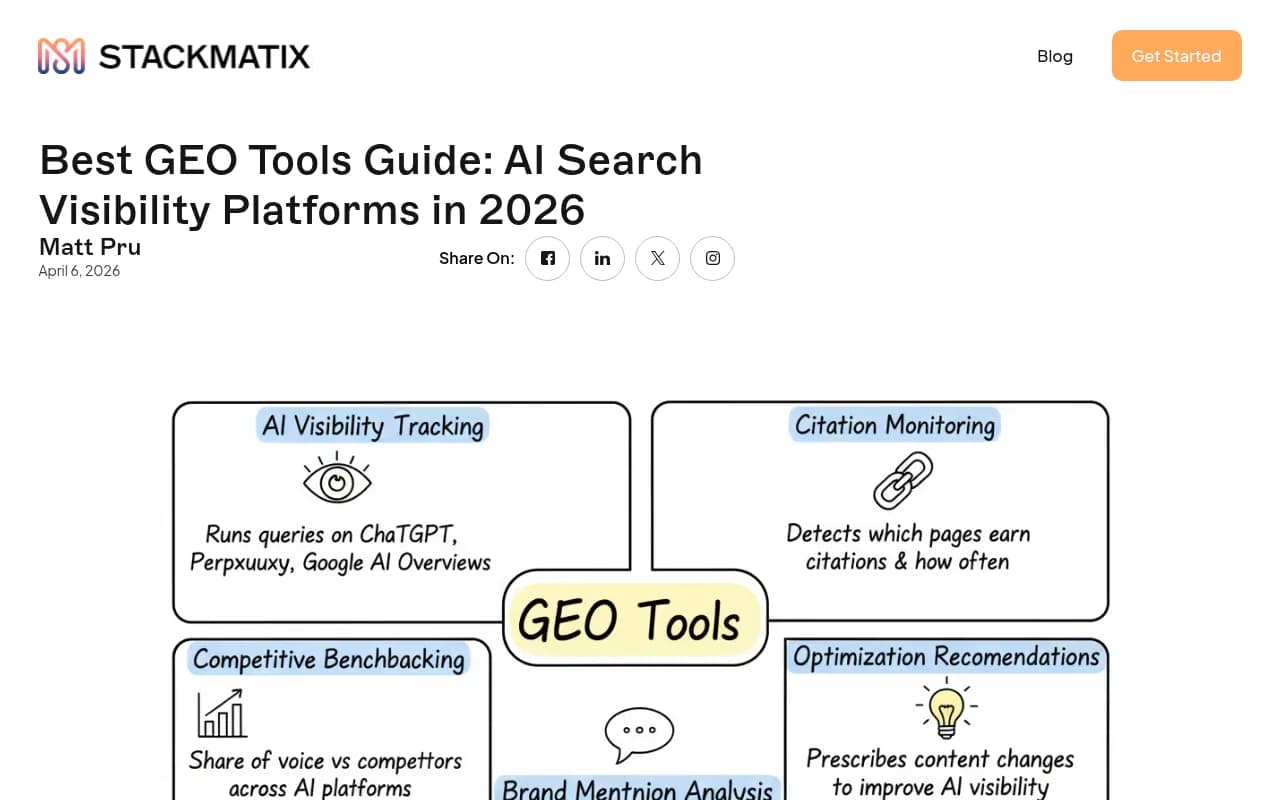
Mistake 1: Treating monitoring as a strategy
This is the big one. Monitoring your AI visibility is necessary. It is not sufficient.
Tools like Profound and Searchable built genuinely useful dashboards. You can see which prompts mention your brand, how often you appear versus competitors, and which AI models are citing you. That information has real value.
But here's what happens in practice: a marketing team runs a GEO audit, discovers they're invisible for 40 high-value prompts, and then... opens a content brief document and tries to figure out what to write. The tool gave them a problem list. It didn't give them a solution.

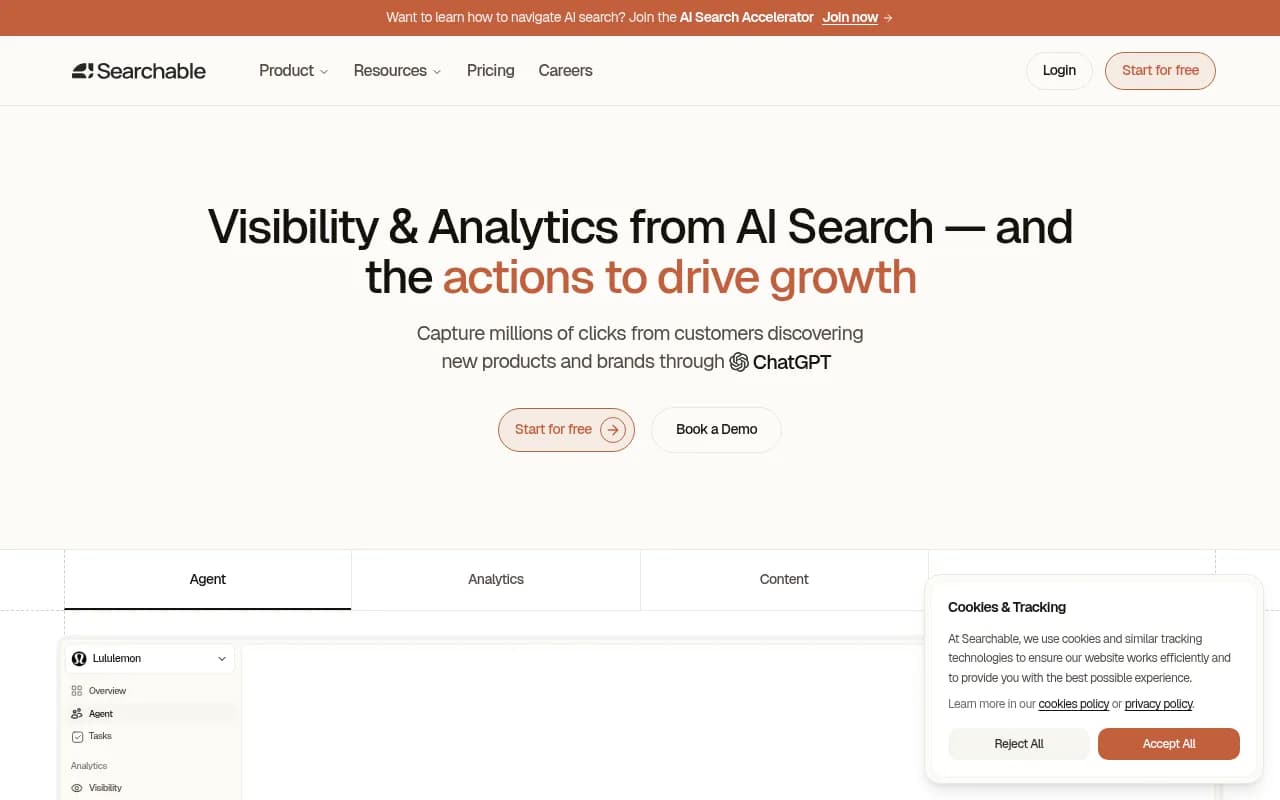
The monitoring-only model made sense when GEO was new and brands just needed to understand the landscape. That phase is over. In 2026, the brands winning in AI search are the ones who closed the loop between "we're invisible here" and "we published something that changed that."
Mistake 2: Checking one AI model and calling it done
This one is surprisingly common. A brand checks ChatGPT, sees they appear for their main category keyword, and marks GEO as "handled."
The reality is that each AI model behaves differently. ChatGPT, Perplexity, Claude, Gemini, and Google AI Overviews pull from different sources, weight different signals, and update at different rates. A brand that ranks well in ChatGPT responses might be completely absent from Perplexity's answers for the same query. Google AI Overviews operate on entirely different logic from conversational LLMs.
Brands need to track presence across multiple models simultaneously. Not because it looks good in a report, but because your customers are using all of them. Someone researching a B2B software purchase might start with a ChatGPT conversation, check Perplexity for sources, and then see a Google AI Overview when they search for reviews. If you're only visible in one of those touchpoints, you're losing the others.
Mistake 3: Ignoring the content gap entirely
Most monitoring tools will tell you that competitors are appearing for prompts you're not. What they won't tell you is why, or what specific content you're missing.
This is where "answer gap analysis" becomes important. The question isn't just "are we invisible for this prompt?" It's "what would an AI model need to find on our website to cite us for this prompt?" Those are different questions, and the second one is actually actionable.
If ChatGPT is citing a competitor's comparison article when someone asks about your product category, you don't just need to "create more content." You need to create a specific type of content, covering specific angles, structured in a way that AI models can extract and cite. Generic blog posts don't fix this. Content engineered around real citation data does.

Promptwatch approaches this differently from monitoring-only tools. Its Answer Gap Analysis shows exactly which prompts competitors rank for that you don't, and then its built-in AI writing agent generates content grounded in citation data from 880M+ analyzed citations. The gap and the fix live in the same platform.
Mistake 4: Underestimating how much Reddit and YouTube matter
Here's something most GEO tools don't surface: a significant portion of what AI models cite isn't brand-owned content. It's Reddit threads, YouTube videos, and third-party reviews.
When someone asks ChatGPT "what's the best project management tool for remote teams," the answer often draws from Reddit discussions, YouTube comparisons, and review aggregators. If your brand isn't mentioned positively in those places, you're not going to appear in the AI response, regardless of how well-optimized your own website is.
Most monitoring tools focus entirely on your owned content. They'll tell you your website isn't being cited. They won't tell you that the Reddit thread ranking for your target prompt is actively recommending a competitor, or that the YouTube video being cited never mentions you.
This is a real gap in the market. Tools that surface Reddit and YouTube signals alongside traditional citation data give brands a much more complete picture of why they're invisible and where to invest.
Mistake 5: No traffic attribution, so no proof of ROI
This one is killing GEO programs at the budget renewal stage.
A team spends six months optimizing for AI search. Their visibility scores improve. They appear in more ChatGPT and Perplexity responses. And then someone in finance asks: "What did that actually do for revenue?"
If you can't connect AI visibility to actual website traffic, and traffic to conversions, you can't answer that question. Most monitoring tools don't attempt this. They stop at "you appeared in X% of responses for these prompts."
The attribution problem is solvable, but it requires either a code snippet on your site, a Google Search Console integration, or server log analysis to identify AI-referred sessions. Brands that set this up early have a massive advantage at budget time. Brands that didn't are now trying to retrofit attribution onto months of historical data.
Mistake 6: Ignoring AI crawler behavior
This one is more technical but it matters. AI models don't just pull from their training data. They actively crawl the web. ChatGPT's crawler (GPTBot), Perplexity's crawler, Claude's crawler -- they're all hitting your website regularly.
If those crawlers are hitting error pages, getting blocked by your robots.txt, or only reading your homepage, that affects what AI models know about you. A brand can have excellent content that AI models never cite simply because the crawler can't access it properly.
Most GEO tools have no visibility into this. They track outputs (what AI models say) but not inputs (how AI crawlers interact with your site). That's a significant blind spot. Knowing that GPTBot visited your pricing page three times last week but never touched your comparison articles tells you something important about where to focus.
The monitoring-only trap: a comparison
Here's an honest look at where different tool categories fall on the monitoring-to-optimization spectrum:
| Tool / Category | Tracks AI mentions | Shows competitor gaps | Content generation | Crawler logs | Traffic attribution | Reddit/YouTube signals |
|---|---|---|---|---|---|---|
| Profound | Yes | Partial | No | No | No | No |
| Searchable | Yes | Partial | Limited | No | No | No |
| Otterly.AI | Yes | Basic | No | No | No | No |
| Peec.ai | Yes | Basic | No | No | No | No |
| AthenaHQ | Yes | Yes | No | No | No | No |
| Promptwatch | Yes | Yes (Answer Gap Analysis) | Yes (AI writing agent) | Yes | Yes | Yes |
The table isn't meant to dismiss monitoring tools. For brands just starting out, knowing where you stand is genuinely useful. But if you've been monitoring for six months and your visibility hasn't improved, the tool isn't the problem. The category is.



What actually works in 2026: the optimization loop
The brands seeing real results in AI search right now are running a consistent loop:
Step 1: Find the gaps. Not just "we're invisible for these prompts" but "here's the specific content our website is missing that AI models want to cite." This requires prompt-level data, competitor citation analysis, and some understanding of query intent.
Step 2: Create content that earns citations. This is different from creating content for Google. AI models cite content that directly answers questions, uses clear structure, and covers topics with appropriate depth. A 500-word blog post optimized for a keyword won't cut it. A 1,500-word piece that directly addresses a specific question, backed by data and structured for extraction, has a real chance.
Step 3: Track what changes. Which new pages are being cited? By which models? How often? And critically, is that visibility translating to traffic and conversions?
This loop sounds simple. Most tools only support one step of it.
The prompt volume problem nobody talks about
One more mistake worth calling out: treating all prompts as equally valuable.
A brand might be invisible for 200 prompts. But those 200 prompts are not equal. Some have high query volume and low competition. Some are asked constantly but dominated by one entrenched competitor. Some are niche but convert extremely well.
Without prompt volume estimates and difficulty scoring, you're essentially guessing at prioritization. Teams end up chasing visibility for prompts that barely get asked, while ignoring high-volume opportunities where they could realistically win.
This is where prompt intelligence data becomes genuinely useful. Knowing that a specific prompt gets asked thousands of times per month and that your competitors are only weakly represented in the answers is a clear signal to prioritize it. That kind of prioritization is what separates teams making real progress from teams generating reports.
What to look for in a GEO tool now
If you're evaluating or re-evaluating your GEO stack in 2026, here's what actually matters:
- Multi-model tracking. At minimum: ChatGPT, Perplexity, Google AI Overviews, Claude, Gemini. Ideally also Grok, DeepSeek, Copilot, Meta AI.
- Answer gap analysis. Not just "you're invisible" but "here's what content you're missing."
- Content generation grounded in citation data. Generic AI writing won't help. You need content built around what AI models actually cite.
- Crawler log access. Know how AI bots interact with your site, not just what they say about you.
- Traffic attribution. Connect visibility to revenue or you'll lose the budget argument.
- Prompt volume and difficulty data. Prioritize intelligently instead of chasing every gap.
- Reddit and YouTube signals. Third-party sources heavily influence AI responses.
No tool does all of this perfectly. But the gap between "monitoring dashboard" and "optimization platform" is real, and it's worth understanding before you commit to a platform for another year.
The honest conclusion
The GEO tool market matured fast in 2025, but it matured unevenly. A lot of platforms built excellent monitoring capabilities and then stopped. That was fine when brands just needed to understand the problem. It's not fine now.
The brands that will win in AI search over the next 12 months are the ones treating GEO as an optimization discipline, not a reporting exercise. That means closing the loop between data and action, publishing content that earns citations rather than hoping existing content gets discovered, and building attribution so you can prove the work is worth doing.
The tools that support that loop are worth paying for. The ones that just show you a dashboard of bad news are not.