Key takeaways
- Surfer SEO is still the strongest choice for writer-focused, real-time on-page optimization, but its credit-based pricing punishes teams publishing at volume.
- Clearscope wins on reliability and clean UX -- it's the safest pick for enterprise teams where consistency matters more than cost.
- NeuronWriter is the most budget-friendly option and the closest Surfer alternative, though its AI writing calibration has known issues.
- Frase is the best tool for the research-to-draft pipeline, especially for teams that want to go from keyword to outline to draft in one place.
- None of these four tools were built with AI search (ChatGPT, Perplexity, Google AI Overviews) in mind -- that's a separate problem requiring a separate layer.
The content optimization tool category made a lot of sense in 2022. You picked a target keyword, ran a SERP analysis, got a list of NLP terms to include, hit a content score, and published. Google rewarded thorough, well-structured content. The tools that helped you get there were genuinely useful.
In 2026, that workflow still matters -- but it's no longer the whole picture. A growing share of search traffic now flows through AI-generated answers. ChatGPT, Perplexity, Google AI Overviews, and Gemini are answering questions directly, citing sources they trust. Getting cited there is a different problem from ranking in position three on a SERP. And none of the four tools in this comparison were designed with that in mind.
So this guide does two things. First, it gives you an honest comparison of Surfer SEO, NeuronWriter, Clearscope, and Frase for traditional content optimization in 2026. Second, it addresses the question most comparison articles skip: what do you actually need to be visible in AI search, and where do these tools fall short?
What these tools actually do
Before getting into the comparison, it's worth being precise about what "content optimization" means in this context, because these four tools don't all do the same thing.
At their core, all four analyze top-ranking pages for a target keyword and use that data to generate recommendations -- which topics to cover, which terms to include, how long the content should be, how to structure it. The mechanism is similar. The differences show up in workflow coverage, scoring reliability, AI writing quality, and price.
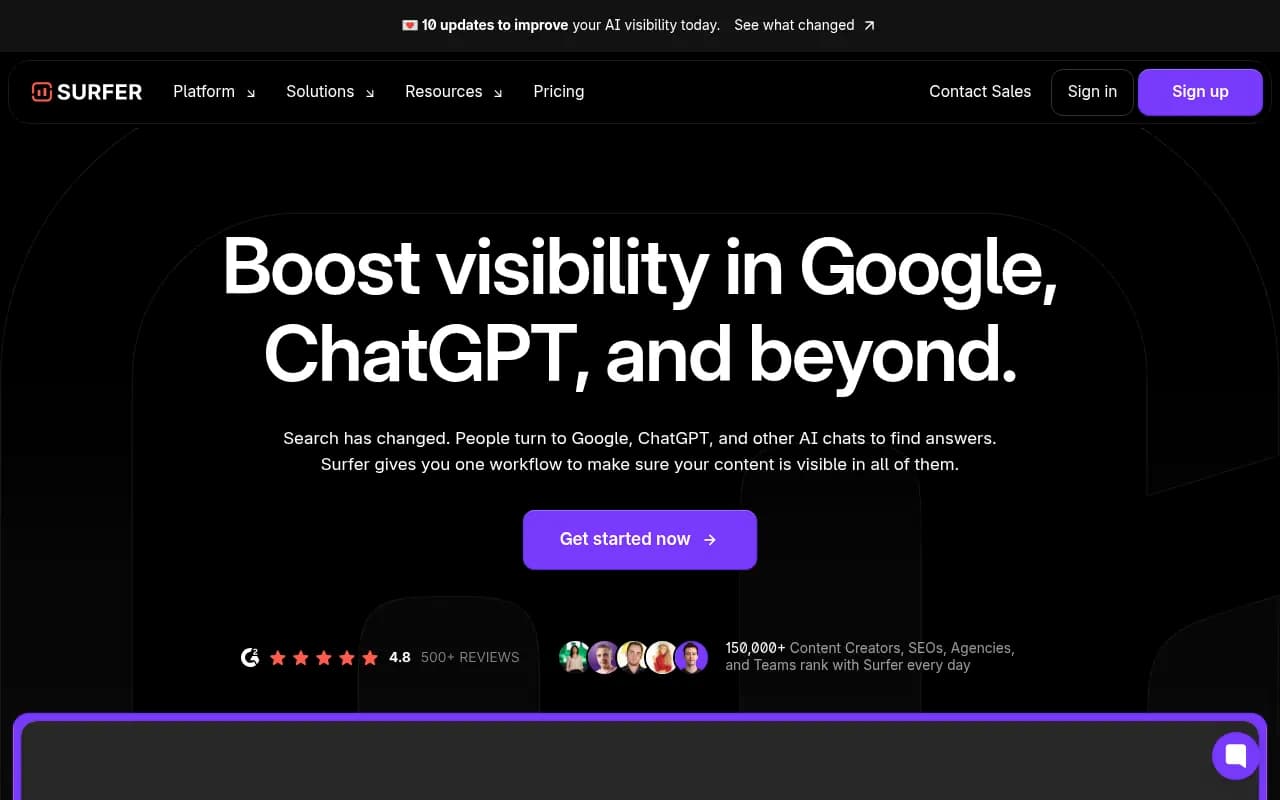
- Surfer SEO: Real-time content editor with SERP-driven scoring, keyword suggestions, and an AI writing layer (Surfer AI). Strongest for writers who want live feedback as they draft.
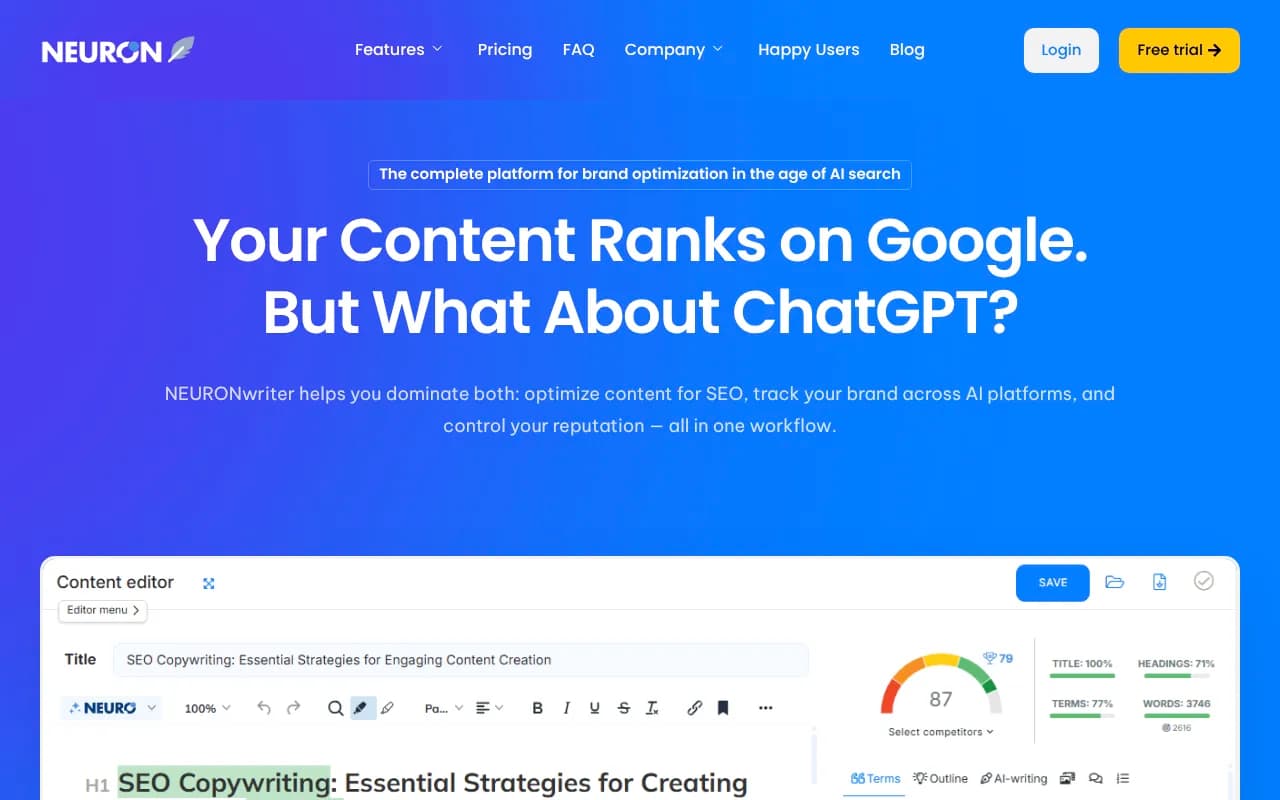
- NeuronWriter: Semantic SEO optimization with NLP term suggestions, content templates, and an AI writer. Closest to Surfer in feature set, significantly cheaper.
- Clearscope: Clean, reliable content grading focused on term coverage and readability. No AI writing. Trusted by enterprise teams for its consistency.
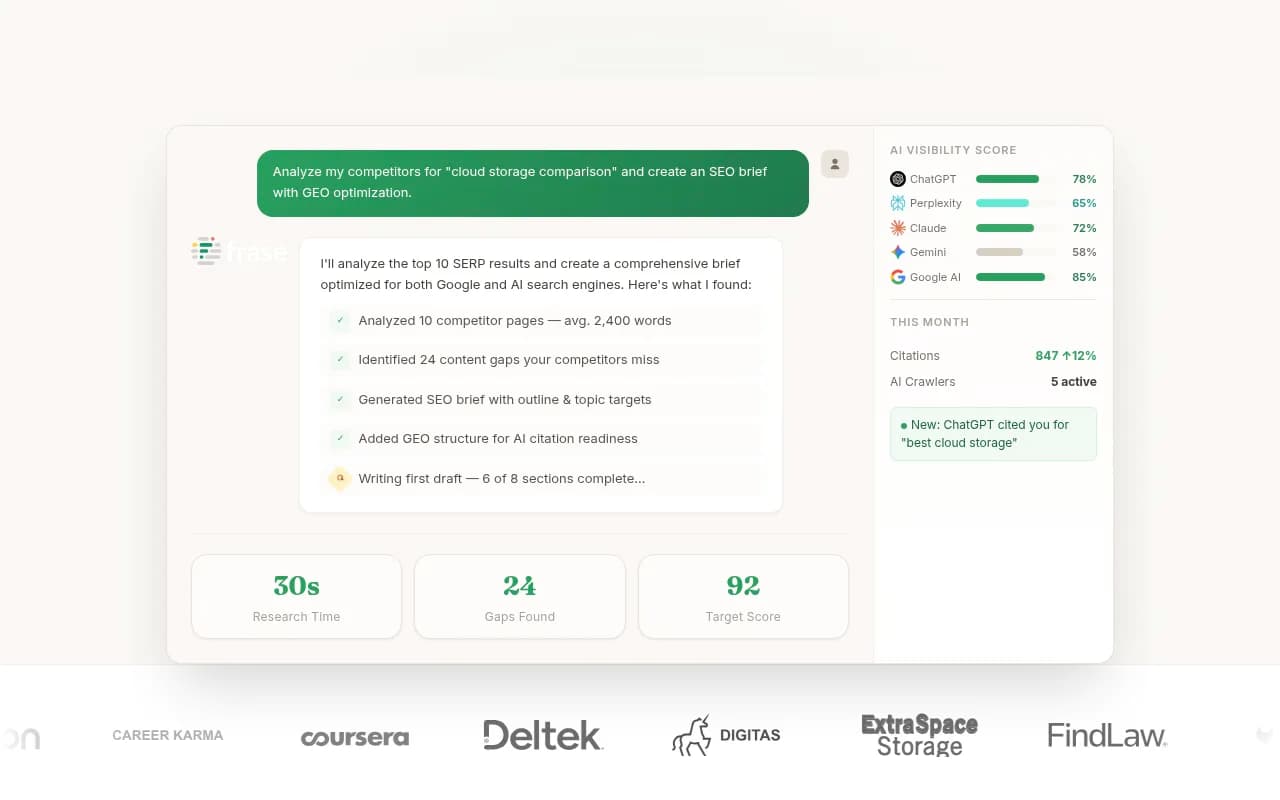
- Frase: Research and brief generation first, optimization second. Best for teams that want to go from keyword to structured brief to draft in one workflow.

Head-to-head comparison
| Surfer SEO | NeuronWriter | Clearscope | Frase | |
|---|---|---|---|---|
| Real-time content scoring | Yes | Yes | Yes | Basic |
| NLP/semantic term suggestions | Yes | Yes | Yes | Yes |
| AI content writing | Yes (Surfer AI) | Yes (flawed calibration) | No | Yes |
| Research & brief generation | Basic | Basic | No | Strong |
| SERP analysis depth | Strong | Moderate | Moderate | Strong |
| Pricing model | Credit-based | Subscription | Per-seat | Subscription |
| Starting price | ~$89/mo | ~$23/mo | ~$189/mo | ~$45/mo |
| Best for | Writers, lean SEO teams | Budget-conscious teams | Enterprise, agencies | Research-heavy workflows |
| AI search (GEO) support | No | No | No | No |
| Scoring reliability | Variable (SERP refreshes) | Moderate | High | Moderate |
Surfer SEO: still the benchmark, but with friction
Surfer built this category. Its real-time content editor, where you see your score update as you write, is still the most intuitive implementation of content optimization in any of these tools. Writers understand it immediately. The feedback loop is tight.
The problem in 2026 is operational. Surfer's credit model -- where each article analysis, audit, and brief costs a credit -- creates anxiety at scale. A team publishing 15 articles a month and refreshing 10 existing ones can burn through credits faster than expected, especially when SERP model refreshes cause scores to drop overnight on content that hasn't changed. That's not a bug exactly, but it erodes trust.
Surfer AI, the built-in writing layer, has improved but still produces content that reads like a SERP digest. It covers the topics, hits the terms, and sounds like nothing in particular. For teams with strong editors who can reshape AI output, that's fine. For teams hoping to reduce editorial time, it's not the shortcut it looks like.
Who it's for: Lean SEO teams and individual writers who want the tightest feedback loop between drafting and optimization, and who publish at a pace where credit economics don't become a constraint.
NeuronWriter: the budget alternative that mostly works
NeuronWriter is the most direct Surfer alternative in terms of feature set. You get semantic NLP analysis, a content editor with real-time scoring, content templates, and an AI writer -- all at a fraction of Surfer's price. The entry plan starts around $23/month, which makes it genuinely accessible for solo operators and small teams.
The scoring is solid. NeuronWriter pulls from Google's NLP API and its own semantic analysis to generate term recommendations, and in most cases the suggestions are reasonable and actionable. The interface is less polished than Surfer's, but it's functional.
The AI writer is the weak point. Multiple users and independent reviews have flagged calibration issues -- the AI writer doesn't always align well with the optimization recommendations, producing content that scores poorly on its own tool. That's a specific and frustrating problem if you're relying on it for first drafts.
Who it's for: Budget-conscious teams and solo SEOs who want Surfer-like functionality without Surfer's pricing. Go in knowing you'll need to treat the AI writer as a rough starting point, not a finished output.
Clearscope: the reliable choice for teams that hate surprises
Clearscope does less than the other three tools, and that's partly why enterprise teams trust it. There's no AI writer, no brief generator, no research dashboard. What Clearscope does is grade your content against top-ranking pages for a keyword, surface the terms you're missing, and give you a letter grade (A+ through F) that's consistent and doesn't randomly shift overnight.
That consistency is the product. When you're managing a team of writers across dozens of articles, you need a scoring system everyone trusts. Clearscope's grades don't fluctuate based on SERP model refreshes the way Surfer's can. Writers know what an A means, editors know what to look for, and the workflow doesn't break down.
The price reflects the positioning. Clearscope starts at $189/month, which is steep for small teams, but reasonable for agencies and enterprise marketing departments where the alternative is inconsistent quality across a large content operation.
Who it's for: Enterprise teams and agencies that prioritize consistency and reliability over feature breadth. If you have strong writers and editors who don't need AI writing assistance, Clearscope's focused approach is a genuine advantage.
Frase: the research-to-draft pipeline
Frase approaches the problem differently. Where Surfer and Clearscope are primarily optimization tools (you bring the draft, they score it), Frase starts earlier in the workflow. You enter a keyword, and Frase pulls together a SERP analysis, surfaces the questions people are asking, identifies the topics competitors cover, and helps you build a structured brief -- all before you write a word.
The optimization layer exists but is less sophisticated than Surfer's or Clearscope's. The content scoring is more basic, and the term recommendations aren't as deep. Where Frase earns its place is in the research and briefing phase, especially for teams that struggle with the "what should this article actually cover?" question.
The AI writer is more useful here than in NeuronWriter, partly because it's grounded in the SERP research Frase has already done. It's not going to produce publish-ready content, but it's a reasonable starting point for a structured draft.
Who it's for: Teams where the bottleneck is research and brief creation, not optimization scoring. If your writers spend hours figuring out what to cover before they start writing, Frase addresses that problem directly.
The question none of these tools answer
Here's what's missing from this entire category in 2026: none of these tools help you rank in AI search.
When someone asks ChatGPT "what's the best project management tool for remote teams?" or "how do I reduce churn in a SaaS product?", the answer they get is generated from sources the AI model has decided to trust. Getting cited there isn't about hitting a content score. It's about whether AI crawlers have found your content, whether it answers the specific questions AI models are processing, and whether your site has the authority signals those models weight.
Surfer, NeuronWriter, Clearscope, and Frase were all designed for Google's ranking algorithm. They analyze SERP results from Google, optimize for Google's signals, and measure success by Google rankings. That's still valuable -- Google remains the dominant search engine. But it's an incomplete picture.
If you're serious about AI search visibility, you need to understand which prompts your competitors are being cited for that you're not, which of your pages AI crawlers are actually reading, and whether your content is structured in a way that AI models can extract and cite. That's a different analytical layer entirely.
Promptwatch is built specifically for that problem -- tracking AI citations across ChatGPT, Perplexity, Google AI Overviews, Claude, and others, and helping you identify the content gaps that explain why competitors get cited and you don't.

The practical approach for most teams in 2026: use one of the four tools above for traditional content optimization, and add a dedicated AI visibility layer on top. They're solving different problems.
Which tool should you actually pick?
The honest answer depends on your specific constraint, not on which tool has the most features.
If your bottleneck is writer experience and feedback speed, Surfer SEO is still the best real-time optimization environment. The credit economics are annoying, but the product works.
If your bottleneck is budget, NeuronWriter gives you 80% of Surfer's functionality at 20% of the price. Go in with realistic expectations about the AI writer.
If your bottleneck is consistency across a large team, Clearscope's reliable grading system is worth the premium. Enterprise teams that have tried to run 10 writers through Surfer's volatile scoring often end up here.
If your bottleneck is research and brief creation, Frase solves a problem the other three don't really address. It's not the strongest optimizer, but it's the best at getting writers to the starting line faster.
One thing worth saying plainly: switching optimization tools often doesn't fix the real problem. If your content isn't ranking, it's usually because of slow publishing cadence, thin topical coverage, or weak authority signals -- not because you're using the wrong scorer. The tool you pick matters less than the system around it.
Pricing summary
| Tool | Entry price | What you get |
|---|---|---|
| Surfer SEO | ~$89/mo | 30 articles, 20 audits, Surfer AI included |
| NeuronWriter | ~$23/mo | 25 queries/month, AI writer, content templates |
| Clearscope | ~$189/mo | Unlimited users, per-report pricing above base |
| Frase | ~$45/mo | 30 documents/month, AI writer, SERP research |
Prices shift regularly, so verify on each tool's pricing page before committing. Most offer free trials or money-back guarantees.
A note on what's coming
The content optimization tool category is under pressure from two directions. Traditional SEO tools are adding AI features to stay relevant. And a new category of AI visibility platforms is emerging to address the search shift that none of these tools were built for.
For now, the four tools in this comparison remain genuinely useful for the traditional SEO workflow. But the teams that will have an advantage in 2026 and beyond are the ones treating AI search visibility as a separate discipline -- tracking which AI models cite them, understanding why, and creating content that answers the specific questions those models are processing.
That's not something a content score can tell you.