Key takeaways
- Answer gap analysis -- finding which prompts your competitors appear in but you don't -- is the most valuable feature in any GEO platform, but most tools stop at showing you the gap without helping you close it.
- AthenaHQ calls its version "AI Blindspot Detection" and it's genuinely solid, but the best features sit behind Enterprise pricing and there's no free trial at $295/month.
- Searchable offers monitoring and some gap analysis, but it's a thinner feature set compared to the other two, with limited content generation to act on what you find.
- Promptwatch's Answer Gap Analysis is the most actionable of the three: it shows you exactly which prompts competitors rank for, then lets you generate content designed to close those gaps -- all in the same platform.
- If your goal is to actually improve AI visibility (not just measure it), the platform that connects gap discovery to content creation wins.
What "answer gap analysis" actually means
Before comparing tools, it's worth being precise about what we're evaluating. Answer gap analysis in the context of AI search means: identifying the specific prompts or questions where your competitors appear in ChatGPT, Perplexity, Claude, or other AI models -- but you don't.
This is different from a traditional keyword gap. In classic SEO, a gap means a keyword your competitor ranks for on Google that you don't. In AI search, the gap is more nuanced. AI models don't rank pages -- they cite sources in conversational responses. So a "gap" means: when someone asks an AI "what's the best project management tool for remote teams?", your competitor gets mentioned and you don't. The question is why, and what you can do about it.
That's the hard part. Most platforms can show you the gap. Far fewer can tell you what content you're missing that would close it, and fewer still can actually help you create that content.
That's the lens for this comparison.
The three platforms at a glance


Here's a quick overview before we go deeper:
| Feature | Searchable | AthenaHQ | Promptwatch |
|---|---|---|---|
| Answer gap analysis | Basic | Strong (AI Blindspot Detection) | Strong (Answer Gap Analysis) |
| Content generation to close gaps | Limited | No | Yes (built-in AI writing agent) |
| AI models tracked | Multiple | 8+ | 10 |
| Crawler logs | No | No | Yes (Professional+) |
| Prompt volume & difficulty scoring | No | No | Yes |
| Reddit & YouTube tracking | No | No | Yes |
| ChatGPT Shopping tracking | No | No | Yes |
| Free trial | Yes | No | Yes |
| Starting price | ~$49/mo | $295/mo | $99/mo |
| Traffic attribution | No | Yes (GA4, Shopify) | Yes (GSC, code snippet, server logs) |
| Multi-region / multi-language | Limited | Enterprise only | Yes |
| Persona targeting | No | Enterprise only | Yes |
The table tells part of the story. But the more interesting question is how each platform's gap analysis actually works in practice.
AthenaHQ: solid detection, limited action
AthenaHQ has been one of the more talked-about platforms in the GEO space, and for good reason. Its "AI Blindspot Detection" is a real feature -- it surfaces prompts where your brand is invisible while competitors are visible, across 8+ LLMs.
The data quality is decent. You can see which AI engines are ignoring you, which competitors are getting cited, and roughly what topic clusters you're missing. For a monitoring use case, it works.
The problems show up when you try to do something with what you've found.
AthenaHQ doesn't have a content generation layer. You see the gap, you note it down, and then you leave the platform to go figure out what to write. That's a real friction point, especially for marketing teams who want a tighter workflow.
The other issue is pricing and access. At $295/month with no free trial, you're committing significant budget before you've validated whether the data is useful for your specific situation. And the features that make the platform genuinely powerful -- persona targeting, multi-region tracking, the Citation Engine, BI tool support -- are all behind Enterprise pricing, which means a custom conversation before you can access them.
One thing worth noting from the research: AthenaHQ's credit system can burn faster than expected. Running 50 prompts across 5 engines daily consumes roughly 250 credits per day, which exhausts the monthly allocation in about 14 days. That's a real operational constraint for teams running serious monitoring programs.
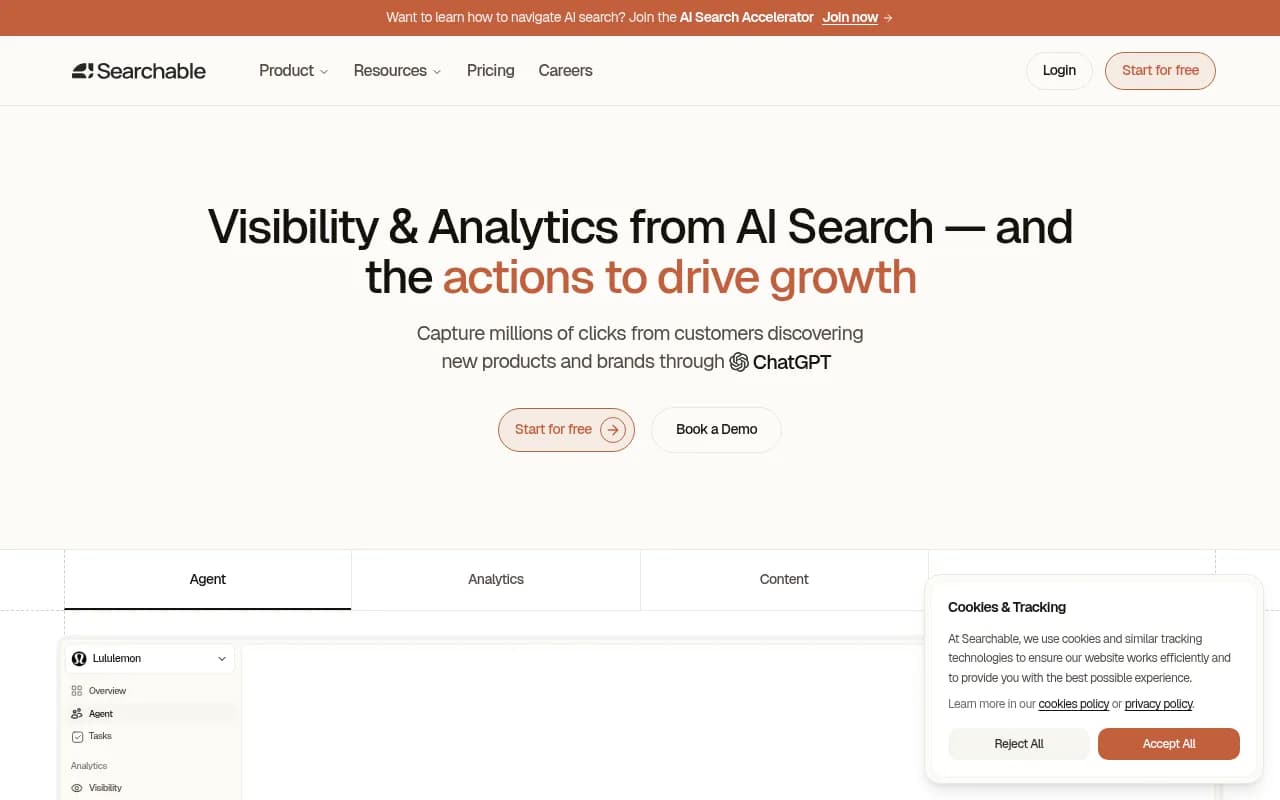
Searchable: lighter footprint, narrower gap analysis
Searchable is a more recent entrant and positions itself as an AI search visibility platform with both monitoring and content tools. The interface is clean and the onboarding is relatively fast.
But when you get into the gap analysis specifically, it's thinner than AthenaHQ or Promptwatch. The platform can show you where you're missing from AI responses, but the depth of competitor analysis -- how many prompts, how granular the topic breakdowns, how clearly it surfaces what content is missing -- doesn't match the other two.
The content tools exist but feel more like a bolt-on than an integrated workflow. You're not getting content that's grounded in citation data or prompt volume estimates. It's more "here's a gap, here's a generic content suggestion."
For smaller teams or early-stage brands just getting started with AI visibility, Searchable is a reasonable entry point. But if you're running a serious GEO program and want gap analysis that actually drives content decisions, you'll hit its limits quickly.
Promptwatch: gap analysis that connects to action
Promptwatch takes a different approach to the whole problem. The gap analysis isn't just a report -- it's the first step in a loop.
Here's how it works in practice. The Answer Gap Analysis shows you exactly which prompts competitors are visible for that you're not. Not just topic clusters, but specific questions and prompts, with volume estimates and difficulty scores so you can prioritize. You can see which competitor pages are getting cited, what those pages cover, and what your site is missing.
Then -- and this is the part that separates it -- you can hand that gap directly to the built-in AI writing agent. It generates articles, listicles, or comparison pieces grounded in real citation data from over 880 million citations analyzed. The output isn't generic SEO filler. It's content built around the specific prompts you're trying to win, the personas you're targeting, and the competitor angles you need to address.
After publishing, you track whether the new content starts getting cited. Page-level tracking shows which pages are being cited, how often, and by which AI models. Traffic attribution closes the loop -- you can connect AI visibility to actual visits and revenue through a code snippet, Google Search Console integration, or server log analysis.
That cycle -- find gaps, generate content, track results -- is what makes this a fundamentally different category of tool compared to monitoring-only platforms.
A few other capabilities worth mentioning in the context of gap analysis:
- Query fan-outs show how a single prompt branches into sub-queries, which helps you understand the full content surface area you need to cover, not just the top-level question.
- AI Crawler Logs (on Professional and above) show which pages AI crawlers are actually reading on your site, which helps you understand why certain pages are or aren't getting cited.
- Reddit and YouTube tracking surfaces discussions that influence AI recommendations -- a signal most platforms ignore entirely, but one that matters a lot for understanding why competitors are getting cited.
Pricing starts at $99/month for the Essential plan (1 site, 50 prompts, 5 articles). The Professional plan at $249/month adds crawler logs, more prompts, and state/city tracking. There's a free trial, so you can validate the data before committing.
How the gap analysis actually compares
Let's get specific about the dimensions that matter most when evaluating answer gap analysis.
Prompt specificity
AthenaHQ and Promptwatch both surface specific prompts, not just topic clusters. Searchable tends to work at a higher level of abstraction, which makes it harder to know exactly what content to create.
Promptwatch adds prompt volume estimates and difficulty scores, which means you can prioritize. "This prompt gets high volume and I have a realistic chance of winning it" is a much more actionable signal than "you're missing from this topic area."
Competitor depth
All three platforms show you competitor visibility in some form. AthenaHQ's Blindspot Detection is solid here. Promptwatch's competitor heatmaps go further -- you can compare your AI visibility vs competitors across individual LLMs and see which specific pages are getting cited and why.
What you do with the gap
This is where the comparison gets stark. AthenaHQ and Searchable both stop at showing you the gap. Promptwatch connects the gap to content creation. That's not a minor difference -- it's the difference between a monitoring dashboard and an optimization platform.
If you have a strong content team that can take a gap report and run with it independently, AthenaHQ's detection quality is good enough. But if you want a tighter workflow where gap analysis directly feeds content production, Promptwatch is the only one of the three that supports that.
Coverage and reliability
Promptwatch monitors 10 AI models: ChatGPT, Perplexity, Google AI Overviews, Google AI Mode, Claude, Gemini, Meta/Llama, DeepSeek, Grok, and Mistral. AthenaHQ covers 8+. Searchable covers multiple but the exact list is less transparent.
The data behind Promptwatch -- 1.1 billion citations, clicks, and prompts processed -- gives the gap analysis a more reliable empirical foundation than platforms working from smaller datasets.
Who should use which platform
There's no single right answer here. It depends on what you actually need.
If you're a large enterprise with a dedicated content team, a custom budget, and you primarily need monitoring and detection (and you're okay with no free trial), AthenaHQ is a capable choice. The Blindspot Detection is real and the attribution integrations with GA4 and Shopify are useful.
If you're a smaller team or agency just starting to track AI visibility and want something lightweight to get oriented, Searchable is a reasonable starting point -- just know you'll likely outgrow the gap analysis depth.
If you want to actually move the needle on AI visibility -- not just measure it -- Promptwatch is the most complete option. The gap analysis is strong, the content generation is built in, the crawler logs give you a layer of insight most platforms don't have, and the pricing is more accessible than AthenaHQ. The fact that 6,700+ brands including Booking.com use it suggests the data holds up at scale.
The bigger picture
The GEO platform market in 2025 split into two camps: tools that monitor and tools that optimize. Most platforms built good monitoring. Very few built the optimization layer.
Answer gap analysis is only valuable if it leads to action. A gap report that sits in a dashboard doesn't improve your AI visibility. Content that closes the gap does.
That's the real test for any of these platforms: not how well it shows you where you're invisible, but how well it helps you become visible. On that measure, the gap between Promptwatch and the other two is significant.
The market has moved fast. Platforms that were "good enough" in early 2025 are already being outpaced by tools that close the loop between data and content. If you're evaluating these three platforms now, that's the question to ask each vendor: what happens after I find the gap?