Key takeaways
- Otterly.AI is the cheapest entry point at $29/month, but it's monitoring-only -- you see data, then you're on your own
- Peec.ai has the best multi-language support and polished reporting, making it a strong pick for agencies with international clients
- Searchable sits in the middle at $50/month and adds basic content creation tools, making it the most "complete" of the three
- None of these tools close the full loop from gap identification to content creation to traffic attribution -- for that you need a more capable platform
- All three are worth considering if you're just starting out and want to understand AI visibility before committing to a bigger budget
The AI visibility tool market has exploded. There are now dozens of platforms claiming to help you "rank in ChatGPT" or "dominate AI search" -- and the pricing ranges from $29/month to well into the thousands. For most small marketing teams, the question isn't which enterprise platform to buy. It's whether the budget options are actually worth it.
Searchable, Otterly.AI, and Peec.ai are three of the most frequently compared tools in this price range. They all track how your brand appears in AI-generated answers. They're all reasonably accessible. And they all have real limitations that matter depending on what you're trying to do.
This guide breaks down exactly what each tool does, where each one falls short, and which one makes sense for your situation.
What these tools actually do
Before comparing them, it's worth being clear about what "AI visibility monitoring" means at this price point.
All three tools work roughly the same way: you define a set of prompts (questions your customers might ask an AI), the tool runs those prompts against AI models like ChatGPT, Perplexity, or Gemini, and it reports back on whether your brand appeared, how often, and sometimes what was said. You get share-of-voice metrics, competitor comparisons, and citation data.
That's genuinely useful. Knowing that your competitor appears in 40% of relevant ChatGPT responses while you appear in 8% is a real signal. The question is what you do with it.
Otterly.AI

Otterly.AI is the most affordable option in this comparison. The Lite plan starts at $29/month, which makes it the lowest entry point in the entire AI visibility category.
For that price, you get brand mention tracking across four AI models (ChatGPT, Perplexity, Gemini, and Claude on the base tier), share-of-voice reporting, and basic competitor comparisons. The interface is clean and simple -- you can be up and running in under an hour.
What it does well
The simplicity is genuinely a feature, not just a limitation. If you're a solo marketer or a small business owner who just wants to know "is my brand showing up in AI answers?", Otterly gets you there without a steep learning curve. The pricing is honest too -- there's no bait-and-switch where the useful features are locked behind a 3x more expensive tier.
The reporting is readable. You get trend lines, competitor share-of-voice charts, and prompt-level breakdowns. For a first pass at understanding your AI visibility, it works.
Where it falls short
Otterly is a monitoring tool. It shows you the problem but doesn't help you fix it. There's no content gap analysis, no AI writing tools, no crawler logs, no Reddit or YouTube tracking. If you find out you're invisible for 80% of your target prompts, Otterly's job is done -- figuring out why and what to do about it is entirely on you.
The four-model coverage on the base plan is also a real limitation. If you care about Google AI Overviews specifically (and most brands should), you'll need to check whether that's included in your tier.
Best for
Teams that want a low-cost way to check in on AI visibility without committing to a full platform. Good for initial benchmarking, client reporting snapshots, or just getting a feel for the category before spending more.
Peec.ai

Peec.ai starts at €85/month and covers up to 10 AI models depending on your plan. It's positioned as a more structured, agency-friendly tool -- and that positioning is accurate.
What it does well
The multi-language support is the standout feature. If you're running campaigns in multiple markets or managing clients across different countries, Peec handles this better than almost anything else in the budget tier. The reporting is polished and structured in a way that makes it easy to share with clients or stakeholders who don't live in the tool.
Onboarding is fast -- reportedly around 30 minutes -- and the interface is intuitive. The model coverage is broad, which matters if your audience uses a mix of AI tools rather than just ChatGPT.
Where it falls short
Like Otterly, Peec is fundamentally a monitoring platform. You get good data about where you stand, but the tool doesn't help you act on it. There's no built-in content creation, no crawler log analysis, no traffic attribution. The gap between "here's your visibility score" and "here's what to do about it" is left entirely to you.
The pricing also steps up meaningfully as you add models and prompts, so the €85 entry price can grow faster than expected for teams with broader monitoring needs.
Best for
Agencies managing multi-language or multi-region clients who need clean, shareable reports. Also a good fit for teams that already have content production workflows and just need the monitoring data to feed into them.
Searchable
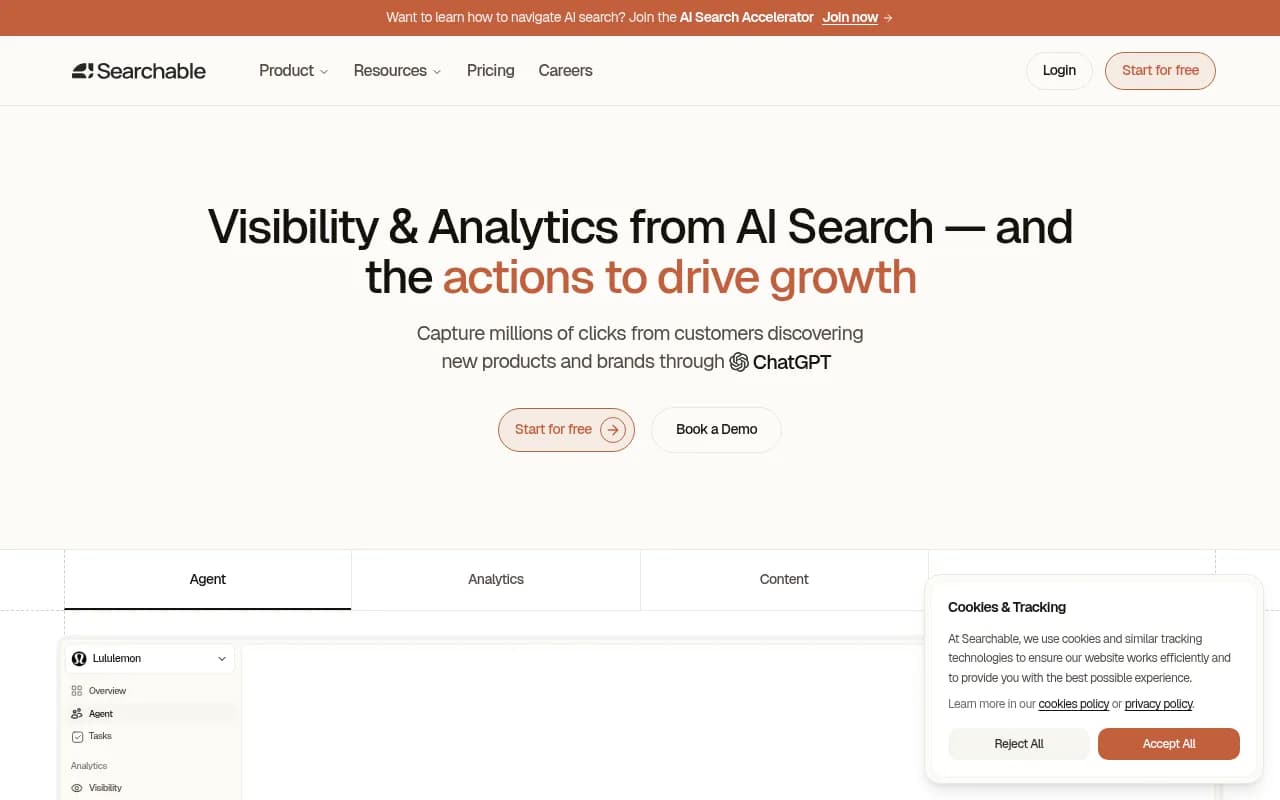
Searchable sits at $50/month and is the most ambitious of the three in terms of scope. It tracks up to 7 AI models and includes basic content creation tools alongside monitoring -- making it the closest thing to an end-to-end solution in this price range.
What it does well
The content tools are the differentiator. Where Otterly and Peec stop at showing you the data, Searchable takes a step toward helping you act on it. You can generate content directly within the platform, which at least closes part of the gap between "I know I'm invisible" and "I've done something about it."
The model coverage is solid for the price -- 7 models is competitive with tools that cost significantly more. And at $50/month, the value proposition is reasonable if you're actively using the content features.
Where it falls short
The content creation tools are basic compared to what you'd get from a more capable platform. The writing output isn't grounded in deep citation data or prompt volume analysis, so there's a real question about whether the content it generates will actually move the needle in AI search results.
There's also limited information available about Searchable's traffic attribution capabilities, crawler log access, and prompt intelligence depth. For a tool positioning itself as "monitor + create + optimize," the optimization layer appears thin.
Best for
Small teams that want monitoring and content creation in one tool without managing multiple subscriptions. A reasonable starting point if you're new to GEO and want to experiment with content before investing in a more capable platform.
Head-to-head comparison
| Feature | Otterly.AI | Peec.ai | Searchable |
|---|---|---|---|
| Starting price | $29/mo | €85/mo | $50/mo |
| AI models tracked | 4 (base) | Up to 10 | Up to 7 |
| Multi-language support | Limited | Best-in-class | Basic |
| Content creation tools | No | No | Basic |
| Crawler log access | No | No | No |
| Traffic attribution | No | No | No |
| Reddit/YouTube tracking | No | No | No |
| Prompt volume/difficulty | No | No | No |
| Best for | Simplest entry point | Agencies, multi-region | Monitor + basic content |
| Free trial | Yes | Yes | Yes |
The gap all three share
Here's the honest assessment: all three tools are monitoring dashboards. They tell you where you stand. They don't tell you why you're invisible for specific prompts, which content gaps are causing it, or how to fix it efficiently.
That's not a knock on any of them specifically -- it's just the nature of the budget tier. Building a full action loop (find gaps, generate optimized content, track results) requires more infrastructure than these tools have built.
If you run Otterly, Peec, or Searchable for a few months and find that you're consistently invisible for important prompts, you'll eventually hit a ceiling. You'll have data showing the problem, but no systematic way to solve it.
For teams that reach that point, a platform like Promptwatch is worth looking at -- it's built around the full cycle of finding content gaps, generating AI-optimized content, and tracking whether that content actually improves your visibility scores.

Which one should you pick?
It depends on what you actually need right now.
If you want the cheapest possible way to start tracking AI visibility and you're comfortable doing your own analysis and content work, Otterly.AI at $29/month is the obvious choice. The simplicity is a genuine advantage when you're just getting started.
If you're an agency managing clients across multiple languages or regions, Peec.ai's reporting and language support justify the higher price. The structured output makes client communication easier, and the broad model coverage means you're not missing visibility in less-monitored AI platforms.
If you want monitoring and basic content creation in one place and you're on a tight budget, Searchable is the most complete option of the three -- just go in with realistic expectations about how much the content tools will move the needle on their own.
And if you've already tried one of these tools and found yourself staring at a dashboard full of bad news with no clear path forward, that's probably the signal to look at something with more depth.
A note on the broader market
The AI visibility tool category is still young and moving fast. Organic click-through rates have dropped significantly on queries where AI Overviews appear (Seer Interactive analyzed 25.1 million impressions and found a 61% drop), and zero-click searches in Google's AI Mode are estimated at around 93%. The stakes for getting this right are real.
The tools in this comparison are good starting points. But the teams that will win in AI search over the next few years are the ones that treat visibility as something to actively optimize, not just passively monitor. That means understanding which prompts matter, why competitors are getting cited and you're not, and having a systematic way to create content that AI models actually want to reference.
Budget tools can get you the first part of that picture. The rest requires more.