Key takeaways
- Searchable offered a clean, accessible entry point into AI visibility monitoring in 2025, with solid brand mention tracking across major LLMs
- Its core weakness: it stayed a monitoring dashboard. No content generation, no crawler logs, no answer gap analysis, no traffic attribution
- Teams that outgrew it typically moved to platforms that could help them act on the data, not just observe it
- The GEO category matured fast in 2025 -- tools that launched as "trackers" faced pressure to become full optimization platforms
- For teams serious about improving AI visibility (not just measuring it), the gap between Searchable and action-oriented platforms became a real problem
How Searchable positioned itself in 2025
When Searchable launched its AI visibility product, the pitch was simple: know when and how AI engines mention your brand. That was a genuinely useful thing to offer. In early 2025, most marketing teams had no idea whether ChatGPT, Perplexity, or Claude were recommending them at all. Just having a dashboard that answered "are we showing up?" felt like progress.
And for a while, it was.
Searchable built a clean interface, covered the major LLMs, and made it easy to set up brand monitoring without a steep learning curve. For teams just waking up to the concept of Generative Engine Optimization (GEO), it was a reasonable first tool.
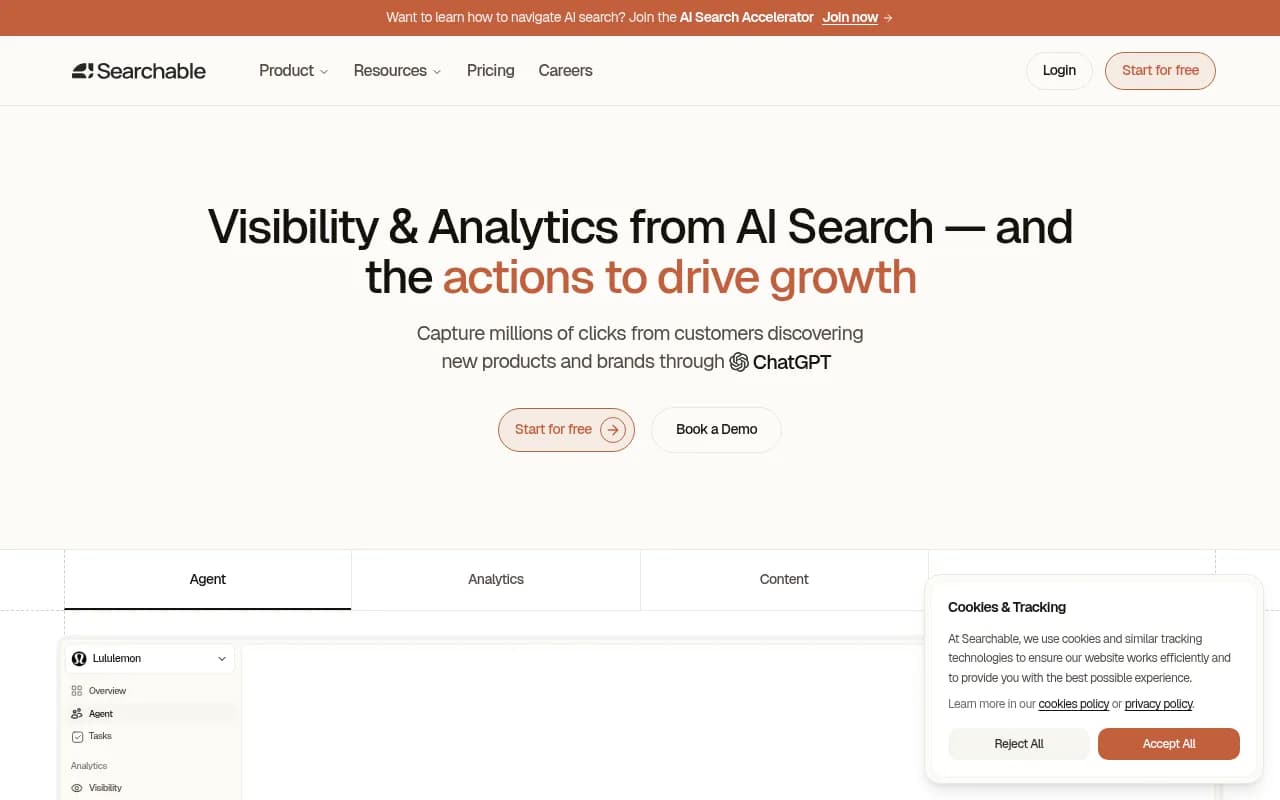
But 2025 turned out to be a year where the category moved fast. What started as "AI brand monitoring" quickly evolved into a much harder question: not just "are we showing up?" but "why aren't we showing up more, and what do we do about it?" That's where Searchable's story gets complicated.
What Searchable got right
Clean onboarding and low friction
One thing Searchable genuinely nailed was accessibility. You didn't need an SEO background or a technical team to get started. Set up a brand, add some prompts, and you'd have data within hours. For marketing managers who needed to show something to leadership quickly, that mattered.
Multi-LLM coverage
Searchable tracked mentions across the main AI engines -- ChatGPT, Perplexity, Gemini, and a few others. Coverage wasn't as wide as some enterprise platforms, but it was enough for most mid-market teams to get a baseline picture of their AI presence.
Sentiment and mention context
Beyond just counting citations, Searchable showed some context around how brands were mentioned -- whether the AI was recommending you, comparing you, or describing you neutrally. That's a useful layer that some cheaper tools skip entirely.
Competitive benchmarking
You could see how your brand stacked up against competitors in AI responses. Not deeply, but enough to answer "are our competitors showing up more than us?" -- which is often the question that gets budget approved.
What Searchable missed
This is the harder part of the story, and honestly the more important one.
No answer gap analysis
The most valuable thing you can do with AI visibility data is figure out which prompts your competitors are winning that you're not -- and why. Searchable didn't offer this. You could see where you appeared, but not where you were invisible and what content was missing. That's a significant blind spot.
No content generation or optimization tools
Knowing you're not being cited is one thing. Knowing what to write to fix it is another. Searchable had no built-in content tools. Teams were left to take their monitoring data and figure out the content strategy on their own, using separate tools, separate workflows, and a lot of guesswork.
No AI crawler logs
This one surprised a lot of teams when they realized it was missing. AI crawler logs show you which pages on your site are actually being read by ChatGPT's crawler, Perplexity's bot, Claude's indexer, and so on. They reveal crawl errors, frequency, and which content AI engines are actually consuming. Searchable had no visibility into this layer at all.
No traffic attribution
You could see your brand mentioned in AI responses, but you couldn't connect those mentions to actual website visits or revenue. There was no code snippet, no Google Search Console integration, no server log analysis. The loop between "AI visibility" and "business outcome" stayed open.
Limited prompt intelligence
Searchable let you track prompts, but didn't give you volume estimates, difficulty scores, or query fan-outs (the sub-queries that branch from a single prompt). Without that, prioritization was basically guesswork. Which prompts are worth winning? Which are too competitive? Searchable couldn't tell you.
No Reddit or YouTube tracking
A growing body of evidence in 2025 showed that AI models heavily cite Reddit threads, YouTube videos, and forum discussions when forming recommendations. Searchable didn't surface any of this. Teams optimizing for AI citations needed to know where to publish beyond their own website -- and that channel was invisible.
The core problem: monitoring without action
The pattern that kept coming up in user feedback was some version of: "The data is interesting, but I don't know what to do with it."
That's not a UI problem. It's a product philosophy problem. Searchable was built as a tracker. It showed you the score but didn't help you play the game differently.
The GEO category in 2025 split into two types of tools: dashboards that show you data, and platforms that help you act on it. Searchable sat firmly in the first camp. For teams that just needed to report on AI visibility to stakeholders, that was fine. For teams that needed to actually improve their AI visibility, it wasn't enough.
Why teams switched (and where they went)
The teams that moved away from Searchable generally fell into a few categories.
Teams that needed content gap analysis
These teams wanted to know specifically which prompts competitors were winning and what content they needed to create to compete. They needed something closer to an "answer gap" workflow -- find the missing topics, generate content to fill them, track the results.
Promptwatch was a common destination here. Its Answer Gap Analysis shows exactly which prompts competitors appear for that you don't, and the built-in AI writing agent generates content grounded in real citation data. The full loop -- find gaps, create content, track results -- is what separated it from monitoring-only tools.

Teams that needed deeper competitive intelligence
Some teams wanted more than a mention count. They wanted to understand the mechanics of why certain brands dominate AI responses -- which pages, which sources, which signals. Tools like Profound and AthenaHQ attracted teams in this camp.


Teams that needed enterprise-grade features
Larger organizations needed multi-region support, custom personas, API access, and integrations with existing reporting stacks. Searchable's feature set wasn't built for that scale.
Agencies that needed client reporting
Agencies managing multiple brands needed white-label reporting, multi-site dashboards, and the ability to show clients a clear story about AI visibility over time. Searchable's reporting wasn't built with agency workflows in mind.
How Searchable compares to the alternatives
Here's a straightforward look at how Searchable stacks up against the tools teams commonly evaluated alongside it:
| Feature | Searchable | Promptwatch | Profound | AthenaHQ | Otterly.AI |
|---|---|---|---|---|---|
| LLM brand monitoring | Yes | Yes | Yes | Yes | Yes |
| Answer gap analysis | No | Yes | Partial | No | No |
| AI content generation | No | Yes | No | No | No |
| AI crawler logs | No | Yes | No | No | No |
| Traffic attribution | No | Yes | No | No | No |
| Prompt volume/difficulty | No | Yes | Partial | No | No |
| Reddit/YouTube tracking | No | Yes | No | No | No |
| ChatGPT Shopping tracking | No | Yes | No | No | No |
| Multi-language/region | Limited | Yes | Yes | Yes | Limited |
| Agency/white-label | Limited | Yes | Yes | No | No |
The pattern is pretty clear. Searchable holds its own on the basics -- brand monitoring, multi-LLM coverage, competitive benchmarking. But almost every feature that turns monitoring into optimization is missing.
Who Searchable still works for
It's worth being honest here: Searchable isn't a bad tool. It's a limited one.
If you're a small team that just needs a simple way to check whether your brand appears in AI responses, and you're not yet ready to invest in a full GEO platform, Searchable can do that job. The setup is fast, the interface is clean, and the price point is accessible.
The problem is that most teams outgrow that use case quickly. Once you've confirmed you have an AI visibility problem, the next question is always "what do we do about it?" -- and that's where Searchable leaves you on your own.
What the 2025 GEO category taught us
The broader lesson from watching this category evolve in 2025 is that monitoring data without action capability has a short shelf life. Teams don't just want to know they're invisible in AI search -- they want to fix it.
The tools that gained the most traction were the ones that closed the loop: show you where you're missing, help you create content that fills the gap, and then track whether it worked. That cycle -- find gaps, generate content, measure results -- is what separates a GEO platform from a GEO dashboard.
Searchable built a good dashboard. The teams that switched were looking for a platform.
For anyone currently evaluating options, the question to ask any vendor is simple: "After you show me where I'm invisible, what do you help me do about it?" The answer will tell you everything about whether you're looking at a tracker or a tool.