Key takeaways
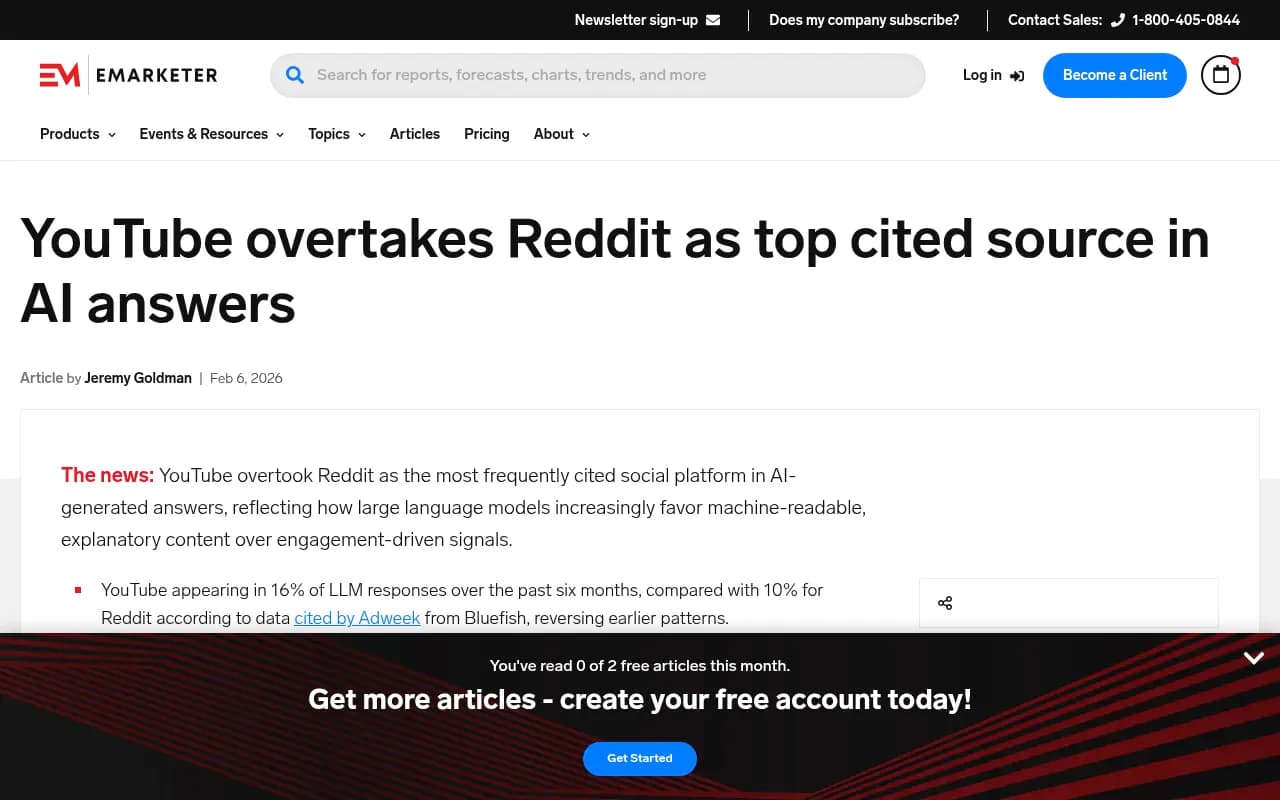
- YouTube has overtaken Reddit as the most-cited social platform in AI-generated answers, appearing in roughly 16% of LLM responses vs Reddit's 10%.
- Your own website is likely being ignored -- 62% of brands are completely absent from AI-generated answers.
- AI models favor sources with structured, explanatory content: transcripts, metadata, and clear formatting beat raw engagement signals.
- A multi-channel strategy (website + YouTube + Reddit) beats betting on any single source.
- Tracking which sources AI actually cites for your category is now a core part of any content strategy.
Here's something that should bother you: you've spent years building your website, publishing blog posts, optimizing for Google -- and AI models are largely ignoring it. Instead, they're pulling answers from YouTube videos and Reddit threads you didn't create, don't control, and probably aren't even monitoring.
That's not a hypothetical. According to data from Bluefish, YouTube appeared as a cited source in 16% of LLM answers over a recent six-month period. Reddit came in at 10%. Your brand's own website? For 62% of brands, the answer is zero.
So what's actually going on? Why do AI models trust a YouTube comment section or a Reddit thread over your carefully crafted product page? And what can you do about it?
Let's get into it.
How AI models decide what to cite
Before comparing sources, it helps to understand what AI models are actually optimizing for when they generate a response. They're not ranking pages the way Google does. They're not counting backlinks or measuring domain authority. They're trying to produce a useful, credible, specific answer -- and they pull from sources that help them do that.
A few things matter a lot:
- Specificity and depth. Vague content gets skipped. If a Reddit thread has someone explaining exactly how they solved a problem with step-by-step details, that's more useful to an AI than a landing page that says "our solution helps businesses grow."
- Format and structure. AI models process text. YouTube transcripts, Reddit posts with clear question-and-answer structure, and well-organized articles all parse cleanly. Marketing copy with lots of buzzwords and no concrete claims does not.
- Trust signals at the domain level. YouTube and Reddit are massive, high-traffic domains with enormous amounts of human-generated content. AI training data is full of them. Your company blog, unless it's genuinely authoritative, starts at a disadvantage.
- Conversational relevance. People ask AI models questions the way they'd ask a person. Reddit and YouTube are full of exactly that kind of natural language. Corporate websites are full of the opposite.
None of this means your website is useless. But it does mean the content you publish there needs to work much harder than it used to.
YouTube: why it's winning
YouTube's rise to the top of AI citations isn't random. A few structural advantages explain it.
Transcripts are machine-readable gold
Every YouTube video with captions generates a transcript. That transcript is text -- indexable, parseable, and full of natural language explanations. When someone makes a 12-minute tutorial video explaining how to configure a firewall or compare two software tools, the transcript of that video is essentially a long-form article. AI models can read it, extract the key claims, and cite it.
This is a big deal. A lot of brands have been sleeping on video content because it felt like a "top of funnel" play. In 2026, a well-made YouTube video with a solid transcript is a direct citation opportunity.
Explanatory format matches AI query patterns
YouTube's dominant content format -- "here's how to do X" or "I tested Y and here's what happened" -- maps almost perfectly to how people prompt AI models. When someone asks ChatGPT "what's the best way to do X," the model is looking for exactly the kind of content YouTube creators produce: opinionated, specific, experience-based.
Metadata and engagement signals
YouTube videos come with titles, descriptions, tags, view counts, and comment sections. This gives AI models multiple signals about what a video is actually about and whether it's considered useful. A video with 200,000 views on "best CRM for small business" is a strong signal that the content is relevant and trusted by real people.
Reddit: still punching above its weight
Reddit's 10% citation rate might sound like it's losing to YouTube, but that number is still remarkable for a platform that's essentially just people talking to each other.
Why Reddit gets cited
Reddit threads are full of first-person experience. "I tried X and it broke after two weeks" or "I switched from A to B and here's what changed" -- these are exactly the kinds of claims AI models use to give nuanced, balanced answers. Corporate content almost never says anything negative about its own product. Reddit does.
AI models have learned that Reddit is a reliable source of unfiltered human opinion. That's valuable when someone asks "is [product] actually worth it?" or "what are the downsides of [approach]?"
Reddit also has a massive archive. Threads from 2019 about a software tool might still be getting cited in 2026 because the underlying question hasn't changed.
The shift away from Reddit
That said, the trend is moving against Reddit. The platform's API restrictions in 2023 and subsequent content changes have made some communities less active. YouTube's transcript advantage is hard to compete with. And Reddit's signal-to-noise ratio in some subreddits has gotten worse as the platform has grown.
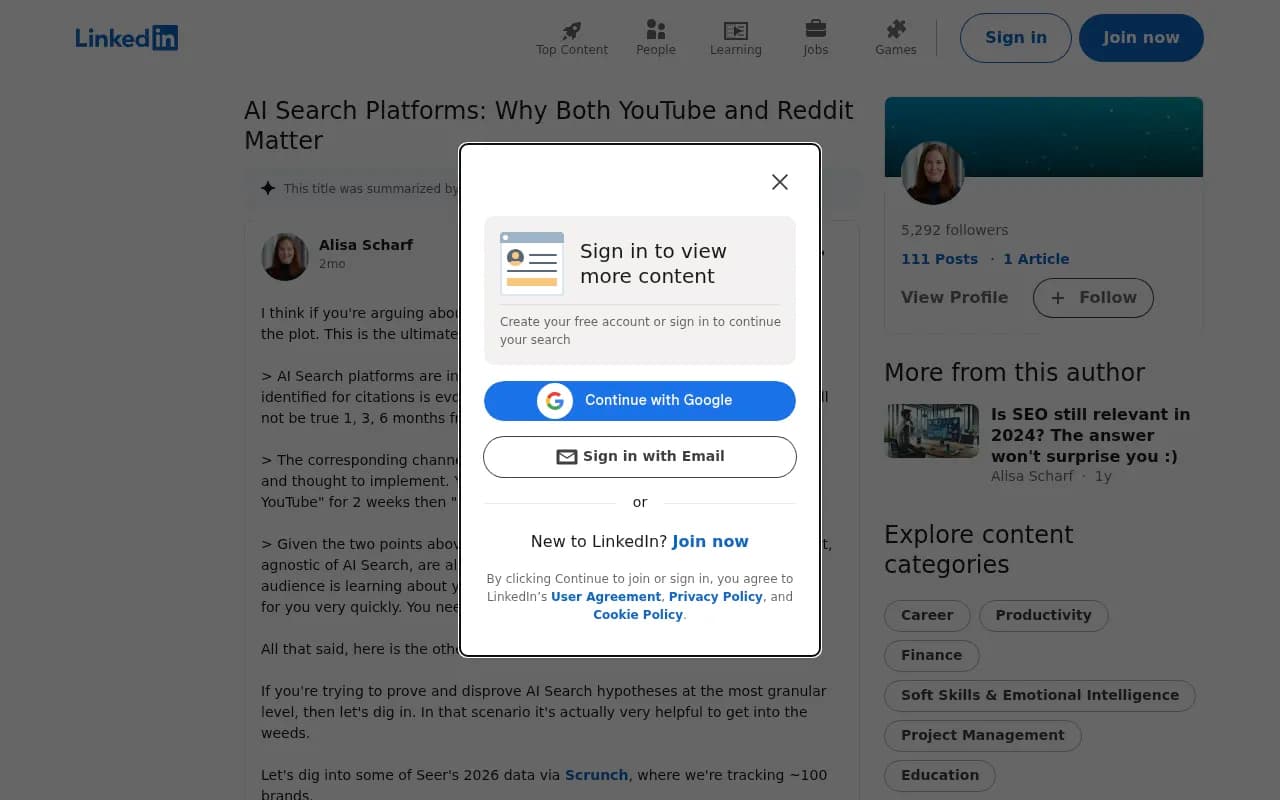
The LinkedIn post from digital marketer Alisa Scharf captured this tension well: the debate isn't really "Reddit vs YouTube" -- it's about understanding that AI models are pulling from wherever they find the most useful, specific, human-generated content.
Your website: the underdog that can win
Here's the honest truth: most brand websites are terrible sources for AI models. They're full of vague claims, product-speak, and content written to rank for keywords rather than actually answer questions.
But that's fixable.
What makes a website page citable by AI
The pages that actually get cited by AI models tend to share a few characteristics:
- They answer a specific question directly, usually in the first paragraph
- They include concrete data, examples, or comparisons
- They're structured with clear headings that match how people phrase questions
- They go deep on a topic rather than covering ten things shallowly
- They include original insights -- something you can't find anywhere else
A 3,000-word comparison of two competing approaches, written by someone with real experience, will outperform a 500-word "overview" page every time. A page that says "our tool reduces churn by 23% for SaaS companies with 50-200 employees" will get cited. A page that says "our powerful platform helps businesses succeed" will not.
The content gap problem
The bigger issue for most brands isn't that their existing content is bad -- it's that they're missing entire categories of content that AI models are actively looking for.
If someone asks ChatGPT "what's the best [category] tool for [specific use case]" and you don't have a page that addresses that specific question, you won't appear. It doesn't matter how good your homepage is.
This is where tools like Promptwatch become genuinely useful -- not just for tracking where you appear, but for identifying exactly which prompts your competitors are visible for that you're not, so you can create the content that fills those gaps.

Comparing the three sources head-to-head
| Source | AI citation rate | Why AI trusts it | Your control | Time to impact |
|---|---|---|---|---|
| YouTube | ~16% of LLM answers | Transcripts, explanatory format, engagement signals | Medium (you can create videos) | Weeks to months |
| ~10% of LLM answers | First-person experience, unfiltered opinions, archive depth | Low (you can participate, not control) | Unpredictable | |
| Your website | Varies widely | Authority, specificity, original data | High (full control) | Months (with right content) |
| Wikipedia | High (often #1 or #2) | Structured, neutral, heavily cited | Very low | Not practical for most brands |
The table makes one thing clear: your website is the only source you actually control. YouTube is controllable if you're willing to invest in video. Reddit is largely not -- you can participate in communities, but you can't manufacture authentic discussion.
What this means for your content strategy
Don't abandon your website -- fix it
The instinct some marketers have after seeing these numbers is to pivot entirely to YouTube and Reddit. That's the wrong move. Your website is the only channel where you have full control over the content, the structure, and the updates. It's also where you can host the kind of deep, data-rich content that AI models increasingly favor.
The fix isn't to abandon your site -- it's to stop publishing thin, vague content and start publishing specific, opinionated, data-backed pages that actually answer the questions your customers are asking AI models.
Build a YouTube presence with transcripts in mind
If you're not already creating YouTube content, the citation data is a strong argument to start. But approach it differently than most brands do. Don't just repurpose your marketing videos. Create content that answers real questions: comparisons, tutorials, "I tested this" videos, honest reviews. Make sure captions are enabled so transcripts are generated. Include specific claims and data points in the video itself -- those are what get cited.
Participate in Reddit authentically
You can't game Reddit. The community will notice and punish you for it. But you can participate genuinely: answer questions in relevant subreddits, share original research, engage with threads where your expertise is relevant. Over time, this builds a presence that AI models can draw on.
The key word is "authentically." Promotional posts get downvoted and ignored. Genuinely helpful answers get upvoted, archived, and eventually cited.
Track what's actually being cited in your category
This is the step most brands skip entirely. You can guess at what AI models are citing, or you can actually measure it. Tools that monitor AI citations -- tracking which sources appear when someone asks a question in your category -- give you a real picture of where the gaps are.
Promptwatch specifically tracks citations across 10 AI models including ChatGPT, Perplexity, Claude, and Gemini, and shows you which Reddit threads, YouTube videos, and domains are being cited in responses about your category. That's the kind of data that turns this from guesswork into a real strategy.
The multi-channel reality
The honest answer to "which source do AI models trust more?" is: it depends on the question, the model, and the category. YouTube is winning overall, but Reddit still dominates for certain types of queries (product reviews, troubleshooting, community opinions). Your website can outperform both if the content is genuinely better.
What the data really tells us is that AI models are omnivorous. They pull from wherever they find the best answer. The brands that win in AI search aren't the ones that dominate a single channel -- they're the ones that show up across multiple channels with consistently specific, useful, experience-based content.
That means:
- A website with deep, question-answering content
- YouTube videos with clean transcripts and specific claims
- Authentic participation in Reddit communities where your customers ask questions
- Monitoring to know which of these is actually working
The 62% of brands that are completely absent from AI answers aren't absent because AI models are unfair. They're absent because their content -- wherever it lives -- doesn't give AI models anything worth citing.
That's a solvable problem. But it requires treating AI visibility as its own discipline, not just an extension of traditional SEO.
Tools worth knowing about
If you want to get serious about understanding and improving your AI citation presence, a few tools are worth exploring:
Promptwatch is the most complete option for tracking citations across multiple AI models, identifying content gaps, and generating content designed to get cited. It covers Reddit and YouTube tracking specifically, which most competitors don't.
For teams focused on tracking AI search visibility more broadly:



The core workflow is the same regardless of which tool you use: find out where you're being cited (and where you're not), understand what content is winning in your category, and create better content that fills the gaps. YouTube and Reddit will keep getting cited -- but so will your website, if you give AI models a reason to trust it.