Key takeaways
- Rankscale has the lowest entry price ($20 Essentials, yearly only, or $99 Pro) and the longest engine list, but credit metering makes the real monthly bill harder to forecast.
- Ranketta (from EUR 79/mo) is built for online stores. It tracks which of your products show up in AI shopping answers, not just whether your brand is named.
- Gauge has one self-serve plan at $599/mo: 600 daily prompts on 3 platforms, plus 18 articles a month and CMS publishing. It is the most expensive and the most execution-oriented.
- The three tools answer different questions. Pick on use case (store, agency, or content team) before you compare price.
- Run a two-week trial on your own prompts. Vendor engine counts and credit math are easy to misread.
Why these three get compared
They sit in the same bracket of the AI visibility market: smaller, leaner products that are not trying to be a full enterprise suite. But they are not really the same product. One is credit-metered and breadth-first, one is catalogue-first for stores, and one is a flat-priced workflow tool that writes and publishes content.
That is why a straight price comparison misleads. A $99 plan and a $599 plan are not buying the same thing, and a EUR 79 plan that tracks products is not a cheaper version of either. Below I go through each one using their current pricing pages, then put them side by side.
One note on sourcing: some details (Ranketta's premium-engine surcharges, Gauge's tracking accuracy) could not be independently verified. I flag those where they matter.
Ranketta: product-level tracking for online stores
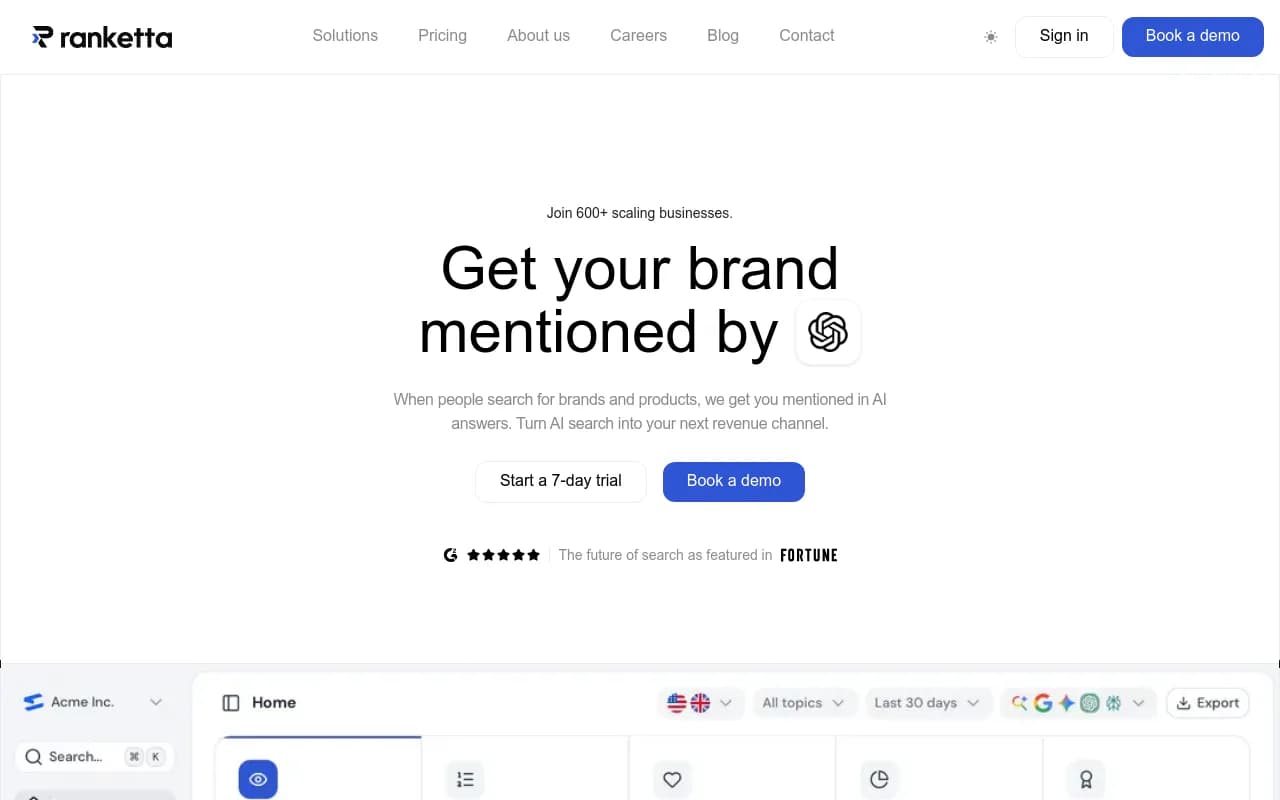
Ranketta is aimed at online stores. Its angle is the product, or SKU, rather than the brand. A brand-level tracker records that you were named in an answer. A product-level tracker records which specific products made the shortlist and which got skipped. If you sell a catalogue, that is the more useful question.
Ranketta's own buyer's guide makes the same argument: decide first whether you need brand-level or product-level data, then score tools on engines, prompt capacity, collection method and what happens after the report. Naturally that framing favors Ranketta, so treat it as a vendor position, but the distinction itself is real.
Ranketta pricing
Prices are in euros, with a 7-day free trial and yearly billing giving two months free.
| Plan | Price | Models | Prompts per model | Credits/mo | Sites and countries |
|---|---|---|---|---|---|
| Starter | EUR 79/mo | 3 of your choice | 50 | 5k | 1 site, 1 country |
| Growth | EUR 199/mo | 4 | 100 | 15k | 2 sites, 3 countries |
| Scale | EUR 449/mo | 5 | 300 | 45k | 5 sites, 10 countries |
| Enterprise | Custom | Custom | 1,000+ | Custom | SLA, SSO, dedicated AEO specialist |
Standard engines are Google AI Overviews, AI Mode, ChatGPT, Gemini and Perplexity. Premium engines include Amazon Alexa, Claude, Microsoft Copilot, Grok, Meta Muse, Walmart Sparky and Instacart Clementine. The retail assistants are genuinely unusual in this category. I could not confirm which plans include the premium engines or what they cost, so ask before you count on Claude or Copilot.
Where Ranketta fits
Stores with a real product catalogue, especially those that sell across several countries. Starter works out to about 150 prompt-engine combinations (50 prompts across 3 models), which is a modest budget, so it suits a focused test of your top categories rather than broad coverage.
Where it fits less well: a services business or a SaaS company with no SKUs. The product layer adds little there.
Gauge: flat price, daily runs, content included
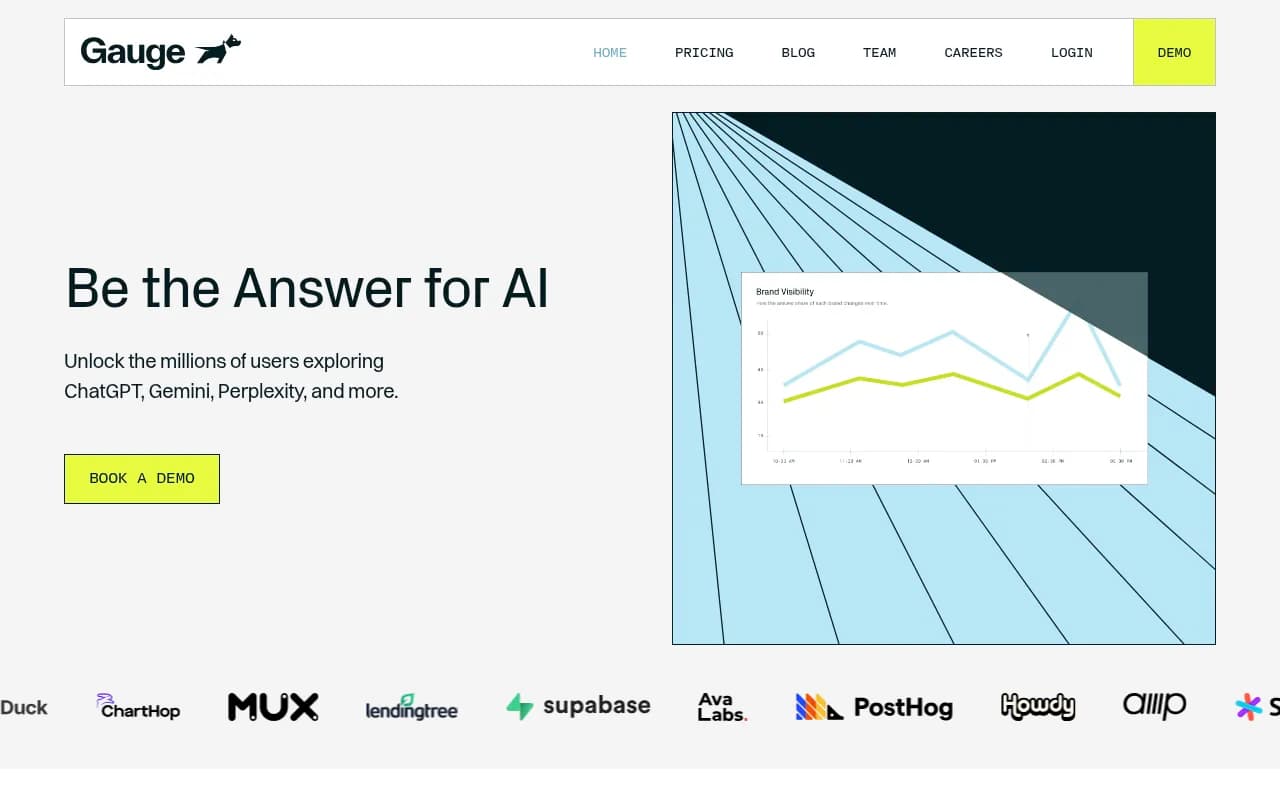
Gauge (the Gauge Chat product, not to be confused with Gauge Agents, a separate coding-agent evaluation tool) takes the opposite approach to Rankscale. There is one self-serve plan and one price.
Gauge pricing
Growth is $599/mo and includes:
- 600 prompts run daily across ChatGPT, Google AI Mode and Microsoft Copilot
- 54,000 answers a month, which Gauge puts at about a penny per answer
- 18 publish-ready articles a month
- 3 seats, unlimited domains and competitors, a single location
- The Ask Gauge agent and Action Center recommendations
- GA4, Search Console and DataForSEO integrations
- CMS publishing to Webflow, Framer, Sanity and GitHub, plus MCP access
Enterprise is custom. It adds Google AI Overviews, Gemini and Perplexity (6 core platforms in total), sentiment analysis, exports, custom prompt, seat, article and location limits, and recurring strategy sessions. Claude and Grok are optional on any plan, but only if you bring your own Anthropic or xAI API key and pay the provider directly.
One thing to check before buying: the plan table does not tick sentiment analysis or exports for Growth, while the Enterprise description lists both as Enterprise additions. If sentiment matters to you, confirm in writing.
Where Gauge fits
Teams that want to go from "where are we missing" to "here is an article" without a second tool. The 600-by-3 prompt budget is far larger than Ranketta Starter, and the daily cadence is built in. The trade-off is the price and the narrow engine list: three platforms on the entry plan means no Gemini or Perplexity unless you move to Enterprise. I also found no independent reviews of Gauge's tracking accuracy, so test it against your own prompts.
Gauge's own comparison content positions it as the better fit for operational teams and Rankscale as the cheaper option with fewer execution tools. That is a vendor view, but the entry-price gap it concedes ($599 vs $20) is accurate.
Rankscale: the widest engine list, billed by the credit
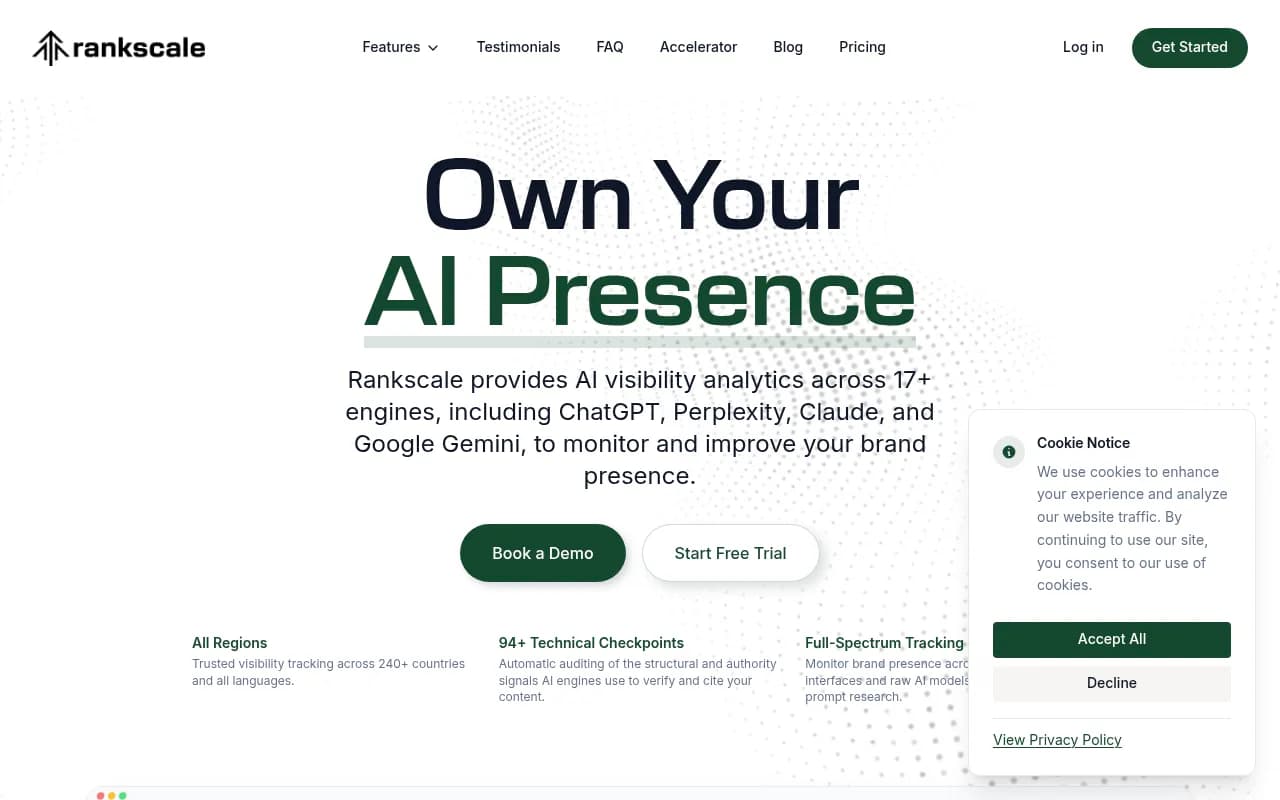
Rankscale is a monitoring-first platform from the German company Rankscale GmbH. It captures full responses from each engine and records mentions, citations, sentiment and competitor comparison. Instead of selling a fixed number of prompts, it meters usage in credits, so you pay per prompt, per engine, per run.
Rankscale pricing
Prices are in USD. Yearly billing saves 15%.
| Plan | Monthly | Yearly (per mo) | Credits | Answers (up to) | Dashboards | Page audits |
|---|---|---|---|---|---|---|
| Essentials | about $20 (third-party figure) | Yearly only | Limited | n/a | n/a | n/a |
| Pro | $99 | $84 | 1,200 | 4,800 | 10 | 50 |
| Pro+ | $229 | $195 | 3,000 | 12,000 | 25 | 100 |
| Growth (agency) | $385 | $327 | 5,500 | 22,000 | 50 | 200 |
| Enterprise | $780 | $663 | 12,000 | 48,000 | 100 | 200 |
Pro+ adds REST API access and monthly prompt research, Growth adds white-label options, and a custom tier covers SSO, custom API and SLA. Rollover is up to 2x on Pro and Pro+, and up to 3x on Growth and Enterprise. Essentials is the exception: no rollover, no sentiment analysis, no custom dashboards, no local results, no AI visits, no shopping analysis and no ad analytics. Those start at Pro. The $20 headline is real, but it is a stripped-down plan.
The engine-count problem
Here is where I would slow down. Rankscale's numbers disagree with each other:
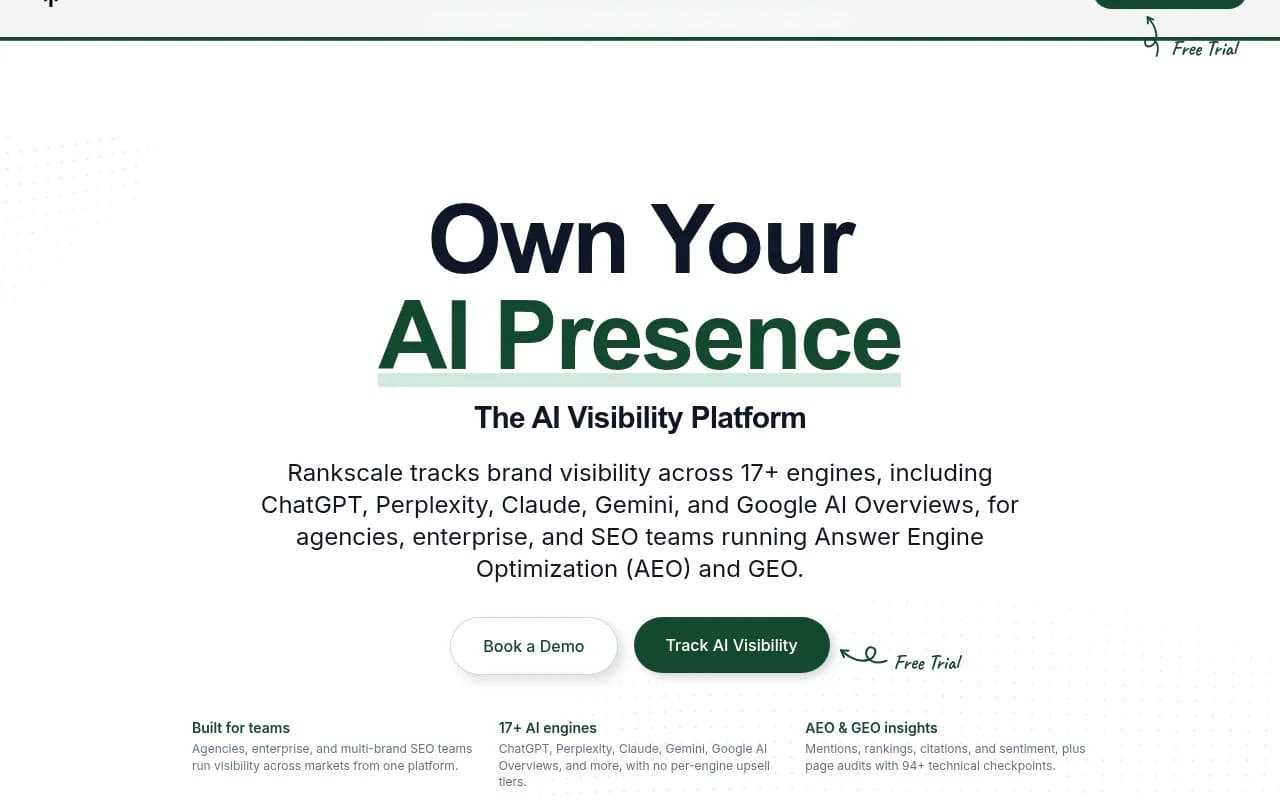
- Third-party reviews and the homepage say 17+ engines.
- The pricing page's plan cards list roughly 9 or 10 (ChatGPT, Perplexity, AI Mode, AI Overviews, Gemini, DeepSeek, Mistral, Claude, Copilot, and recently Meta Muse Spark).
- The feature table text reads "280+", but the scrape looked garbled, so I would not lean on that.
My read: the larger numbers likely count GUI and API variants of the same engines separately. That is not dishonest, but it means "17+" is not 17 different assistants. Per-engine credit rates also vary (from 0.25 credits up to several), so the same prompt set can cost very different amounts depending on which engines you switch on. One independent review calls this the catch buried in the engine count.
And the credit math is what makes forecasting hard. A prompt run against 6 engines daily burns credits quickly, which is why the "up to 4,800 answers" on Pro is a ceiling, not a promise.
Where Rankscale fits
Solo marketers, DIY SEO leads and agencies managing many small brands. Each prompt can run on its own engine mix and schedule, scheduling runs from hourly to monthly, and that granular control is rare at this price. The dashboards are plain and there is no native report builder, so agencies will do their own reporting.
Side-by-side comparison
| Ranketta | Gauge | Rankscale | |
|---|---|---|---|
| Entry price | EUR 79/mo | $599/mo | $20 (yearly, stripped) or $99/mo |
| Pricing model | Plan caps plus credits | Flat, fixed prompts and platforms | Credit pool, rollover |
| Engines on entry plan | 3 of 5 standard, chosen by you | 3 (ChatGPT, AI Mode, Copilot) | About 9 to 10 listed (17+ claimed) |
| Prompt budget | 50 per model | 600 daily | Unlimited terms, limited by credits |
| Focus | Product and SKU visibility | Tracking to execution | Monitoring and audits |
| Content creation | Merchandising layer | 18 articles/mo, CMS publishing | No |
| Agency features | Separate agency pricing page | 3 seats, one location | White-label from Growth |
| Free trial | 7 days | Check pricing page | Free trial offered |
What each price actually buys
Roughly, per month on entry plans: Ranketta gives you about 150 prompt-engine pairs for a store; Gauge gives you 54,000 answers plus articles; Rankscale Pro gives you up to 4,800 answers across a wider engine mix. Those are my own multiplications from the published limits, so check them against your actual plan.
If you divide it out, Gauge looks cheap per answer and expensive per month. Rankscale looks cheap per month and uncertain per answer. Ranketta is the only one pricing around products.
How to choose
| If you are... | Pick | Why |
|---|---|---|
| An online store with a catalogue | Ranketta | Tracks which products get recommended, not just the brand |
| A solo marketer or small agency on a tight budget | Rankscale | Lowest floor, broadest engine list, granular control |
| A team that wants tracking and articles in one place | Gauge | Daily runs, content generation, CMS publishing |
| Someone who needs Gemini and Perplexity on a flat price | Rankscale or Ranketta | Gauge needs Enterprise for both |
| Someone who needs predictable bills | Gauge or Ranketta | Rankscale credits vary by engine |
When none of the three is enough
All three are lean. If you need crawler logs that show whether AI bots can actually read your pages, visitor analytics that tie AI traffic to conversions, and a content workflow that checks whether published pages get cited, you are looking at a broader platform.
Promptwatch is one example. It tracks ChatGPT, Gemini, Perplexity, Claude, Google AI Overviews and others through their real interfaces, then adds IP-verified AI crawler logs, a Content Agent that publishes to WordPress, Webflow or Framer, and visitor analytics. Plans start at $95/mo (Essential), and you can confirm current pricing at promptwatch.com/pricing.

If you want to browse more options, the GEO software directory at bestgeosoftware.com lists dozens of trackers across price brackets.
A two-week trial plan
Do not choose from pricing pages. Run the same test on each shortlisted tool:
- Pick 20 to 30 prompts your buyers really type, split between category, comparison and branded queries.
- Run them on the same engines and in the same market in every tool.
- Compare whether the three tools agree on whether you were mentioned. Disagreement tells you about collection method.
- For Rankscale, record how many credits the test burned, then extrapolate to a month.
- For Ranketta, check whether the product data it flags matches what you would fix by hand.
- For Gauge, judge the generated articles as drafts, not finished work.
Then decide. If the answers are close, price and workflow should break the tie.
Bottom line
Rankscale is the budget pick with the most control and the most billing math. Ranketta is the pick if you sell products and care which SKUs get named. Gauge is the pick if you would rather pay once and get articles out the other end. None of them is a bad choice, but they are three different purchases, and the cheapest sticker price will not be the cheapest bill for everyone.