Key takeaways
- Otterly.AI has the cleanest, fastest-to-learn interface of the three. Setup takes minutes, and its trade-off is a thinner data layer once you outgrow basic monitoring.
- Profound is the most data-dense and the hardest to learn. The depth (prompt volumes, agents, enterprise governance) comes with a real learning curve.
- Promptwatch sits in the middle on looks but is the one that bundles tracking, crawler logs, content creation and action lists. That breadth makes the dashboard dense, so expect an onboarding period.
- "Easiest" depends on what you want to do after the dashboard shows a gap. A clean monitor is easy until you need to act on what it shows.
- Third-party ease-of-use scores come from vendor-authored blogs. Treat them as opinion and run a trial before you pay.
What "clean and easy" actually means for an AI visibility tool
Every AI visibility dashboard looks fine in a demo. The real test is week three, when you have 150 prompts, five competitors, three countries and a boss asking "so are we winning in ChatGPT or not?"
I break interface quality into four things:
- Time to first useful answer. How long from signup to a number you can screenshot?
- Density at scale. Does the dashboard stay readable with hundreds of prompts?
- Interpretation. Does it tell you what a metric means, or assume you already know?
- What happens next. Can you act from the same screen, or do you export and switch tools?
A caveat up front: I haven't clicked through all three on a fresh account for this article. What follows combines the vendors' own documentation and pricing pages with third-party reviews. Most of those reviews are written by competing vendors, so I flag where a claim is opinion.
The short version: side-by-side
| Otterly.AI | Promptwatch | Profound | |
|---|---|---|---|
| Interface feel | Clean, minimal, "otterly simple" | Functional, dense, less flashy | Data-heavy, enterprise-style |
| Time to first data | Minutes | Short setup, longer to master | Longer, often guided onboarding |
| ContentMonk ease score (opinion) | 7/10 | 6/10 | 5/10 |
| Reviewer complaints | Clutter at scale | Dense dashboard, learning curve, agent credits run out | Learning curve, data overload |
| Entry paid price | $29/mo (15 prompts) | $95/mo (50 prompts) | Trial or custom Enterprise for brands |
| Free option | 7 to 14 day trial, no card (sources differ) | Free Explore plan, 10 prompts, ChatGPT only | 7-day trial |
| Crawler logs | From $189 Standard | From $245 Professional | Enterprise-level CDN integrations |
| Acts on the gap? | Recommendations and briefs; execution is external | Content Agent, Action Board, CMS publishing | Aim agent proposes and builds agents |
| Best for | Solo marketers, small teams, agencies starting out | SEO teams and agencies that want one loop | Enterprise programs with dedicated budget |
The ContentMonk scores come from a vendor-authored comparison, so they are one opinionated data point, not a benchmark. They do line up with what other sources say, though, which is why I'm using them as a rough ordering.
Otterly.AI: the simplest interface of the three
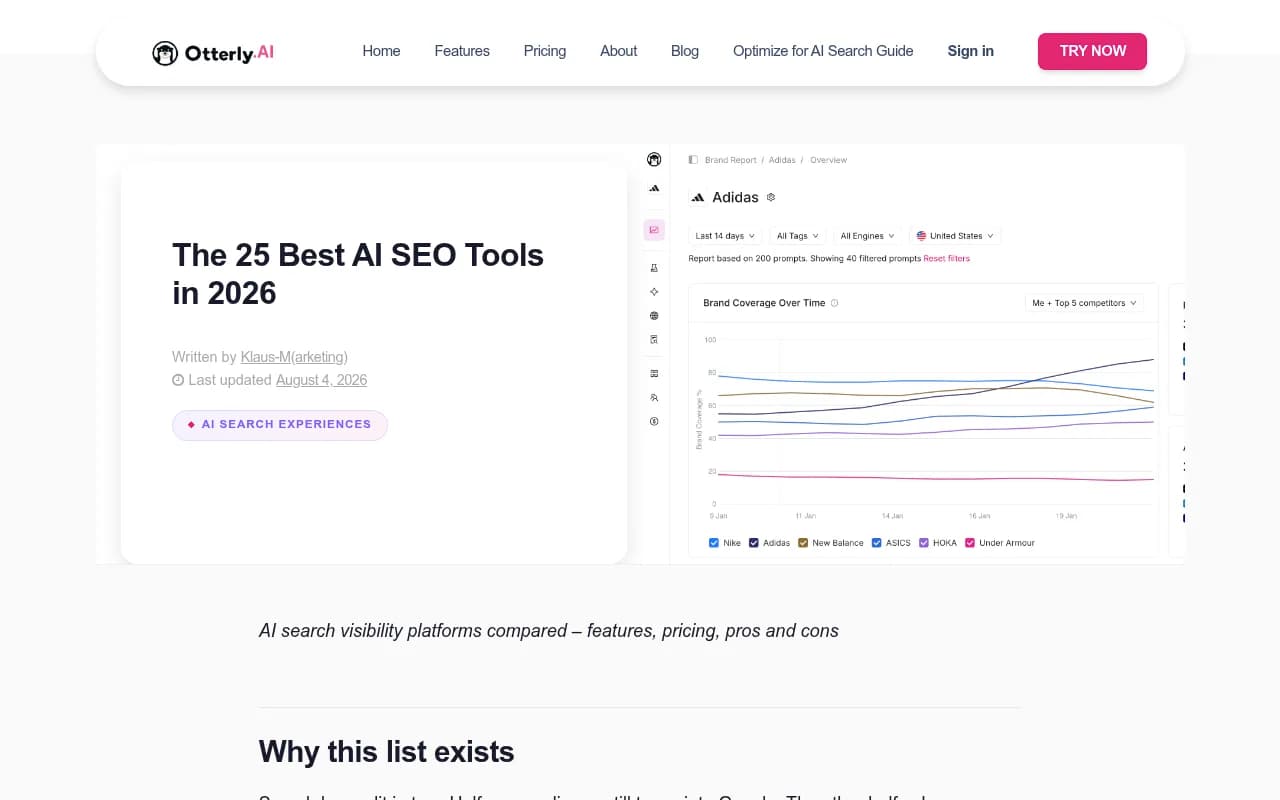
Otterly.AI earns its reputation for simplicity. Even Profound's own comparison article, which has every reason to be critical, concedes that "the 'otterly simple' positioning is earned. Setup is fast, the interface is clean, and you can start tracking visibility within minutes."

Why it feels easy
A few reasons, beyond visual design:
- Fewer products under one login. Otterly tracks, reports and recommends. It doesn't try to be a content studio, an agent platform and an analytics suite at once.
- Low prompt counts at the entry level. Lite is $29/month for 15 prompts, so the dashboard has little to be cluttered with at the start.
- Unlimited team members on every plan, which removes seat-management screens from your life.
- A built-in prompt research tool and a free GEO audit that give new users something to do on day one.
Where the cleanliness runs out
Two places. First, G2 reviewers quoted in the ContentMonk piece note clutter once you scale. Simple interfaces tend to get messy when you add prompts, countries and competitors.
Second, pricing structure. Core engines on every plan are ChatGPT, Google AI Overviews, Perplexity and Copilot. Claude, Google AI Mode and Gemini are paid add-ons. One source puts Standard at $189 plus $59 each for AI Mode and Gemini and $109 for Claude, which lands near $416 for all seven engines. That isn't an interface problem, but a clean dashboard that hides engines behind add-ons can confuse people. Model the final number before you commit.
Also worth knowing: content generation sits in a separate GEO Content Creator outside the monitoring workflow, and acting on recommendations happens outside the tool. If your idea of easy includes "fix it from the same screen," Otterly will feel incomplete.
Profound: powerful, and you will feel it
Profound is the best-funded company in the category (a $96M Series C in February 2026 at a $1B valuation, per Otterly's blog) and its product reflects an enterprise customer. It combines Answer Engine Insights, Prompt Volumes (a dataset of real consumer prompts, which Profound says exceeds 2 billion), Agent Analytics for crawler logs, and Aim, an agent layer that proposes ranked projects.

Interface reality
ContentMonk scores Profound 5/10 for ease of use and cites G2 reviewers mentioning a learning curve and data overload. WorkDuo's comparison also calls it heavier than the alternatives. Both are competitor-adjacent sources, so don't take them as gospel. But the direction is consistent, and it makes sense: a platform with prompt demand segmentation by intent, age, income and country, plus agents and CDN-level analytics, has a lot of surface area.
If you have a team member whose job is AI search, that depth is a feature. If you're a marketer who wants a weekly number, it's a lot of product.
Pricing makes the trial matter more
This is the part to verify yourself. Older roundups list Starter at $99 and Growth at $399. A more recent buyer-side article reports that those self-serve brand plans were gone by late September 2026, with Profound's pricing page showing a 7-day trial and custom Enterprise pricing. I did not verify the live pricing page directly, so check it before you plan around any number. Vendr's buyer data, cited in that same article, puts the median contract at $35,250 a year.
Practically: with Profound you are probably choosing based on a trial and a sales conversation, not a self-serve signup. A guided onboarding can offset some interface complexity, but it also means you don't get to poke around at your own pace as freely.
Promptwatch: dense, but built around doing something about it
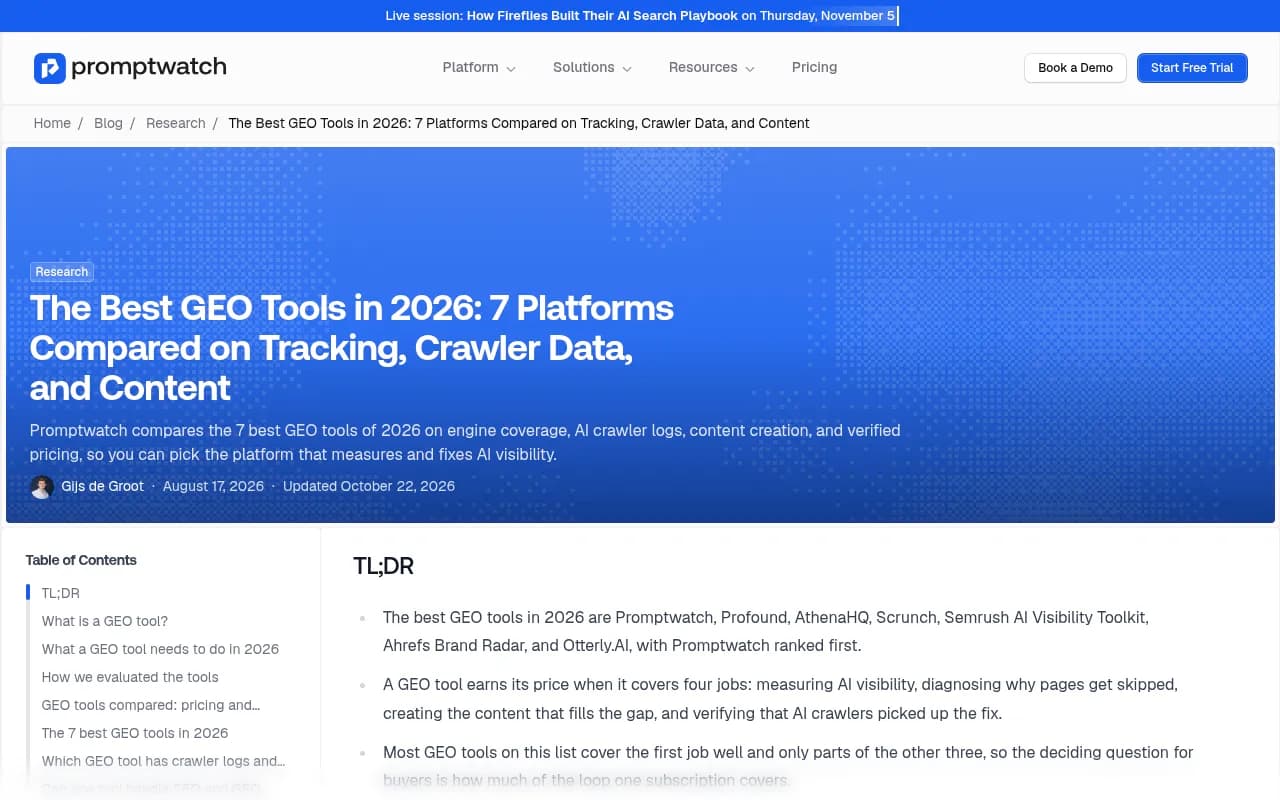
Promptwatch is the odd one out. It isn't trying to win on minimalism. An independent review from generatemore.ai describes the user experience as "less flashy than other tools compared (Scrunch AI and Profound), but in day-to-day testing it was easy to use, simple to configure and reliable." That matches my read of how these things go: workmanlike rather than pretty.

What makes the dashboard dense
Promptwatch packs the full loop into one product: real-interface prompt tracking across ChatGPT, Google AI Overviews, AI Mode, Gemini, Perplexity, Copilot and others, IP-verified crawler logs, visitor analytics, site audits, a Content Agent that writes and publishes to WordPress, Webflow or Framer, and an Action Board with a prioritized to-do list. More widgets means more to learn. ContentMonk scores it 6/10 and cites G2 reviewers on a dense dashboard, a learning curve and agent credits running out quickly.
Two mitigations are worth knowing about. Agent Chat is a conversational analyst over your own data, so instead of hunting for a report you can ask for it. And the Action Board turns a wall of metrics into a short list of things to do, which is the part that makes a busy interface feel less overwhelming. The generatemore reviewer also notes that the Answer Gap report can be hard for non-SEOs to read, though it is concise for people who manage multiple domains.
Plans and limits
A free Explore plan covers 10 prompts on ChatGPT only. Paid plans start at $95/month (Essential, 50 prompts, one seat), then Professional at $245 and Business at $579, with a 7-day trial on monthly Essential and Professional. Confirm current numbers at promptwatch.com/pricing. Crawler logs and AEO articles start on Professional. Seats are limited, from one to five on brand plans, where Otterly offers unlimited.
A disclosure that matters here: this site is run by 1001 SEO Media, which uses Promptwatch as its own GEO platform. I've tried to keep the comparison fair, and the reviewer complaints above are the unflattering ones.
Interface by task: who wins what
| Task | Easiest | Why |
|---|---|---|
| Get a first visibility number today | Otterly.AI | Minutes to set up, few moving parts |
| Decide which prompts deserve effort | Profound | Real prompt volume data (Otterly and Promptwatch estimate instead) |
| See which AI bots hit which pages | Promptwatch or Profound | Both built around crawler logs; Otterly gates it at $189 |
| Go from gap to published article | Promptwatch | Content Agent and CMS publishing in the same product |
| Manage many clients with unlimited seats | Otterly.AI | Unlimited users on every plan |
| Pass a security review | Profound or Promptwatch | SOC 2 Type II and HIPAA on Profound; ISO 27001 on Promptwatch |
How to test interface quality yourself in an afternoon
Because most of the ease-of-use opinions online come from competitors, a short hands-on test is worth more than any score. Here is a method I'd use.
- Load the same 20 prompts into each trial. Mix brand, category and competitor comparison prompts.
- Time yourself on three things: finding your share of voice, finding which sources are cited for one prompt, and exporting a report. If any takes more than a few minutes, note it.
- Add a second country and a competitor, then see whether the dashboard still reads clearly.
- Ask a non-specialist colleague to find one insight without help. If they can't, your stakeholders won't use it either.
- Check what the tool suggests you do next, and whether you can do it there.
The free GEO checks from some vendors can help warm up before committing. Promptwatch also offers a free AI visibility report that needs no login.
What the data layer means for "easy"
One reason simpler interfaces feel easier is that they show fewer numbers. Be aware of what each tool measures. Promptwatch's own research shows how much answer composition varies by engine: in Promptwatch's average sources per response data, ChatGPT cites roughly 5 sources per web-search answer, while Google AI Overviews and Perplexity cite about 10. A dashboard that blends engines into one score hides that difference. A denser one shows it. Neither is wrong, but know which you're buying.
If you want to explore more options before choosing, the directory at bestgeosoftware.com lists many other GEO platforms, and ai-rank-tools.com focuses on AI rank trackers.
My verdict
Pick Otterly.AI if your priority is a clean screen and a fast start, you are a solo marketer or a small team, and you are happy to take recommendations elsewhere to execute them. Budget for the add-on engines.
Pick Profound if you have enterprise needs, a person who owns AI search full time, and you value demand data and governance enough to accept a heavier interface and a sales-led process.
Pick Promptwatch if "easy" to you means fewer tools stitched together. The dashboard is busier, and you'll spend a week learning it, but the loop from tracking to crawler logs to a published, tracked page lives in one place. For teams who would otherwise juggle a monitor, a log tool and a content tool, that is the simpler workflow even if it isn't the prettier screen.
Whichever you choose, run the afternoon test above. Pricing and plans in this space changed repeatedly in 2026, so check each vendor's live pricing page before you commit.