Key takeaways
- Promptwatch and Profound answer different ad questions. Promptwatch's Ads Radar shows which advertisers appear on the prompts you track. Profound's OpenAI Ads integration shows how your own campaigns perform.
- Ads Radar is on Promptwatch's Business plan ($579/mo), not Essential or Professional. Check promptwatch.com/pricing before buying.
- Profound's public material describes an integration with your own OpenAI Ads account. I found no source saying it logs competitor ads, so verify that in a demo.
- ChatGPT ad prevalence is high and noisy. Promptwatch Data measured ads in a 90-day average of 20.1% of search responses, with a daily peak of 43.9%. One manual check proves nothing.
- Many teams will want both views: competitor observation for the prompts you care about, and first-party campaign data for what you spend.
Why ChatGPT ad tracking is two separate problems
People say "ChatGPT ad tracking" and mean two different things.
The first is competitive: who is showing ads on the prompts my buyers type, what do their creatives say, and where do they send people? You can't get this from your own ad account. Someone has to run prompts repeatedly and write down what appears.
The second is first-party: how are my own campaigns doing? Impressions, clicks, spend, conversions. This lives in OpenAI's ad platform, and the question is whether a tool can pull it in next to your organic AI visibility data.
Most of the confusion in vendor comparisons comes from treating these as one feature. They aren't. A tool can be excellent at one and absent from the other, and that is more or less what we see when comparing Promptwatch and Profound.


How common are ChatGPT ads now?
Before comparing tools, it helps to know how much there is to track. Promptwatch Data's ChatGPT Ads Over Time report covers May 20 to August 17, 2026:
- ChatGPT showed no ads until May 27, when they appeared in 1.69% of responses.
- The 90-day average was 20.1% of responses that ran a web search.
- The daily rate peaked at 43.9%.
- The last 7 days of the period averaged 32.4%, and the last 30 days averaged 29.6%.
- Of ad-bearing responses, roughly 73% were organic prompts, 18% brand-specific, and 9% competitor comparisons.
A caveat from the report itself: that prompt-type mix partly reflects how many prompts of each type a monitor contains. Add more organic prompts and their share rises even if OpenAI changed nothing.
Seer Interactive published its own early view of ChatGPT ads (updated July 28, 2026) from client tracking workspaces. They reported ads in 7 out of 10 tracked responses, which is far higher than Promptwatch's figure. Different prompt sets, different methods, different numbers. That gap is a good reason to ask any vendor for the date range and prompt set behind a prevalence claim.
Seer also found that only 2.2% of a brand's own branded-prompt responses featured its own ad, so a rival can take that slot without outbidding anyone. That finding is the strongest argument for competitor-facing observation: you only learn about it if something is watching.
What Promptwatch's Ads Radar shows
Ads Radar is Promptwatch's competitor-facing ad view. Per Promptwatch's own guide to tracking ChatGPT ads (vendor content, so read it that way), each captured placement records:
- the advertiser name and root domain
- the creative (title, one-line description, image)
- the landing page URL, usually with UTM parameters intact
- the prompt it appeared on, filterable by prompt type and intent
Monitors refresh daily by default, so captures build into a time series. You can view by ad or by prompt. Ads are stored as a separate data type from citations and mentions, which matters because an ad slot and an organic citation are different things.
The method is a fixed panel of prompts run against the real ChatGPT interface. All ads captured so far came from the search-powered surface, not ordinary conversational replies, and Promptwatch says it hasn't seen them in Google AI Overviews, AI Mode, or Gemini.
The practical use cases:
- Find out which advertisers bid on your commercial prompts, and whether they are your known competitors or surprises.
- Read their ad copy and claims, then compare to what ChatGPT says organically about them.
- Spot whether anyone is buying your branded prompts.
- Check whether an advertiser is also earning the organic mention. Seer's early data suggests the advertiser appears in the organic answer only around 5% of the time.
The limitation is plan access. Ads Radar sits on Business ($579/mo), every agency plan, and Enterprise. Essential and Professional don't include it. It also covers prompts you track, not every prompt in ChatGPT, and it shows what advertisers display, not what they spend or what converts.
If you want the same data programmatically, it's also exposed through the REST API and MCP server. See the Ads Radar page for the feature overview.
What Profound shows
Profound's approach, based on its public integration page, is to connect to your own OpenAI Ads account through the Integrations Center. Once linked, it can read ad campaigns, ad groups, ads, files, and reports, and it ties ChatGPT ad performance to organic AI search data. Profound also shipped OpenAI Ads nodes for Profound Agents on the day self-serve ChatGPT Ads rolled out, so customers can build dashboards, alerts, and reports from ads data.
That is a legitimately useful thing. If you are spending money in ChatGPT, seeing your campaign metrics next to your organic mention rate in one place saves a lot of spreadsheet stitching, and agent-built alerts are a nice touch.
What I couldn't confirm is the competitor side. The sources I found describe own-account data and don't mention logging competitors' ads. Promptwatch's comparison table labels Profound's ad tracking "Own spend", and says Profound and HubSpot "only connect your own ChatGPT Ads account, which answers a different question." That is a competitor's characterization, so treat it as a claim, not a verdict. The honest approach is to ask Profound directly: "Do you capture competitor ad creatives and landing pages on tracked prompts?"
Two other Profound notes from the comparison data. Prompt volumes and ChatGPT Shopping sit at the Enterprise tier, and Profound removed brand plans in September 2026, leaving agency workspaces at $399 per client and custom Enterprise pricing (the Agency Growth entry in the comparison is listed at $99 with 1,500 responses). Confirm current pricing at tryprofound.com/pricing, because I couldn't retrieve it.
Side-by-side comparison
| Question | Promptwatch | Profound |
|---|---|---|
| Competitor ads on tracked prompts | Yes, Ads Radar (advertiser, creative, landing page) | Not found in public sources; verify |
| Your own campaign performance | Not the focus; Promptwatch observes, it isn't an ad platform | Yes, via OpenAI Ads account integration |
| Agent or alert workflows on ads data | Action Board, Agent Chat, API and MCP | OpenAI Ads nodes for Profound Agents |
| Tie ads to organic visibility | Yes, same monitors and prompts | Yes, linked to organic AI search data |
| Ads data cadence | Daily by default; up to hourly on Business | Per integration sync (confirm) |
| Plan that includes ad features | Business $579/mo and up, plus agency plans | Confirm with sales |
| Crawler logs and AI visitor analytics | Included (Professional and up for logs) | Confirm per plan |
| Fix side: content creation and publishing | Content Agent with CMS publishing (Business) | Primarily monitoring and analytics |
One more note on the broader comparison. In Promptwatch's own 22-platform comparison, only Promptwatch clears all six core capabilities it scores, with Profound at five. That is the vendor's scorecard, so weigh it accordingly, but the ad column is where the two diverge most.
Don't confuse ads data with OpenAI's Business Hub
OpenAI recently launched Businesses in ChatGPT with an analytics Hub, and Profound published a useful breakdown of what its numbers actually count. It's worth knowing because teams will be tempted to treat it as ad or visibility reporting.
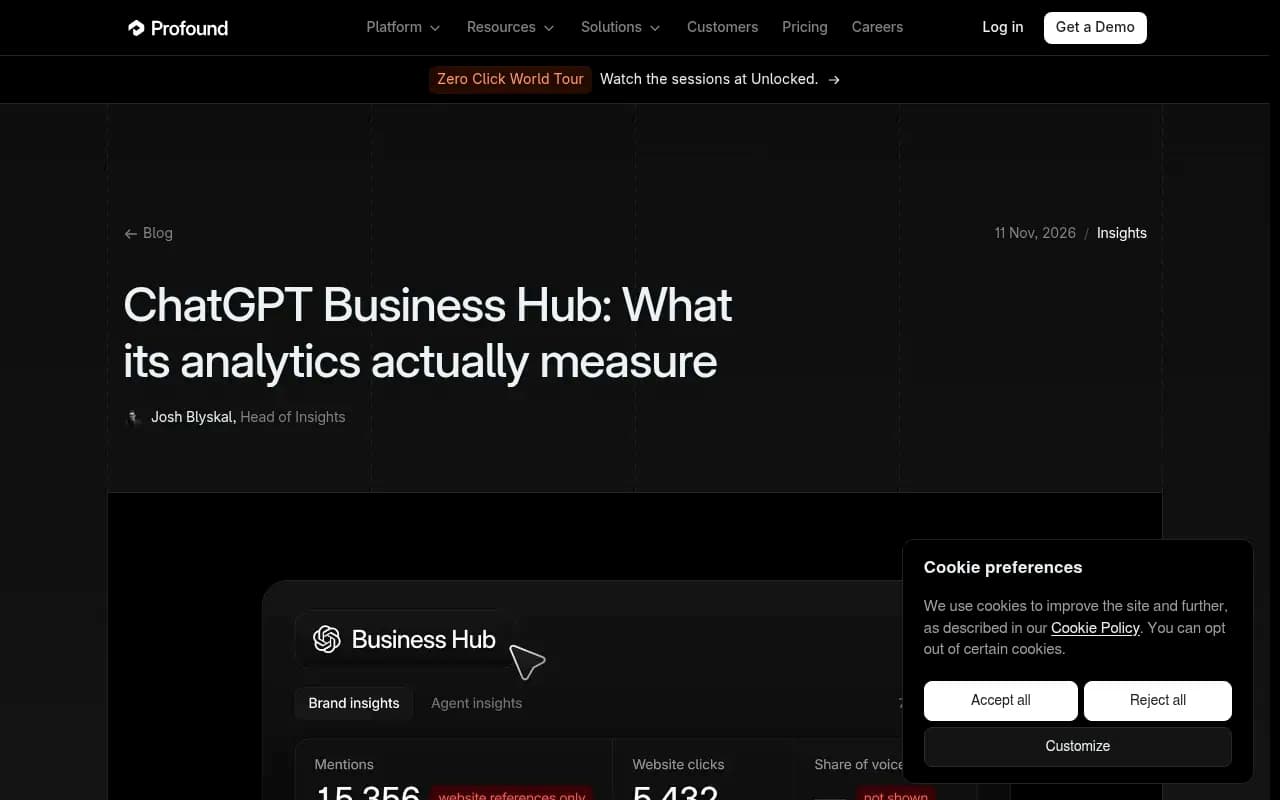
The short version from Profound's post:
- Mentions for an online business count only when ChatGPT references your website URL. A brand name with no link counts for nothing.
- Website clicks are recorded link clicks, not confirmed visits or conversions.
- Discovery topics are grouped themes, not the prompts people typed.
- There are no prompts and no competitors in the Hub, so it tells you what happened, not why.
Profound also noted that the count swings when OpenAI changes linking behavior. On May 7, 2026, brand names became hyperlinks overnight and the share of responses with a URL went from about 4.5% to roughly 20-24%. A URL-based count would have jumped even though nothing about your brand changed.
And traffic attribution is shaky right now. ChatGPT stopped sending a referrer on October 8, 2026, and Profound's own writeup tracked the missing UTM tags through their return on October 16. If you report AI traffic, annotate those dates.
None of this is an ad tracker. But it explains why you need a controlled prompt panel: the Hub, your ad account, and a prompt tracker will never show the same number, because they count different things.
How to set up ad tracking that holds up
Whichever tool you pick, a few habits matter more than the tool.
Build a prompt panel on purpose
Start with 30 to 50 generic commercial prompts of the "best X for Y" type, plus a handful of branded and competitor-comparison prompts. Organic prompts carry most ad volume, but branded prompts are where the uncontested slot opportunity sits.
Run it repeatedly
Ads rotate. A single manual check misstates frequency, and Promptwatch's report specifically warns that one run can land on an outlier day. Look at several days before drawing conclusions. Daily runs are the default on every Promptwatch plan.
Include the search-powered surface
All captured ads so far come from ChatGPT's search surface. If your monitor doesn't include it, you will see nothing and conclude, wrongly, that there are no ads.
Keep prompt mix stable
If you add 40 organic prompts next month, your "share of ad-bearing responses by type" will move for reasons unrelated to OpenAI. Log changes to the panel alongside changes to the data.
Read the landing pages
The most actionable output isn't the count. It is which advertisers win the slot, what claims they make, and where they send traffic. Compare it to the organic answer for the same prompt.
Which should you choose?
Pick based on the question you are trying to answer.
You aren't running ChatGPT ads yet and want to know if competitors are. Competitor observation is what you need. Promptwatch's Ads Radar fits, along with organic visibility, citations, and crawler data in one product. It costs Business-tier money, so if budget is tight, the free AI visibility report and the 7-day trial are the cheap way to see how your brand shows up before committing.
You are spending in ChatGPT and want campaign metrics next to organic data. Profound's integration is built for that. Ask whether it also covers competitor creatives, and what plan you need.
You want to find gaps and then fix them. This is where Promptwatch is stronger. Ads data feeds the Action Board, and the Content Agent can write and publish pages to WordPress, Webflow, or Framer, with Page Tracker and visitor analytics measuring whether the fix worked. Profound is stronger as an analytics layer than as an execution layer.
You are an agency. Promptwatch's Kick-off ($199), Growth ($399), and Scale ($799) plans include Ads Radar with unlimited projects. Profound moved to per-client workspaces at $399 each. Do the arithmetic for your client count.
Honestly, plenty of teams will end up wanting both views, one for what rivals are showing and one for what you pay. They aren't mutually exclusive.
Other tools worth a look
The ad-monitoring category is young and crowded. From the 2026 comparison pages and the tools catalog:
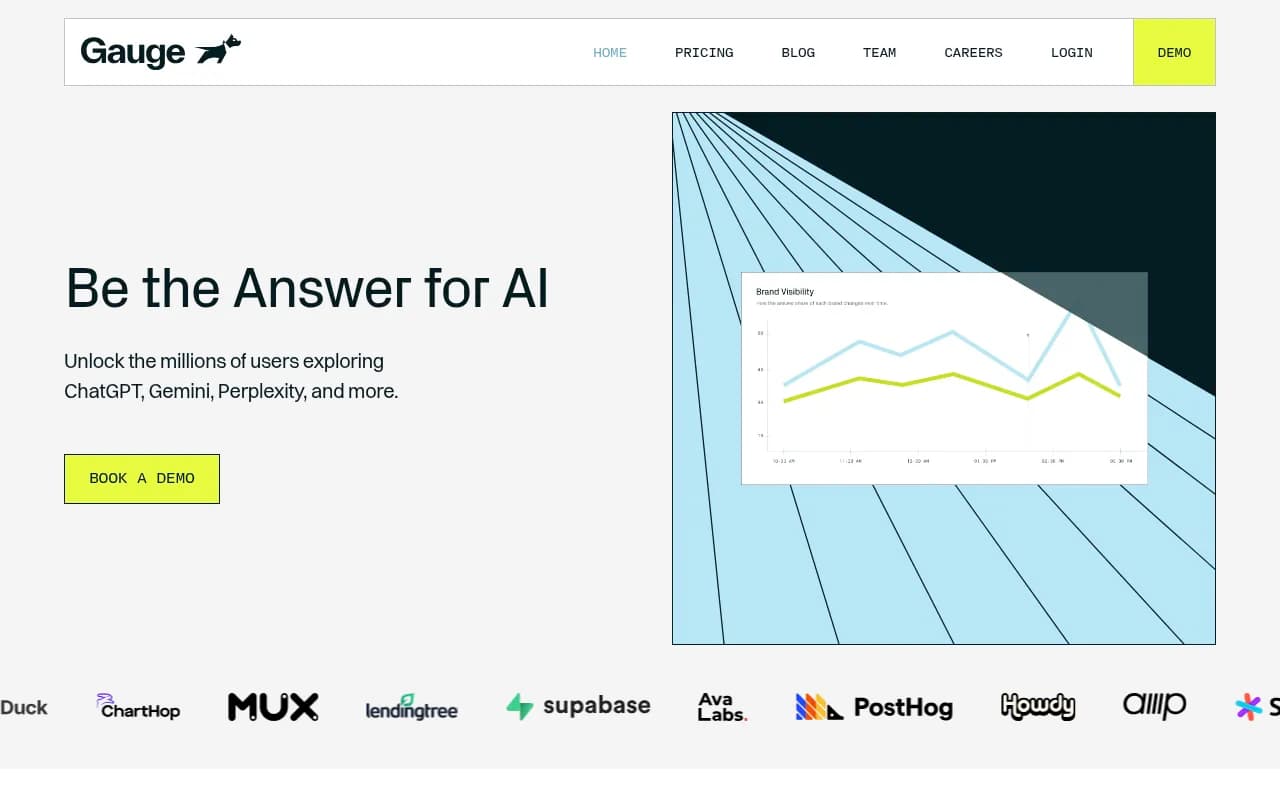
- Gauge pairs observed competitor ads with first-party OpenAI campaign metrics after account connection. It lists $599/month for Growth (checked November 12, 2026).
- Metistic focuses on prompt and market control with presence, absence, advertiser, and creative data. $79/month Starter, $299/month Growth, with a 7-day card-required trial.
- Adthena publishes a ChatGPT ad intelligence price and a defined trial.
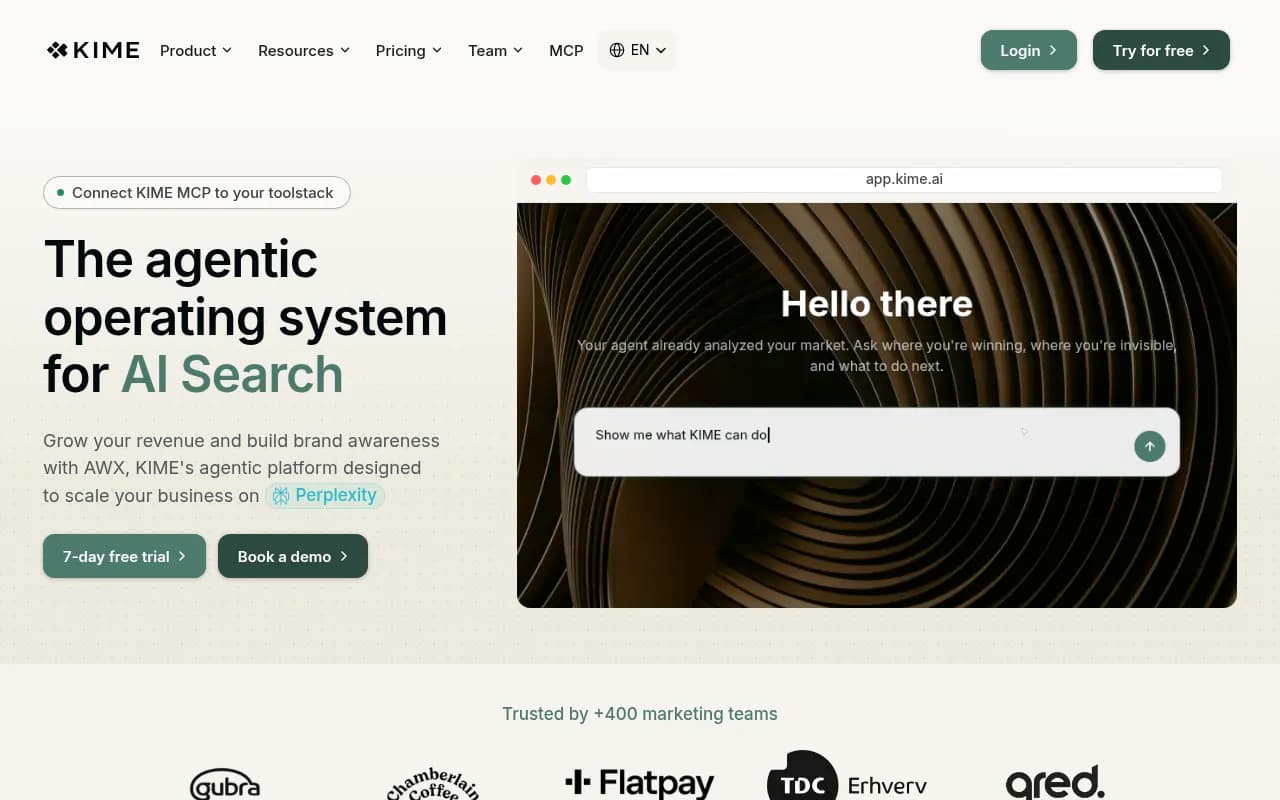
- KIME advertises AI visibility across nine engines with ad insights.
For wider browsing, the GEO software directory at bestgeosoftware.com lists a lot more options, and the AI rank tracking directory is useful if you only want monitoring.
Questions to ask in any demo
- Do you capture competitor ads on tracked prompts, or only my own campaigns?
- Which plan includes ad features? Is it the plan I'm looking at?
- What prompt set and date range sit behind your prevalence claims?
- How often do you refresh, and does it include the search-powered ChatGPT surface?
- Can I export ad creatives and landing pages through an API?
- How do you handle ChatGPT's missing referrer and UTM changes in attribution?
If a vendor can't answer questions 1 and 3 clearly, move on.
Bottom line
Promptwatch shows who is advertising against you on the prompts you track, with creatives and landing pages, and connects that to organic visibility and content fixes. Profound shows your own ChatGPT ad performance beside organic AI data. Different questions, different tools. I'd start with the competitor view if you haven't launched ads, and add first-party reporting once you have spend to measure. Confirm pricing at promptwatch.com/pricing and tryprofound.com/pricing before you commit, since both vendors have changed plans this year.