Key takeaways
- Fan-out tools come in two classes. Simulators predict the sub-searches an engine would run. Recorders log the searches an engine actually ran for prompts the tool sent.
- Plan with a simulator, report with a recorder. Neither shows what happens inside your buyers' own sessions.
- Fan-outs are unstable and sample-dependent. Averages in published studies run from about 1 to nearly 7 per prompt, depending on the model and the period.
- Track themes and clusters, not exact-match fan-out strings. Both Seer Interactive and LoudFace reach the same advice.
- Platform behavior can change overnight, so one-off fan-out audits go stale fast.
What a query fan-out actually is
When you ask ChatGPT, Perplexity, or Google AI Mode a question, the engine often doesn't search for your literal words. It rewrites the prompt into several smaller searches, retrieves results for each, and merges them into one answer. Those hidden searches are query fan-outs.
Google's own example: for "how to fix a lawn that's full of weeds", the sub-queries might include "best herbicides for lawns" and "remove weeds without chemicals". Each has its own result set, and the AI can cite a page from any of them.
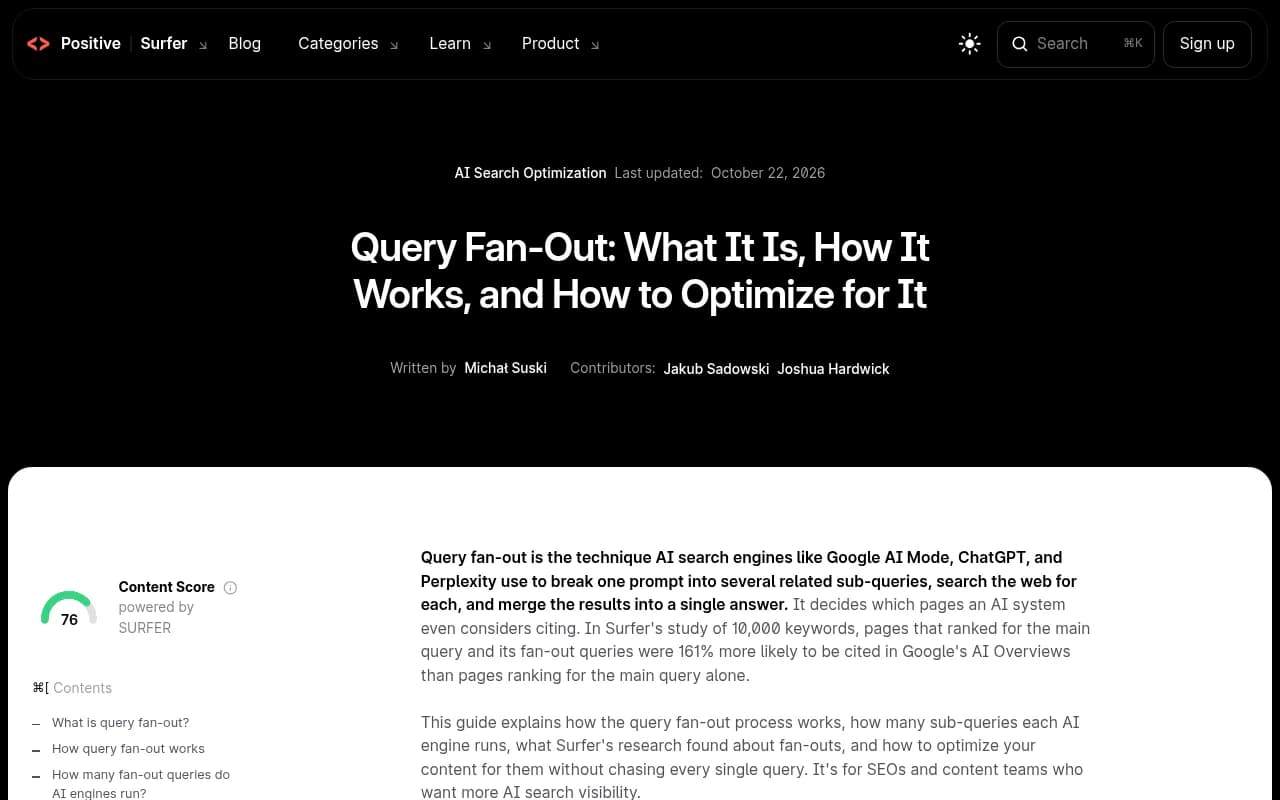
That matters because the fan-outs decide which pages the engine even considers. Surfer's study of 10,000 keywords found that pages ranking for both the main query and its fan-outs were 161% more likely to be cited in Google AI Overviews than pages ranking for the main query alone. It is a third-party study, so treat it as directional, but it fits what practitioners see.
Simulators, recorders and extensions: the three ways to see fan-outs
LoudFace's 2026 comparison of fan-out tools draws the cleanest line I've seen, and I'm borrowing it. A tool either guesses or it records.
Simulators
Simulators predict the sub-queries an engine would likely run. Qforia (from iPullRank) uses Gemini and needs your own Gemini API key. Wellows, Indexly, Rankability and OtterlyAI's free tool also fall here. Most don't say which model produces the predictions. Only Qforia and Wellows name one, and Wellows cites GPT-4o only as an example.
Simulators are cheap and fast. They're good for brainstorming sub-topics before you write. They are not evidence of what an engine did.
Recorders
Recorders log the searches an engine actually ran in answers the tool triggered. Profound, Peec AI, Goodie, Radarkit, Ahrefs Brand Radar and Promptwatch sit here. Because they capture real runs, they're what you should report from.
There is one catch. A recorder only logs the runs it sends. The prompts are yours, from a fixed set, in a monitored location. LoudFace notes that no tool page it read claims to show fan-outs inside your buyers' own sessions.
Browser extensions
Extensions capture your own session. Backlinko's ChatGPT Query Fan-Out Tool does this for ChatGPT, and its store page shows no price. Promptwatch also has a free GEO Inspector Chrome extension that shows fan-outs, fetched versus cited sources, and the reasoning trail, running locally with no sign-in. These are handy for spot checks. They don't scale to a prompt set.
Comparison table: who shows fan-outs, and how
Prices below come from the LoudFace comparison, read 18 October 2026, plus vendor statements. Confirm on each vendor's site before buying.
| Tool | Type | Engines named | Starting price | Best for |
|---|---|---|---|---|
| Qforia | Simulates | Gemini | Free, you pay Gemini API usage | Google-first sub-topic planning |
| OtterlyAI Query Fan Out | Simulates | ChatGPT, Google AI Mode, AI Overview | Free tool; plans from $29/month | ChatGPT and Google side by side |
| Wellows | Simulates | Not stated | $29/month | CSV of variants for keyword research |
| Indexly | Simulates | Not stated | $99/month | Long lists of long-tail variants |
| Rankability | Simulates | Not stated | $97/month | A visual brief for a writer |
| Profound | Records | Tracked engines | Not read | Share percentage per sub-query |
| Peec AI | Records | Tracked models, by plan | Not in page text | Daily tracking with fan-out views |
| Goodie | Records | ChatGPT, Gemini and more | $295/month (Core) | Prompt research and tracking together |
| Ahrefs Brand Radar | Records | ChatGPT and Perplexity fan-outs | Not read | Teams already in Ahrefs |
| Promptwatch | Records | Real UIs of major AI engines | See promptwatch.com/pricing | Fan-outs tied to an action loop |
The recorders in more detail
Profound
Profound launched Query Fanouts on 8 October 2025 and says that for the prompts it sends, it also captures the resulting query fanouts. Its feature page describes showing every sub-query an answer engine generates from a tracked prompt, with a share percentage for each variation. The share figure is the useful bit: it tells you which variants dominate, rather than leaving you to eyeball a list.

Peec AI
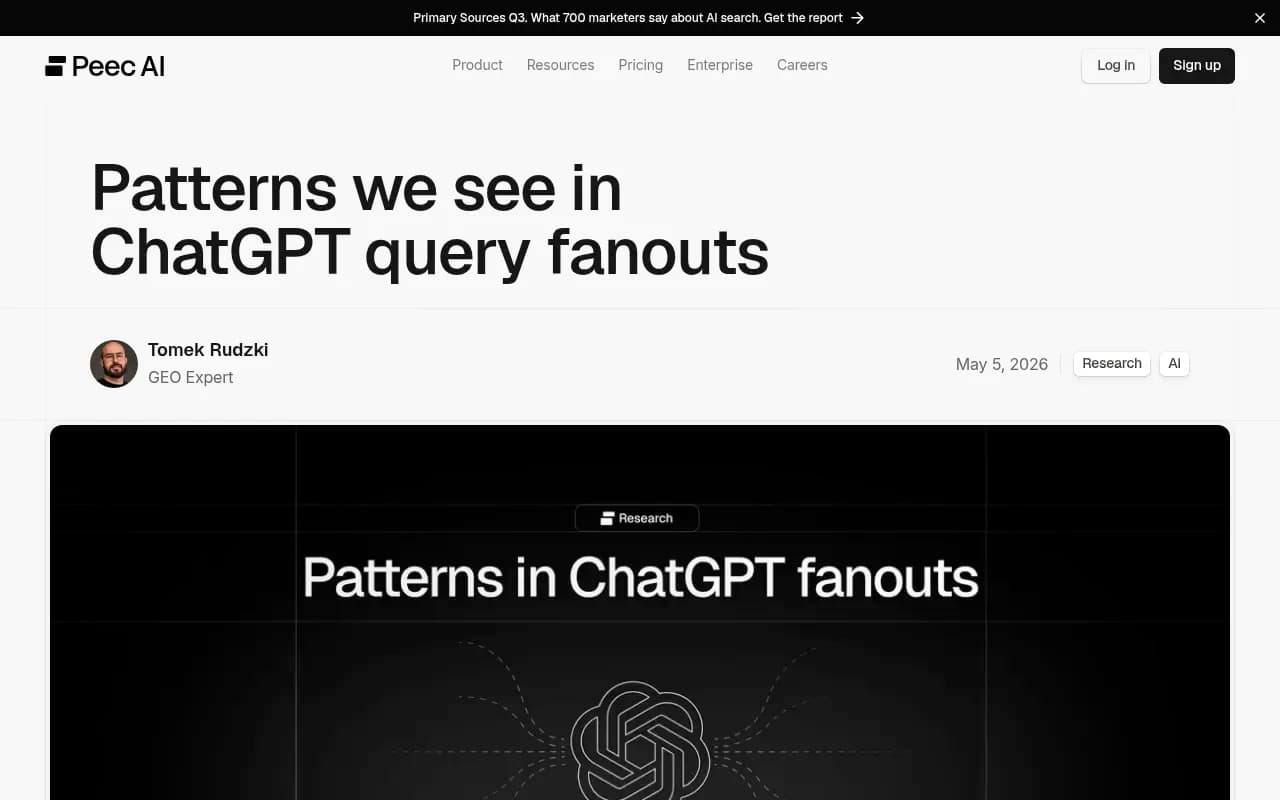
Peec AI is built around daily tracking of a fixed prompt set with fan-out views per model. Its research is worth reading even if you never buy it. In a study of 5 million fan-outs collected 1 to 21 April 2026 across ChatGPT, Perplexity and Grok, Peec found ChatGPT averaged 2.1 fan-outs per prompt, Perplexity 1.4, and Grok 6.8. It also found "best" was the word ChatGPT most often injected, which helps explain why listicles keep winning citations.

Ahrefs Brand Radar
Ahrefs says the AI responses report in Brand Radar shows fan-out queries for ChatGPT and Perplexity prompts, so you can find content gaps behind a custom prompt. The limitation is coverage: Brand Radar tracks prompts on seven platforms, but Ahrefs' own guide shows fan-outs only for ChatGPT and Perplexity.

Goodie
Goodie records fan-outs for ChatGPT and Gemini, "and more", and bundles prompt research with tracking. The entry price in the LoudFace comparison was $295/month on the Core plan, after a 7-day trial. That puts it above the budget trackers.
Radarkit
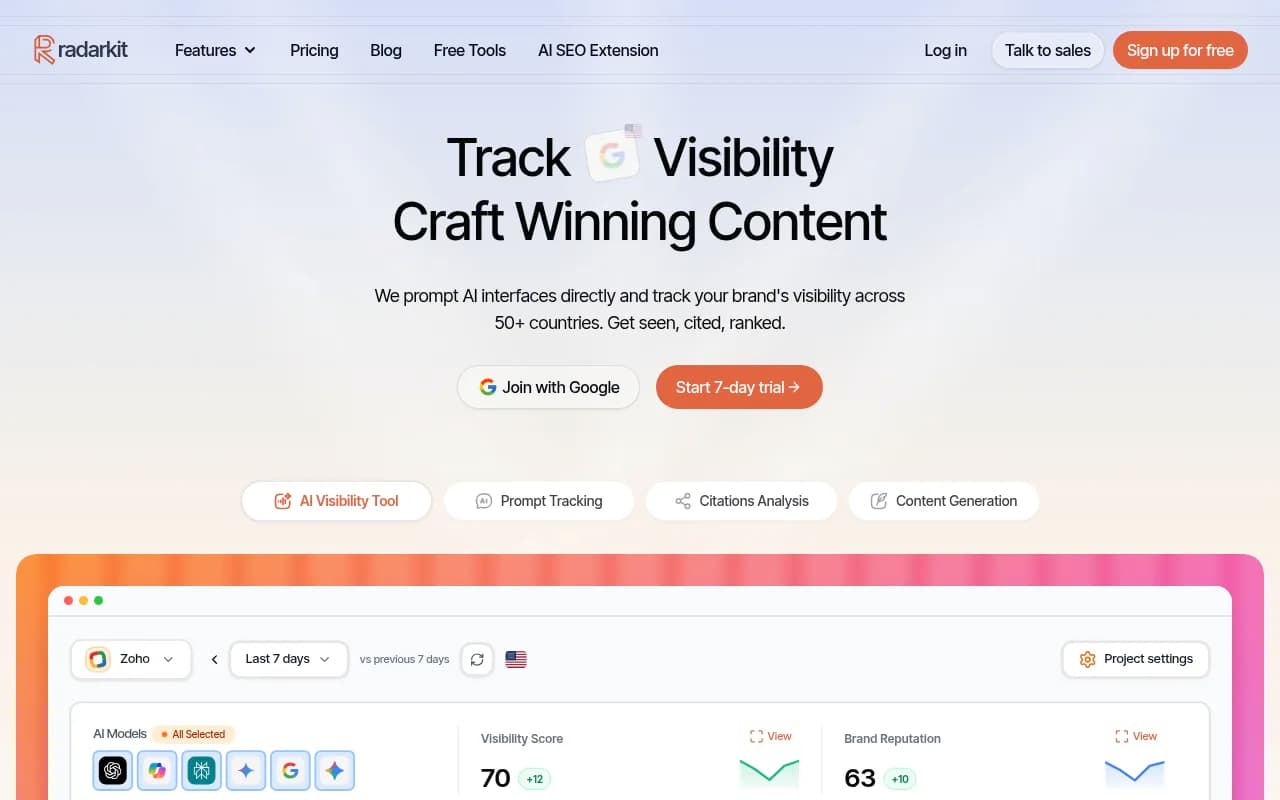
LoudFace lists Radarkit among the recorders. I haven't seen enough of its fan-out output to say more, so check a demo before relying on it.
Promptwatch
Promptwatch tracks prompts from the real interfaces of ChatGPT, Gemini, Perplexity, Google AI Overviews, AI Mode, Copilot and others, and shows the query fan-outs per response, compared across models. Its prompt tracking sits next to crawler logs, citation data and visitor analytics, so a fan-out isn't an isolated curiosity. You can see which of your pages answer a sub-question, whether AI bots can read them, and whether they get cited. The ChatGPT Query Fan-Out Generator is a free simulator if you want to start there. Paid plans start at $95/month on Essential; confirm at promptwatch.com/pricing.

For a wider view of the category, the GEO software directory at bestgeosoftware.com lists far more trackers than fit here.
Why you shouldn't trust any single fan-out string
This is the part vendors tend to underplay. Fan-outs are noisy.
Surfer found only about 27% of fan-outs repeat across runs of the same prompt, and 66% appear just once. Ahrefs reaches a similar conclusion: unique fan-out queries are common even with the same prompt, model and user. So if a dashboard shows you a neat list of eight sub-queries, that list is one sample of a moving target.
The good news from the same Surfer data: about 90% of fan-outs fall into four or fewer topic clusters. Strings vary, but themes hold. Seer Interactive's advice follows: monitor themes, not exact-match fan-out queries.
Numbers differ because samples differ
Promptwatch's ChatGPT Query Fanouts data measured average fan-outs per response at 2.15 in early December and about 1.84 by early March. After a gap, fan-outs returned in April at exactly 1.0 per response. Average query length fell from about 117 characters in December to roughly 53 characters in April. Peec's 2.1 is a different sample from a different month. Neither is a universal constant, and I'd distrust any article that quotes one as if it were.
Platforms change overnight
On 8 August 2026, ChatGPT started using the site: operator at scale. According to Promptwatch Data, site:-scoped fan-outs jumped from 0.37% to 16.8% of all ChatGPT fan-out queries in one day, and average fan-outs per response rose from about 1.08 to about 1.83. Any fan-out analysis or keyword mapping built before that date is stale.
There's a side effect worth noting. A site: query can only surface pages that search engines have indexed, so your own domain becomes a retrieval surface. Crawlability and indexing matter more than they did.
Google is quieter still. LoudFace pulled 150 Google AI Overviews answers via Peec AI in October 2026 and found no queries exposed in them. If a tool claims full AI Overviews fan-out visibility, ask how.
How to pick
If you're planning content
Start with a simulator. Qforia is free if you have a Gemini key, and OtterlyAI's free tool covers ChatGPT and Google. Use the output to brainstorm sub-topics, then treat it as a hypothesis.
If you're reporting to a client or a boss
Use a recorder. You want fan-outs that engines actually ran, tied to tracked prompts and a date. Ask each vendor three questions:
- Which engines are fan-outs captured for, not just tracked?
- Are they collected from real user interfaces or APIs? Outputs can differ.
- Can I see changes over time, so a platform shift doesn't silently invalidate my view?
If you want to act on the findings
A fan-out list doesn't help unless it turns into pages. Promptwatch's own report suggests writing headings that read like search queries, front-loading entity and category in titles and H2s, building focused pages for sub-questions like comparisons, pricing and alternatives, and re-auditing after major ChatGPT updates. Don't build one page per fan-out. Google calls that scaled content abuse. Build clusters.
Tools like Ahrefs Brand Radar work well if your team already lives in Ahrefs. If you're after cheaper trackers to pair with a simulator, browse the AI rank tracking directory at ai-rank-tools.com.
Practical workflow
- Pull 20 to 50 prompts your buyers actually use, split by intent.
- Run them through a simulator to get candidate sub-topics.
- Track the same prompts in a recorder for at least a few weeks.
- Group the recorded fan-outs into four or fewer themes per prompt.
- Map each theme to an existing page. Where none exists, that is a content gap.
- Check crawler access and indexing for those pages.
- Re-run after any major model update, and treat older findings as stale.
The bottom line
Most tools that say they show fan-outs fall into one of two buckets, and the label on the tin rarely tells you which. Ask whether it predicts or records. If you can only afford one, pick a recorder with daily runs and history, because the history is what lets you see a shift like the 8 August site: change instead of discovering it months late. Then spend your effort on topic clusters, not on memorizing strings that won't repeat next week.
For more on how AI engines pick sources, see the Promptwatch Data hub.