Key takeaways
- Peec.ai and Searchable are solid monitoring tools, but both stop at showing you data -- neither helps you act on it
- Profound has strong enterprise features and a clean interface, but comes at a price point that's hard to justify for most mid-market teams
- Promptwatch is the only platform of the four that closes the loop: find gaps, generate content, track results
- If your team's goal is to actually improve AI visibility (not just measure it), the tool you pick matters enormously -- monitoring-only platforms leave you stuck
The AI visibility platform market moved fast in 2025. What started as a handful of scrappy monitoring tools has turned into a proper software category, with real pricing, real feature differentiation, and real stakes for brands trying to show up in ChatGPT, Perplexity, and Google AI Overviews.
Four names kept coming up in every comparison thread, agency recommendation, and Reddit debate: Profound, Promptwatch, Peec.ai, and Searchable. They're not the same product. They don't serve the same customer. And the gap between "monitoring your visibility" and "actually improving it" turns out to be the most important distinction in the whole category.
This is a straightforward breakdown of what each platform does well, where each falls short, and which one makes sense for different situations.
What the category actually looks like now
Before getting into the tools, it's worth naming the core split that defines this market.
On one side: monitoring platforms. They query AI models on your behalf, track whether your brand gets mentioned, and show you a dashboard. Useful. But they're essentially telling you a problem exists without giving you any tools to fix it.
On the other side: optimization platforms. They do the monitoring, but they also analyze why you're not appearing, identify the specific content gaps that are costing you citations, and help you create content that AI models will actually cite.
Most platforms launched as monitoring tools. A few have tried to add optimization features. Only one has built the full workflow from the ground up.
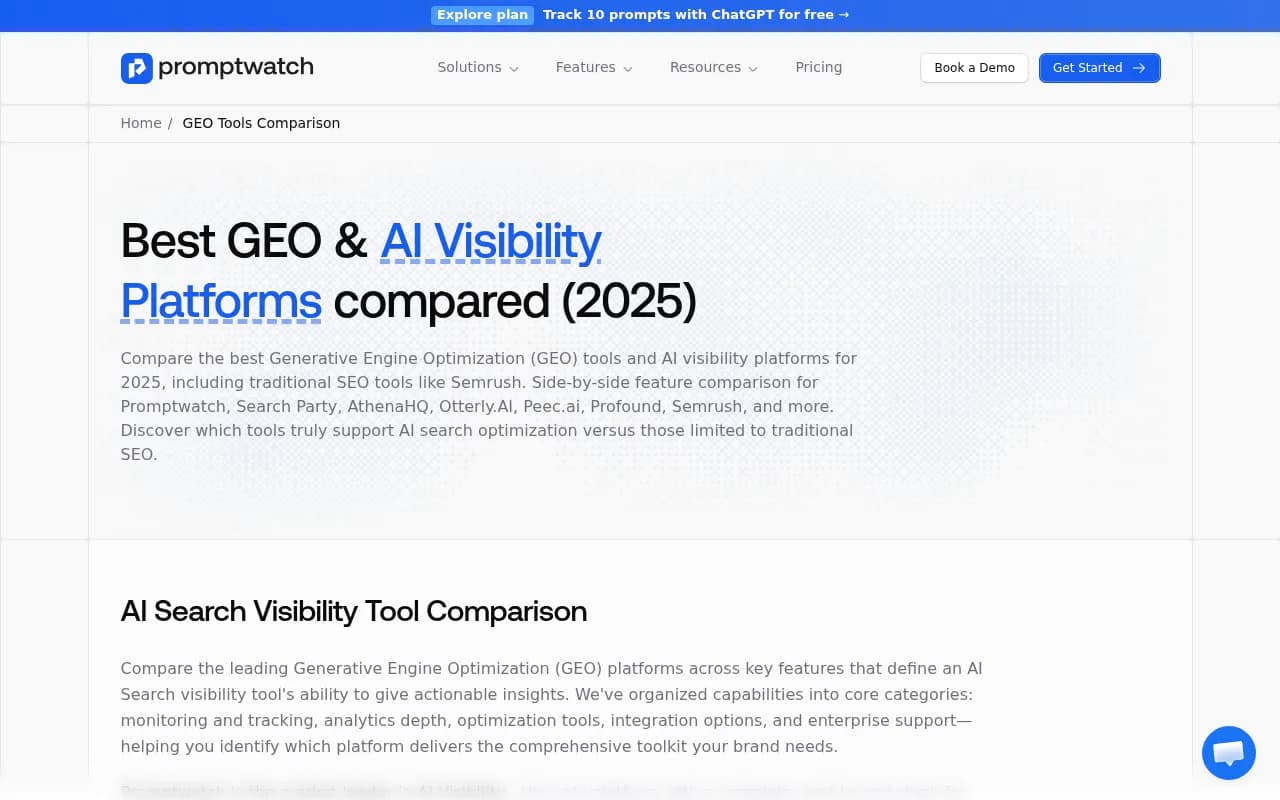
Peec.ai
Peec AI launched as one of the first dedicated AI visibility trackers, and it's earned a genuine following among teams that want clean, transparent monitoring without a lot of complexity.

What it does well
Peec.ai tracks brand mentions across ChatGPT, Perplexity, and Google AI Overviews. It shows citation frequency, source URLs, and competitive share of voice. Pricing starts around $100/month, which is among the more accessible entry points in the category. The platform also offers unlimited seats, which matters for teams where multiple people need to see the data without paying per-user fees.
The setup is straightforward. You define your prompts, Peec.ai runs them against the models, and you get a dashboard showing where you appear and where competitors do. For a team that just needs to answer "are we visible in AI search?", it does that job well.
Where it falls short
Peec.ai is a diagnosis tool. It tells you there's a problem. It doesn't help you fix it.
There's no content generation, no gap analysis that surfaces specific topics you're missing, no crawler logs showing how AI bots interact with your site. A review from Discovered Labs, based on testing across multiple client implementations, put it plainly: Peec AI "stops at diagnosis. It tracks mentions but doesn't write content, build authority signals, or implement technical optimizations needed to improve your numbers."
For teams that want to hand off optimization work to an agency anyway, this is fine. But for in-house marketing teams trying to move the needle themselves, monitoring-only means you're always waiting for someone else to interpret the data and tell you what to do next.
Who it's for
Peec.ai makes sense for smaller teams or early-stage companies that want to start tracking AI visibility without a big budget commitment. It's also reasonable as a secondary tool if you're already using a more capable platform and want a lightweight cross-check.
Searchable
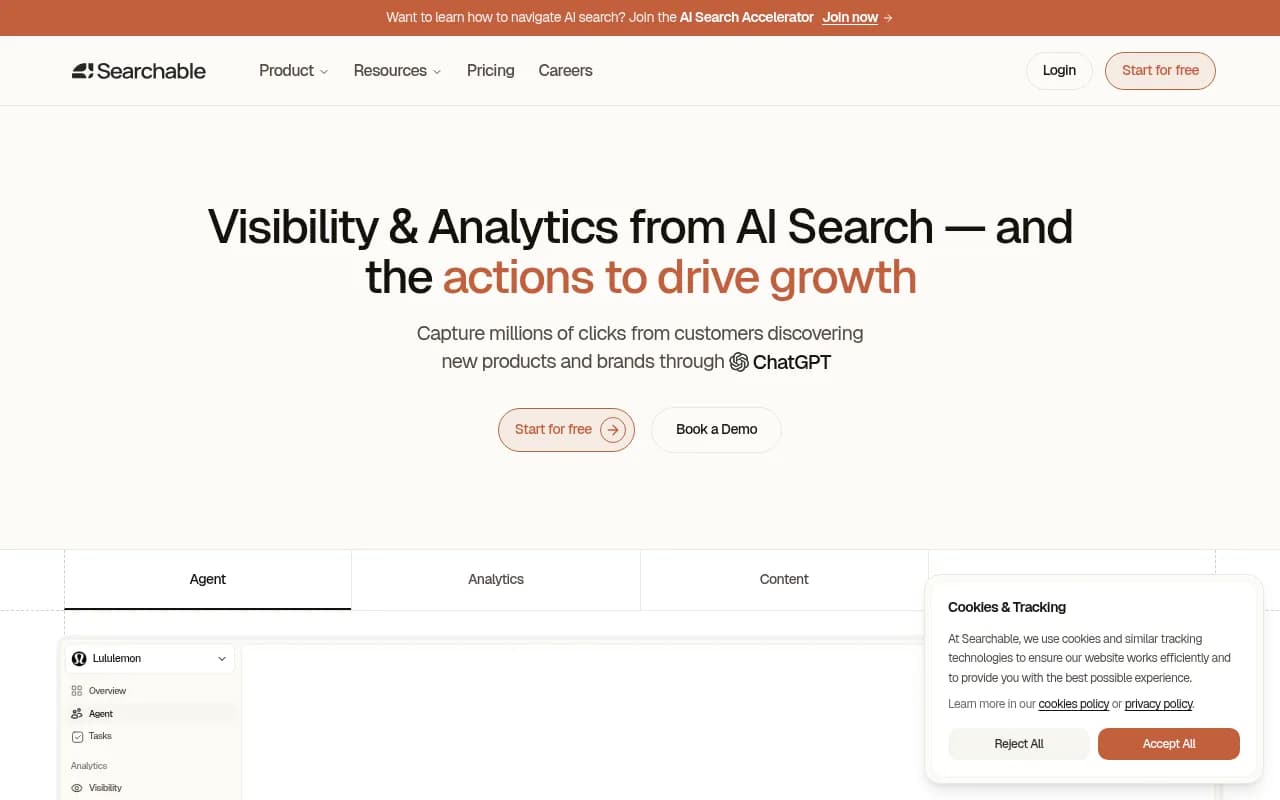
Searchable sits in a similar tier to Peec.ai -- a monitoring-focused platform that covers the basics of AI visibility tracking.
What it does well
Searchable tracks brand mentions across major AI models and provides share-of-voice metrics. It's positioned as accessible for teams that are newer to the GEO space and don't need enterprise-level complexity.
Where it falls short
Searchable is one of the thinner feature sets in the category. Compared to the other three platforms in this review, it lacks depth in analytics, has limited optimization tooling, and doesn't offer the crawler log visibility or content generation capabilities that more mature platforms provide. It's categorized as a "niche player" in Promptwatch's own competitive analysis of 12 platforms, which tracks.
For teams that need to go beyond basic monitoring, Searchable will feel limiting fairly quickly.
Who it's for
Searchable works for teams that are just getting started with AI visibility tracking and want something simple to get a baseline reading. It's not a long-term solution for brands that take AI search seriously.
Profound
Profound is the most enterprise-oriented of the four platforms. It has a polished interface, solid feature depth, and a clear focus on larger brands and agencies.

What it does well
Profound covers monitoring across multiple AI engines, provides competitive benchmarking, and has a cleaner UX than most competitors. It's one of the few platforms that takes brand tracking seriously at scale, with features designed for teams managing multiple brands or client accounts.
The platform also has decent analytics depth -- more than Peec.ai or Searchable -- and has invested in making the data actionable through reporting and dashboards.
Where it falls short
Profound's pricing is on the higher end, which makes it harder to justify for mid-market teams. More importantly, it's still primarily a monitoring and analytics platform. It doesn't offer the content generation capabilities or the full optimization workflow that the category is moving toward.
There's also no Reddit or YouTube tracking, no ChatGPT Shopping monitoring, and no AI crawler logs -- features that matter if you want to understand not just whether you're cited, but why AI models are or aren't finding your content.
Who it's for
Profound is a reasonable choice for larger enterprises or agencies that need polished reporting and are comfortable handling content optimization separately. If budget isn't a constraint and you have a content team that can act on the data independently, it works. But you're paying enterprise prices for a monitoring tool.
Promptwatch
Promptwatch is the platform that keeps coming up when people ask "which tool actually helps you improve your AI visibility, not just measure it."

What it does well
The core difference is the action loop. Most platforms show you a problem. Promptwatch shows you the problem, tells you exactly what's causing it, and gives you tools to fix it.
That loop works in three steps:
-
Answer Gap Analysis identifies the specific prompts where competitors are visible but you're not. Not just "you're missing here" -- it shows you the exact topics and questions AI models want answered that your site doesn't cover.
-
AI content generation produces articles, listicles, and comparisons grounded in real citation data. The platform has analyzed over 880 million citations, so the content it generates isn't generic filler -- it's built around what AI models actually cite.
-
Page-level tracking shows exactly which pages are being cited, by which models, and how often. Traffic attribution connects that visibility data to actual revenue through a code snippet, GSC integration, or server log analysis.
Beyond the core loop, Promptwatch also has AI crawler logs (real-time logs of ChatGPT, Claude, Perplexity, and other bots visiting your site), prompt volume and difficulty scoring, Reddit and YouTube source tracking, ChatGPT Shopping monitoring, and competitor heatmaps. It monitors 10 AI models including Google AI Overviews, Google AI Mode, Grok, DeepSeek, Mistral, and Meta AI.
After testing 15+ AI visibility platforms, the Generate More agency team named Promptwatch their top overall pick for B2B SaaS companies, citing daily tracking, attribution, and strategic intelligence as the differentiators.
Where it falls short
Promptwatch isn't the cheapest option. The Essential plan starts at $99/month for one site and 50 prompts. If you're a solo blogger or a very small team with minimal monitoring needs, that's a real cost. Peec.ai's entry point is comparable, but Promptwatch's higher tiers (Professional at $249/month, Business at $579/month) are priced for teams that are serious about optimization, not just tracking.
The platform is also more complex than Peec.ai or Searchable. There's more to set up, more to learn, and more decisions to make about how to use it. That's a feature if you want depth; it's friction if you just want a quick dashboard.
Who it's for
Promptwatch is built for marketing and SEO teams that want to move the needle on AI visibility, not just report on it. B2B SaaS companies, digital agencies managing multiple clients, and any brand in a competitive category where AI search is already driving meaningful traffic.
Head-to-head comparison
| Feature | Promptwatch | Profound | Peec.ai | Searchable |
|---|---|---|---|---|
| AI models monitored | 10 (ChatGPT, Claude, Gemini, Perplexity, Grok, DeepSeek, Mistral, Copilot, Google AI Overviews, Google AI Mode) | Multiple | ChatGPT, Perplexity, Google AI Overviews | Limited |
| Answer gap analysis | Yes | No | No | No |
| AI content generation | Yes (built-in writing agent) | No | No | No |
| AI crawler logs | Yes | No | No | No |
| Prompt volume & difficulty scoring | Yes | No | Limited | No |
| Reddit & YouTube tracking | Yes | No | No | No |
| ChatGPT Shopping tracking | Yes | No | No | No |
| Page-level citation tracking | Yes | Limited | No | No |
| Traffic attribution | Yes (GSC, code snippet, server logs) | No | No | No |
| Competitor heatmaps | Yes | Yes | Yes | Limited |
| Multi-language / multi-region | Yes | Yes | Yes | Limited |
| Starting price | $99/month | Higher | ~$100/month | Lower |
| Best for | Teams that want to improve AI visibility | Enterprise monitoring | Basic monitoring | Getting started |
The monitoring-only problem
It's worth being direct about something. Most of the debate in this category -- "which tool is better?" -- misses the more important question: "what do you actually need to do?"
If your goal is to understand your current AI visibility, any of these four tools will give you a number. But if your goal is to improve that number, the tool you pick determines whether you can act or whether you're stuck waiting for someone else to interpret the data.
The platforms that stop at monitoring are useful for reporting. They're not useful for optimization. And in a market where AI search traffic converts at 4.4x the rate of traditional organic search (according to 2025 industry data), the difference between measuring and improving is a real business outcome.
How to choose
A few honest heuristics:
If you're just starting out and want to understand your baseline AI visibility without spending much, Peec.ai is a reasonable starting point. It's transparent about what it does and doesn't do.
If you're at an enterprise with a dedicated content team and primarily need polished reporting for stakeholders, Profound is worth evaluating. Just go in knowing you'll need to handle optimization separately.
If you want to actually improve your AI visibility -- find the gaps, create content that gets cited, track the results, and connect it to revenue -- Promptwatch is the platform built for that workflow. The other three don't offer it.
Searchable is hard to recommend over the others at this point. It covers the basics, but so does Peec.ai at a comparable price, with more transparency and a larger user base.
Final thought
The AI visibility platform category is maturing. The monitoring-only tools that launched in 2023 and 2024 served a real purpose: they helped brands understand that AI search was happening and that they weren't in control of their own narrative.
But "understanding the problem" is table stakes now. The brands winning in AI search in 2026 are the ones that moved from tracking to optimizing. The platform you use to do that matters.