Key takeaways
- Answer gap analysis varies dramatically across platforms: some show you which prompts competitors win; others go further and tell you exactly what content to create to close those gaps.
- Promptwatch is the only platform in this comparison that combines gap detection with built-in content generation, letting you act on findings without switching tools.
- Profound has strong analytics depth but is monitoring-only and priced significantly above market rate, with key features locked behind Enterprise tiers.
- Peec AI is a clean, reliable monitoring tool with strong multi-language support, but it stops at observation -- there's no content layer.
- Searchable covers the basics but lacks the prompt intelligence depth and action features of the other three platforms.
- If you need to close the loop from "we're invisible here" to "we published something that fixed it," Promptwatch is the clearest path.
Answer gap analysis sounds simple: find the prompts where your competitors show up in AI answers and you don't. But the difference between platforms doing this well and doing it badly is enormous -- and it directly affects whether the data you're paying for is actually useful.
Some tools show you a list of missed prompts and call it a day. Others dig into why you're missing, what content would fix it, and how to prioritize. This guide compares four platforms -- Profound, Promptwatch, Peec AI, and Searchable -- specifically on the quality and usefulness of their answer gap analysis in 2026.
What "answer gap analysis" actually means
Before comparing tools, it's worth being precise about what we're evaluating. Answer gap analysis in the context of AI search visibility means:
- Running a set of prompts through AI models (ChatGPT, Perplexity, Claude, Gemini, etc.)
- Identifying which prompts return competitor mentions but not yours
- Understanding why -- is it a missing page, a weak citation signal, a topic you haven't covered?
- Knowing what to do about it
Most platforms nail steps 1 and 2. Steps 3 and 4 are where they diverge sharply. A tool that only does steps 1-2 is a monitoring dashboard. A tool that does all four is an optimization platform.
Platform overview
Profound

Profound is one of the more established names in AI visibility tracking. It covers 10+ AI engines at higher tiers and has solid analytics for enterprise teams. The data quality is generally regarded as reliable, and its competitive benchmarking features are detailed.
The core limitation is that Profound is built around observation. It will show you the gaps, but it won't help you fill them. There's no content generation layer, no built-in writing tools, and the features that matter most for actually acting on gap data tend to be locked behind Enterprise pricing. One independent review noted Profound costs roughly 48% above market rate for comparable monitoring functionality.
For teams that already have a strong content operation and just need reliable data piped in, Profound works. For teams that need the full loop -- find gap, create content, track improvement -- it's only half the solution.
Promptwatch

Promptwatch is the platform most directly built around the full answer gap cycle. Its Answer Gap Analysis feature identifies specific prompts where competitors appear but you don't, and it surfaces the exact topics and content angles that AI models are looking for but can't find on your site.
What separates it from the others is what happens next. The built-in AI writing agent generates articles, listicles, and comparison pages grounded in real citation data -- over 880 million citations analyzed -- so the content it produces is engineered to get cited, not just written to fill a brief. You can go from "we're invisible for this prompt" to "we have a published article targeting it" without leaving the platform.
Promptwatch also adds context that makes gap analysis more useful: prompt volume estimates, difficulty scores, and query fan-outs that show how a single prompt branches into sub-queries. That means you can prioritize gaps by how much traffic they're likely to drive, not just by how many competitors beat you there.
The platform monitors 10 AI models including ChatGPT, Claude, Perplexity, Gemini, Grok, DeepSeek, and Google AI Overviews. It also includes AI crawler logs -- real-time data on which AI bots are visiting your pages, how often, and what errors they're hitting. That's a feature most competitors don't offer at all.
Pricing starts at $99/month for the Essential plan (1 site, 50 prompts, 5 articles). Professional is $249/month and adds crawler logs, state/city tracking, and 150 prompts.
Peec AI

Peec AI is a Berlin-based monitoring platform that uses UI scraping to interact with AI models the way real users do. The result is accurate, authentic response data -- particularly strong for multi-language and regional tracking. If you're running campaigns across multiple countries and need reliable visibility data in different languages, Peec AI is one of the better options.
The platform covers ChatGPT, Perplexity, and Google AI on its base plan, with additional models at higher tiers. The interface is clean and intuitive, which matters when you're trying to get a team up to speed quickly. Customer support is notably responsive -- direct Slack access to founders on lower tiers.
Where Peec AI falls short is the same place most monitoring tools do: it stops at the data. There's no content creation layer, no gap-to-content workflow, and no crawler log visibility. It tells you what's happening but leaves you to figure out what to do about it. For teams with a separate content operation, that's fine. For teams that want everything in one place, it's a gap.
Searchable
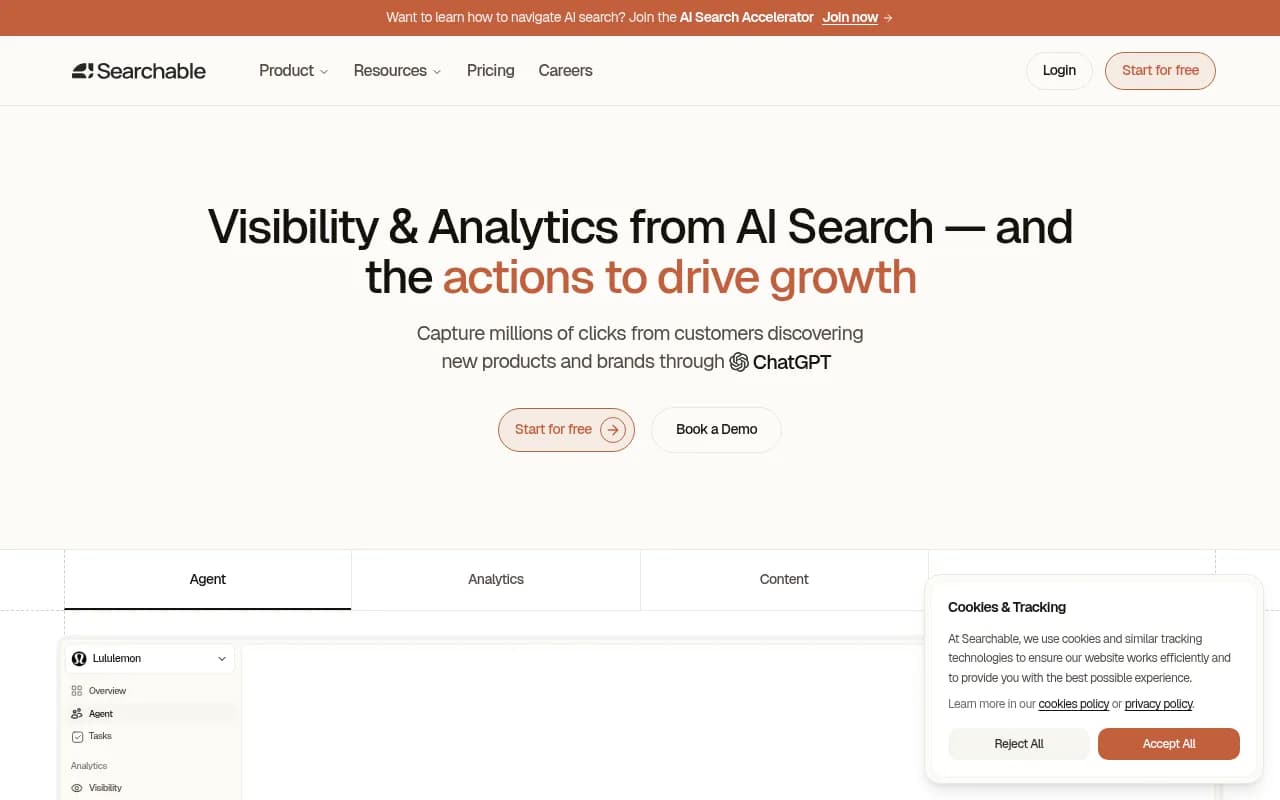
Searchable covers AI search visibility monitoring with a focus on brand tracking and content tools. It's a reasonable option for teams getting started with GEO, and it handles the basics of tracking brand mentions across AI platforms.
The honest assessment is that Searchable is a tier below the other three platforms in this comparison when it comes to answer gap analysis specifically. Prompt intelligence -- volume estimates, difficulty scoring, query fan-outs -- is limited compared to Profound or Promptwatch. The content tools exist but aren't as deeply integrated with citation data. It's a capable entry-level platform, but if answer gap analysis is your primary use case, you'll likely outgrow it.
Head-to-head comparison
| Feature | Profound | Promptwatch | Peec AI | Searchable |
|---|---|---|---|---|
| AI models covered | 10+ (Growth+) | 10 | 3 (base), more on higher tiers | Multiple |
| Answer gap detection | Yes | Yes | Yes | Basic |
| Prompt volume/difficulty scoring | Limited | Yes | No | No |
| Query fan-outs | No | Yes | No | No |
| Content generation from gaps | No | Yes (built-in AI writer) | No | Limited |
| AI crawler logs | No | Yes (Professional+) | No | No |
| Reddit/YouTube citation tracking | No | Yes | No | No |
| ChatGPT Shopping tracking | No | Yes | No | No |
| Multi-language/region | Yes | Yes | Strong | Basic |
| Traffic attribution | No | Yes (GSC, snippet, server logs) | No | No |
| Starting price | ~$150/mo (est.) | $99/mo | $95/mo | Varies |
| Free trial | Yes | Yes | 7-day | Yes |
| Best for | Enterprise analytics | Full optimization loop | Multi-language monitoring | Entry-level tracking |
Where each platform wins on gap analysis
Profound: best raw data depth
If you need granular competitive benchmarking across many AI engines and you have a team that can act on raw data independently, Profound's analytics are hard to beat. The coverage at higher tiers is extensive, and the data quality is reliable.
The catch is that "best data" doesn't automatically mean "most useful." Data without an action layer means your team has to do the translation work manually -- identify the gap, brief a writer, publish the content, then come back to the platform to see if it moved. That's a slow loop.
Promptwatch: best end-to-end gap workflow
For teams that want to close the loop without stitching together multiple tools, Promptwatch is the strongest option. The gap analysis itself is solid -- prompt-level visibility data, competitor comparisons, and the context of why you're missing (topic coverage, citation signals). But the real differentiator is what comes after: you can generate the content to fix the gap directly in the platform, then track whether it improves your visibility scores over time.
The prompt volume and difficulty scoring also makes prioritization practical. Instead of staring at a list of 200 gaps and guessing where to start, you can sort by estimated traffic and difficulty to find the high-value, winnable prompts first.
Peec AI: best for accuracy in non-English markets
Peec AI's UI scraping approach -- interacting with AI models exactly as a real user would -- produces particularly reliable data for regional and language-specific queries. If your gap analysis needs to be accurate in French, German, Spanish, or other languages, Peec AI has a real edge here.
The limitation is that gap analysis in Peec AI is observational. You'll know you're missing prompts in the German market. You won't get a built-in path to fix it.
Searchable: best for teams just starting out
Searchable is the most accessible entry point in this comparison. If you're a smaller team that needs basic gap visibility without a steep learning curve or a high price tag, it covers the fundamentals. Just know that as your GEO program matures, you'll likely need more prompt intelligence and a tighter content workflow than Searchable provides.
The question most teams don't ask
When evaluating answer gap analysis tools, most teams focus on accuracy: "Does this platform correctly identify where I'm missing?" That's important, but it's not the only question.
The more useful question is: "What happens after I find the gap?"
A platform that shows you 50 gaps but leaves you to figure out the content strategy, brief writers, publish, and manually re-check visibility is doing half the job. A platform that shows you 50 gaps, scores them by priority, generates the content to address them, and then tracks whether your visibility improved is doing the whole job.
That distinction is why the monitoring-only tools -- even good ones like Peec AI and Profound -- have a ceiling for teams that are serious about improving their AI search presence, not just measuring it.
Practical recommendation by use case
If you're an enterprise team with a large content operation and you just need reliable data to feed into your existing workflow, Profound is worth evaluating despite the price premium. The analytics depth is real.
If you're a marketing or SEO team that needs to both find gaps and fix them -- and you don't want to manage three separate tools to do it -- Promptwatch is the most complete option. The combination of gap detection, prompt scoring, content generation, and traffic attribution in one platform is genuinely useful, not just a feature list.
If your primary concern is multi-language accuracy and you have a separate content team to act on the data, Peec AI is a strong monitoring choice at a competitive price.
If you're just getting started with GEO and need something accessible to build a baseline, Searchable gets you moving without a large investment.
A note on what "accurate" really means here
One thing worth flagging: no platform has perfect accuracy in answer gap analysis, because AI models themselves are non-deterministic. The same prompt can return different results on different days, in different sessions, with different system prompts. What you're really measuring is a statistical picture of visibility over time, not a precise ranking.
The platforms that handle this best are the ones that run queries at scale, average results across multiple sessions, and give you trend data rather than point-in-time snapshots. Promptwatch and Profound both do this reasonably well. Peec AI's UI scraping approach captures authentic responses but is inherently session-dependent.
The practical implication: treat gap analysis data as directional intelligence, not ground truth. The goal is to identify patterns -- topics you consistently miss, competitors that consistently outrank you -- and act on those patterns. Any platform that presents its gap data as perfectly precise is overstating what's technically possible.
Bottom line
Answer gap analysis is only as valuable as what you do with it. Profound and Peec AI give you good data. Promptwatch gives you good data and a path to act on it. Searchable gives you a starting point.
For most marketing and SEO teams in 2026, the gap between "we know where we're invisible" and "we fixed it" is where programs stall. The platforms that close that gap -- literally -- are the ones worth investing in.
Promptwatch is the clearest option if you want the full loop. Peec AI is the right call if multi-language monitoring is your priority and you have a content team ready to execute. Profound makes sense if you're enterprise-scale and need the deepest analytics. Searchable works if you're just starting out.