Key takeaways
- Peec.ai and Hall AI are solid monitoring tools for specific use cases -- Peec.ai for citation benchmarking, Hall AI for AI referral traffic tracking
- Neither Peec.ai nor Hall AI helps you act on what you find: there's no content gap analysis, no content generation, and no way to close the loop from insight to improvement
- Promptwatch is the only one of the three that covers the full cycle: find gaps, generate content, track results, and attribute revenue
- If your team is past the "just curious" stage and actually needs to grow AI visibility, the tool you pick matters a lot
- All three had paying customers in 2025 -- but for very different reasons
In 2025, a lot of marketing teams went through the same awkward phase: they knew AI search was becoming important, they weren't sure how to measure it, and they started signing up for whatever tools seemed credible.
Peec.ai, Hall AI, and Promptwatch all picked up users during that window. They're all loosely described as "AI visibility tools," but they solve pretty different problems. Calling them competitors is a bit like calling a thermometer and a doctor the same thing because both deal with health.
This guide breaks down what each tool actually does, where it falls short, and which one makes sense depending on where your team is right now.
What each tool is actually built for
Before comparing features, it helps to understand the core job each tool was designed to do.
Peec.ai: citation monitoring and competitive benchmarking
Peec.ai is built around one central question: "When someone asks an AI a question in my category, does my brand get mentioned?"
It monitors multiple AI engines (ChatGPT, Perplexity, Google AI Overviews, and others), tracks citation frequency, and lets you benchmark your brand against competitors. The interface is clean. Setup is fast. You can run multi-client projects, which makes it popular with agencies.
What it does well: giving you a clear picture of where you stand relative to competitors across AI platforms. The competitive comparison features are genuinely useful for benchmarking reports.
What it doesn't do: tell you why you're missing, what content would fix it, or help you create that content.

Hall AI: AI referral traffic tracking
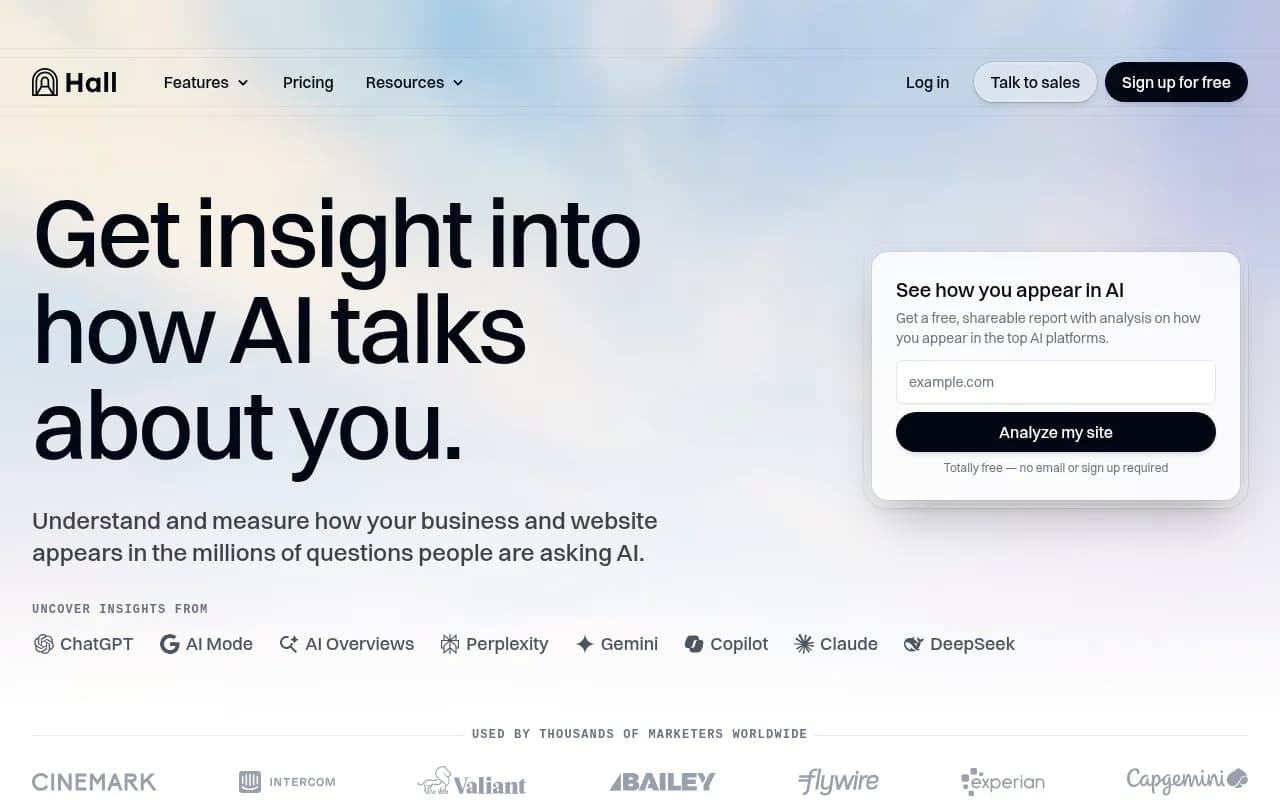
Hall AI approaches the problem from a different angle. Rather than asking "does AI mention us?", it asks "is AI sending us traffic?"
It tracks referral visits from AI platforms, shows you which AI tools are sending users to your site, and provides what it calls "AI agent reports." There's a generous free plan, and paid plans start at $199/month. For teams that primarily care about traffic attribution from AI sources, it's one of the more focused tools available.
The limitation is the flip side of that focus: Hall AI is essentially a traffic analytics layer. It can tell you that Perplexity sent 47 visitors last week, but it can't tell you which prompts triggered those visits, which competitors are getting cited instead of you, or what you'd need to publish to change that.
Promptwatch: the full optimization loop
Promptwatch is built around a different premise entirely. Monitoring is just the starting point. The real value is in what happens after you see the data.
The platform covers three stages: finding gaps (which prompts are your competitors visible for but you're not), creating content to close those gaps (a built-in AI writing agent that generates articles grounded in citation data), and tracking whether that content actually moved the needle. Traffic attribution connects visibility scores to real revenue through a code snippet, Google Search Console integration, or server log analysis.
That's a meaningfully different product category. Peec.ai and Hall AI show you a dashboard. Promptwatch runs a workflow.

Feature comparison
Here's how the three tools stack up across the capabilities that actually matter for a team trying to grow AI visibility:
| Feature | Peec.ai | Hall AI | Promptwatch |
|---|---|---|---|
| AI mention/citation monitoring | Yes | Partial (traffic-focused) | Yes (10 AI models) |
| Competitor benchmarking | Yes | No | Yes |
| Content gap analysis | No | No | Yes (Answer Gap Analysis) |
| AI content generation | No | No | Yes (built-in writing agent) |
| AI crawler logs | No | No | Yes |
| Prompt volume & difficulty scoring | No | No | Yes |
| AI referral traffic tracking | No | Yes | Yes (via GSC, snippet, logs) |
| Reddit & YouTube citation insights | No | No | Yes |
| ChatGPT Shopping tracking | No | No | Yes |
| Multi-language / multi-region | Yes | No | Yes |
| Agency/multi-client support | Yes | Limited | Yes |
| Free plan | Yes (limited) | Yes (generous) | Free trial |
| Starting price | ~$49/mo | $199/mo (paid) | $99/mo |
The pattern is clear: Peec.ai and Hall AI each do one thing well. Promptwatch covers the full surface area, including several capabilities (crawler logs, prompt intelligence, ChatGPT Shopping, Reddit tracking) that neither competitor offers at all.
Where Peec.ai genuinely shines
It would be unfair to dismiss Peec.ai. For teams that need clean, shareable competitive benchmarking reports, it's one of the better options in the market. The multi-client project structure works well for agencies producing monthly reports. The prompt suggestion feature helps teams who aren't sure what to monitor. And the unlimited seats model means you're not paying per user, which matters for larger teams.
Multiple independent reviewers testing 20+ AI visibility tools have flagged Peec.ai as strong for competitive comparison and agency reporting. That reputation is earned.
The honest caveat: it's a benchmarking tool. If your goal is to understand the competitive landscape and report on it, Peec.ai is solid. If your goal is to actually improve your position in that landscape, you'll quickly hit a wall. There's no path from "we're not being cited for this prompt" to "here's what we should publish."
Where Hall AI genuinely shines
Hall AI's free plan is legitimately useful for teams just getting started. If you've never looked at AI referral traffic before, Hall AI gives you a quick, low-friction way to see which AI platforms are sending visitors to your site. The weekly update cadence is fine for teams that don't need real-time data.
For very small teams or solo marketers who just want to know "is AI driving any traffic to us at all?", Hall AI is a reasonable starting point. It's not trying to be a comprehensive platform.
The limitation becomes obvious once you want to do anything beyond passive monitoring. Hall AI doesn't tell you which prompts are driving that traffic, which competitors are getting cited in the same conversations, or what content gaps you need to fill. It's a rear-view mirror, not a navigation system.
The core problem with monitoring-only tools
Both Peec.ai and Hall AI share the same fundamental limitation: they stop at observation.
This matters more than it might seem. In 2025, a lot of teams signed up for monitoring tools, got their dashboards set up, and then... sat there. They could see that competitors were being cited more often. They could see that their AI referral traffic was low. But the tool offered no path forward.
The question "why aren't we being cited?" requires understanding what content AI models are actually pulling from, which topics they associate with your category, and what your site is missing relative to competitors. The question "what should we publish?" requires prompt volume data, citation analysis across hundreds of millions of responses, and ideally a writing tool that can produce content specifically engineered to get cited.
Monitoring-only tools generate reports. Optimization platforms generate results.
Who should use each tool
Use Peec.ai if:
- You're an agency producing competitive benchmarking reports for clients
- You need multi-client project management with clean exports
- Your primary deliverable is "here's how we compare to competitors in AI search"
- You're not yet at the stage of actively trying to improve visibility
Use Hall AI if:
- You're just starting to explore AI visibility and want a free entry point
- Your main question is "is AI sending us any traffic at all?"
- You have a very small team and a very limited budget
- You don't need competitive data or content optimization
Use Promptwatch if:
- You've moved past curiosity and need to actually grow AI visibility
- You want to know which specific prompts you're losing to competitors
- You need content that's built to get cited by ChatGPT, Claude, and Perplexity
- You want to connect AI visibility to actual revenue, not just impressions
- You're running an agency and need to show clients measurable improvement over time
Pricing reality check
Peec.ai's entry pricing is lower than Promptwatch's, which makes it attractive for teams with tight budgets. But price-per-feature math changes quickly. A team paying $49/month for Peec.ai still needs to figure out content strategy, content creation, and traffic attribution separately. Those costs add up fast.
Promptwatch's Essential plan at $99/month includes 50 prompts, 5 AI-generated articles per month, and the full monitoring stack. The Professional plan at $249/month adds crawler logs, city/state tracking, and 15 articles. For teams that would otherwise be paying for a monitoring tool plus a content tool plus an analytics layer, the consolidated pricing often works out cheaper.
Hall AI's paid plans starting at $199/month are harder to justify given the narrow feature set. The free plan is worth using; the paid tier is a tougher sell unless AI referral traffic tracking is your specific, isolated need.
What the research actually shows
Independent reviews from 2025 consistently describe Peec.ai as "great for competitive comparison" and "agency reporting friendly" but note it's "more about benchmarking than fixing." That's an accurate description. Hall AI gets credit for its free plan and traffic-focused approach but rarely appears in lists of tools teams use to actually improve their AI visibility.
Promptwatch's positioning as the only platform rated "Leader" across all categories in a 2026 comparison of 12 GEO platforms reflects a real difference in scope. The 1.1 billion citations processed and the 6,700+ brands using the platform (including Booking.com and Center Parcs) give its citation data a depth that smaller monitoring tools simply can't match.
The honest verdict
In 2025, Peec.ai and Hall AI were worth paying for if your needs matched their specific strengths. Peec.ai earned its place in agency workflows for competitive reporting. Hall AI was a reasonable free tool for teams dipping their toes in.
But "worth paying for" depends entirely on what you're trying to accomplish. If you needed to show a client a competitive benchmark, Peec.ai was fine. If you needed to actually move the needle on AI visibility, neither tool gave you the means to do it.
Promptwatch is the only one of the three that treats AI visibility as something to be improved, not just observed. The gap analysis, content generation, crawler logs, and revenue attribution aren't extras bolted onto a monitoring dashboard. They're the core product. That's a different tool for a different stage of maturity.
Most teams that started with Peec.ai or Hall AI in 2025 eventually hit the same wall: great data, no clear path to action. The tools that survive 2026 will be the ones that help you do something with what you find.