Key takeaways
- Persona-based tracking lets you simulate how different buyer types (job titles, locations, intent stages) experience AI search results -- it's not just a nice-to-have anymore.
- Peec.ai offers smart prompt suggestions and a clean interface, but its persona customization is relatively shallow compared to the other two.
- Conductor integrates AI visibility into a broader content intelligence suite, with solid persona grouping tied to intent and topic clusters.
- Promptwatch goes furthest on persona customization -- you can define custom personas by country, language, and prompt type, then track visibility changes per persona over time and tie them to actual traffic.
- If your goal is to monitor and report, Peec.ai or Conductor may be enough. If you want to close the loop from persona insight to content fix to measurable result, Promptwatch is the clearest path.
Persona-based tracking sounds like a feature footnote. It isn't. The whole premise of AI search visibility is that different people ask different questions -- and the AI gives different answers depending on who's asking, where they are, and how they phrase the query. A CMO in London asking "what's the best B2B analytics platform" gets a different ChatGPT response than a growth marketer in São Paulo asking the same thing in Portuguese.
If your AI visibility tool treats all prompts the same, you're flying blind on a huge chunk of your actual audience.
In 2025, three tools got serious attention for persona-based tracking: Peec.ai, Conductor, and Promptwatch. This guide breaks down how each one actually handles it -- not the marketing copy, but the mechanics -- and which one made the most sense depending on what you're trying to do.
What "persona-based tracking" actually means in AI visibility
Before comparing tools, it's worth being precise about what we mean. Persona-based tracking in AI visibility covers a few distinct things:
- Simulating prompts as different user types (e.g., a procurement manager vs. an end user)
- Running those prompts from different geographic locations or in different languages
- Grouping prompt results by intent stage (awareness, consideration, decision)
- Tracking how visibility changes per persona over time
- Connecting persona-level visibility to actual traffic or revenue
Most tools in 2025 did some version of the first two. Very few did all five. That gap is where the real differences between Peec.ai, Conductor, and Promptwatch show up.
Peec.ai: smart suggestions, lighter persona depth
Peec.ai built its reputation on being genuinely easy to use. When you set up a project, it doesn't dump you into a blank prompt builder -- it suggests relevant prompts and competitors based on your industry. That's a real time-saver, especially for teams new to GEO.

On persona tracking specifically, Peec.ai lets you run prompts across multiple AI models (ChatGPT, Perplexity, Gemini, and others) and compare how your brand appears in each. You can set up separate projects for different markets or languages, which functions as a rough proxy for persona segmentation. If you have a US audience and a German audience, you create two projects and compare results.
What Peec.ai doesn't do well is structured persona definition. There's no built-in way to say "track this set of prompts as a CFO in the financial services sector" and then compare that against "track these prompts as an IT manager in manufacturing." The segmentation is more manual -- you're essentially doing it yourself through how you organize your prompt lists.
For smaller teams or agencies managing a handful of clients, that's workable. You build the structure yourself and it's not that complicated. But if you're running persona-based tracking across multiple buyer types, multiple regions, and multiple AI models simultaneously, the manual overhead adds up fast.
Peec.ai's citation analysis is genuinely good -- it shows you which sources AI models are pulling from and how often your brand appears. That's useful context even if the persona layer is thin.
Conductor: persona tracking inside a content intelligence platform
Conductor comes at this from a different angle. It's not a pure-play AI visibility tool -- it's a content intelligence platform that added AI visibility tracking as AI search became impossible to ignore. That context matters because it shapes how persona tracking works inside the product.
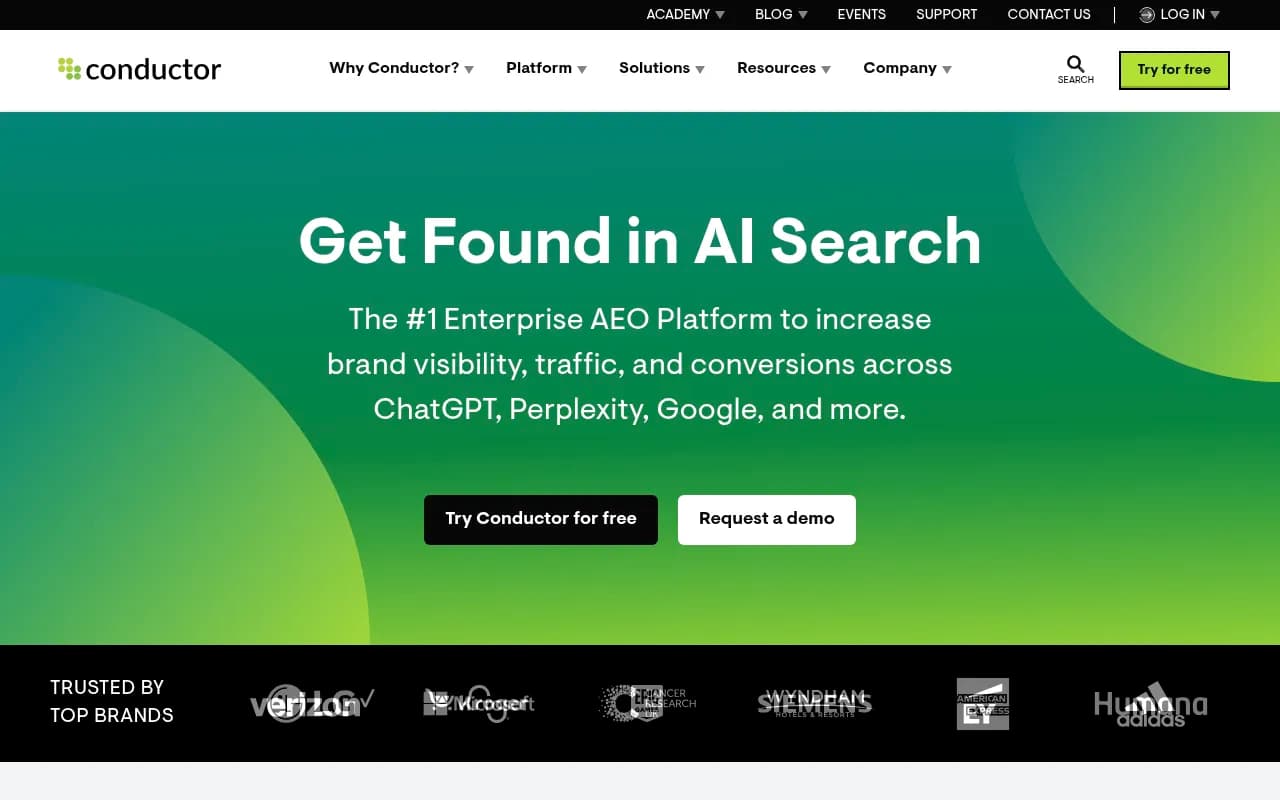
Conductor's strength is grouping prompts by user persona and intent, then tying those groups to topic clusters. If you've already mapped out your content strategy by audience segment, Conductor lets you layer AI visibility data on top of that existing structure. A team that already thinks in terms of "awareness-stage CFO content" vs. "decision-stage IT buyer content" will find Conductor's organization intuitive.
The integrations are a genuine differentiator here. Conductor connects with Google Search Console and GA4, which means you can see traditional search performance and AI visibility in the same view, segmented by the same audience buckets. That's a meaningful workflow improvement over tools that live in isolation.
Where Conductor gets complicated is depth. The AI visibility features feel like a solid addition to a content platform rather than a purpose-built tracking system. The persona definitions are tied to how you've set up your content strategy -- which is great if that's already well-structured, but adds friction if you're trying to do exploratory persona testing. You're working within Conductor's content framework, not building a freestanding persona model.
Pricing also reflects its enterprise positioning. Conductor isn't cheap, and smaller teams may find they're paying for a lot of content intelligence infrastructure they don't need just to get the AI visibility features.
Promptwatch: persona customization built into the core tracking loop
Promptwatch was designed from the start around the idea that different people ask different questions, and that AI visibility only makes sense when you track it through that lens.

The persona system in Promptwatch lets you define custom personas with specific attributes: country, language, and the type of prompts that persona would realistically ask. You're not just switching languages -- you're building a model of how a specific buyer type interacts with AI search, then tracking your brand's visibility through that model consistently over time.
This matters more than it sounds. A persona set up as a mid-market IT decision-maker in the UK will generate different prompt results than a persona set up as a small business owner in Australia, even if the underlying topic is the same. Promptwatch tracks both, separately, and shows you how your visibility score changes per persona as you publish new content or your competitors shift their strategy.
The other piece that separates Promptwatch on persona tracking is what happens after you see the data. Most tools show you where you're invisible to a given persona and leave you to figure out what to do next. Promptwatch's Answer Gap Analysis shows you the specific prompts where competitors are visible to that persona but you aren't -- and the built-in content generation tool creates articles and pages designed to close those gaps. The content isn't generic; it's grounded in citation data from 880M+ analyzed citations, so it's engineered to get picked up by the AI models your target persona uses.
The traffic attribution layer closes the loop: you can connect AI visibility improvements to actual site traffic using a code snippet, GSC integration, or server log analysis. So you're not just tracking persona-level visibility in the abstract -- you're watching it translate into measurable outcomes.
For teams managing multiple brands or markets, Promptwatch's multi-language and multi-region support means you can run genuinely distinct persona setups without creating separate accounts or manual workarounds.
Side-by-side comparison
| Feature | Peec.ai | Conductor | Promptwatch |
|---|---|---|---|
| Custom persona definitions | Basic (project-level) | Yes, tied to content strategy | Yes, with country/language/prompt type |
| Multi-language tracking | Yes | Yes (via GSC integration) | Yes, native multi-language |
| Multi-region tracking | Partial | Yes | Yes, city/state level on higher plans |
| Intent-based prompt grouping | Manual | Yes, built-in | Yes, with prompt volume + difficulty |
| AI models tracked | Multiple | Multiple | 10+ (ChatGPT, Claude, Gemini, Perplexity, Grok, DeepSeek, Copilot, Mistral, Meta AI, Google AI Overviews) |
| Citation analysis | Strong | Moderate | Strong (880M+ citations) |
| Content gap analysis | No | Partial | Yes (Answer Gap Analysis) |
| AI content generation | No | No | Yes (built-in writing agent) |
| Traffic attribution | No | Yes (GSC/GA4) | Yes (snippet, GSC, server logs) |
| AI crawler logs | No | No | Yes (Professional plan+) |
| Reddit/YouTube tracking | No | No | Yes |
| ChatGPT Shopping tracking | No | No | Yes |
| Pricing (entry) | Lower | Enterprise | $99/mo (Essential) |
| Free trial | Yes | Demo-based | Yes |
Which one fits which situation
The honest answer is that these tools serve different stages of maturity and different organizational needs.
Peec.ai makes sense if you're early in your AI visibility journey and want a tool that gets you oriented quickly without a steep learning curve. The prompt suggestions are genuinely helpful, the interface is clean, and you can get meaningful citation data without a lot of setup. The persona tracking is thin, but if you're managing one or two markets and don't need granular buyer-type segmentation, that's probably fine.
Conductor makes sense if you're already invested in a content intelligence workflow and want AI visibility to slot into that existing structure. The GSC and GA4 integrations are real advantages, and the intent-based prompt grouping will feel natural to teams that already think in audience segments. The limitation is that you're working within Conductor's framework -- it's not built for exploratory persona testing or rapid iteration on new audience segments.
Promptwatch makes sense if persona-based tracking is actually central to your strategy rather than a reporting checkbox. The ability to define personas with real specificity, track visibility per persona over time, identify content gaps per persona, generate content to close those gaps, and then measure whether it worked -- that's a complete loop that the other two tools don't offer end-to-end.
For agencies managing multiple clients across different markets, Promptwatch's multi-site and multi-language support also scales more cleanly. You're not building manual workarounds to simulate persona differences -- the system is built for it.
The deeper question: monitoring vs. optimization
The persona tracking comparison exposes a broader difference between these tools. Peec.ai and Conductor are primarily monitoring platforms. They show you data about how your brand appears in AI search, organized in ways that are more or less useful depending on the tool.
Promptwatch is built around optimization. The monitoring is there -- it's good monitoring -- but the product is designed around the assumption that seeing the data is only useful if you can do something about it. The Answer Gap Analysis, the content generation, the traffic attribution: these aren't add-ons. They're the point.
That distinction matters more as AI search matures. In 2024 and early 2025, knowing your AI visibility score was novel enough to be valuable on its own. By mid-2025, the question shifted: "We know we're invisible to this persona -- now what?" Tools that answer that question are worth more than tools that just confirm the problem.
Bottom line
If you want the most capable persona-based tracking in 2025, Promptwatch wins on depth, flexibility, and what you can actually do with the data. Conductor is a solid choice if you're already in its ecosystem and want AI visibility layered onto content intelligence. Peec.ai is the easiest starting point but the shallowest on persona specificity.
The right choice depends on whether you need a dashboard or a workflow. For most teams serious about AI search visibility, the answer is increasingly the latter.