Key takeaways
- Meta AI lives inside WhatsApp, Instagram, Facebook and Messenger, so its answers are personalized and hard to reproduce. One manual check proves nothing; repeated sampling does.
- Sentiment is a different question from visibility. You can be mentioned in every answer and still be described as the "alternative worth considering" while a rival gets "the leading solution".
- Very few AI visibility tools explicitly cover Meta AI. Knowatoa has a dedicated Meta AI page; most others (Otterly, for one) list ChatGPT, Perplexity, Gemini and AI Overviews. Check each vendor before you buy.
- Don't assume what is true for ChatGPT holds for Meta AI. Promptwatch Data shows each AI engine has a very different social source mix.
- A workable program is: build a prompt set, sample it repeatedly, score tone against competitors, trace the sources, fix the content, and re-measure.
Why Meta AI sentiment is worth tracking at all
Most brand monitoring conversations about AI focus on ChatGPT and Google. Meta AI gets less attention, which is a mistake for some categories. Knowatoa's Meta AI page cites over 1 billion monthly users across Facebook, Instagram, WhatsApp and Messenger, with roughly 63% of interactions happening on WhatsApp. Treat those as vendor-reported figures, but the direction is clear: people ask Meta AI for restaurant picks, product advice and local services in the middle of a chat with friends.
That context changes what sentiment means. A recommendation inside a group chat is not a search result a person scrolls past. It is a sentence that a friend reads and acts on. If Meta AI describes your brand with caveats, that tone travels.
I'd also be honest about what we don't know. Meta has not published documentation on how Meta AI chooses sources or forms an opinion about a brand. Anything you read claiming to explain its ranking logic is inference. What you can do is measure the outputs, and that is the whole point of this guide.
Visibility versus sentiment
These two get conflated constantly.
- Visibility asks: does Meta AI mention my brand, how often, and in what position?
- Sentiment asks: when it does mention me, is the language enthusiastic, neutral, hedged or negative, and is it accurate?
OtterlyAI's March 2026 write-up on brand sentiment makes a useful point here. A competitor can beat you on raw mention volume yet carry a weaker sentiment score, which gives you a way to win on quality of perception even if you trail on quantity. The reverse is also true, and it is the more painful version: you show up everywhere, described tepidly.
The scores you will see in tools
There is no standard. Three styles are common:
- Net Sentiment Score, which balances positive against negative mentions on a scale from -100 to +100 (Otterly's approach).
- Average sentiment as a percentage. Rank Math's AI Visibility shows, for example, 61% for one tracked product and 74% for another.
- A 0-100 score where roughly 50 is neutral, which is how Promptwatch reports it.
So never compare numbers across tools. Compare your brand to your competitors inside one tool.
Step 1: Build a prompt set that reflects real buyers
Start with 15 to 30 questions a real customer would ask. A Quora answer I liked suggests roughly 15 buyer questions, run in a fresh chat each time, noting whether you show up, whether you are recommended, and whether the facts are right. That is a good baseline.
Split them into four groups:
- Category prompts: "What are the best project management tools for small agencies?"
- Brand prompts: "Is [your brand] any good?" and "What are the downsides of [your brand]?"
- Comparison prompts: "[Your brand] vs [competitor], which is better?"
- Local or social-context prompts: "Where should we eat near me tonight?" if you are a local or multi-location business.
Add deliberately polarized prompts
Otterly's suggestion here is smart. Don't only ask neutral questions. Ask for the worst in your category and why people leave a competitor:
- "What are the worst [product category] products? Why?"
- "Why do people switch away from [competitor name]?"
These surface the exact language an assistant uses when it warns people away. It is uncomfortable to run them against your own brand. Do it anyway.
Step 2: Sample manually, but know the limits
You can start for free. Open Meta AI in WhatsApp, Instagram, Messenger and on the web, and run your prompts. Record each answer in a spreadsheet with the date, surface, prompt, whether you were mentioned, position, tone, and any factual errors.
The pitfall is that Meta AI responses in social apps are personalized and not easily reproducible. Two people can ask the same question and get different answers. So:
- Run each prompt at least three to five times, using fresh conversations.
- Use more than one account and device if you can.
- Log the surface. WhatsApp and Instagram answers may not match.
- Treat results as a distribution, not a single truth.
Manual sampling scales to maybe 20 prompts before it becomes a chore. That is where tools come in.
Step 3: Pick a tool that actually covers Meta AI
This is where I'd slow down. The AI visibility market is crowded, and many products track ChatGPT, Perplexity, Gemini and Google AI Overviews but say nothing about Meta AI. From what I could verify, Knowatoa is the one with a dedicated Meta AI monitoring page. It says it tracks brand mentions, rankings, competitor share of voice, citations, accuracy, sentiment and the questions that trigger each, across Facebook, Instagram, WhatsApp and Messenger. I did not verify its pricing, so check knowatoa.com/pricing.
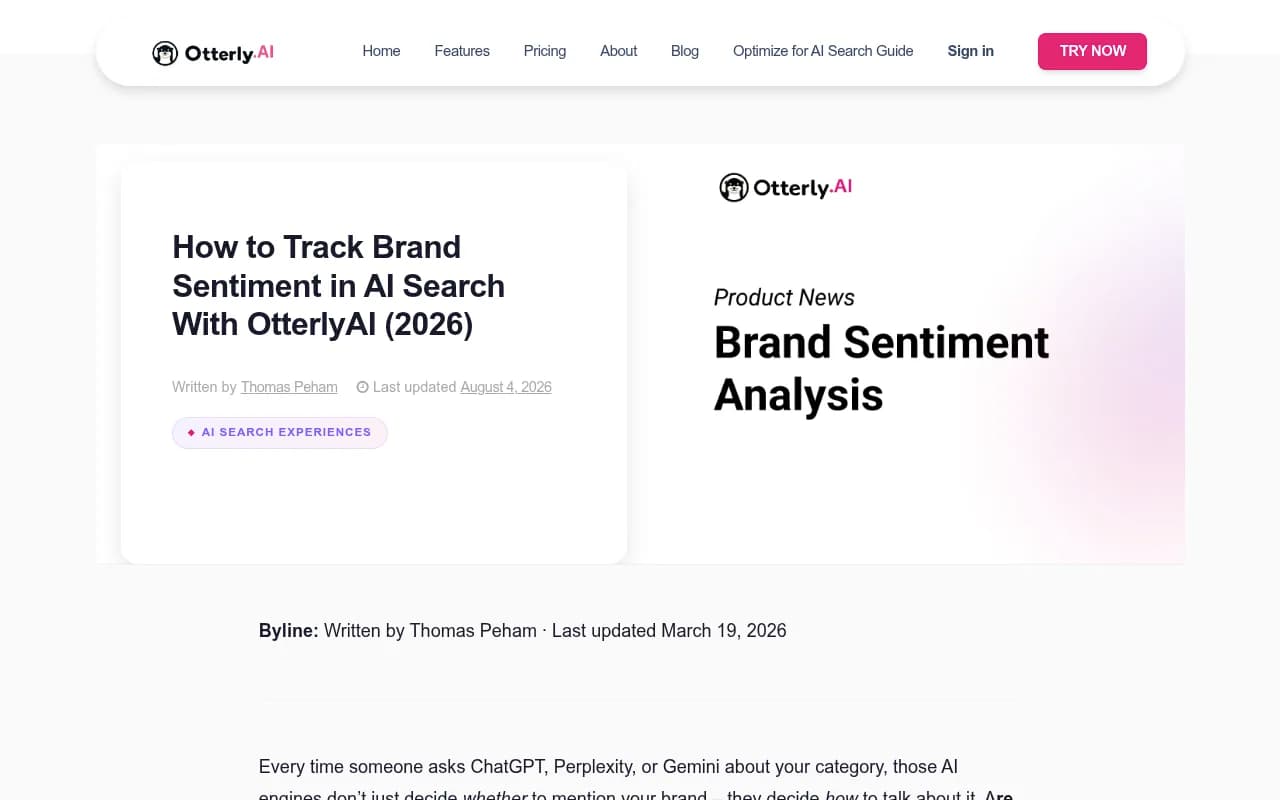
OtterlyAI has a well-documented Brand Sentiment feature with an NSS, competitor benchmarking in its Brand Ranking view, and prompt-level drill-downs. Its published coverage is ChatGPT, Perplexity, Gemini, Google AI Overviews and AI Mode, so don't assume Meta AI is in there.

For the engines that matter alongside Meta AI, Promptwatch tracks real-UI responses in ChatGPT, Google AI Overviews, AI Mode, Gemini, Perplexity, Copilot, Claude and Meta AI, with per-response sentiment, a weekly AI summary, and sentiment heatmaps by competitor and topic. Confirm the current Meta AI coverage on its pricing and integrations pages before you commit.

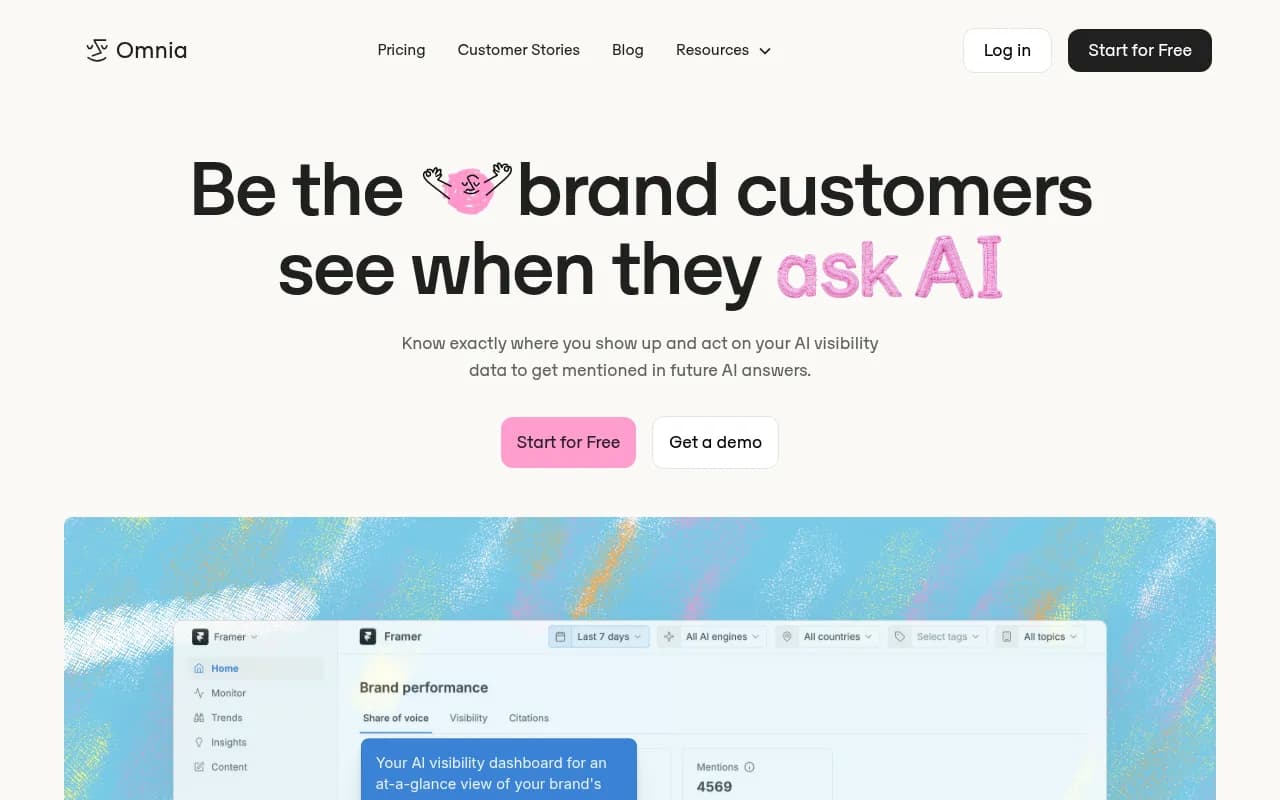
A few others on the list worth a look for sentiment-style reporting are Omnia, which breaks AI responses into feature-by-feature scores, and Rank Math's AI Visibility if you already live in WordPress.
Comparison table
| Tool | Sentiment feature | Meta AI coverage | Best for |
|---|---|---|---|
| Knowatoa | Yes, with mentions, accuracy and share of voice | Dedicated Meta AI page (Facebook, Instagram, WhatsApp, Messenger) | Teams that specifically want Meta AI monitoring |
| OtterlyAI | Net Sentiment Score (-100 to +100), competitor benchmarking | Not stated in sources I saw | Affordable sentiment benchmarking on the major engines |
| Promptwatch | Per-response sentiment, trends, heatmaps, weekly summary | Listed among tracked platforms; verify current plan access | Teams that want to track and then fix, with content and crawler data |
| Omnia | Feature-by-feature sentiment | Verify with vendor | Positioning work and competitor feature gaps |
| Rank Math AI Visibility | Average sentiment per brand and per query | Verify with vendor | WordPress teams already on Rank Math |
| Manual sampling | Your own judgment | Yes, any surface | Starting out, under 20 prompts |
Third-party roundups put entry-level AI monitoring around $29 a month for 15 to 25 prompts, with Peec AI near $95 and Ahrefs Brand Radar around $199 as an add-on. Those figures come from vendor-authored listicles, so check official pricing pages.
If you want to browse more options, the directory at bestgeosoftware.com lists GEO and AI visibility tools by category.
Step 4: Score sentiment consistently
Whether you use a tool or a spreadsheet, define your scale before you collect data. Here is a simple rubric:
| Score | Label | Example language |
|---|---|---|
| +2 | Enthusiastic | "The best choice for...", "widely recommended" |
| +1 | Positive | "A solid option for..." |
| 0 | Neutral | Listed with no judgment |
| -1 | Hedged or negative | "Some users report...", "may not suit..." |
| -2 | Dismissive or warning | "Avoid if...", "known for problems" |
Then calculate the average per prompt group, and track accuracy as a separate column. An assistant can be glowing and wrong. A wrong price or a discontinued feature that Meta AI repeats confidently is a different problem from a lukewarm tone, and it needs a different fix.
What to read from the pattern
- Low mention rate, fine tone: a coverage problem. You need more content and third-party coverage.
- Good mention rate, weak tone: a reputation or positioning problem. Look at reviews and comparison pages.
- Fine tone, wrong facts: a source problem. Something outdated is being retrieved.
- Sentiment worse on competitor-comparison prompts than on category prompts: your comparison content is losing to a rival's framing.
Step 5: Benchmark against competitors
Run the same prompt set for three to five competitors. Compare:
- Share of mentions in category prompts
- Average sentiment
- Which attributes the assistant attaches to each brand (price, support, quality)
- Who gets recommended first
The feature-level view matters most. Omnia's pitch is right on this point: you want to know where you lead, where you fall short, and which competitor strengths the assistant amplifies that you aren't getting credit for. A rival described as "easy to use" in every answer is winning that attribute whether or not it is true.
Step 6: Trace where the opinion comes from
An assistant's tone rarely comes from nowhere. It is usually summarizing what it retrieved. So ask: which pages and platforms are feeding these answers?
One clue is Meta's recent crawling. Promptwatch Data reports that Meta-WebIndexer grew from about 2.2% to 37.8% of tracked AI crawler requests between mid-July and August 9, 2026, making it the heaviest AI crawler in Promptwatch's logs. The report notes this lines up with reports that Meta is building its own search index, but those reports are unconfirmed, sourced to a single post. Still, it is a reason to check your server logs and robots.txt for the four Meta user agents (meta-webindexer, meta-externalagent, meta-externalfetcher and FacebookBot) and not block them casually if you want to be citable.
Another clue is social sources. Meta owns Facebook and Instagram, so it is tempting to assume Meta AI leans on them heavily. I can't confirm that, and Promptwatch has no Meta AI citation report. What the data does show is how much engines differ. In Promptwatch's social media citations report for Sep 28 to Oct 4, 2026:
| Engine | Share of citations from social platforms |
|---|---|
| ChatGPT | 0.46% |
| Perplexity | 2.7% |
| Google AI Overviews | 12.2% |
That report covers only those three engines, not Meta AI. The lesson is that one engine's source mix tells you little about another's, so measure Meta AI directly instead of borrowing conclusions.
Step 7: Fix what you find
Once you know where tone or accuracy is off, the response is ordinary content and reputation work:
- Update or create pages that answer the exact prompts producing weak answers: product pages, comparison pages, pricing and FAQ content.
- Correct stale facts at the source. Check your own site, Google Business Profile, social bios and third-party listings.
- Earn third-party coverage. Otterly's own research claims 95% of AI citations come from third-party sources, so treat it as a vendor figure, but earned mentions and reviews clearly matter.
- Keep your Facebook and Instagram presence accurate and active: description, hours, product info, replies to reviews.
- Make sure Meta's crawlers can read your site.
If you'd rather hand this off, an agency that does GEO work can run the whole loop. 1001 SEO Media does exactly this, and its team uses Promptwatch for AI visibility tracking.
Step 8: Re-measure on a schedule
A single snapshot says where you stand. A trendline says whether your work is landing. Re-run the full prompt set weekly or fortnightly, and log any event that might move things: a new product page, a press hit, a review campaign, a site migration.
Expect noise. Because Meta AI responses vary, a one-week dip of a few points means nothing. A sustained shift across multiple prompts and surfaces does.
A realistic starter workflow
If you have one afternoon:
- Write 20 prompts across the four groups above.
- Run each five times in WhatsApp and Instagram, logging results.
- Score tone and accuracy using the rubric.
- Repeat for two competitors.
- Pick the three worst-scoring prompts and trace which pages could be feeding them.
- Decide whether you need a tool. If you are past 30 prompts, or need more than one surface, you do.
For broader coverage of ChatGPT, Gemini and Perplexity alongside Meta AI, compare options in the AI rank tracking directory.
Common mistakes
- Treating one answer as the answer. Sample repeatedly.
- Copying ChatGPT conclusions to Meta AI. The data says engines differ.
- Ignoring accuracy. A positive tone with a wrong price is a liability.
- Buying a tool without checking Meta AI support. Ask the vendor which surfaces it queries, and whether it uses the real interface or an API.
- Blocking Meta's crawlers without thinking about it.
Bottom line
Meta AI sentiment is measurable today, just not neatly. Start with manual sampling to learn what the assistant says, add a tool that explicitly covers it once your prompt set grows, benchmark against competitors on the same prompts, and fix the sources behind weak answers. The part I'd push hardest on is verification: ask every vendor for proof of Meta AI coverage before you pay for it.