Key takeaways
- Meltwater, Cision and Brandwatch are strong at monitoring what was published. None of them was built to explain or change what ChatGPT, Gemini or Perplexity say about a brand.
- Meltwater sells GenAI Lens, reported as an add-on. Cision added an AI Visibility Dashboard in July 2026, powered by Trajaan data. Brandwatch is owned by Cision, so treat the two as one corporate family.
- Vendor sources disagree about who tracks AI answers. Some say Cision doesn't, Meltwater's own blog says Cision and Brandwatch do. Ask for a live demo on your own brand.
- Social listening says little about what ChatGPT shows, because ChatGPT cites social platforms very rarely.
- A dashboard reports a number. Moving it takes content, citations and crawler access work, which usually means a dedicated GEO platform alongside the suite.
The short version
I have watched a lot of PR teams renew a Meltwater or Cision contract and assume the AI question is covered because a new tab appeared in the product. Sometimes it is partly covered. Often it is a readout of a handful of prompts with no path from the number to a fix.
This guide compares the three suites on what they actually do for AI search, flags where the sources contradict each other, and explains what is still missing. None of the three publishes prices, so expect to talk to sales for all of them.
Who owns what
Ownership explains a lot about how these products behave.
- Cision is owned by Platinum Equity (since 2020). It bought PR Newswire in 2016 and Brandwatch in 2021, reportedly for $450 million. A Presswire timeline also reports that Cision acquired Trajaan, a French search-intelligence and AI-monitoring company, in December 2025. I could not verify that against a primary source, but it fits the product timeline.
- Meltwater went private in 2023 under Marlin Equity Partners and Altor.
- Brandwatch sits inside Cision, so "Cision vs Brandwatch" is not really a competition.
That means the real choice is two vendors: Meltwater, or the Cision family with CisionOne for PR workflows and Brandwatch for social and consumer research.
What each suite is actually good at
Meltwater
Meltwater is the broadest on raw coverage. Its own site claims 240+ languages and 200+ countries, and third-party reviews describe 300,000+ sources across news, print, broadcast, podcasts and social. Its Mira AI assistant answers plain-language questions across products.
Meltwater is the pick if you need global coverage and one place for news, broadcast and social. The common complaint is pricing opacity and fragmentation across acquired products. A G2 discussion thread on the Meltwater vs CisionOne choice shows buyers asking specifically about unpredictable per-outlet costs.
CisionOne
CisionOne is the enterprise PR workhorse: monitoring, a journalist database (reported at 1.7M+ contacts) and wire distribution through PR Newswire. It is the natural choice for corporate comms teams that want distribution and monitoring from one vendor. One roundup cites a 25% recommendation rate for Cision against 87% for Muck Rack, which is a reminder that big is not the same as loved.
Brandwatch
Brandwatch is the deepest of the three on social listening and consumer intelligence: historical social analysis, image recognition for visual mentions, and detailed audience segmentation. It is the one you buy when insights teams need to understand audience reaction, not count press clips.
Brandwatch Consumer Intelligence
AI search coverage, side by side
This is where the sources get messy. The table reflects what vendors and reviewers say, not something I tested hands-on, so verify each row in a demo.
| Meltwater | Cision (CisionOne) | Brandwatch | |
|---|---|---|---|
| AI answer product | GenAI Lens | AI Visibility Dashboard (launched July 2026) | No dedicated product confirmed in the research |
| How it is sold | Reported as an add-on to an existing subscription | Added to CisionOne | Part of the Cision family |
| Models covered | Reported as the broadest: ChatGPT, Gemini, Claude, Perplexity, Grok, DeepSeek, Llama, AI Overviews, AI Mode | ChatGPT, Gemini, Claude, Perplexity, Grok, DeepSeek, AI Overviews, AI Mode, Mistral | Unclear |
| Competitor benchmarking | Yes, per vendor | Share of voice against competitors | Social benchmarking |
| Cited sources shown | Yes | Journalists, publications and domains cited in AI answers | Not confirmed |
| Pricing | Contact sales | Contact sales | Contact sales |
The disagreement is worth pausing on. Shadow's April 2026 guide lists Cision as "not currently offered" for AI search monitoring. Meltwater's own blog says Cision and Brandwatch track AI answers. Cision's own July 2026 release announces the dashboard. The likely explanation is timing: the Shadow guide predates the launch, and Meltwater's claim about Brandwatch may be loose. That is a good illustration of why you shouldn't buy on a comparison article, including this one.
What PR suites still miss
1. They measure mentions, but AI answers work differently
A news-monitoring model counts mentions. AI engines give you a small, unstable number of citation slots. According to Promptwatch Data's average sources per response report (published September 2025, so check for a refresh), ChatGPT cites about 5 sources per web-search answer, Google AI Overviews about 10, and Perplexity almost exactly 10. Copilot has swung from under 2 to nearly 17.
So the question is not "how many mentions did we get." It is which slot you hold, in which engine, for which prompt, and how that changes week to week.
2. Social listening does not predict ChatGPT
This is the big one for teams leaning on Brandwatch. Promptwatch's November 2026 social media citations report (Oct 11 to Nov 9, 2026) found social platforms are 13.16% of Google AI Overviews citations, 1.94% of Perplexity citations and just 0.64% of ChatGPT citations. In AI Overviews, YouTube alone is 6.71%. In ChatGPT, Reddit is 0.40% and YouTube 0.03%.
What ChatGPT leans on instead is pages: Promptwatch's content type data puts product pages at 22.4% of ChatGPT citations (Sep 28 to Oct 4, 2026), followed by landing pages and listicles. Reddit's share of ChatGPT citations also collapsed from about 4% to 0.5% on August 14, 2026, per Promptwatch's Reddit report. A great social sentiment dashboard can tell you almost nothing about what ChatGPT says about you.
3. News coverage decays fast in AI answers
PR teams like earned coverage. Promptwatch's content half-life study tracked every page ChatGPT cited on July 6, 2026 for 90 days: news lost half its pages within 36 days, while landing pages and docs stayed cited longest. A press hit helps, but it is the least durable thing to build AI visibility on.
4. Citation accuracy is a separate problem
The Columbia Tow Center, via the Columbia Journalism Review, compared eight AI search engines and found them poor at citing news correctly. I did not read the full study, but the implication for PR is practical: appearing in an answer is not the same as being described accurately in it. You need to check the claims, not just count appearances.
5. No crawler visibility
None of the three suites, as far as the research shows, reports which AI bots actually fetch your pages, which ones hit errors, and how that relates to citations. If GPTBot or ClaudeBot cannot read your site, no amount of press fixes it. Promptwatch Data's AI crawler traffic report shows how much verified crawler volume there is, and it is a channel your suite does not see.
6. Measurement without execution
One roundup puts it well: a dashboard reports the number, but earning the third-party coverage and owned content that moves it is a different job. Ahrefs' analysis of the 1,000 pages ChatGPT cited most in September 2025 found that among cited pages that also rank in Google, 65.3% sit on domains with Domain Rating 81 or higher. The study does not prove DR causes citation. Promptwatch's own August 2026 data points the other way: mid-authority sites (DR 46-75) earned almost half of ChatGPT citations, while DR 91-100 fell to about 3%. The honest read is that the evidence is mixed, and you need your own prompt-level data, not a generalization.
Which suite for which team
| If you are | Start with | Why |
|---|---|---|
| A global brand needing news, broadcast, podcasts and social in one tool | Meltwater | Widest stated coverage and the broadest model list for GenAI Lens |
| A corporate comms team that wants distribution plus a journalist database | CisionOne | PR Newswire, database and the new AI dashboard in one vendor |
| An insights team studying audiences and sentiment | Brandwatch | Deepest social and consumer analysis |
| A mid-size team with a smaller budget | Brand24 or Mention | Cheaper, though with thinner coverage and, per reviews, less AI depth |
What to add on top of a PR suite
If AI search matters to revenue, I would treat the suite as the earned-media layer and add a platform built for AI visibility. A few things to demand:
- Data collected from the real interfaces of ChatGPT, AI Overviews, Gemini and Perplexity, not only APIs, since user-facing answers and citations can differ.
- Prompt-level tracking by country and language, with competitors, sentiment and cited sources.
- Crawler logs, so you can separate an access problem from a content problem.
- Traffic attribution, so you can say what AI sends you.
- A way to act: content gap analysis, content creation and a prioritized to-do list.
Promptwatch is the platform 1001 SEO Media uses for this and the one I would put on the shortlist. It tracks ChatGPT, Gemini, Claude, Perplexity, Google AI Overviews and AI Mode, Copilot and others, shows which of your pages and which third-party sources get cited, and logs AI crawlers with IP verification. Its Content Agent writes and publishes pages against the gaps it finds, and visitor analytics measure whether they bring traffic. Brand Narrative pulls out the individual claims AI makes about you, which speaks directly to the accuracy problem above. Pricing starts at $95/month for Essential and $579/month for Business, which adds the Content Agent and faster tracking. Confirm current prices at promptwatch.com/pricing.

There is a free way in too: the free AI visibility report scans how ChatGPT, Gemini and Perplexity talk about your brand, with no login. Run it before your next vendor demo and you will know what to ask.
Other tools in the catalog worth a look if you are comparing AI visibility trackers are Profound, Otterly.AI and Peec AI, though those are mostly monitoring-focused. Promptwatch vs Profound is a useful head-to-head if you are leaning enterprise.


For a wider survey, the GEO software directory at bestgeosoftware.com lists the category.
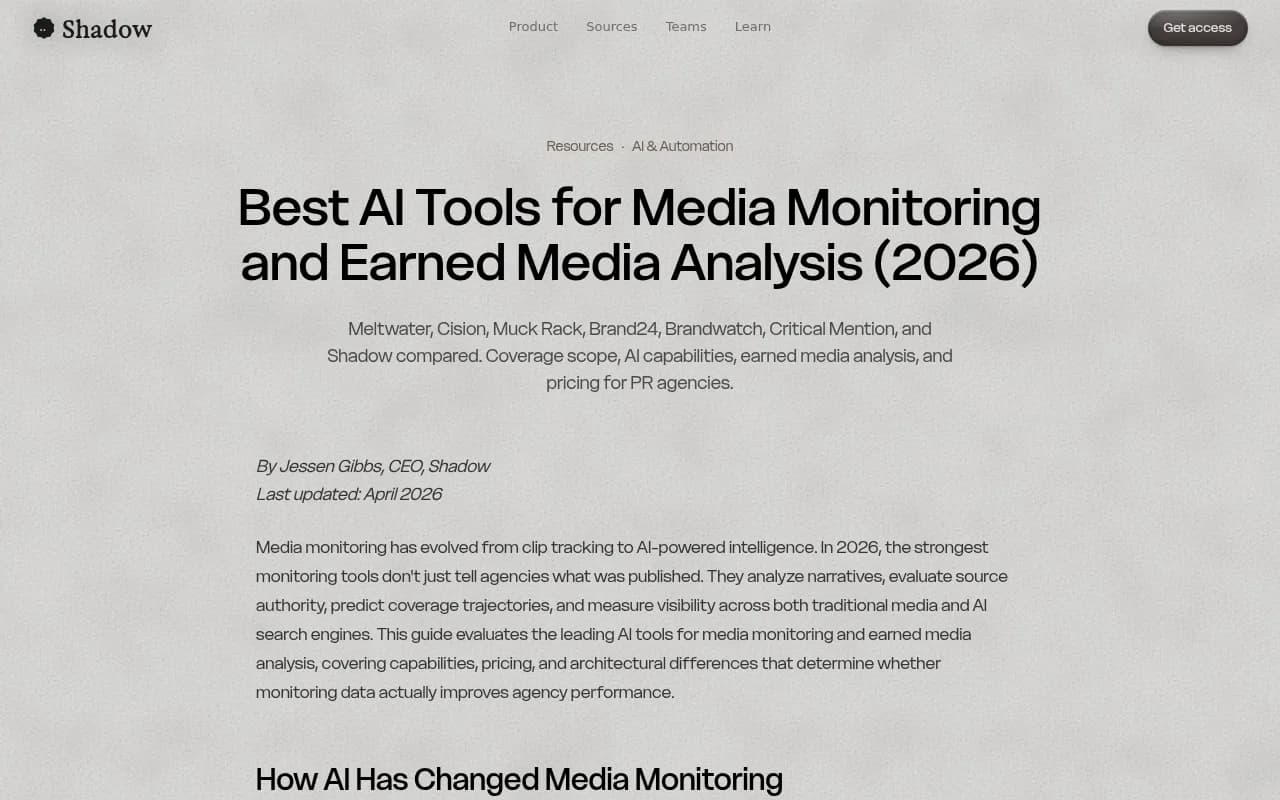
A caution on the screenshot above: Shadow sells a competing product, so its table favors itself. Use it for structure, not verdicts.
Questions to ask in the demo
- Which AI engines do you read, through the real interface or an API?
- How many prompts can I track, and can I choose them rather than use a fixed set?
- Is the AI module in the base contract or a separate add-on, and what does it cost?
- Can I see which URLs and domains are cited, and where they land in the source list?
- Do you show AI crawler activity on my site?
- Can the tool tell me what to publish or fix, or only report?
- Can you run it live on my brand during the call?
The last one matters most. A vendor who hesitates to run your brand live is telling you something.
Bottom line
Pick Meltwater for breadth, CisionOne for PR workflow and distribution, Brandwatch for audience insight. All three now touch AI search to some degree, and for a PR team the built-in module may be enough for a first look. But if AI answers are becoming a place buyers form shortlists, the suite will show you the score and leave the work to you. Pair it with a dedicated AI visibility platform, and start by running a free report on your own brand.