Key Takeaways
- In a seven-day sample, HTML took 99.94% of AI search citations and Markdown files took 0.05%, roughly 2,000 to 1 (Promptwatch Data).
- Google says it does not use llms.txt, and that maintaining one will neither help nor harm your visibility. No major AI search provider promises citation gains for it either.
- Markdown and llms.txt do have a real audience: coding agents, IDE tools, and documentation platforms that fetch docs directly.
- For marketing and blog pages, put your effort into crawlable, server-rendered HTML with clear headings and direct answers.
- The cheap middle path: keep a tidy llms.txt, publish .md only for developer docs, and check your server logs to see who actually asks for them.
The short answer
No, you do not need Markdown mirrors of your blog posts to get cited by ChatGPT, Claude, Perplexity, or Google AI Overviews. The numbers are not subtle. Yes, you may still want Markdown for developer documentation, because a different kind of visitor fetches it.
That split is the whole story. Consumer AI search and developer agent retrieval are turning into two separate systems, and the advice that fits one does not fit the other. Most of the confusion online comes from people mixing them up.
What the data says about Markdown citations
Promptwatch published a report called Markdown in AI Search covering one week of citations from ChatGPT, Claude, Perplexity, and Google AI Overviews. A separate summary of the same sample puts it at 1,665,674 citations. The split by format:
| Format | Share of citations |
|---|---|
| HTML pages | 99.94% |
| Markdown (.md) files | 0.050% |
| Images | 0.015% |
That is HTML winning about two thousand to one. Promptwatch's conclusion is blunt: markdown does not influence citations in AI search.
Two caveats are worth keeping in mind, and the Publii team makes the first one well. The measurement tells you which URLs were cited, not every representation a system may have processed before writing an answer. A model could, in theory, read a Markdown version and still cite the HTML page. So 0.05% is not proof that Markdown is useless everywhere. It is proof that nobody is being sent to .md URLs by AI search, and that you gain nothing visible by creating them.
The second caveat is that this is one week of data. Promptwatch Data reports are refreshed as the numbers move, so check the report itself before quoting a figure in a deck.
Who is requesting .md files then?
The same report has a table of the most-requested .md paths. Every one of them sits under /docs/. The top path got 3,241 requests, followed by 2,870, 1,934, 1,512, and 1,207, and the crawlers were Anthropic's ClaudeBot and OpenAI's search bot. Promptwatch describes a big uptick in documentation crawling from the bots behind Claude Code and Codex.
So the traffic is real. It is just not search traffic. It is coding agents pulling documentation into a context window, which is a different job from answering a consumer question with a cited source.
What llms.txt actually is
llms.txt is a plain Markdown file at the root of your site (yoursite.com/llms.txt) that gives AI tools a short, curated overview of who you are and links to your important pages. Jeremy Howard of Answer.AI proposed it in September 2024. The protocol also describes an optional llms-full.txt, which packs detailed content into a single file.
It is not robots.txt. Robots.txt tells crawlers what they may fetch. llms.txt is a suggestion about what is worth reading. Nothing enforces it, and nothing obliges a model provider to look.
The v2 update
On August 10, 2026, Howard published the first revision of the spec, according to Search Engine Journal. The changes are modest and practical:
- Two accepted URL patterns for Markdown pages. You can append .md to the full filename (/docs/tutorial.html becomes /docs/tutorial.html.md, the original pattern) or replace the extension (/docs/tutorial.md).
- A rel="alternate" link with type="text/markdown", which points from a page to its Markdown version.
- A rel="describedby" link, which points from a page to the llms.txt file covering it. One llms.txt can describe every page under its path.
- Both relations work in the HTML head or in an HTTP Link response header. The header route can be set at the server or CDN with no template changes, and it works for non-HTML files too.
Moving an existing file to v2 is a minor job. The syntax is still open for feedback on GitHub, so expect it to shift a little more.
Where the official positions stand
Google's AI optimization guide says Google Search does not use llms.txt and that publishing one will neither harm nor help your visibility or rankings. SEJ notes the Search team has said for over a year that support is not on its agenda. The Publii article adds that OpenAI, Anthropic, and Perplexity do not promise extra search visibility for sites that publish Markdown either.
Chrome's Lighthouse added an Agentic Browsing category in May 2026 with an llms.txt check. Read that carefully. It flags server errors, treats a 404 as not applicable because the file is optional, and does not test the new link relations. It is a hygiene check, not an endorsement.
On the adoption side, thousands of sites publish the file. Mintlify generates one for every site it hosts. Anthropic, OpenAI, and Google's Gemini team all publish one for their developer docs. Look at that list again: every name is a developer documentation site. That pattern keeps showing up.
The one experiment that looked promising
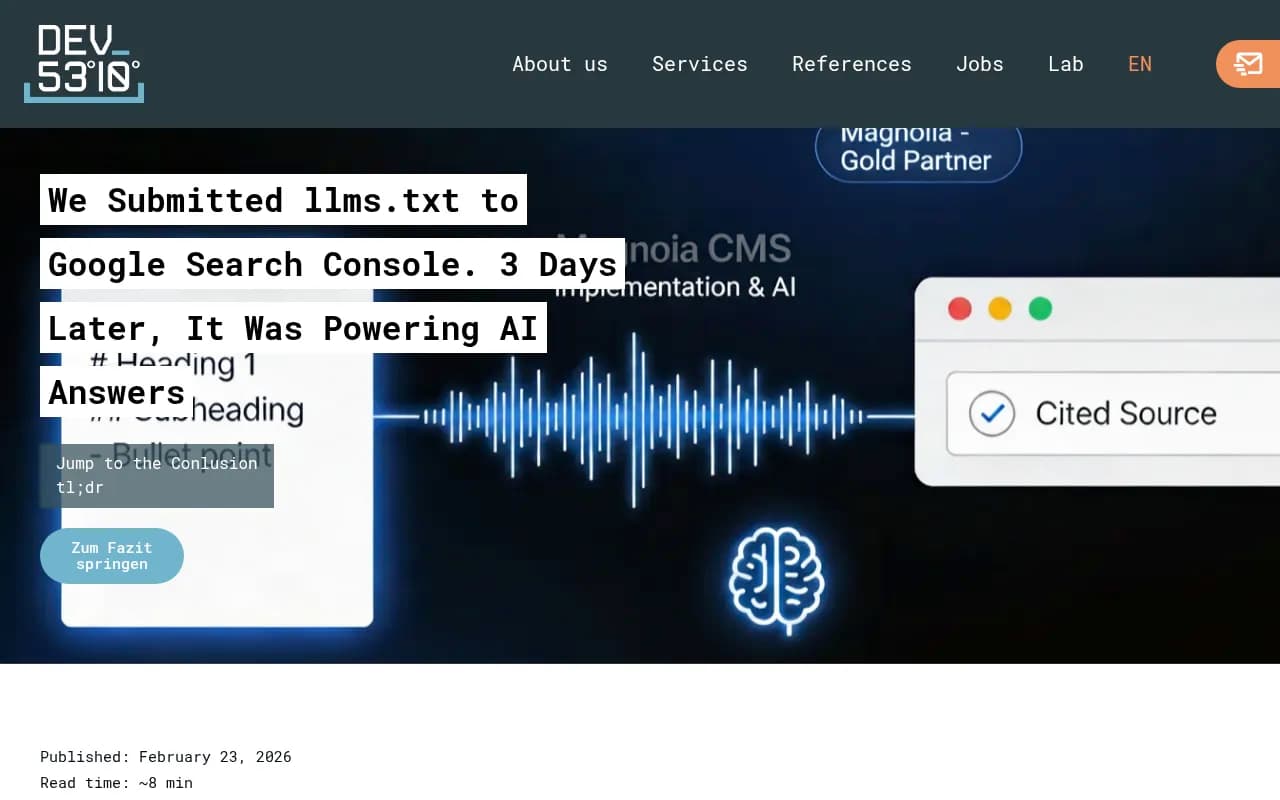
A Hamburg agency, dev5310, wrote up a test where it submitted its llms.txt to Google Search Console on February 2, 2026. Google crawled it the same day. The next day Google AI Mode cited the file as its number one source for a brand query, and by February 20 it was cited in three of four queries across different topics. Six AI bots hit the file in four days.
I find this interesting and also easy to over-read. It is one site, brand and service queries (where the file is basically a summary of the company), and a file that was submitted by hand through URL Inspection. It shows that a Markdown file can get indexed and cited when it is the cleanest statement of who you are. It does not show that llms.txt as a standard is a ranking lever. The authors say as much themselves. Note also that it is a cited URL for a niche query, not a sign that your product pages should be replaced by text files.
Efficiency is the honest argument for Markdown
The strongest case for Markdown has nothing to do with citations. Agents reading documentation work within token limits, and a page stripped of navigation, scripts, and layout wrappers is simply smaller. Fern claims Markdown is 80-90% more efficient than HTML for this, though I would treat that as a vendor figure and measure your own pages. Cloudflare's Markdown for Agents and OpenAI's developer docs both deliver Markdown for machine workflows, per Publii. I did not verify Cloudflare's pricing or plan details, so check those before committing.
That tells you where Markdown pays off:
- API references and SDK docs a coding agent will fetch mid-task
- Product docs and help centers where exact steps matter
- Changelogs and specs that agents read to write code
It tells you where it does not: blog posts, landing pages, comparison pages, and anything whose job is to win a citation in a consumer answer.
What to do instead for AI search
Promptwatch's recommendations in the report are sensible, and I agree with the ordering:
- Skip .md mirrors of marketing and blog pages if your goal is AI search visibility.
- Fix client-side JavaScript rendering first. A page retrieval systems cannot parse loses citations because it is unreadable, not because it is not Markdown.
- Use clear heading hierarchy, semantic markup, and direct answers on the HTML pages.
- Keep .md endpoints for developer documentation.
Other Promptwatch Data reports point at what actually earns citations. Product pages are the most cited content type in ChatGPT at 22.4% (Sep 28 to Oct 4, 2026), followed by landing pages and listicles. In the content half-life study, landing pages and docs stayed cited longest, while news lost half its pages within 36 days. And almost half of ChatGPT responses cite 10 or more unique domains, so there is a lot of room for well-built HTML pages from sites that are not giants.
None of that is about file format. It is about page type, access, and content quality.
Check crawler access before anything else
If AI bots cannot fetch your pages, Markdown cannot save you. Promptwatch's AI Crawler Traffic report shows OpenAI at 79.8% of IP-verified AI crawler requests in the week of Aug 31 to Sep 6, 2026, down from 94.8% in early June. Its advice: compare your own logs against that mix, and if a provider is big in the mix but near zero in your logs, you are probably blocked by robots.txt, your CDN, or a WAF rule.
Tools that read crawler logs can answer this directly. Promptwatch has IP-verified AI crawler logs that show which bots hit which pages and what errors they got, and the free AI Crawler URL Inspector is a quick first check. DarkVisitors is another option for tracking bot visits.

Decision table: what to publish
| Site type | llms.txt | .md page versions | Main priority |
|---|---|---|---|
| Developer docs or API product | Yes, cheap and used by coding agents | Yes, for docs paths | Docs discoverable by agents |
| SaaS marketing site | Optional, low effort | No | Crawlable HTML, product and landing pages |
| Blog or publisher | Optional | No | Fresh, structured HTML with direct answers |
| E-commerce | Optional | No | Product pages, feeds, structured data |
| Local business | Not needed | No | Listings, reviews, accurate HTML |
A low-effort llms.txt setup
If you decide to publish one, treat it as ten minutes of work, not a project. A minimal file looks like this:
# Example Co

> Example Co makes invoicing software for freelancers.

## Docs

- [Quickstart](https://example.com/docs/quickstart.md): Set up your first invoice
- [API reference](https://example.com/docs/api.md): REST endpoints and auth

## Key pages

- [Pricing](https://example.com/pricing/): Plans and limits
- [About](https://example.com/about/): Who we are
For docs pages that have a Markdown version, add the v2 discovery hint, ideally as an HTTP header so you do not touch templates:
Link: </docs/quickstart.md>; rel="alternate"; type="text/markdown"
Link: </llms.txt>; rel="describedby"
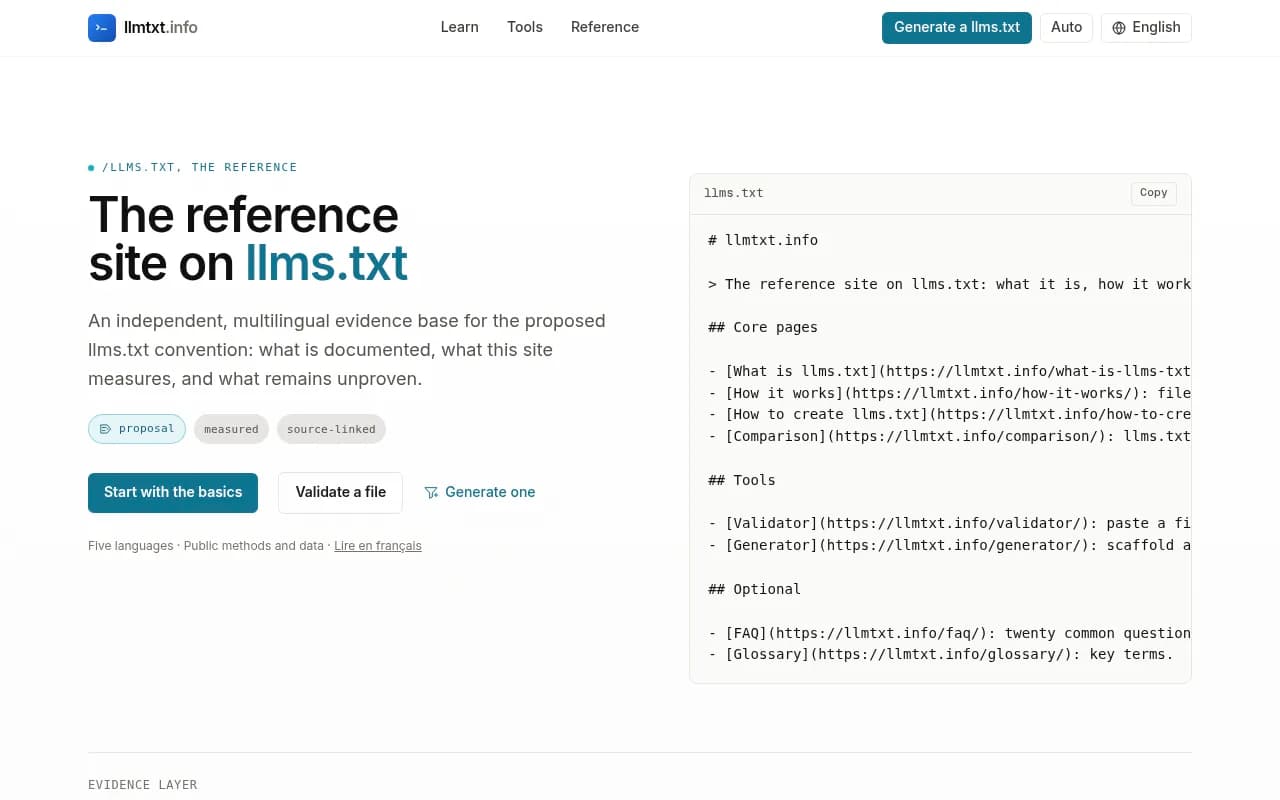
If you do not want to write the file by hand, Promptwatch's LLMs.txt Generator and llmtxt.info both generate and validate one. The Agentic Readiness Check shows which agent standards your site supports.
Measure instead of guessing
The reason this debate never ends is that people ship a file, see no change, and either declare victory or give up, with no data in between. Do the boring thing:
- Log requests to /llms.txt and any .md paths, and see which user agents show up.
- Track whether your HTML pages are cited for the prompts you care about, before and after any change.
- Watch AI-referred visits in your analytics to see if citations turn into traffic.
A GEO platform handles the second and third items. Promptwatch tracks citations across ChatGPT, Gemini, Perplexity, Claude, and Google AI Overviews, then ties pages to crawler logs and AI-referred traffic, so you can tell an access problem from a content problem. Other trackers in this space include Peec AI, Profound, and Otterly.AI, mostly focused on monitoring. For a wider list, the GEO software directory at bestgeosoftware.com is a decent starting point.


What I would do this quarter
If you run a marketing or content site, skip the Markdown mirrors. Spend the afternoon on server-side rendering, heading structure, and checking that no WAF rule is blocking GPTBot, ClaudeBot, or PerplexityBot. Publish a short llms.txt if you want, knowing it is harmless and probably inert for citations.
If you run developer documentation, do both: ship llms.txt and serve .md versions of docs, add the v2 link headers, and watch your logs. That is where the 3,241-request paths live.
The 0.05% figure is not an argument against Markdown. It is an argument against expecting a file format to do the work that page quality and crawler access do.