Key takeaways
- Your own website is still the biggest single source in local AI answers. Strategi's 2026 study found business websites carried about 90% of citations, and BrightLocal's study put them at 42%. The studies measure different things, so treat the numbers as a direction, not a rule.
- Directories matter most in specialised verticals. BrightLocal saw ChatGPT draw on ten different dental directories for dentistry prompts, and Super Lawyers and FindLaw dominate legal queries.
- Reviews work more as a filter than a source. SOCi found that locations ChatGPT recommends average 4.3 stars.
- The citing pattern is local. The third parties that show up are regional: BBB, Houzz and Angi in the US, Yell and Checkatrade in the UK, hipages in Australia.
- Fix the basics first: a consistent name, address and phone number across listings, a dedicated page per service and per city, and a Google Business Profile that is complete.
Why local citations work differently in AI answers
In classic local SEO, a citation was a mention of your name, address and phone number (NAP) on another site. You built them for Google's local pack and moved on. AI assistants use the same data differently. They don't show ten blue links or a map with a pack of three. They write a short answer, name two to four businesses, and cite a handful of pages as support.
That changes what a citation is worth. A listing on a directory is no longer just a ranking signal. It is a source the model may read, quote or use to cross-check what your own site says.
The gap between the two surfaces is large. Arcane Marketing, summarising a 2026 BrightLocal study of 200,085 local searches, reports that tracked businesses appeared in 32% to 38% of AI answers, against 66% on Google Maps. SOCi's 2026 Local Visibility Index found ChatGPT recommends 1.2% of the locations studied, while Google's local pack shows 35.9%. Being listed is easy. Being named is the hard part.
The four families of sources AI cites for local queries
Across the studies, local citations fall into four buckets. It helps to treat them separately because each needs different work.
1. Your own website
This is the anchor. Strategi's research across 18 industries and 10 countries found business websites took 90.1% of citations overall, and 69.1% of named businesses had their own site cited. For city questions, 68.8% of answers cited a business page for that city. In the US the website share was 87.5%, in Canada 91% and in Ireland 96.4%.
Specific pages win. Service pages and city pages are what the models pull, not a generic homepage. If you serve three cities and have one page that mentions all three, you are asking the model to guess.
2. Directories and listing portals
Smaller by raw share, but decisive in some verticals. Strategi's country table puts directories and listing portals at 0.9% of citations in the US, 1.3% in Australia and 2.8% in India and the UAE. Low percentages, yes. But the businesses named in the answer often got there because a directory confirmed what their site said.
Yext's October 2025 analysis, a third-party figure worth labelling as such, found 86% of AI citations come from sources a brand manages or can influence, led by websites (44%) and directory listings (42%). The two sets of numbers don't match, and they shouldn't be forced to. Yext counted brand-controlled sources across a wide set of queries. Strategi counted citations in answers to specific local questions.
3. Google Business Profile and maps data
BrightLocal's study found Google Business Profile was cited more than any other single source. In Strategi's data, Google Maps and Business Profile share is small in most countries (0.5% in the US) but climbs to 3.4% in New Zealand and 1% in Canada and Ireland. Google's own AI Overviews and AI Mode lean on this data most heavily, which makes sense.
4. Reviews and editorial mentions
Review platforms and booking sites are a small share of citations: 0.6% in the US, 0.4% in Australia. But the ratings feed a filter. SOCi found ChatGPT-recommended locations average 4.3 stars. A review that says "e-bike repair within 24 hours" gives a model something to repeat. "Great shop" doesn't.
For "best X in Y" queries, editorial mentions (city guides, local press, curated lists) take a bigger share, according to the Getfluence write-up. Regional news and city guides tend to come back from one answer to the next.
Which directories show up, by industry
Generic directories are not enough. The models favour industry-specific sources when they exist.
| Vertical | Sources models lean on | Where the evidence comes from |
|---|---|---|
| Dentistry | Ten dental directories in ChatGPT tests; Toprateddentist.com for Gemini, AI Mode and ChatGPT | BrightLocal |
| Legal | Super Lawyers, FindLaw (ChatGPT, Perplexity); Avvo | BrightLocal, ACS Creative |
| Home services (US) | Google Business Profile, BBB, Houzz, Angi | Strategi |
| Trades (UK) | Yell, Checkatrade | Strategi |
| Property (UK) | Rightmove, Zoopla | Strategi |
| Trades (Australia) | hipages, Product Review | Strategi |
| Agencies and B2B services | Clutch | ACS Creative |
| Healthcare | Healthgrades, plus government and public health sites | ACS Creative, Promptwatch Data |
The pattern is that whatever directory the local industry already treats as the reference ends up as the model's reference too.
Healthcare, travel and automotive look different
In Promptwatch Data's healthcare citation report (Sep 9 to Oct 8, 2026), government and public health sites earn almost half of the citations shown, with NIH, the FDA and the NHS leading. That is about health information rather than finding a nearby clinic, so don't read it as a local report. It does show why a clinic's own pages need to cite credible sources too.
The travel report (Sep 28 to Oct 4, 2026) is the closest destination-style vertical. Skyscanner leads at 0.78% of travel citations, then Going at 0.52% and Tripadvisor at 0.49%. The 17 listed domains together hold 4.18%, which tells you share is spread thinly. No single site owns destination answers.
For automotive prompts in August 2026, marketplaces like Autotrader and Cars.com outrank every car brand. Intermediaries often beat the brand itself.
To be clear, Promptwatch has no local-citation report. Treat these as context for how ChatGPT weighs directories and marketplaces, not as city-level data.
What the country data says
Strategi's table of where citations came from is the best city-adjacent dataset I found. The same story repeats with local names.
| Country | Citations analysed | Business websites | Directories and portals | Google Maps and Business Profile | Review and booking sites |
|---|---|---|---|---|---|
| United States | 163,625 | 87.5% | 0.9% | 0.5% | 0.6% |
| Australia | 85,261 | 82.8% | 1.3% | 0.5% | 0.4% |
| India | 48,096 | 77.1% | 2.8% | 0.2% | 0.4% |
| United Kingdom | 35,829 | 84.7% | 1.0% | 0.3% | 0.2% |
| Canada | 12,069 | 91.0% | 0.7% | 1.0% | 0.4% |
| New Zealand | 7,762 | 85.3% | 0.4% | 3.4% | 0.5% |
| Ireland | 6,994 | 96.4% | 0.3% | 1.0% | 0.1% |
Source: Strategi.is, AI recommendations research 2026 (third-party). Columns not shown include publishers and guides, government and education, marketplaces, and social media.
Two takeaways. First, India's directory share is the highest at 2.8%, so if you operate there, listings carry more weight. Second, the data says 71.4% of named businesses outside the US had a local domain, so a .co.uk or .com.au beats a generic global presence.
Social platforms are a separate story. In Promptwatch Data's social media citations report (Oct 11 to Nov 9, 2026), social makes up 13.16% of Google AI Overviews citations, 1.94% of Perplexity's and 0.64% of ChatGPT's. In AI Overviews, YouTube is 6.71% and Facebook 2.34%. Note the October comparison period covered only seven days and November covers thirty, so don't read the growth as like for like. If you want to show up in Google's AI answers for local queries, a Facebook page and YouTube videos about your service area are worth maintaining. For ChatGPT, the report's advice is to lean on your own site instead.
How different assistants use local sources
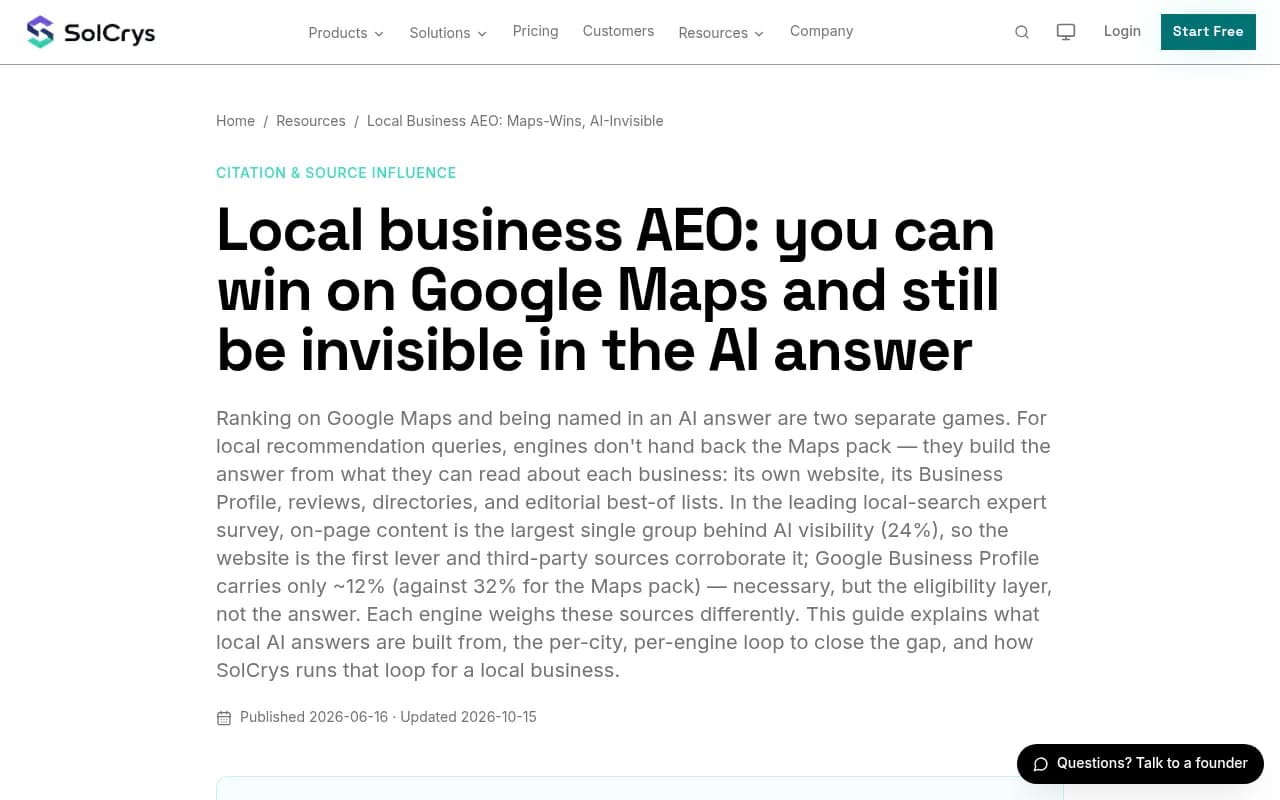
The sources vary by assistant. A solcrys write-up on local business AEO says ChatGPT leans on web consensus and directories while Perplexity leans on experts and reviews. BrightLocal's findings add that all LLMs it tested used directories as sources, and Yelp was prevalent.
| Assistant | Local sources it tends to lean on |
|---|---|
| ChatGPT | Web consensus, directories, business websites |
| Perplexity | Expert content, reviews, legal and specialist directories |
| Google AI Overviews and AI Mode | Google Business Profile, Maps data, social platforms such as YouTube and Facebook |
| Gemini | Specialist directories (Toprateddentist.com appeared in dentistry tests) |
These are tendencies drawn from a handful of studies, not guarantees. Models change, and the ChatGPT numbers move month to month.
A practical plan for city-level visibility
Step 1: Make your NAP boringly consistent
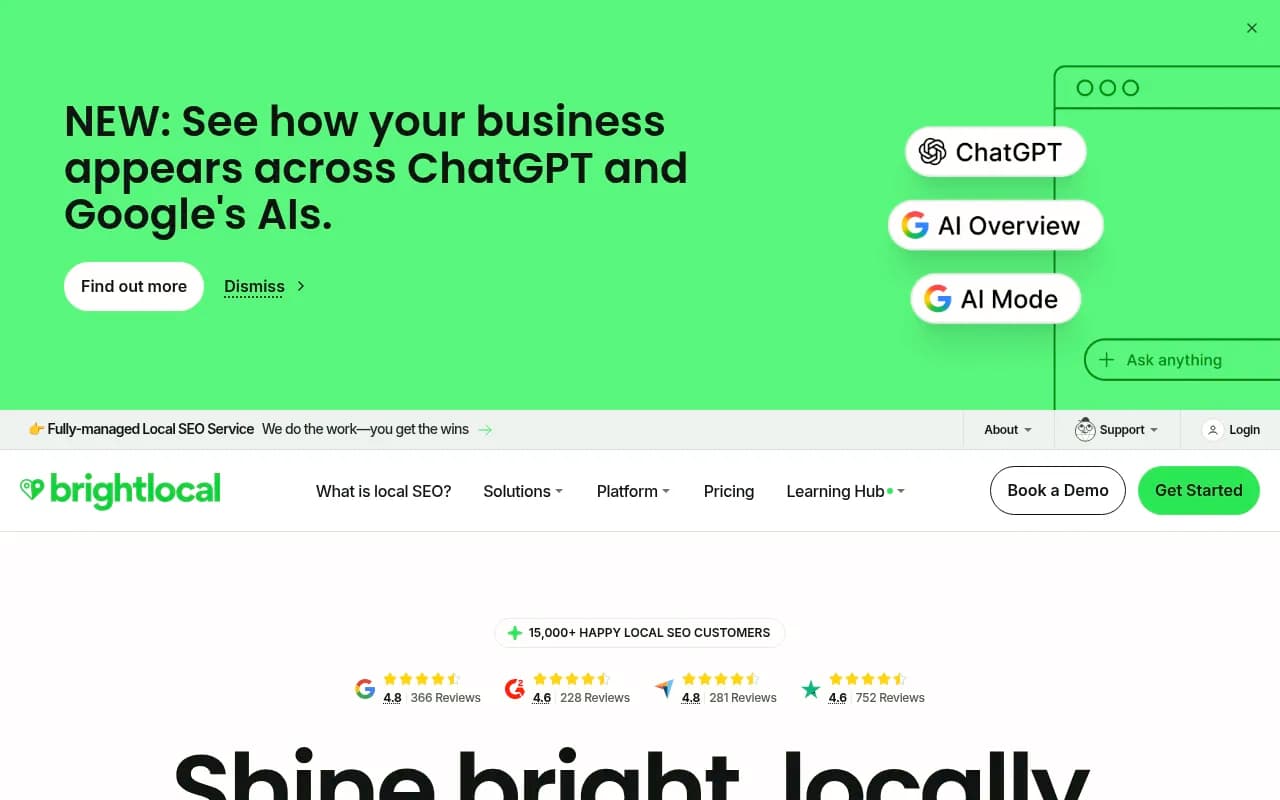
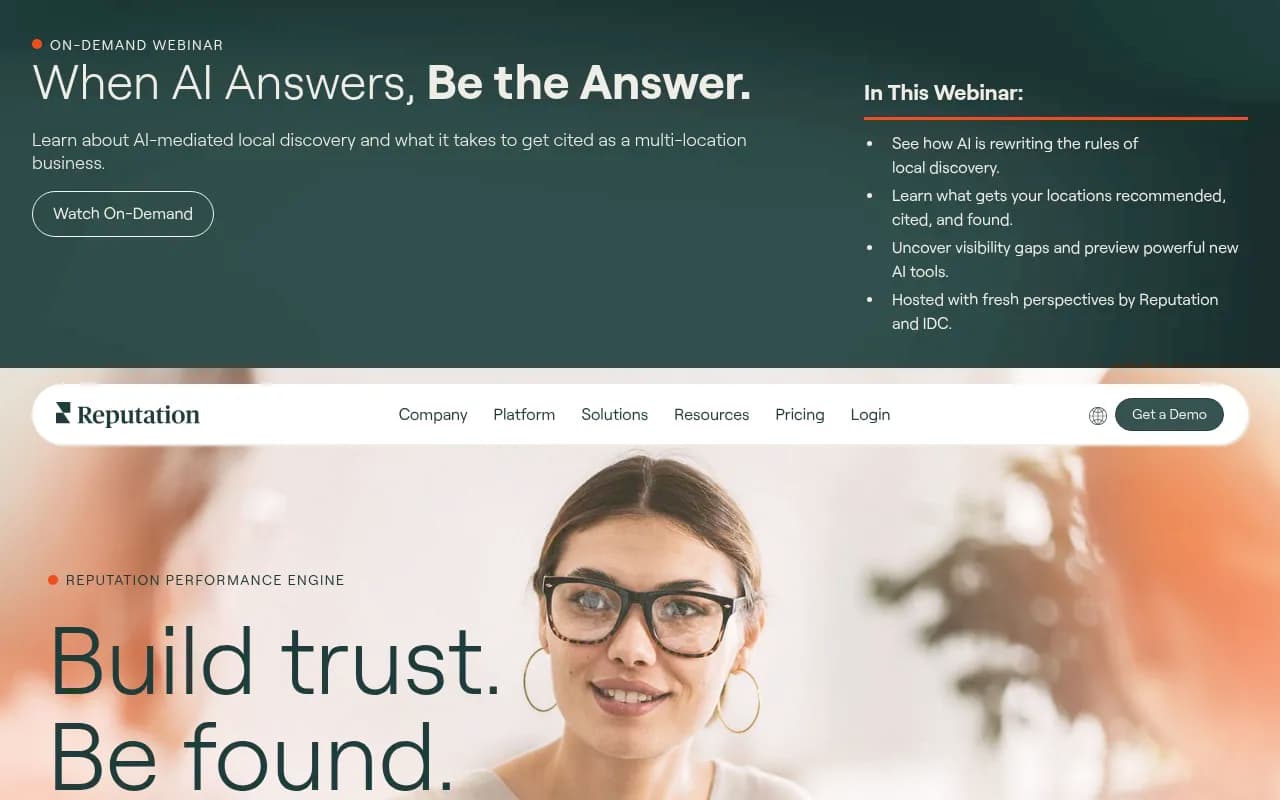
Same business name, same address format, same phone number on your site, Google Business Profile, Apple Maps, Bing Places and every directory. Inconsistent data is how a model decides it is unsure about you and names someone else. Directory management platforms handle this at scale. Yext and BrightLocal both do listings sync, and Reputation.com bundles listings with reviews.
Step 2: Find the directories your competitors already appear on
Pick the three businesses AI names for your query. Check their Google Business Profile, Apple Maps presence, review sites, industry directories, local guides and association pages. Whatever appears for all three is table stakes. Whatever appears for one is a gap you can exploit. BrightLocal publishes lists of top citation sites by industry, which is a faster starting point than guessing.
Step 3: Build service and city pages
Strategi found service pages made up between roughly 10% and 21% of business pages cited, depending on industry, and that the share of city questions citing a page for that city ran from 39.3% (manufacturing) to 59.6% (education). That is a wide spread. In practice it means the cities you actually serve deserve their own pages with real details: neighbourhoods, local project examples, staff names, hours.
Step 4: Earn reviews with specifics
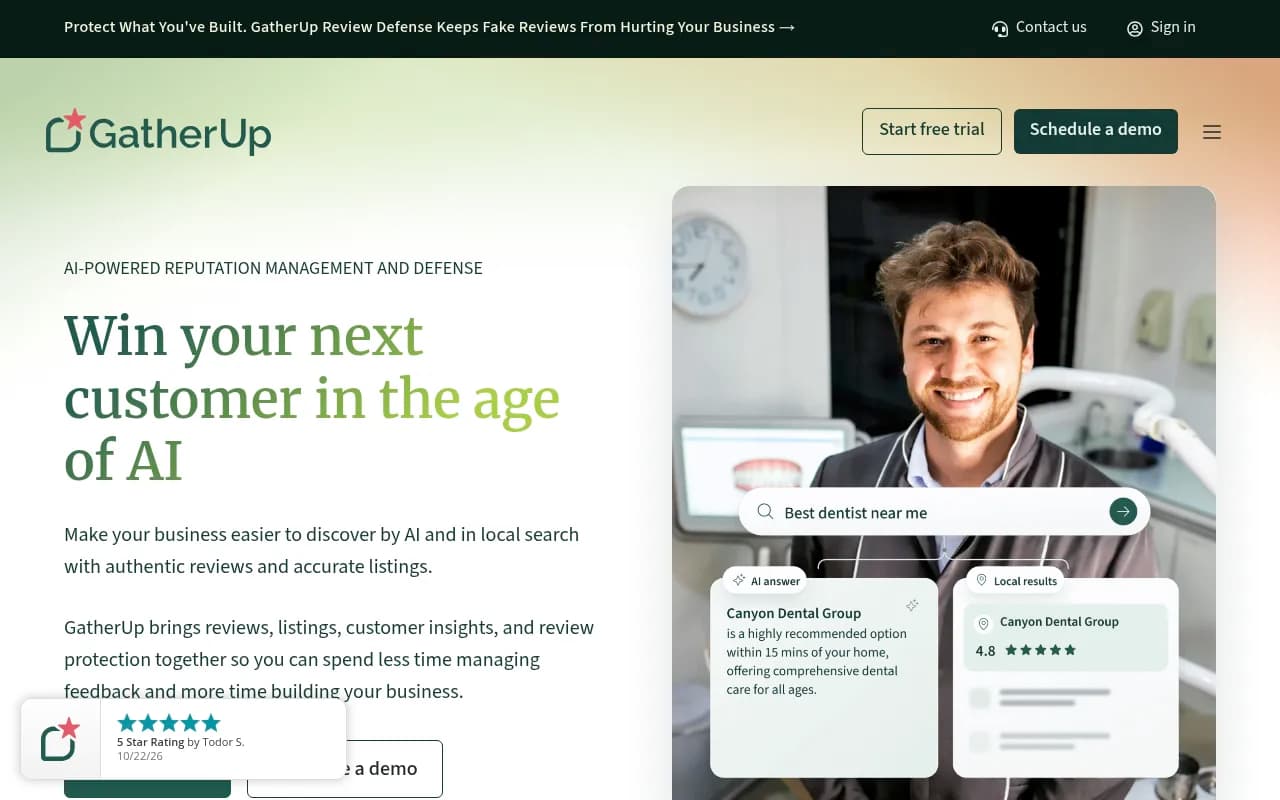
Ask customers to mention what you did and where. Software like NiceJob, GatherUp and ReviewTrackers automate requests and monitor ratings. Don't fake any of it. Fake-review defence matters, and the 4.3-star average suggests a model will not recommend a poorly rated location.


Step 5: Pursue local editorial mentions
Regional press, city guides and trade outlets come back across answers on "best X in Y" queries. A pitch to a local publication that already ranks and gets cited does more than ten new directory listings.
Step 6: Check whether crawlers can read you
A citation doesn't help if the AI bot is blocked from your site. Check robots.txt and server logs. Promptwatch's free AI crawler URL inspector is a quick way to test a page.
Measuring what you get
Once the basics are in place, you need to see which prompts name you, where, and which sources the models cited. Manual spot checks in ChatGPT and AI Mode work for a first pass, but they don't scale across cities and services.
Promptwatch tracks how ChatGPT, Google AI Overviews, AI Mode, Gemini, Perplexity and other assistants mention and cite a brand, and Business plans add state and city tracking and local targeting at exact coordinates, so a monitor can answer as if asked from a specific spot. It also shows which of your pages get cited and which third-party pages name you without linking. See the pricing page for current plans.

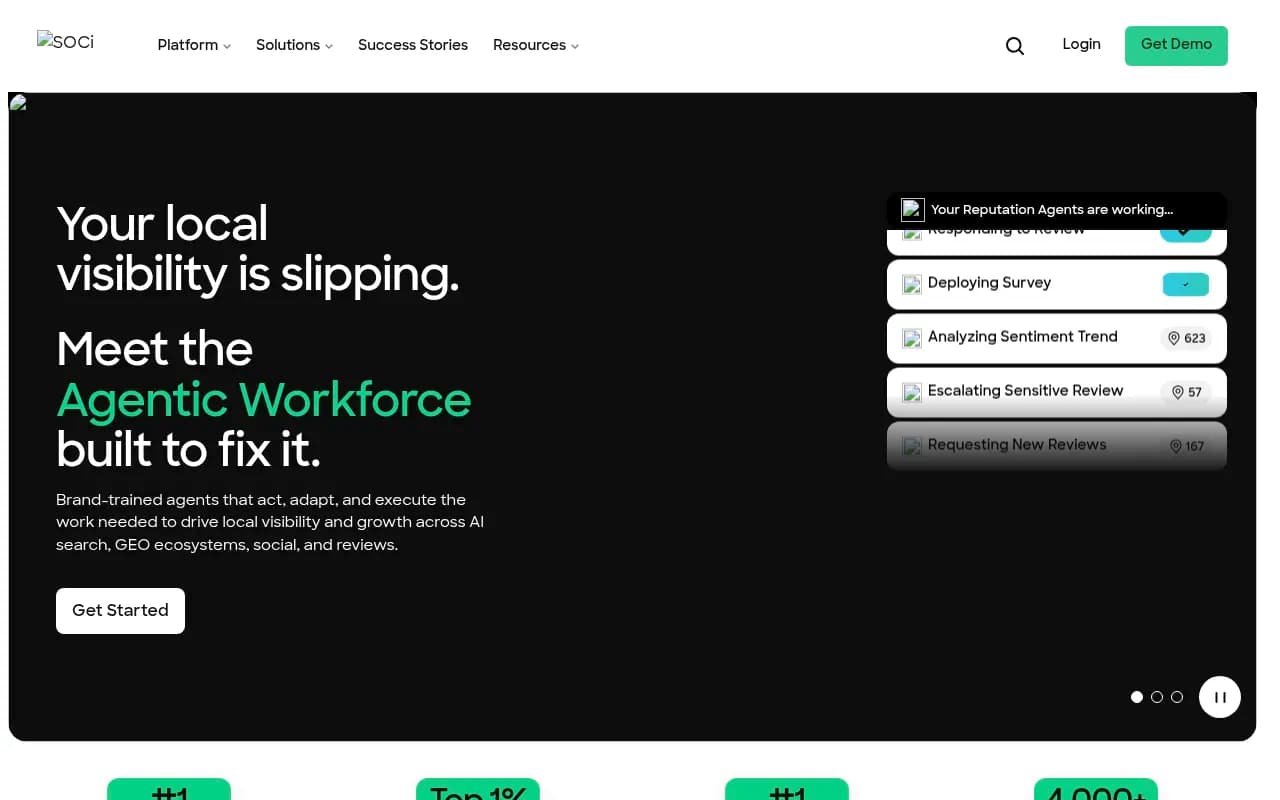
Multi-location brands may prefer a local-first suite. SOCi runs local search, social and reviews for multi-location brands, and its Local Visibility Index is the source of the 4.3-star figure above.
| Tool | Strength for local AI visibility | Best for |
|---|---|---|
| Promptwatch | Tracking AI mentions and citations by country, state and city, plus content and crawler data | Brands and agencies measuring and fixing AI visibility |
| BrightLocal | Listings, local rankings and reviews | Local SEO teams and agencies |
| Yext | Listings sync across directories | Multi-location brands |
| SOCi | Local search, social and reviews at scale | Multi-location brands |
| Reputation.com | Reviews, listings and local AI visibility | Brands consolidating reputation work |
| NiceJob, GatherUp, ReviewTrackers | Review requests and monitoring | Single and multi-location review work |
For more tools in the category, the GEO software directory lists trackers and optimisation platforms side by side.
What to ignore
A few things get oversold in this space.
- Mass citation submissions to low-quality directories. The data shows models lean on a short list of recognised sources per country and industry, not on volume.
- Treating AI answers as a replacement for Google Maps. BrightLocal's July 2026 survey found 23% of consumers used AI at some point in their latest local search, but only 8% started with it. Maps still does the most work.
- Chasing a single ranking. AI answers vary by prompt and by day, so look at how often you appear across a set of prompts, not one screenshot.
The short version
Your own site, with real service and city pages, is the base layer. Google Business Profile comes next. Directories matter where your industry has a reference directory, and reviews decide whether the model feels safe naming you. Fix NAP consistency, claim the industry-specific listings your competitors already hold, collect detailed reviews, and measure by city rather than nationally.
One caution on the data: most of the figures here are third-party studies from Strategi, BrightLocal, SOCi and Yext, with different methods and time frames. Promptwatch Data has no local-specific report, so its reports serve as context for ChatGPT's general citation behaviour. Check the original sources before quoting any single number.
More regularly updated research on how AI assistants choose sources is available at Promptwatch Data.