Key takeaways
- Candidates now ask AI tools questions like "staffing agency for warehouse jobs in Dallas" instead of just Googling, and most multi-location recruiting firms have no idea which of their branches show up in the answer
- ChatGPT works with a tight budget of roughly 5 sources per response, while Google AI Overviews and Perplexity cite closer to 10, so branch pages need to be narrow and specific to earn one of the few slots
- Third-party listicles, review sites, and directories often outrank a staffing firm's own branch page in AI answers, similar to how marketplaces dominate citations in other local-service verticals
- Reddit's role in AI answers is shrinking fast (ChatGPT's citation share from reddit.com fell from roughly 4% to 0.5% in mid-August 2026), so don't build a GEO strategy around it
- LinkedIn behaves very differently depending on the engine, ChatGPT leans on your Company Page and job listings, while Google's AI surfaces favor Pulse articles, which matters a lot for a LinkedIn-native industry like staffing
Why this matters for staffing agencies specifically
A local search fact that recruiting firms haven't fully absorbed yet: candidates and hiring managers are increasingly running their first search inside ChatGPT, Gemini, or Google's AI Overviews instead of typing a query into classic Google. "Best staffing agency in Charlotte for manufacturing jobs" is now a real prompt, not a hypothetical. The American Staffing Association's data shows AI adoption inside staffing firms jumped to 61% in 2025/2026 from 48% the year before, and nearly two-thirds of job seekers say they now use AI tools somewhere in their job search process, according to Citrin Cooperman. That's candidates finding you through a layer you don't control and, in most cases, aren't measuring.
Here's the part that makes this genuinely different from ranking a website in Google: a multi-location staffing brand doesn't have one visibility problem, it has one per branch, per city, per specialty. Your Chicago light-industrial desk and your Austin healthcare desk can have completely different AI visibility outcomes, driven by completely different sources. A single "brand mentioned: yes/no" dashboard tells you almost nothing useful at that level of granularity.
How LLM citation tracking is actually different from rank tracking
Traditional rank tracking answers "where does my page sit in the results for this keyword." LLM citation tracking answers a messier, more useful question: which sources did the AI model actually pull from to build its answer, and did my brand make the cut. For a staffing firm, that's the difference between knowing you rank #4 for "staffing agency Denver" and knowing that ChatGPT's answer to "warehouse staffing agency Denver" cited two Indeed listing pages, a local subreddit thread, and a competitor's Glassdoor profile, and never touched your own site.
That distinction matters more once you look at how few citation slots actually exist. Promptwatch's data on average sources per response shows ChatGPT typically cites around 5 sources per web-search-triggered answer, roughly half of what a classic Google results page used to offer. Google AI Overviews and Perplexity are more generous, both averaging near 10 sources per answer, which makes them the more forgiving surfaces for a smaller regional staffing brand trying to break in. Microsoft Copilot, meanwhile, is genuinely unstable, swinging from under 2 to nearly 17 sources per response within weeks, which makes it a poor engine to optimize for right now.
The practical takeaway: with only about 5 slots on ChatGPT, a broad "best staffing agencies" page competing against national brands is a losing bet. A tightly scoped page like "Warehouse and logistics staffing in Aurora, CO" has a real shot, because it's answering the exact question rather than a generic one.
Who actually gets cited in your space (and it might not be you)
There's no staffing-specific citation report yet, but the closest available analog is Promptwatch's automotive citation-share data, and the pattern is worth taking seriously. In ChatGPT's automotive answers, marketplaces and listing sites (Autotrader, Cars.com) and review/research platforms account for over a quarter of all citations combined, seven of the top eight cited domains aren't manufacturer or dealer sites at all. Only one manufacturer domain cracked the top group.
But here's the encouraging detail buried in that same dataset: a single local dealer's own domain still made the top 31 cited domains, at a modest 0.28% share. It proves individual local-business pages can get cited alongside national marketplaces, if the content is specific enough.
Apply that to staffing and the implication is clear. Before assuming your branch page needs to be the cited source, audit what's actually showing up: Glassdoor, Indeed, Google reviews, BBB profiles, Clutch, G2, and local "best staffing agencies in [city]" listicles. For a regional or mid-size firm, winning a mention inside one of those third-party pages might move the needle faster than trying to out-cite them directly.
What to actually publish: the content-type angle
Promptwatch's July 2026 breakdown of what ChatGPT Search cites by content type found product pages are now the single most-cited format, at roughly a third of all citations, nearly double their March share. Listicles are the fastest-growing format within the month.
Staffing doesn't have "product pages" in the literal sense, but the equivalent exists: a specific job-category-plus-location landing page ("Warehouse Staffing in Dallas, TX" or "Travel Nurse Placement in Phoenix"). Treat those pages the way an e-commerce site treats a product page: clear factual specs (services offered, coverage area, industries served, placement fees or model, direct contact for that branch), not marketing copy. Comparison content ("staffing agency vs. direct hire") and how-to guides ("how to choose a staffing agency in [city]") are still low-competition categories worth building out, per the same report.
The Reddit trap
Recruiting is a heavily Reddit-discussed industry (r/recruitinghell, r/jobs, dozens of local city subs), so it's tempting to lean hard into Reddit as a GEO channel. Be careful here. Promptwatch's social-citation data shows Reddit is genuinely the top social source across ChatGPT, AI Overviews, Perplexity, and Grok, ChatGPT alone pulls over 5% of its citations from Reddit, more than 20 times its next social source.
But reddit.com's overall citation share inside ChatGPT Search collapsed from around 4% down to 0.5% in a single day, August 14, 2026, according to Promptwatch's tracking of the drop. That's not a slow decline like the one happening on Google's AI surfaces, it's a sudden structural shift. Within the Reddit citations that do survive, virality doesn't predict inclusion: about 71% of cited posts had under 10 upvotes, and cited posts skew old, roughly 60% are more than six months old. So a focused, complete answer in a small local subreddit is worth more than chasing a viral thread, but treat Reddit as a supplementary signal for 2026, not a core strategy.
LinkedIn behaves differently per engine, and staffing firms live on LinkedIn
This is one of the more actionable findings for recruiting specifically. Promptwatch's LinkedIn citation-type data shows the page type that gets cited depends heavily on which AI engine you're looking at.
ChatGPT treats LinkedIn almost like a company directory: Company Pages get nearly 24% of its LinkedIn citations and job listings punch well above their weight at 8%, while Pulse articles get under 9%. Google's AI Mode and AI Overviews flip that completely, Pulse articles dominate at 44.85% and 42.25% respectively. Perplexity is the outlier where ordinary feed posts beat Pulse articles.
| Engine | What gets cited most on LinkedIn | What this means for your firm |
|---|---|---|
| ChatGPT | Company Page (23.84%), LinkedIn homepage (22.55%), job listings (8.02%) | Keep your parent Company Page accurate on locations, headcount, specialties. Write descriptive job listings |
| Google AI Mode | Pulse articles (44.85%), posts (27.37%) | Have regional recruiters publish long-form Pulse posts on local hiring market trends |
| Google AI Overviews | Pulse articles (42.25%), posts (27.72%) | Same long-form content strategy as AI Mode |
| Perplexity | Posts (41.88%) over Pulse articles (32.46%) | Frequent, conversational market-update posts win here |
For a multi-location firm, this suggests a split workflow: national brand team owns the Company Page accuracy, branch-level recruiters own Pulse articles and posts about their specific local market.
Tooling: the pricing gap nobody warns you about
Local SEO tools have a mature, per-location pricing model. Tools tracking listings and local rankings typically run somewhere between $5 and $30 per location per month, with enterprise deals for larger networks. That's a familiar budgeting exercise for any multi-branch staffing firm.
LLM visibility trackers don't work that way yet. Pricing is based on tracked prompts and models, not locations. That's a real trap: if you have 20 branches and you want 5-10 location-specific prompts per branch ("staffing agency for [role] in [city]", "temp agency near me in [city]"), you can blow through a mid-tier prompt allowance fast, in a way a per-location local SEO tool never would. Budget for this explicitly rather than assuming your existing local SEO spend maps cleanly onto GEO tooling.
Comparing your options
| Tool | Pricing model | Multi-location fit | Notes |
|---|---|---|---|
| Promptwatch | Per-site/prompt tiers, Essential from $95/mo | Strong, custom prompt sets per location plus crawler logs and offsite mention tracking | Only platform with agentic content generation and CMS publishing, not just monitoring |
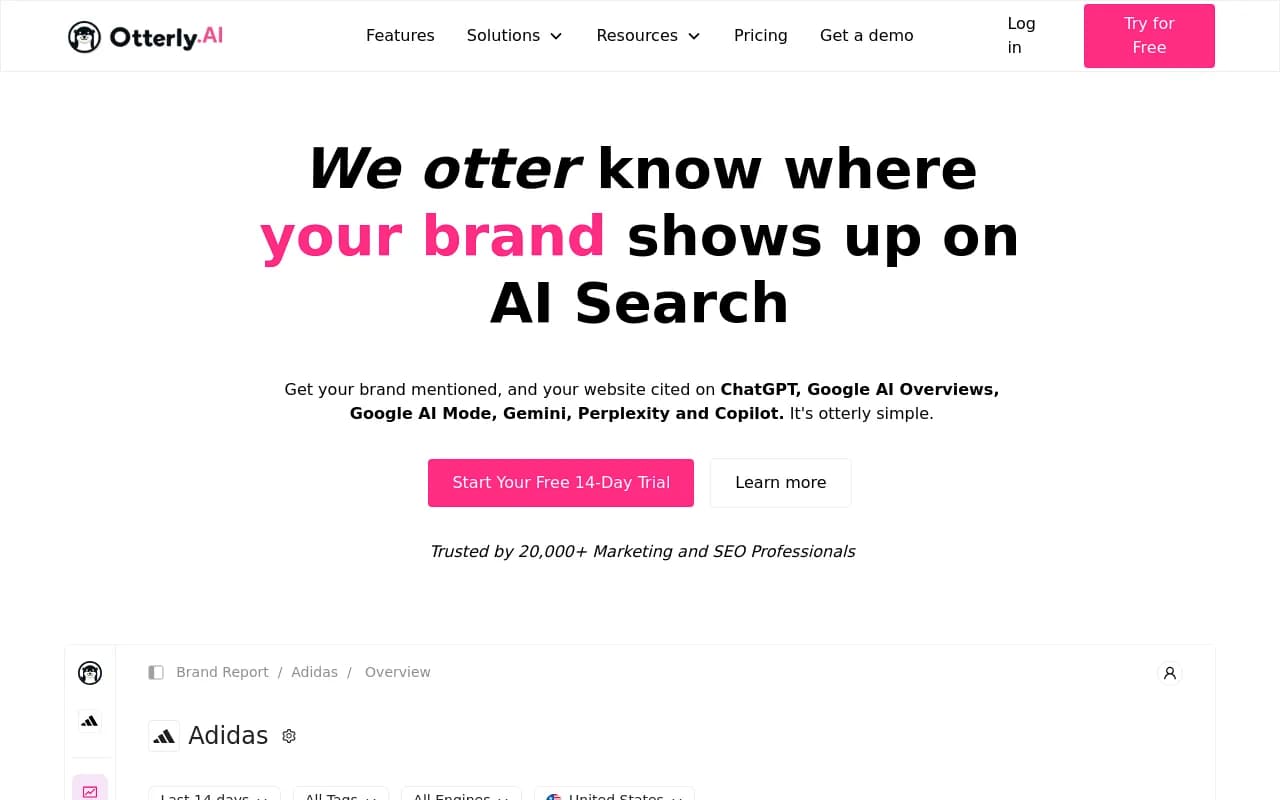
| Otterly.AI | From $29/mo | Basic, prompt-based | Good entry point but no crawler logs or content generation |
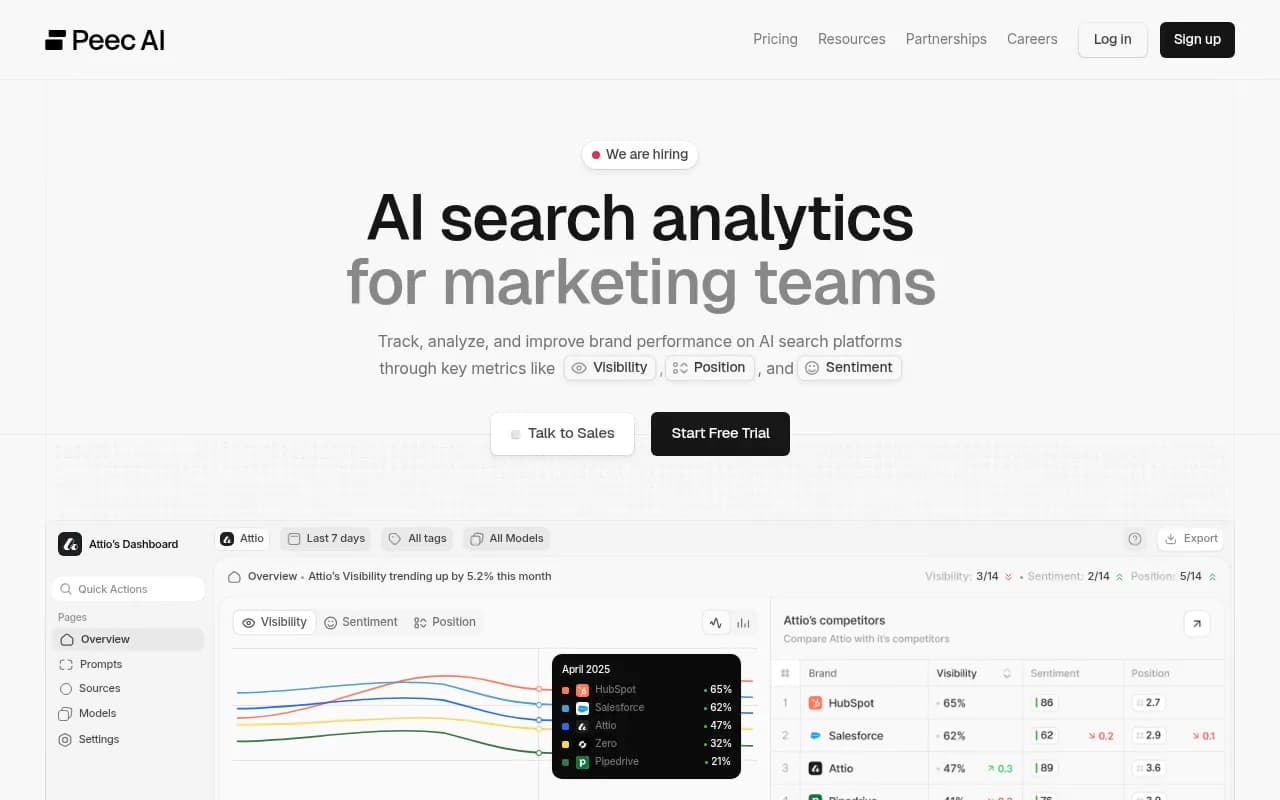
| Peec AI | From roughly $95-245/mo | Supports multi-brand sub-accounts, useful for franchise-style networks | Tracks up to 13 models on annual plans |
| Profound | From ~$499/mo | Enterprise-oriented | Likely the tier a large multi-branch network needs, priced accordingly |
| Ahrefs Brand Radar | From $828/mo (incl. base Ahrefs plan) | Bolt-on to existing SEO suite | Shallow AI-specific data compared to dedicated GEO platforms |
Worth noting: for a staffing firm with two dozen branches, the tool that only tells you "you were mentioned" isn't enough. You need to see which pages got cited, whether your crawler logs show AI bots hitting your branch pages at all, and ideally a way to generate location-specific content without briefing a writer for every single city. Promptwatch covers that fuller loop, prompt tracking with volume and difficulty scoring, AI crawler logs showing exactly when ChatGPTBot or PerplexityBot visits a branch page, offsite mention tracking that catches your brand named in a third-party listicle even without a link, and Content Agents that can draft and publish location pages to your CMS on a schedule.

Other tools worth a look depending on budget and scope include Otterly.AI for a lighter starting point, and Peec AI if you're running several regional sub-brands under one account.
A practical rollout for multi-location firms
Start small and specific rather than trying to track everything on day one.
- Pick your 5-10 highest-revenue branches and build location-specific prompts for each: role type plus city, not generic brand-name prompts
- Audit what's currently cited for those prompts before changing anything. You may find third-party review sites and listicles already carrying your brand, in which case outreach to get listed accurately matters more than new content
- Rebuild your weakest branch pages as tightly scoped, factual landing pages: services, coverage area, industries, direct branch contact, similar in structure to a product page rather than a marketing page
- Fix your Company Page on LinkedIn first, since ChatGPT weights it heavily, then layer in Pulse articles from regional recruiters for Google's AI surfaces
- Set a quarterly cadence to recheck citations per branch. Visibility shifts fast, ChatGPT's Reddit citation share fell by roughly 90% almost overnight in August 2026, and nobody wants to find that out from a client instead of from their own tracking
If you're weighing whether to handle this internally or bring in outside help, an SEO or GEO specialist familiar with AI search behavior can shortcut a lot of the trial and error, particularly around which content types and sources actually earn citations in your market. 1001 SEO Media works with multi-location brands on exactly this kind of technical SEO and AI search visibility work, if that's a path worth exploring. For a broader look at GEO platforms beyond what's covered here, the directory at bestgeosoftware.com is a reasonable place to compare options side by side.