Summary
- AI search engines now process billions of queries monthly -- ChatGPT reaches 800 million weekly users, Google AI Overviews serves 2 billion monthly users, and Perplexity handles hundreds of millions of searches
- Manual checking (testing prompts yourself in ChatGPT, Perplexity, Claude, Gemini) works for spot checks but misses the majority of queries and can't scale
- Automated tracking tools like Promptwatch monitor thousands of prompts across multiple AI engines, track citation trends, and alert you when competitors appear but you don't
- AI search visitors convert at 4.4x higher rates than traditional organic traffic, making visibility tracking directly tied to revenue
- Most brands have zero AI visibility -- 73% don't appear in AI answers at all, creating a massive opportunity for early movers
The problem: your customers moved to AI search and you didn't notice
Google's AI Overviews appear in 13.14% of search results as of March 2025. ChatGPT processes 7 billion monthly visits. Perplexity, Claude, Gemini -- all growing fast. Your customers are asking these engines for product recommendations, comparisons, and buying advice.
And most brands have no idea if they're even mentioned.
I tested this myself last week. I asked ChatGPT "best project management tools for remote teams" and got a detailed answer with six recommendations. Then I asked Perplexity the same question. Different list. Then Claude. Different again. Not one of these engines cited the same set of tools.
If you're not tracking this, you're flying blind. Your competitor might be the top recommendation in ChatGPT while you don't appear at all. You'd never know unless you checked.
This guide walks through two approaches: manual checking (free, limited) and automated tracking (scalable, comprehensive). You'll learn exactly how to do both.
Manual checking: the free but limited approach
Manual checking means opening ChatGPT, Perplexity, Claude, Gemini, and Google AI Overviews yourself and typing in queries to see if your brand appears. It's tedious but it works for spot checks.
Step 1: Build your prompt list
Start by listing 10-20 queries your customers actually use. Not what you think they search for -- what they actually type.
Examples:
- "best [your category] for [use case]"
- "[competitor name] alternatives"
- "how to [solve problem your product solves]"
- "[your product category] comparison"
- "what is the best [your category] in 2026"
Don't guess. Pull these from:
- Google Search Console (queries driving traffic to your site)
- Customer support tickets (questions people ask before buying)
- Sales call transcripts (phrases prospects use when describing their problem)
- Reddit threads in your industry subreddit
Step 2: Test each prompt in multiple AI engines
Open five tabs:
- ChatGPT (chatgpt.com)
- Perplexity (perplexity.ai)
- Claude (claude.ai)
- Gemini (gemini.google.com)
- Google Search with AI Overviews enabled (google.com -- make sure you're logged in and AI Overviews are turned on in your account settings)
Type the same prompt into each engine. Copy the full response into a spreadsheet.
For each response, note:
- Does your brand appear? (Yes/No)
- Position if mentioned (1st, 2nd, 3rd, etc.)
- Context of mention (recommended, compared to others, cited as source, mentioned in passing)
- Competitors mentioned
- Sources cited (URLs, if provided)
Step 3: Look for patterns
After testing 10-20 prompts across five engines, you'll start seeing patterns:
- Which engines mention you most often?
- Which queries trigger your brand?
- Which competitors dominate?
- What content types get cited (blog posts, product pages, comparison articles, Reddit threads)?
This gives you a baseline. You now know where you stand.
The limits of manual checking
Manual checking works for initial assessment but breaks down fast:
- Time cost: Testing 20 prompts across 5 engines = 100 manual checks. That's hours of work.
- No historical data: You see today's results but have no idea if you're improving or declining.
- Sampling bias: You only test prompts you think of. You miss the long tail -- the thousands of variations customers actually use.
- No alerts: If a competitor suddenly starts appearing for your key prompts, you won't know until you manually check again.
- Persona blindness: AI engines personalize responses based on location, browsing history, and user context. Your manual check shows what you see, not what your customers see.
For a one-time audit, manual checking is fine. For ongoing monitoring, you need automation.
Automated tracking: the scalable approach
Automated tracking means using a platform that runs your prompts across AI engines on a schedule, logs the results, and alerts you to changes. This is how you actually stay on top of AI visibility.
What automated tracking looks like
Instead of manually typing prompts into ChatGPT, you:
- Upload a list of 50-500 prompts to a tracking platform
- The platform runs those prompts daily or weekly across ChatGPT, Perplexity, Claude, Gemini, Google AI Overviews, and other engines
- You get a dashboard showing:
- Your visibility score (what % of prompts mention your brand)
- Citation trends over time (are you appearing more or less?)
- Competitor comparison (who's winning for each prompt?)
- Source analysis (which pages get cited most?)
- Alerts when competitors appear but you don't
Key features to look for in a tracking tool
Not all AI visibility tools are the same. Here's what actually matters:
1. Multi-engine coverage The tool should track at least ChatGPT, Perplexity, Claude, Gemini, and Google AI Overviews. Bonus if it includes Meta AI, Grok, DeepSeek, Mistral, Copilot.
2. Custom prompt lists You should be able to upload your own prompts, not just track a fixed set the platform chooses.
3. Historical data See trends over time. A snapshot is useless -- you need to know if you're improving.
4. Competitor tracking The tool should show which competitors appear for each prompt and how often.
5. Citation analysis Which specific pages, URLs, or sources do AI engines cite? This tells you what content works.
6. Alerts Get notified when your visibility drops or when a competitor starts appearing for your key prompts.
7. Persona and geo targeting AI engines personalize responses by location and user context. The tool should let you simulate different personas (e.g. "small business owner in Texas" vs "enterprise buyer in California").
Recommended tools for AI visibility tracking
Promptwatch is the most comprehensive platform for tracking and improving AI search visibility. It monitors 10 AI engines (ChatGPT, Perplexity, Google AI Overviews, Claude, Gemini, Meta AI, DeepSeek, Grok, Mistral, Copilot), tracks custom prompts, and shows exactly which pages get cited. The key difference: Promptwatch doesn't just show you data -- it helps you fix gaps with built-in content generation and Answer Gap Analysis that shows which prompts competitors rank for but you don't.

Other tools worth considering:
Otterly.AI -- Affordable monitoring-only platform. Good for basic tracking but lacks content optimization features.

AthenaHQ -- Tracks 8+ AI engines with clean dashboards. Monitoring-focused, no content gap analysis or generation.

Profound -- Strong feature set but higher price point. No Reddit tracking or ChatGPT Shopping monitoring.

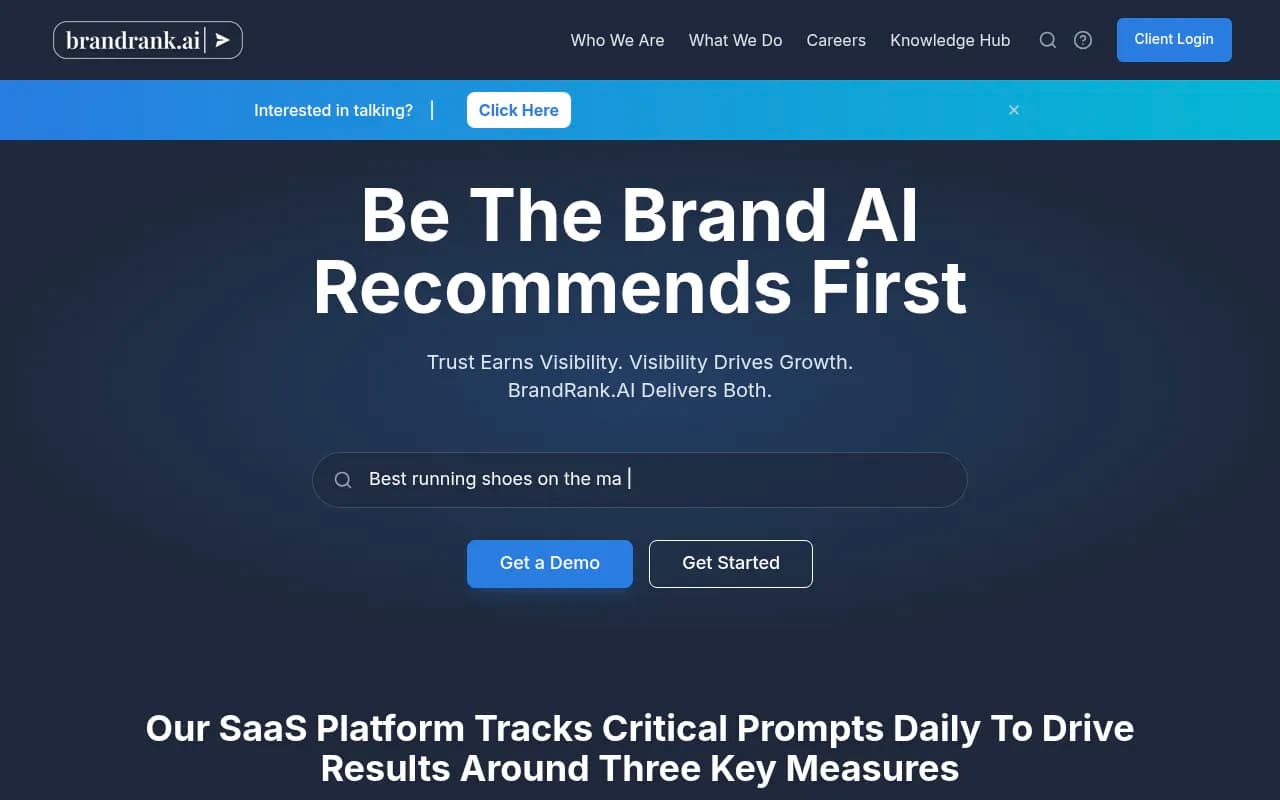
BrandRank.AI -- Simple interface, good for small teams. Limited prompt volumes on lower tiers.
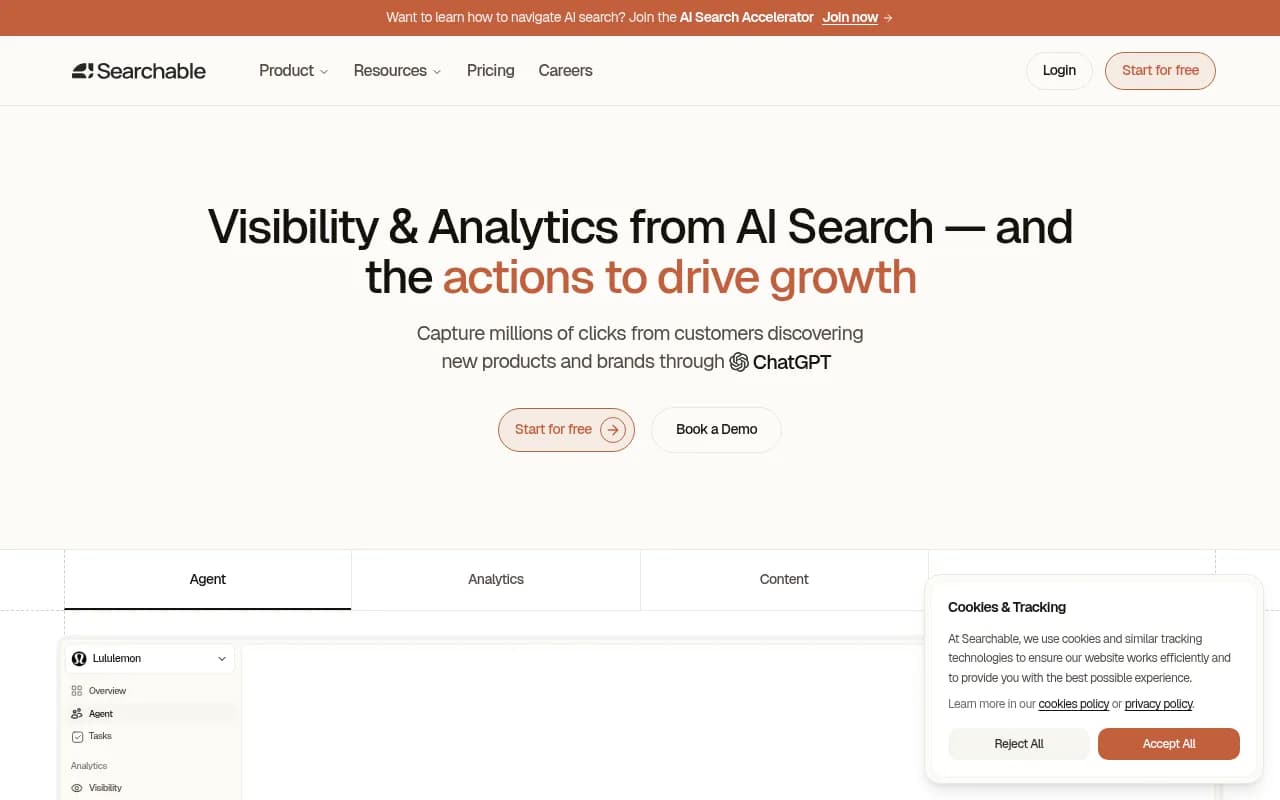
Searchable -- Combines monitoring with content tools. Mid-tier pricing.
Tool comparison table
| Tool | Engines tracked | Custom prompts | Content generation | Starting price |
|---|---|---|---|---|
| Promptwatch | 10 (ChatGPT, Perplexity, Claude, Gemini, Google AI Overviews, Meta AI, DeepSeek, Grok, Mistral, Copilot) | Yes | Yes (AI writing agent) | $99/mo |
| Otterly.AI | 6+ | Yes | No | $49/mo |
| AthenaHQ | 8+ | Yes | No | $99/mo |
| Profound | 5+ | Yes | No | $199/mo |
| BrandRank.AI | 5+ | Yes | No | $79/mo |
| Searchable | 6+ | Yes | Limited | $149/mo |
Setting up automated tracking: step-by-step
Here's how to actually set up AI visibility tracking using Promptwatch as an example. The process is similar for other tools.
Step 1: Sign up and connect your website
Go to Promptwatch and create an account. Add your website URL. The platform will start crawling your site to understand your content.
Step 2: Upload your prompt list
Remember those 10-20 prompts you tested manually? Expand that list to 50-100 prompts. Include:
- Product category queries ("best [category] for [use case]")
- Comparison queries ("[your product] vs [competitor]")
- Problem-solving queries ("how to [solve problem]")
- Alternative queries ("[competitor] alternatives")
- Buying intent queries ("should I buy [your product]")
Upload the list to Promptwatch. The platform will start tracking these prompts across all 10 AI engines.
Step 3: Add competitors
List 3-5 direct competitors. The platform will track their visibility alongside yours so you can see who's winning for each prompt.
Step 4: Set up alerts
Configure alerts for:
- Visibility drops (your brand stops appearing for a key prompt)
- Competitor gains (a competitor starts appearing for a prompt where you don't)
- New citations (a new page on your site gets cited)
- Crawler activity (AI engines crawl your site -- Promptwatch tracks this with AI Crawler Logs)
Step 5: Review your baseline report
After 24-48 hours, you'll have your first full report showing:
- Your overall visibility score (what % of prompts mention your brand)
- Per-engine breakdown (which AI engines mention you most?)
- Competitor heatmap (who's winning for each prompt?)
- Citation analysis (which pages get cited?)
- Gap analysis (which prompts do competitors rank for but you don't?)
This is your starting point. Everything you do next is measured against this baseline.
What to do with the data
Tracking is useless if you don't act on it. Here's how to turn visibility data into actual improvements.
Fix content gaps
The Answer Gap Analysis (available in Promptwatch and a few other platforms) shows prompts where competitors appear but you don't. These are your biggest opportunities.
For each gap:
- Look at what content competitors have that you don't
- Check which sources AI engines cite for those prompts
- Create content that covers the same topic but better -- more specific, more actionable, more up-to-date
Promptwatch's AI writing agent can generate articles grounded in real citation data, but you can also write manually. The key is covering the angles AI engines want.
Optimize existing pages
If you're getting cited but not ranking first, look at the pages AI engines cite instead of yours. What do they have that you don't?
- More specific examples?
- Better structure (headings, lists, tables)?
- More recent data?
- Clearer answers to common questions?
Update your pages to match or exceed what's currently winning.
Monitor crawler activity
AI engines send crawlers (like GPTBot, PerplexityBot, ClaudeBot) to read your site. If they can't access your content, they can't cite it.
Promptwatch's AI Crawler Logs show:
- Which pages AI crawlers visit
- How often they return
- Errors they encounter (404s, blocked by robots.txt, slow load times)
Fix any crawling issues immediately. If GPTBot can't read your best content, ChatGPT will never cite it.
Track traffic attribution
Visibility is great but revenue is better. Connect AI visibility to actual traffic and conversions.
Most platforms (including Promptwatch) offer:
- JavaScript snippet for client-side tracking
- Google Search Console integration
- Server log analysis
This shows which AI engines send traffic, which pages they link to, and how those visitors convert compared to traditional organic traffic. (Spoiler: AI search visitors convert at 4.4x higher rates.)
Common mistakes to avoid
Testing only branded queries Don't just check "[your brand name] review" or "what is [your product]". Test queries where customers don't know your brand yet -- those are the high-value opportunities.
Ignoring long-tail prompts The prompt "best CRM" gets tested by everyone. The prompt "best CRM for real estate teams under 10 people" is where you actually win customers. Test the long tail.
Checking only ChatGPT ChatGPT is huge but it's not the only game. Perplexity, Claude, Gemini, and Google AI Overviews all have massive user bases. Track them all.
Not tracking competitors Your absolute visibility score is less important than your relative position. If you appear in 30% of prompts but competitors appear in 60%, you're losing.
Treating this as a one-time audit AI search is moving fast. A prompt that mentions you today might not mention you next week. Set up ongoing monitoring, not a one-time check.
Why this matters more than you think
Gartner predicted traditional search volume will drop 25% in 2026 as users shift to AI engines. That's not a maybe -- it's happening now.
73% of brands have zero AI visibility. They don't appear in ChatGPT, Perplexity, Claude, or Gemini at all. If you're in that 73%, you're invisible to millions of potential customers.
But here's the opportunity: AI search is still new. The brands that show up consistently in AI answers are the ones that moved early. There's no legacy SEO advantage here -- no 10-year-old domain authority, no massive backlink profile. AI engines cite the content that best answers the question, regardless of who published it.
That levels the playing field. A startup can outrank an incumbent if they create better content for AI search.
Start with manual checks, graduate to automation
If you're reading this and thinking "I should check if we show up in ChatGPT," start there. Spend an hour manually testing 10 prompts across ChatGPT, Perplexity, and Claude. See where you stand.
But don't stop there. Manual checking gives you a snapshot. Automated tracking gives you a system.
Tools like Promptwatch turn AI visibility from a guessing game into a measurable, improvable metric. You see exactly where you're invisible, why competitors are winning, and what content to create next. The platform tracks thousands of prompts, monitors 10 AI engines, and shows you the specific gaps to fill.
The brands that dominate AI search in 2026 won't be the ones with the biggest SEO budgets. They'll be the ones that started tracking, optimizing, and iterating before everyone else figured it out.
You're either visible in AI search or you're not. Time to find out which one you are.