Key takeaways
- GEO needs at least six skills: technical SEO, content, structured data, digital PR, analytics and prompt testing. One hire rarely covers all of them.
- A tool tells you where you are invisible. It does not write, publish or maintain the pages that fix it, so it is enough only if you already have people who can do that work.
- Agencies fit companies missing several of the skills at once. In-house fits a permanent, large workload. A freelancer fits one narrow gap.
- Content decays. Pages ChatGPT cites need upkeep, which favors a standing owner or a retainer over a one-off project.
- The most common pattern that works: an agency builds the system, a coordinator in-house runs it, and a tool measures it.
The question behind the question
Most teams ask "agency or in-house?" when the real question is "what exactly is missing?" A company with a good developer, a good writer and a marketing manager might be missing only two of the six skills GEO needs. Hiring a full agency to cover those two gaps is overkill. Hiring one generalist to cover all six is wishful thinking.
There is also a third answer that gets skipped: a monitoring or optimization tool, which costs a fraction of either and changes what you need people for. So this guide treats it as three options plus a fourth, doing it yourself.
One caveat before we start. Nobody controls what an AI system says, so none of these options guarantees a result. Anyone promising otherwise is selling a label. (That applies to agencies, freelancers and tool vendors alike.)
What GEO work actually requires
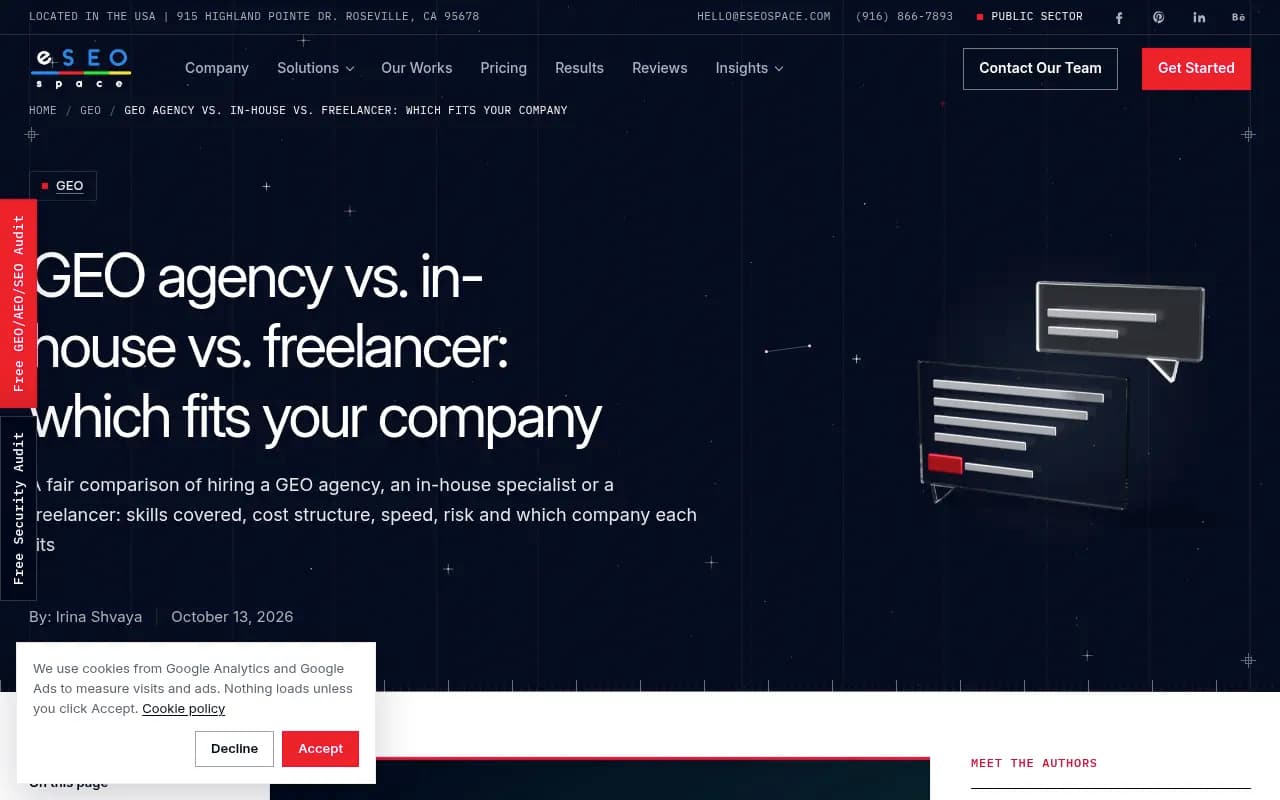
The eSEOspace comparison of agency, in-house and freelancer options lists six skill areas. I find it a useful checklist because it makes the gap visible:
| Skill | What it covers | Typical gap in a small team |
|---|---|---|
| Technical SEO | Crawlability, rendering, site health, bot access | Often missing |
| Content | Pages that answer real customer questions, kept current | Usually present |
| Structured data | Schema, accurate business details everywhere | Often missing |
| Digital PR | Third-party mentions and citations | Often missing |
| Analytics | Tying AI visibility to traffic and revenue | Partial |
| Prompt testing | Running and tracking the prompts buyers use | Rare |
Google's own position is that optimizing for generative AI search is "still SEO." So whoever you pick needs solid SEO fundamentals first. A GEO specialist with no SEO background is a red flag.
Option 1: the in-house team
You employ a specialist or add GEO to an existing marketer's role. They work only on your business.
Where in-house wins
- Deep knowledge of your products, customers and internal experts.
- Full-time attention and fast reactions when something changes.
- Knowledge stays with the company, at least as long as the person does.
Where it hurts
- One person rarely covers technical, content, PR and analytics equally well.
- Recruiting is slow. Glassdoor puts an average hiring process at around 28 days per hire, and it is hard to interview for a skill nobody in your company has.
- If they leave, much of the knowledge leaves too.
- Cost. The U.S. Bureau of Labor Statistics reports a May 2025 median wage of $78,760 for market research analysts and marketing specialists, but that broad category is not specific to GEO. Director-level hires run far higher. One home-services agency study puts a fully loaded in-house hire at $120,000 to $170,000 a year, against $30,000 to $96,000 for a full-service agency retainer. That is a vendor comparing itself favorably, so treat the exact figures with some skepticism, but the shape is right: a salary plus tools plus management time is a bigger commitment than it looks.
In-house makes sense when you have enough ongoing content and product change to keep a specialist busy full time, and a manager who can direct the work.
Option 2: the GEO agency
An agency suits companies with no in-house search specialist, companies missing several of the six skills, and companies that cannot wait for a hiring cycle. Optimist's analysis of the agency market makes the speed argument bluntly: a GEO hire ramping for two quarters is two quarters of competitors getting recommended while you are not. Their data points are worth knowing but unverified here: Conductor's 2026 report says 94% of CMOs plan to increase AEO and GEO investment, and G2 reports 51% of B2B software buyers now start research in an AI chatbot more often than Google.
What to watch for
The discipline is barely two years old, so many agencies simply relabeled their SEO services. Red flags worth taking seriously:
- GEO appeared on their site this year with no published AI outcomes behind it.
- They lead with an "AI visibility score" and cannot connect it to pipeline, signups or demos.
- They sell GEO as a disconnected product, or tell you SEO is dead.
- You cannot tell who actually does the work.
Also remember Google's warning in its guidance on hiring search help: "Ultimately, you are responsible for the actions of any companies you hire."
If you want a full-service option with a GEO focus, 1001 SEO Media covers technical SEO, content, digital PR and AI search work on a no-long-term-contract basis. For the broader market, the directories at bestgeosoftware.com and surferstack.com list both tools and providers.
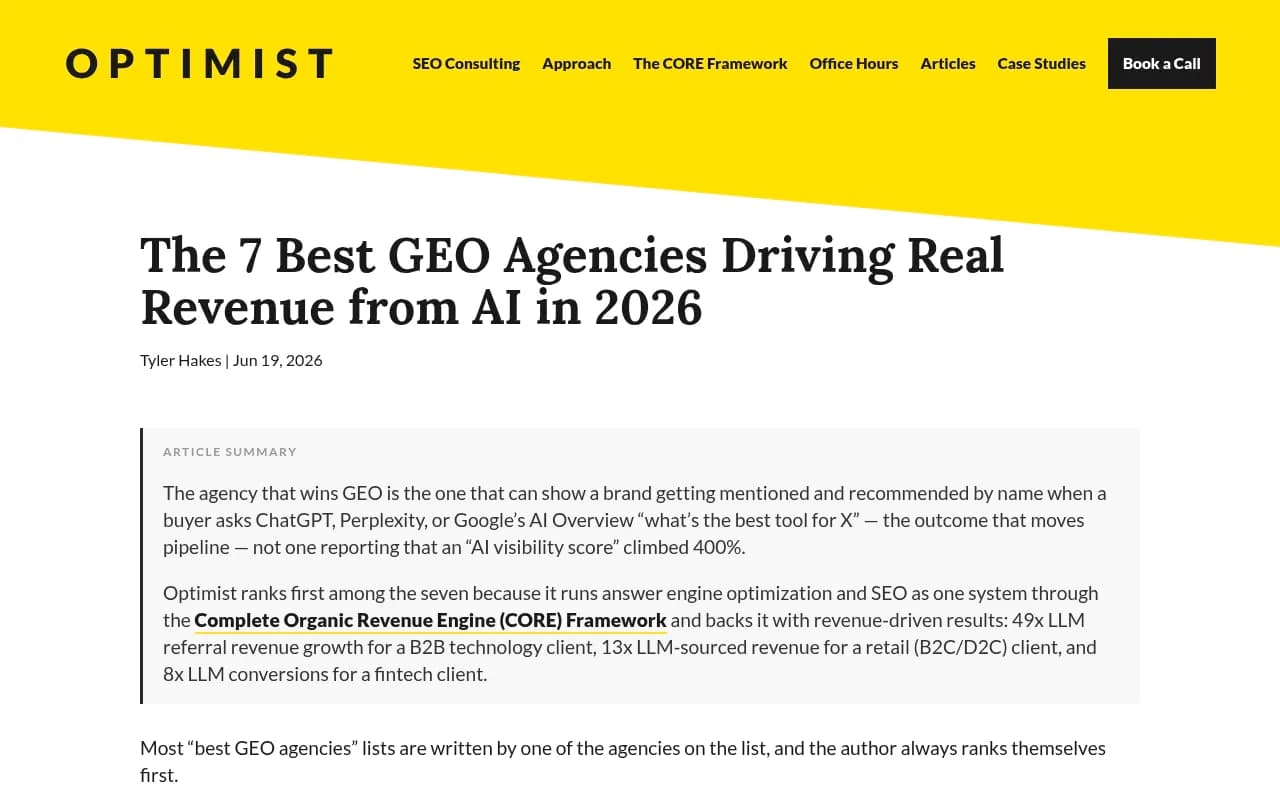
A practical note from that same analysis that matches what I would expect: agencies deliver the most when you can execute their roadmap and content briefs internally. If you need the agency to do all production too, you are buying a more expensive engagement and should price it that way.
Option 3: the freelancer
A freelancer suits a narrow, well-defined job, such as a structured data cleanup or a technical audit, or a business that needs a few expert hours a month and can coordinate the rest itself. The weakness is coverage and continuity. One person, one set of skills, and no backup.
Option 4: a tool, and what it can and cannot do
Tools fall into two groups, and the difference matters when deciding whether a tool is "enough."
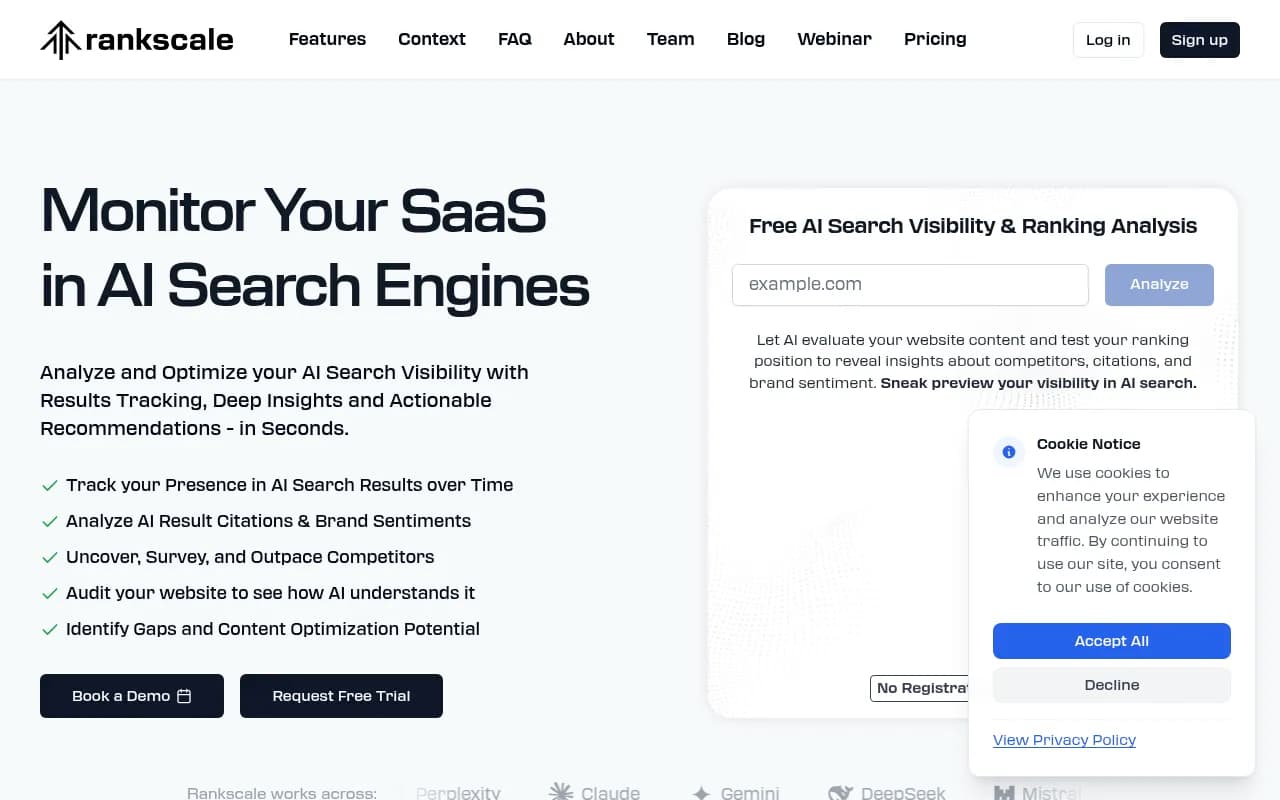
Monitoring tools answer "was my brand mentioned?" They run prompts across ChatGPT, Perplexity, Google AI Overviews and others, and report visibility, share of voice and citations. Examples in this category include Otterly.AI, Peec AI and Rankscale.


Optimization platforms go further: they show why you are not cited, find content gaps, and in some cases help produce and publish the fix. Promptwatch sits here. It tracks the real interfaces of the major AI engines, shows IP-verified AI crawler logs and AI-referred traffic, and its Content Agent can plan, write and publish gap-closing articles to Webflow, Framer or WordPress. That matters for the in-house question, because it replaces some of the content and analytics labor rather than only reporting on it.

Other platforms worth a look if you are comparing: Profound for enterprise monitoring, AthenaHQ, and Semrush if you want AI tracking inside an SEO suite you already use.

| Option | Typical cost shape | Covers the six skills? | Best for |
|---|---|---|---|
| Monitoring tool | Low monthly fee | Prompt testing and analytics only | Teams that can already fix what the data shows |
| Optimization platform | Monthly plan, higher tiers add content automation | Prompt testing, analytics, much of content and technical diagnosis | Lean teams that want the loop closed |
| Freelancer | Hourly or project | One or two skills | A single known gap |
| Agency | Monthly retainer or project | Most or all | Missing several skills, or needing speed |
| In-house hire | Salary plus tools plus management | Depends on the person | Large, permanent workload |
A tool is enough when two conditions hold: you have someone who can ship content and technical fixes, and your gap is mostly knowing what to do next. It is not enough when nobody owns the pages, the PR or the site fixes. Software will not get a third-party site to mention you.
The part everyone forgets: maintenance
GEO is not a one-off project, and Promptwatch's data makes the maintenance burden concrete. In Promptwatch Data's content half-life study, which tracked every page ChatGPT cited on July 6, 2026 for 90 days, landing pages and docs were still cited 78% and 76% of the time after 30 days. News pages were the fastest to decay: half were gone after 36 days. Product pages, reviews and how-tos reach their half-life after roughly 74 to 77 days.
The practical read: landing pages, docs and pricing pages are long-term assets you must keep accurate, while news and press content gives short bursts only. That ongoing upkeep favors an in-house owner or a standing retainer over a one-time agency project.
Competition for slots is tight too. According to Promptwatch's average sources per response data (published September 2025, ChatGPT web-search answers only), ChatGPT cites about 5 sources per answer, while Google AI Overviews and Perplexity cite about 10. With so few slots, small quality gaps in your pages matter, and the same data advises measuring each engine separately since ChatGPT citations do not predict AI Overviews citations.
More recent figures from Promptwatch's ChatGPT unique-domains report show almost half of ChatGPT responses cite 10 or more unique domains (Sep 28 to Oct 4, 2026), so source counts vary by method and period. Read the numbers with their dates attached.
How to decide: a short procedure
1. Size the gap
Score yourself against the six skills. One missing skill points to a freelancer. Several missing points to an agency. A large, permanent workload points to a hire.
2. Check your execution capacity
If you have writers and a developer who can ship, a tool plus occasional expert help may be enough. If every task needs to be handed off, you are buying execution, and that means an agency or hires.
3. Check your budget honestly
A small local business can probably do much of the work itself, as Google says. Accurate business details everywhere, pages that answer real customer questions, and a monthly check of what AI assistants say about you cover a lot of ground. Paying a retainer before doing that is usually premature.
4. Decide on speed
Agencies start in weeks. A new hire takes months to recruit and onboard. If competitors are being recommended now, speed counts.
5. Plan the handover
The pattern that shows up repeatedly: the agency builds the engine and proves the model, then a coordinator in-house runs it day to day. Plan that from the first contract, with documentation and briefs you own.
Scenarios
| Situation | Likely fit |
|---|---|
| Solo marketer at a small SaaS, decent content skills | Optimization platform, plus a freelancer for technical fixes |
| Mid-size B2B with writers but no technical SEO or PR | Agency for strategy and PR, in-house for production, tool for tracking |
| Enterprise with many markets and a large site | In-house lead plus agency for execution, enterprise-grade tooling |
| Local business under a few million in revenue | Do it yourself with a monthly check, tool if budget allows |
| Agency considering offering GEO to clients | Multi-client platform, since reselling a tracker alone is thin |
What I would do
If I were starting from zero this quarter, I would run a free scan of how the main assistants describe the brand, buy one tool and use it for 60 days, and only then decide on people. That sequence tells you whether your gap is knowledge, execution or both. Hiring first means guessing.
If the data shows you are invisible and nobody on your team can fix the causes, bring in an agency with proof of AI-specific outcomes, not just a visibility score. Then keep a person in-house who owns the work after the engagement ends. For more tool options, the directory at bestgeosoftware.com is a good place to compare platforms side by side.
All pricing and plan details change often, so confirm with each vendor before you commit.