Key takeaways
- Put who, what, when, where and why in the first one or two sentences. PR Newswire's own LLM formatting guide says models give more weight to the first 50 words.
- Quotes with a real statistic or claim help. Generic enthusiasm gives a model nothing to extract.
- Descriptive subheadings like "Key Findings" correlated with 61% more AI citations in a Notified study of 25,000+ GlobeNewswire releases. That is vendor research, so treat it as directional.
- A release behaves like news in AI answers. Promptwatch Data shows news pages lose half their ChatGPT citations in about 36 days, so link every release to durable pages.
- Press releases are a small citation type. Treat the release as a source of facts and third-party coverage, not a main citation surface.
Be honest about what a press release can do
Before the templates, a reality check. Most guides on this topic are written by newswire vendors and PR software companies, and they have a reason to oversell. I would rather give you the numbers as they are.
Promptwatch's data on which content types ChatGPT cites (Sep 28 to Oct 4, 2026) shows product pages at 22.4% of classified citations and landing pages at 16.8%. Press releases are not even broken out in the all-prompt top list. For branded prompts, meaning prompts that name a company, they reach 2.1% of citations. That is more than their overall share, but it is still small.
So a press release is not your main route into AI answers. Its job is narrower and still useful: it puts clean, quotable facts on a crawlable page, and it seeds third-party coverage that AI models then cite. Write it with that in mind.
What the research says (and how much to trust it)
Three sources come up repeatedly, and they differ in quality.
| Finding | Source | Caveat |
|---|---|---|
| Releases with structured data, original quotes and current metadata were 3.4x more likely to appear in AI citations (200,000 releases vs 13 million citations) | Notified / GlobeNewswire | Vendor-published, newswire has an interest in the result |
| Descriptive subheadings: +61% AI citations. Links to the company's own site: +57%. High fact density: +29% to 33% | Notified Q4 2026 study of 25,000+ releases and nearly 1 million citations | Same vendor, but a large sample |
| Adding quotations: +41% visibility. Statistics: +33%. Authoritative citations: +28%. Keyword stuffing: -10% | Princeton GEO paper (ACM KDD 2024) | Tested general web content, not press releases |
The direction is consistent across all three: specific facts, named entities, clear structure and quotes beat adjectives. I trust that direction more than any single percentage. Do not put "+41%" in a slide and promise it for your next announcement.
Decide whether you have news at all
The Shadow guide cites PRSA on reserving releases for real news: product launches with named customers, funding rounds, executive hires that signal a strategy shift, acquisitions, partnerships that create something new for customers, and original research. A redesigned website is not news.
This matters for AI as much as for journalists. A release with no concrete claim gives a model nothing to cite, and it gives reporters nothing to write about. If you cannot state the news in one sentence with a number or a name in it, wait.
Original research is the strongest candidate. A release built around a dataset gives you the statistics, the quotes and the authority signals the studies above reward.
Write the first 50 words like they are the whole release
PR Newswire's formatting guidance says LLMs give more weight to the first 50 words. The inverted pyramid has been standard for a long time, but now software enforces it.
A weak lead:
We're thrilled to announce that after months of hard work, our talented team has developed something we believe will change the way businesses think about customer engagement.
That is 29 words with no company, no product and no figure. Compare it with the lead in the annotated PressPilot example (a fictional company from a 2026 press release guide):
PARIS, April 12, 2026. PressPilot, the AI-powered press release distribution platform, today announced a 4 million euro Series A round led by Northline Ventures, with participation from 20 operator angels.
Company name, what it does, the event, the amount, the lead investor and the date. A model can lift that sentence whole and it will still be correct.
Checklist for the lead:
- Company name and a one-clause description of what it does
- The verb that carries the news (launched, raised, acquired, found)
- A number, a named partner or a named customer
- A real date, not "recently"
- No "thrilled", "revolutionary" or "best-in-class"
Headline and subheadline
Keep the headline short. The Zeover guide recommends under 55 characters and under 8 words, and a headline like "Zeover Partners with CISION for AI Press Distribution" (53 characters) fits. I would not treat the exact cutoff as a law, but shorter headlines are easier to extract and easier for journalists to scan.
Use the subheadline to carry the supporting data. A subheadline that names the investor, the figure or the study sample size gives a second extractable fact right under the title.
Structure the body with descriptive headings
This is where most releases fall short. A 400-word wall of text with no internal markers is hard for a person and for a retrieval system.
Notified's study found that headings such as "Key Findings" or "Financial Highlights" correlated with 61% more AI citations. The Zeover guide suggests sections of roughly 150 to 300 words. For a standard 300-to-500-word release, that means two or three clearly labeled blocks at most.
For a research release, the template Notified publishes looks like this:
HEADLINE: [X]% of [Audience] Miss [Opportunity], New Study Shows
SUBHEADLINE: [Sample size, method, one supporting stat]
DATELINE + LEAD: [City, Date] - [Org] report shows [stat].

Key findings
- Stat 1 with sample size
- Stat 2 with comparison
- Stat 3 with trend

Methodology
[Who, how many, when]

What this means
[Quote from named expert]

About [Org]
[Locked boilerplate]

Media contact
[Name, role, email, phone]
Two habits help here. First, write headings that describe the content ("Funding and use of proceeds") instead of teasers ("The road ahead"). Second, keep one fact per sentence where you can. Dense paragraphs with five claims each are hard to quote cleanly.
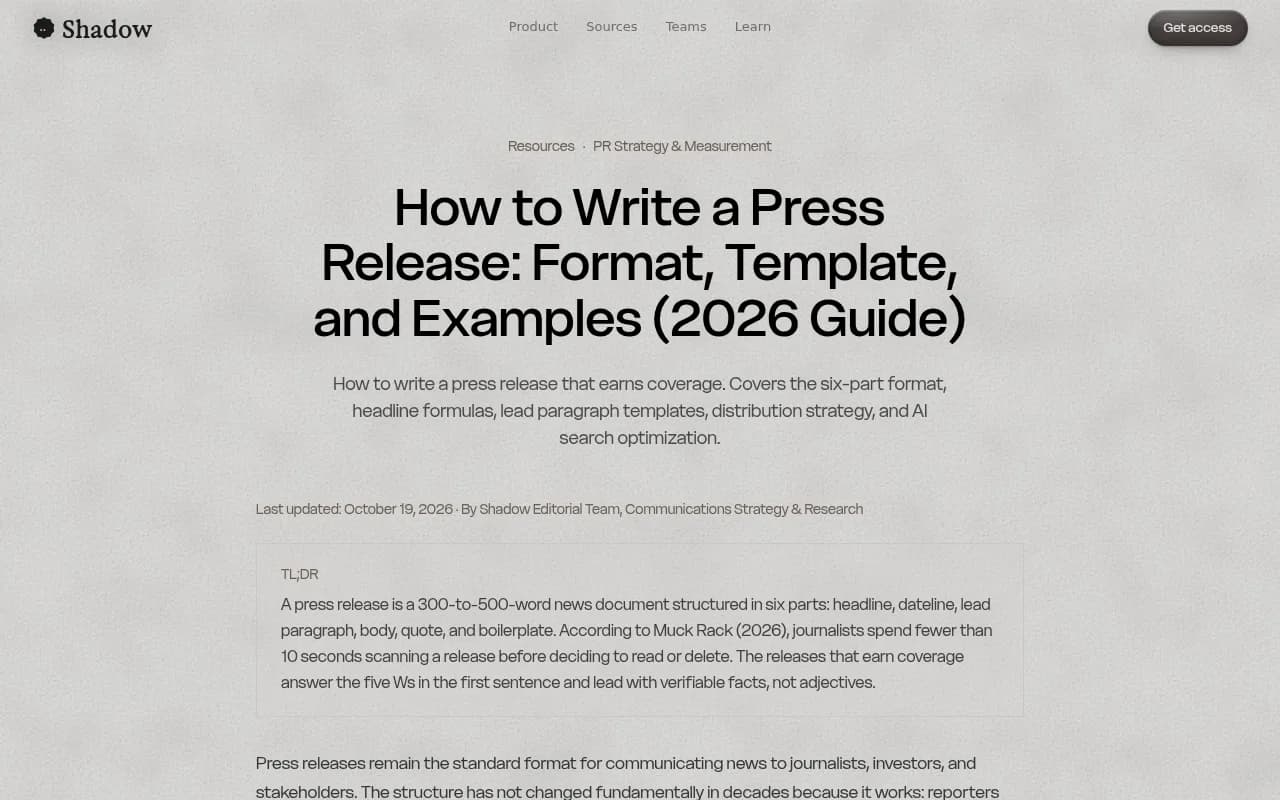
The six-part format in the Shadow guide above (headline, dateline, lead, body, quote, boilerplate) is still the right skeleton. The AI-era changes are about what you put in each part.
Write quotes that contain something
The Princeton GEO study found quotation addition was the highest-impact optimization it measured, at +41% visibility. That study was about general web content, so do not read it as a press release guarantee. The underlying logic does hold up: a model answering a question needs a sentence that answers it, and a good quote can be that sentence.
A low-value quote:
We're excited about this partnership and look forward to delivering incredible value to our customers.
Zero extractable facts. No query is answered by it.
A high-value quote, from the Zeover guide's example:
Our analysis of 500 million AI citations shows that 89% of brand recommendations come from third-party sources. Brands that don't invest in earned media are invisible to the AI models their customers are consulting.
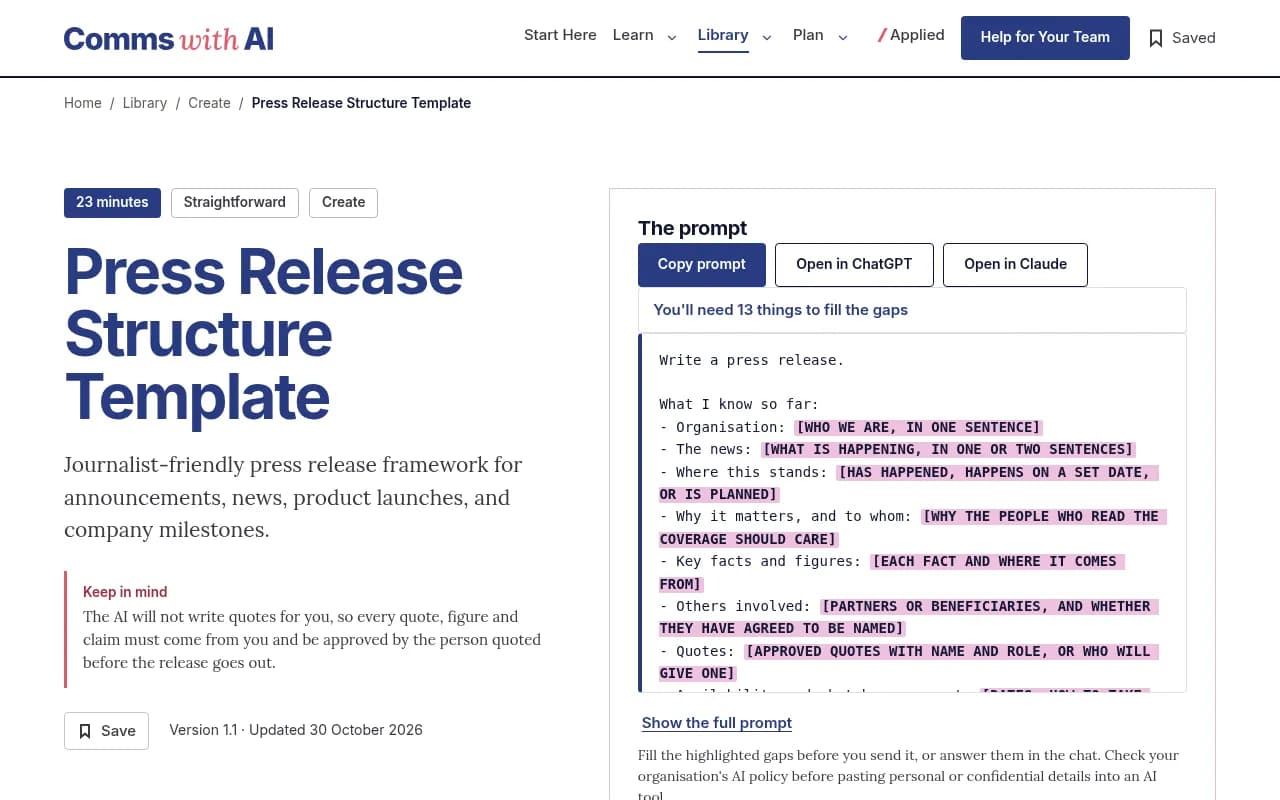
That one has a dataset, a statistic, a causal claim and a named speaker. I would add that quotes also need approval from every person named, and every figure needs a source you could hand to a journalist. The Comms With AI review checklist asks exactly that, and it also flags legal review for anything price-sensitive, health-related or involving a regulator.
Two quotes is a sensible number. One from your own spokesperson with a specific claim, and one from a customer, partner or investor who adds an outside view.
Facts, entities and metadata
Write for a reader who has no context. Use full names of companies, products, people and places at first mention. Give dates in full. State units. Where you can, pair a claim with its source in the sentence itself ("according to a survey of 900 residents by X").
A few concrete rules:
- Replace adjectives with measurements. "Faster" becomes "reduced load time from 4.1 to 1.8 seconds".
- Name the investor, the customer or the study author.
- Keep your boilerplate identical across releases so the entity description stays consistent.
- Link to your own site. Notified's study found releases that do so received 57% more AI citations. Point to the specific product page, report page or docs, not just the homepage.
- Publish the same release on your own newsroom page with clean markup. Presspilot's guide recommends schema.org NewsArticle markup and canonical URLs.
One more finding worth knowing: Notified reports that most AI systems cite the version they crawled first, sometimes days or weeks after publication. Get the facts right before it goes out, because corrections do not travel as far as the original.
Distribution: what to pay for and what to skip
I did not research newswire pricing or compare services in depth, so I will not rank them. What the sources do agree on is the principle: AI systems weigh both structure and the source. Notified's template guidance says even a well-formatted release may not perform if it is not distributed through trusted channels.
A sensible split:
- Publish on your own site first, on a stable URL with a clear headline and the full text.
- Send through a newswire if you need syndication and a credible host domain. The Zeover guide recommends a high-reach network for journalist pickup in the first 48 hours, though Zeover sells distribution through PR Newswire, so weigh that accordingly.
- Pitch named journalists directly. A release that becomes a news article in a respected outlet gives you a third-party source, which matters more than the release itself.
- Share it where your audience is, including LinkedIn and relevant communities.
Promptwatch's data on unique domains per ChatGPT response (Sep 28 to Oct 4, 2026) explains why coverage matters. 47.6% of responses with citations cite 10 or more domains. Answers are crowded, and you share them with many sources. For brand-specific prompts the picture is tighter: 21.3% cite 10 or more domains, and 5 is the most common count. In that case your own pages and a handful of review or news sites carry the weight.
Timing and shelf life
Here is the part most press release guides skip. Promptwatch's content half-life report tracked every page ChatGPT cited on July 6, 2026 for 90 days. News decays fastest: about a quarter of news pages were never cited again after day 0, half were gone after 36 days, and 41% were still cited at day 60. ChatGPT cited 93% of docs again after day 0, against 77% of news pages.
| Content type | Still cited after 30 days | Still cited after 60 days |
|---|---|---|
| Landing pages | 78% | 69% |
| Docs | 76% | 67% |
| Comparisons | 72% | 63% |
| Listicles | n/a | 60% |
| Product pages, reviews, how-tos | n/a | 55% (half-life 74 to 77 days) |
| News | n/a | 41% |
A press release behaves like news. Its citation life is short. That is not a reason to skip it. It is a reason to point it at something durable.
In practice:
- Link the release to a landing page, docs page or comparison page that holds the same facts permanently.
- Update those durable pages the day the release goes out, so the claims match.
- Do not rely on the release as the only place a fact lives.
- Expect a long tail anyway. Notified found that 56.4% of AI citations from ChatGPT and Claude to releases arrive more than a week after publication, up from 48.4% in April 2026. That is vendor data on its own customers' releases, so I would not generalize it, but it suggests the first week is not the whole story.
A workable process
A process I would use for any announcement:
- Write down the news in one sentence with a number or a name. If you cannot, stop.
- Gather the facts: figures with sources, dates, named customers, and a boilerplate.
- Draft the lead, then the headline and subheadline.
- Add two or three descriptive subheadings and a methodology block if you have data.
- Write two quotes that each carry a claim. Get them approved.
- Link to specific pages on your own site.
- Update the durable pages the release points to.
- Publish on your site, then distribute.
- Check what happened.
AI writing tools can help with step 3. The PressPilot guide describes a sane workflow: give the tool the company facts, the five Ws and your two quotes, let it scaffold the structure in AP style, then spend 20 to 30 minutes with a human correcting facts, tightening quotes and deleting anything that reads like marketing. Tools like Claude work for this.
The checkpoint that matters is the last one. Fact-check every number before it goes out, because models will repeat whatever you publish.
Measuring whether it worked
This is where most teams go blind. They send the release, count pickups, and never look at what AI models say afterward.
What to look at:
- Whether the release URL, or the coverage it generated, is cited in answers to prompts you care about
- Whether the facts in your lead appear correctly in AI answers, or whether a model is repeating something stale or wrong
- Whether AI crawlers actually reached your newsroom page
- Whether any of it sent traffic
A platform like Promptwatch covers this loop. Its Page Tracker shows which prompts and responses cite a given URL, Brand Narrative pulls out the individual claims AI makes about you, and AI crawler logs show whether bots read your page or hit errors. That lets you tell a crawl-access problem from a content problem.

If you want a broader view of options, the directory at bestgeosoftware.com lists GEO platforms side by side. For media monitoring of the coverage itself, tools such as Meltwater and Mention track pickup across news and social.
Check again after a week and after a month. Given the half-life data, a release's direct citations should fade, while the durable pages you linked to should hold. If they do not, the page content is the problem, not the release.
Common mistakes
- Writing a release for something that is not news.
- Burying the news under a paragraph of context.
- Quotes that sound like a brand voice guide.
- Superlatives with no source: "first", "largest", "only".
- Claims that exist only in the release and nowhere on your site.
- Different boilerplate in every release, which blurs how models describe you.
- Treating the newswire as the finish line instead of the start of coverage.
- Quoting a vendor study's percentage as a guaranteed outcome.
Quick template
HEADLINE (under ~55 characters): [Company] [verb] [specific thing]
SUBHEADLINE: [Supporting number, partner, or sample size]

[CITY, Month Day, Year]. [Company], [one-clause description], today [verb] [what], [number or named partner]. [Why it matters in one clause].

[Descriptive subheading, e.g. Key findings or Funding and use of proceeds]
[2 to 4 sentences, one fact each, with sources and dates]

[Descriptive subheading, e.g. Availability and pricing]
[Specific details, link to the exact product page]

"[Quote with a statistic or a claim]," said [Name], [Title] at [Company].

"[Outside perspective with its own fact]," said [Name], [Title] at [Partner].

About [Company]
[Locked boilerplate: what you do, founding year, location, URL]

Media contact
[Name, role, email, phone, press kit URL]
Where this leaves you
A press release that AI models quote is mostly a well-written press release: facts in the first sentence, quotes with content, headings that describe sections, links to specific pages. The AI angle raises the bar on all of that without changing the craft.
The larger lesson from the data is about expectations. Press releases are a small citation type and they age like news. Use them to get clean facts into the world and to earn the third-party coverage that crowded AI answers lean on, then keep the durable pages those facts point to accurate. If you need help planning that wider program, the team at 1001 SEO Media works on this kind of GEO and digital PR strategy.