Key takeaways
- Listicles are the most-cited content format in AI search, accounting for up to 50% of top citations -- but only when they have genuine depth, not thin AI-generated filler.
- The specific pattern that wins citations in 2026: detailed methodology sections, external validation signals, structured item entries with features/pros/cons/pricing/"best for", and tight question-answer formatting.
- Google's early 2026 crackdown wasn't on listicles as a format -- it targeted sites publishing hundreds of self-promotional, AI-generated "best of" articles with no editorial substance.
- To get cited by ChatGPT and Perplexity, your content needs to be crawlable, extractable at the claim level, and backed by proof-grade sourcing that survives paraphrasing.
- Tracking whether your listicles actually get cited requires dedicated AI visibility tooling -- not traditional rank tracking.
Listicles have a reputation problem. They're associated with clickbait, thin content, and the kind of "Top 10 Tools You Need Right Now" articles that exist purely to rank and monetize. That reputation isn't entirely unfair.
But here's the thing: listicles are also the single most-cited content format in AI search. According to research from Radyant, they account for up to 50% of top citations across ChatGPT, Perplexity, and Gemini. If you write them off entirely, you're abandoning the most effective format for AI visibility at exactly the moment AI search is becoming a real traffic and pipeline channel.
The question isn't whether to write listicles. It's how to write ones that AI models actually want to cite.
Why AI models cite listicles in the first place
To understand what makes a listicle citation-worthy, you need to understand how AI models select sources. They're not doing SEO. They're doing retrieval -- pulling content that is easy to extract, easy to verify, and easy to attribute at the claim level.
Listicles, when structured correctly, are ideal for this. Each item is a discrete, labeled chunk of information. A model can extract "Item 3: [Tool Name] -- best for [use case], pricing starts at $X, pros include Y and Z" without needing to parse a wall of prose. The structure does the work.
The problem is that most listicles aren't structured that way. They're padded with vague descriptions, missing concrete data, and written to satisfy a word count rather than answer a question.
The listicles that get cited share a different pattern entirely.
The anatomy of a citation-worthy listicle
A methodology section that explains your selection criteria
This is the single most underrated element of a high-performing listicle in 2026. Before you list anything, explain how you chose what to include.
Not a vague "we tested these tools" paragraph. A real methodology: what criteria you used, how many options you evaluated, what you excluded and why, whether you have any commercial relationships with the tools you're recommending.
This does two things. First, it gives AI models something to cite when a user asks "how was this list compiled?" Second, it signals editorial legitimacy -- the kind of signal that separates genuine research from self-promotional content farms.
A methodology section doesn't need to be long. Four to six sentences covering your evaluation framework is enough. But it needs to be specific. "We evaluated 47 tools across six criteria including pricing transparency, integration depth, and customer support response time" is useful. "We tested the best tools on the market" is not.
Structured item entries with consistent fields
Every item in your list should follow the same structure. Not identical prose, but the same informational fields. The pattern that performs best in early 2026 AI citations:
- What it is (one sentence)
- Who it's best for (specific use case or persona)
- Key features (two to four concrete capabilities, not marketing language)
- Pricing (actual numbers, not "starts at competitive rates")
- Pros and cons (honest, not promotional)
- A verdict or recommendation sentence
This consistency matters because AI models are essentially doing structured data extraction. When your format is predictable, extraction is reliable. When every item is written differently, models have to guess what's a feature versus a price versus a limitation -- and they often get it wrong or skip the item entirely.
Comparison tables with real data
A comparison table does more work per word than almost any other element in a listicle. It's scannable for humans and highly extractable for AI models. It also forces you to be specific -- you can't hide vague claims in a table cell.
The table doesn't need to cover every dimension. Pick four to six attributes that actually matter for the decision your reader is making. For a software listicle, that might be:
| Tool | Free tier | Best for | Starting price | AI features |
|---|---|---|---|---|
| Tool A | Yes | Small teams | $29/mo | Basic |
| Tool B | No | Enterprise | $199/mo | Advanced |
The specific attributes matter less than the fact that you're committing to real data. If you don't know a pricing figure, find it. If a tool doesn't have a free tier, say so. Vagueness in tables is a citation killer.
External validation signals
AI models weight content that has been validated externally -- cited by other sources, linked to from authoritative domains, referenced in discussions on platforms like Reddit or YouTube. This isn't something you can fake, but it is something you can build toward.
Practically, this means a few things:
- Link out to primary sources. If you're citing a stat, link to the original study. If you're describing a tool's feature, link to their documentation. This signals that your claims are verifiable.
- Reference real user experiences. A quote from a G2 review or a Reddit thread is more credible than your own assessment.
- Be transparent about your position. If you have an affiliate relationship or commercial interest in any item on your list, say so. Disclosure doesn't hurt credibility -- hiding it does.
Tight question-answer formatting within each item
ChatGPT and Perplexity are fundamentally question-answering systems. When they retrieve content, they're looking for text that maps cleanly onto a question.
Within each list item, write as if you're answering the question "what should I know about [this tool/approach/option]?" That means leading with the most important information, not burying it. It means using subheadings within items for longer entries. It means writing sentences that can stand alone as answers -- not sentences that only make sense in context.
This is harder than it sounds. Most writers default to building toward a conclusion. AI retrieval rewards front-loading.
What Google's 2026 crackdown actually targeted
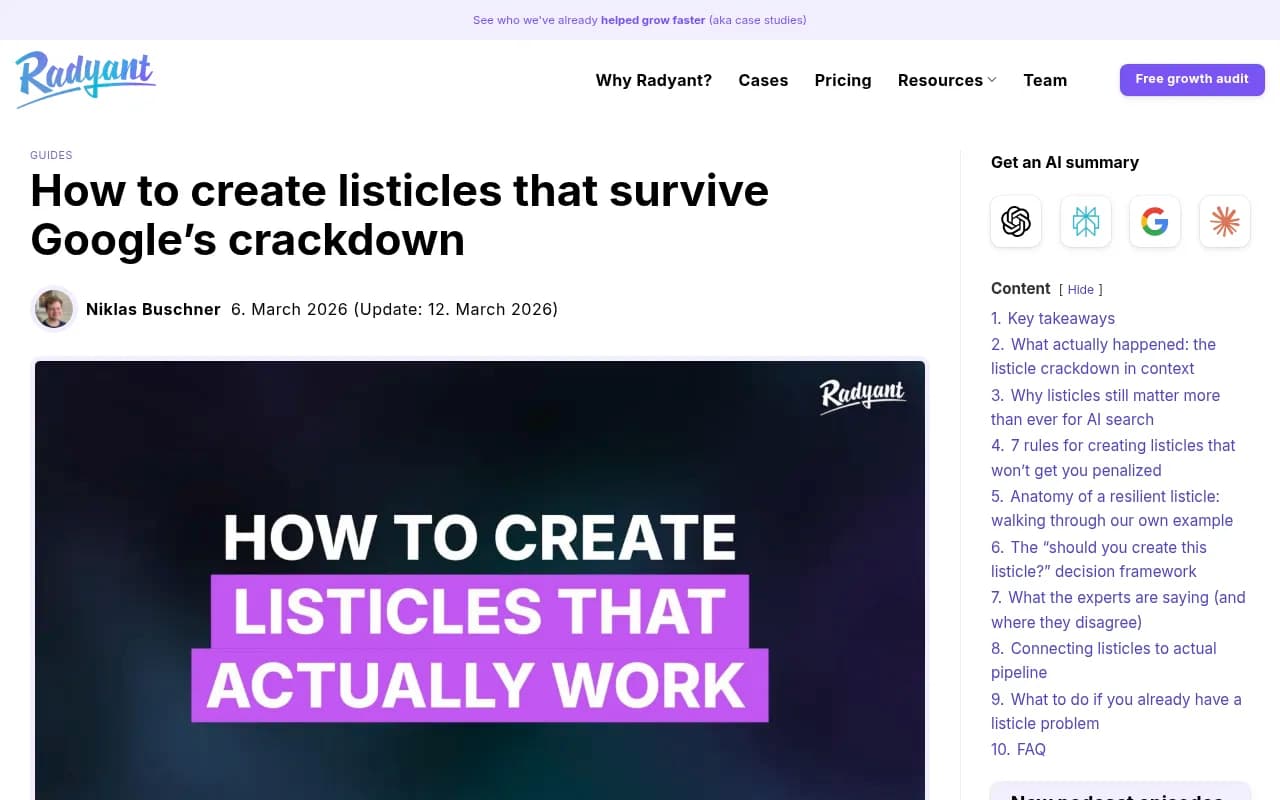
In February 2026, SEO analyst Lily Ray published data connecting sharp organic visibility drops to a specific pattern of listicle abuse. Multiple sites lost between 30% and 50% of their organic visibility following the December 2025 Core Update.
The affected sites shared specific characteristics: extreme volume (one site had 191 listicles following the same template), high AI-detection scores suggesting bulk generation, and a consistent pattern of ranking the site's own product first across every list. Some sites had between 76 and 340 self-promotional listicles on a single domain.
The lesson here is not "don't write listicles." It's "don't publish content at scale that exists purely to promote yourself." The format wasn't penalized. The approach was.
One well-researched listicle with genuine alternatives, honest pros and cons, and a transparent methodology is worth more than 200 thin ones -- for both Google rankings and AI citations.
The depth signals that actually move the needle
Genuine alternatives, including competitors
If you're writing a "best tools for X" listicle and every item is either your own product or a product you have an affiliate deal with, AI models will eventually learn to distrust your content. More immediately, readers will.
Include tools you don't benefit from recommending. Include options that are genuinely better for certain use cases even if they're not your preferred recommendation. This isn't just ethical -- it's a credibility signal that makes the entire list more trustworthy.
Specific limitations, not just strengths
Every tool has real limitations. Every approach has real downsides. Listing them isn't weakness -- it's the thing that makes your content useful rather than promotional.
"The main limitation is the lack of a native mobile app, which matters if your team works primarily on phones" is a useful observation. "Some users may find the interface slightly complex" is filler. Be specific about what the limitation actually means for the reader.
Updated data with visible timestamps
AI models have a strong preference for recent content, and they can often detect when content has been artificially refreshed (changing a year in a title without updating the substance is a well-documented pattern that the December 2025 update specifically targeted).
If you update a listicle, actually update it. Add new tools, remove discontinued ones, refresh pricing data, note what's changed since the last version. A visible "last updated" date with genuine changes is a positive signal. A "2026" in the title with 2023 data underneath is not.
Technical requirements for AI crawlability
Your content can be perfectly structured and still not get cited if AI crawlers can't access it reliably.
The basics: clean HTML, fast load times, no JavaScript-rendered content that blocks crawlers, no aggressive bot-blocking rules that accidentally exclude AI crawlers. Most sites don't have major issues here, but it's worth checking.
More specifically for listicles: use proper heading hierarchy. Each list item should be an H2 or H3, not a bolded paragraph. This gives AI models clear structural signals about where one item ends and another begins. Use schema markup where relevant -- FAQ schema for question-answer sections, ItemList schema for the list itself.
If you want visibility into how AI crawlers are actually interacting with your pages -- which ones they're reading, how often they return, what errors they're hitting -- that requires dedicated tooling. Promptwatch has AI crawler logs that show exactly this, which is genuinely useful for diagnosing why a page isn't getting cited despite appearing well-optimized.

How to track whether your listicles are getting cited
Traditional rank tracking doesn't tell you whether ChatGPT is citing your content. A page can rank on page one of Google and never appear in a single AI response. The metrics are different.
What you actually want to know:
- Is your page being cited in responses to the prompts you're targeting?
- Which AI models are citing it, and for which specific queries?
- Are competitors being cited instead of you, and what does their content have that yours doesn't?
- Is AI-driven traffic actually converting?
These questions require AI visibility tooling, not traditional SEO dashboards. A few options worth knowing about:


The meaningful difference between these tools is whether they just show you data or help you act on it. Monitoring that you're not being cited is only useful if you can figure out why and fix it.
A practical checklist before you publish
Before you hit publish on a listicle you want cited in AI search, run through this:
Structure
- Does every item follow the same field structure (what it is, best for, features, pricing, pros/cons)?
- Is there a comparison table with real data?
- Are items using H2 or H3 headings, not just bold text?
Depth
- Is there a methodology section explaining your selection criteria?
- Does each item include specific limitations, not just strengths?
- Are pricing figures actual numbers, not vague ranges?
Credibility
- Do you link out to primary sources for key claims?
- Are there external validation signals (user quotes, third-party data)?
- Have you disclosed any commercial relationships?
Technical
- Is the content accessible to AI crawlers (no aggressive bot-blocking)?
- Is there a visible "last updated" date?
- Is ItemList or FAQ schema implemented where relevant?
Honesty
- Does the list include genuine alternatives you don't benefit from?
- Are the pros and cons specific and honest?
- Would a reader who chose the "wrong" item for their use case feel misled?
If you can answer yes to most of these, you have a listicle that's built to get cited. If several of these are missing, you have a listicle that might rank but won't survive the next core update or the continued maturation of AI retrieval systems.
The format question: how long should a listicle be?
There's no universal answer, but the research points toward a specific pattern. The listicles growing fastest in AI citations in early 2026 aren't the longest ones -- they're the ones with the most consistent depth per item.
A 10-item list where every item has 200 words of genuine substance, real pricing data, and honest pros/cons will outperform a 30-item list where each item gets 50 words of vague description. Breadth without depth is a citation killer.
For most topics, 8 to 15 items is the right range. Fewer than 8 and you're not covering the space adequately. More than 15 and you're almost certainly padding.
The total word count follows from the depth of each item, not the other way around. Write until you've covered what matters for each item. Stop when you haven't.
The self-promotional trap
One more thing worth saying directly: if your listicle exists primarily to promote your own product or service, AI models will increasingly recognize that -- and so will readers.
The sites that got hit hardest in early 2026 weren't just publishing a lot of listicles. They were publishing listicles where the editorial conclusion was always predetermined. Every "best tools" article ranked their own tool first. Every "alternatives to competitor X" article concluded that their product was the obvious choice.
That's not a content strategy. It's advertising dressed up as editorial content. The distinction matters more now than it did two years ago, because AI models are getting better at detecting it, and because readers have gotten better at recognizing it too.
Write listicles where you'd be comfortable recommending a competitor's product to a reader for whom it's genuinely the better fit. That's the bar. It's also, not coincidentally, the kind of content that gets cited.