Key takeaways
- Google launched AI Overviews in Dutch in late May 2025. They can't be turned off, so every Dutch searcher can see them.
- Google says AI Overview presence and content vary by query, location, device and other factors, so a US-based check tells you little about what Dutch users see.
- Search Console blends AI Overview data into normal Web results, and GA4 reports AI Overview clicks as plain organic traffic. Both are useful but incomplete.
- Reliable Netherlands monitoring needs a tool that runs real queries from a Dutch location, in Dutch, on desktop and mobile.
- Track three things: whether an Overview triggers, whether you are cited, and who is cited next to you.
Why the Netherlands needs its own tracking
Most AI Overview studies you will read are global or US-centric. That is a problem if you sell in the Netherlands. The answer a Dutch user gets for "beste zorgverzekering vergelijken" can differ from what an American gets for the English equivalent. The sources differ, the language differs, and so do the competitors.
Google's Dutch blog announced AI Overviews in het Nederlands at Google I/O, and Dutch coverage such as Frankwatching places the official Netherlands launch in late May 2025. I could not verify an exact day beyond that, so treat "late May 2025" as the safe statement. Google's English announcement says AI Overviews cover more than 200 countries and territories and over 40 languages. Notably, the Netherlands is not in the later EEA rollout thread Google maintains (it lists Austria, Belgium, Germany, Ireland, Italy, Poland, Portugal, Spain and Switzerland), so the Dutch launch came through its own announcement.
Advanced Web Ranking makes the core point plainly: presence and content of an AI Overview can vary depending on query, location, device and other factors. That one sentence is the reason region-specific monitoring exists.
What the data says (and doesn't)
I found no reliable Netherlands-only prevalence figure, so I won't invent one. What exists is global. Otterly.AI reports that AI Overviews appeared on 48% of queries in February 2026, up from 31% a year earlier, and cites Seer Interactive data showing organic CTR falling from 1.76% to 0.61% when an Overview shows. Treat those as directional for the Netherlands, not as Dutch benchmarks. Your own tracking is the only way to get the Dutch number.
Promptwatch Data gives a useful picture of what Google cites, again globally. In Promptwatch's June 2026 AI Overview citation share report (May 31 to Jun 26, month-to-date), YouTube reached 4.16% of citations, Reddit 2.72% and google.com 2.30%. google.com went from 0.37% in January to 2.30% in June. Month-to-date numbers can overstate fast risers, so read that as a trend, not a final figure.
What to measure
Before picking tools, decide what you are tracking. There are three layers.
- Trigger rate: which of your Dutch keywords produce an AI Overview at all.
- Citation: whether your domain is linked inside it, and in which position.
- Competitive set: which other domains Google cites for the same query.
Add a fourth if you can: what the Overview actually says about your brand. A citation with a wrong claim is worse than none.
Build a Dutch keyword set
Don't translate your English list. Dutch users type differently, mix in English terms, and use compound words. Start from Search Console queries on your .nl pages, add question-style searches (hoe, wat is, beste, vergelijken, kosten), and keep long, multi-part queries, since Google primarily shows Overviews for complex questions. Segment by intent so you can see where Overviews bite hardest.
Method 1: Search Console (free, partial)
Google Search Console is where you start. When your page is cited in an AI Overview, the impression takes the position of the Overview block, which is #1. The impression registers once the citation scrolls into view. Search Console has also covered AI Mode data since June 2025.
The catch: AI Overview data is mixed into standard Web results rather than labeled. Goodie's guide notes that some properties may show more detail and that Google hasn't confirmed a universal rollout, so don't be alarmed if you can't find a separate view.
For the Netherlands, use the Performance report's country filter, set to Netherlands, and optionally filter pages to your .nl section. Then look for long conversational queries with an unusually high share of position-1 impressions and low CTR. That pattern is a hint, not proof, of Overview exposure. Whether Search Console splits AI Overview traffic by country in a more specific way is something I could not confirm, so check your own property.
Method 2: GA4 and click-level tricks
GA4 doesn't separate Overview clicks from normal organic. Otterly.AI states there is no separate referral parameter, so your AI channel in GA4 mostly captures ChatGPT, Perplexity and similar, while Google Overview traffic stays in Organic Search.
Goodie describes a workaround: links inside AI Overviews often land users on URLs containing a text fragment (#:~:text=). You can detect that with a Google Tag Manager setup and send a custom event to GA4. It is directional, since it only catches clicks that use that fragment, but it gives you page-level evidence. Filter the resulting reports by Netherlands to keep the view regional.
Method 3: manual checks, done properly
Manual checks are fine for spot-checking a handful of queries. Do them carefully:
- Use a clean browser profile and set Google's region to the Netherlands and language to Dutch.
- Use a Dutch IP or VPN endpoint. Without it, you are seeing your own location's results.
- Check mobile as well as desktop. AI Overviews can expand with a Show more option leading into AI Mode.
- Remember you can't switch Overviews off. Google's help page says the Web filter shows only text links, which is handy for comparing the classic results against the Overview.
The weakness is obvious: results vary between runs, and you will never sample enough to see trends.
Method 4: dedicated tools with location control
This is where Netherlands tracking gets reliable. Look for four capabilities: country and language selection, city-level options for local queries, desktop and mobile, and citation-level output (the actual cited URLs).
I could not confirm pricing or Dutch-specific support for most tools from my research, so check each vendor's current page before buying. Here is how the main types compare.
| Tool type | Examples | Location control | Best for |
|---|---|---|---|
| Traditional rank trackers with AIO | Advanced Web Ranking, SE Ranking, AccuRanker | Custom locations down to region, state, city or ZIP in AWR | SEO teams who want AIO next to keyword rankings |
| AI visibility platforms | Promptwatch, Otterly.AI, Peec AI | Country and language per monitor | Brands tracking AI answers across several engines |
| Local-focused trackers | Local Falcon | Map-based grid by market | Multi-location and local businesses |
| Enterprise suites | seoClarity, BrightEdge, Semrush | Varies by plan | Large teams already on these suites |
Rank trackers
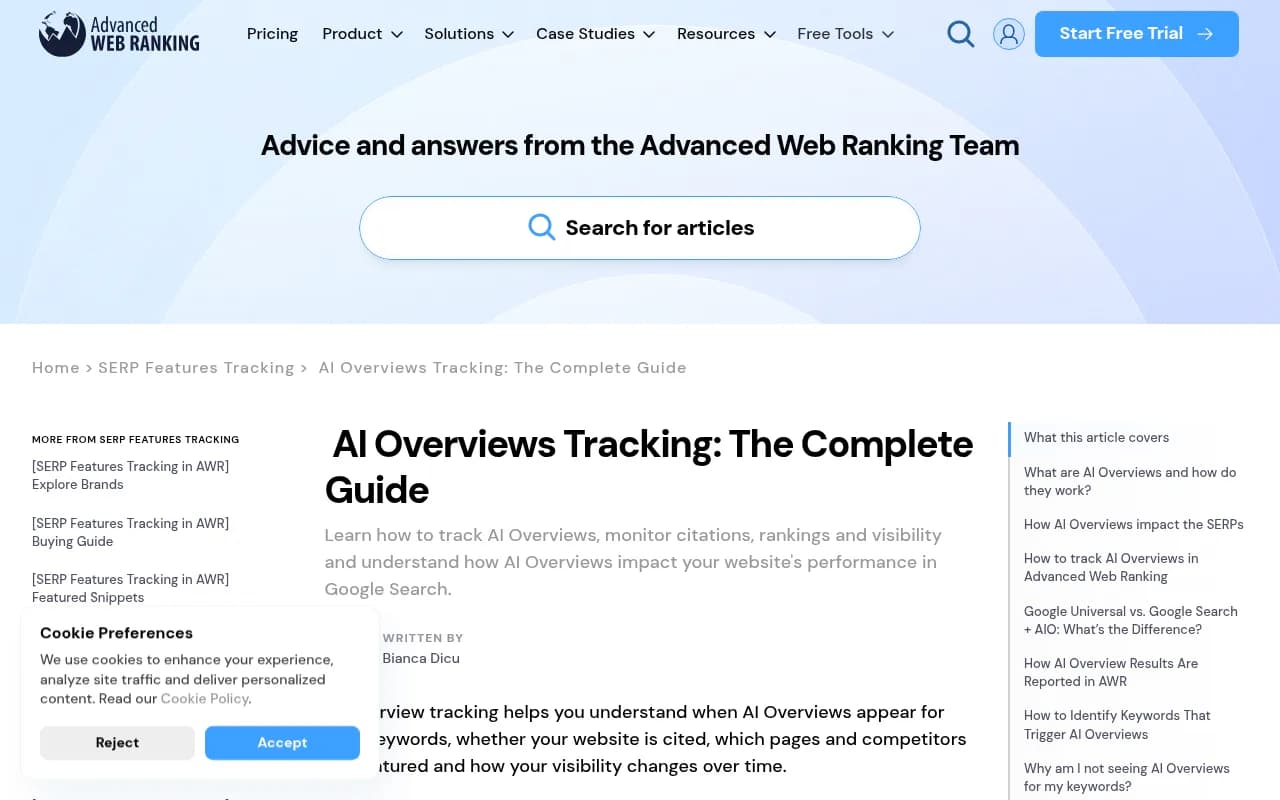
Advanced Web Ranking lets you track AI Overviews on desktop and mobile and set custom locations. It offers two modes: Google Universal and Google Search + AIO. The second retrieves Overview content more consistently, while Universal can occasionally return incomplete or missing source URLs. The trade-off is cost: Search + AIO uses twice the keyword units.
SE Ranking and AccuRanker also bolt AI tracking onto rank tracking, and Otterly's FAQ points to SE Ranking and AWR as the deeper Google-AIO-specific options.
AI visibility platforms
If you care about Overviews and also ChatGPT, Perplexity and Gemini, a multi-engine platform saves you from running two stacks. Promptwatch monitors the real user interface of Google AI Overviews and AI Mode by country and language, which matters because user-facing answers and citations can differ from API output. You can also see which pages get cited, and its Business plan adds state and city tracking and local targeting at exact coordinates. That fits Dutch use cases like a retailer with stores in Utrecht and Eindhoven. Confirm current plans at promptwatch.com/pricing.

Otterly.AI is a lower-priced monitor with broad multi-platform coverage, and Peec AI is pitched around multi-language tracking, which is relevant for Dutch and English side by side.


Local tracking
Local Falcon shows where Google shows an Overview across a market, whether it mentions your brand, which sources it cites and which competitors it names instead. For a Dutch business competing city by city, that grid view is useful.
If you want to compare more options, the directories at ai-rank-tools.com and bestgeosoftware.com list dozens of trackers.
What to do with the data
Know which content types win
Promptwatch Data's AI Overview citation types for July 2026 showed listicles at 18.0%, product pages 16.3%, how-tos 15.1% and news 13.5%. From July 28, product pages were the top format every day, ending the month at 17.9% against 16.2% for listicles. Listicles had averaged about 26% in Q1, so the mix is moving. If your Dutch category pages are thin and your competitors' product pages are cited, that is your gap.
Don't ignore video and social
In Promptwatch's October 2026 social citations report (Sep 28 to Oct 4), social platforms made up 12.2% of AI Overview citations, about 26 times ChatGPT's 0.46%. YouTube had 4.28%, Facebook 2.38%, Reddit 2.15%, Instagram 1.61% and LinkedIn 1.55%. For Dutch brands, a Dutch-language YouTube presence and complete Facebook and Instagram profiles are cheap to test. These figures are global, so verify against Dutch queries in your own monitor.
Watch Google's own properties
Promptwatch's advice from the June data: audit which target queries now cite google.com surfaces such as Business Profile, Merchant Center and Shopping data. For Dutch local and retail queries, that means keeping your Google Business Profile and product feeds in order.
Report per country
Split reporting by Netherlands and by language. A Dutch .nl page can lose an Overview citation to a Belgian or German domain for the same Dutch query, and a global dashboard will average that away.
Common mistakes
- Checking from the wrong location. A US or UK VPN gives you the wrong answer set.
- Tracking only whether an Overview exists, not whether you are cited. Presence without a citation is a CTR loss with no upside.
- Using only English prompts for a Dutch market.
- Reading one-off results as truth. Overviews change between runs, so use daily or weekly sampling and look at trends.
- Treating all keywords equally. Prioritise by commercial value and by how often the Overview appears.
A simple setup that works
- Export Dutch queries from Search Console, filtered to Netherlands.
- Pick 50 to 150 priority queries and add Dutch question variants.
- Load them into a tracker with the Netherlands and Dutch selected, on desktop and mobile.
- Record trigger rate, your citation rate, and the top three cited competitor domains weekly.
- Add the GTM text-fragment event in GA4 to see which landing pages receive Overview clicks.
- Every month, compare cited pages against your content and fix the gaps.
If you want an outside team to run this, 1001 SEO Media handles AI search and GEO work, and it uses Promptwatch for the tracking side.
Bottom line
Nobody can track Overviews perfectly, as one Reddit thread on the topic bluntly put it. But you can get a reliable Dutch picture by combining Search Console's country filter, GA4 event tracking and a tool that runs queries from a Dutch location. Start small, sample consistently, and judge by citations, not by the mere presence of an Overview.