Key takeaways
- Google AI Mode displays brands in 90% of responses (vs 43% in AI Overviews), making visibility tracking critical for modern SEO strategy
- Traditional rank tracking misses how your brand appears in AI-generated answers -- you need specialized AI Mode monitoring tools to see citations, sentiment, and competitor positioning
- The best tracking approach combines automated prompt testing, citation analysis, and competitor benchmarking across multiple AI models
- Most brands should start with a mid-tier tool ($99-249/mo) that covers Google AI Mode plus ChatGPT, Perplexity, and Claude for comprehensive visibility
- Focus on citation quality over content volume -- topical authority and structured data matter more than publishing frequency
Why Google AI Mode visibility matters in 2026
Google AI Mode has changed how search works. When users ask questions, they get AI-generated answers right on the results page. Your brand either appears in those answers or it doesn't. There's no middle ground.
The numbers tell the story: brands show up in 90% of AI Mode responses, compared to just 43% in traditional AI Overviews. That's a massive shift in how visibility works. If you're not tracking AI Mode, you're missing the majority of your brand's search presence.
Traditional rank tracking still works for blue links, but it's blind to AI citations. You might rank #1 for a keyword but never get mentioned in the AI answer that sits above your listing. Users see the AI response first. Many never scroll past it.
This isn't about traffic anymore -- it's about influence. When Google's AI cites your brand as a recommendation, that builds authority even if the user doesn't click through. Share of Model (how often AI systems mention you vs competitors) is becoming as important as share of voice in traditional search.
How Google AI Mode differs from traditional search results
AI Mode generates conversational answers by synthesizing information from multiple sources. Instead of showing ten blue links, it gives you a direct answer with inline citations. The user experience is fundamentally different.
Traditional search: you scan titles and snippets, click a result, read the page. AI Mode: you get an answer immediately, maybe click a citation if you want more detail. The friction is gone. So is most of the traffic.
For brands, this means visibility happens at the citation level. Google's AI decides which sources to reference based on topical authority, content structure, and freshness. You're competing to be one of 3-5 cited sources in each answer, not one of 10 results on page one.
The ranking factors are different too. AI Mode prioritizes:
- Topical clusters that demonstrate expertise across related queries
- Structured data that helps AI models parse your content
- Citation-worthy content (research, data, clear explanations) over keyword-stuffed pages
- Freshness signals that show content is current
- Domain authority from traditional SEO, but weighted differently
You can't optimize for AI Mode the same way you optimize for blue links. The game has changed.
What to track: Core AI Mode visibility metrics
If you're going to monitor AI Mode, you need to know what actually matters. These are the metrics that tell you whether your strategy is working.
Citation frequency
How often does Google's AI cite your brand or website when answering relevant queries? This is your baseline visibility score. Track it over time and compare it to competitors.
Most tools show this as a percentage: "Your brand appears in 23% of AI Mode responses for tracked prompts." That number should go up as you optimize.
Citation position
Being cited isn't enough -- position matters. The first source mentioned in an AI answer gets more attention than the third. Track where you appear in the citation order.
Some tools break this down into "primary citation" (mentioned first or most prominently) vs "supporting citation" (mentioned later or in passing). Aim for primary.
Prompt coverage
Which specific prompts trigger AI responses that mention your brand? You want to expand this list over time by building topical authority in adjacent areas.
Good tracking tools show you:
- Prompts where you're already visible
- Prompts where competitors appear but you don't (gap analysis)
- Prompt volume estimates so you can prioritize high-value queries
Sentiment and context
How is your brand being described? Positive, neutral, or negative? Is the AI recommending you as a solution or just mentioning you in passing?
Sentiment tracking catches reputation issues early. If AI Mode starts describing your product negatively, you need to know immediately.
Competitor benchmarking
Your visibility score means nothing without context. Track 3-5 direct competitors and measure your share of citations vs theirs. This tells you whether you're winning or losing.
Most platforms show this as a heatmap: green when you're ahead, red when competitors dominate. The goal is more green over time.
Source diversity
Which of your pages are being cited? If AI Mode only references your homepage, you're missing opportunities. Ideally, multiple pages across your site should earn citations for different topics.
This metric also shows whether AI models are pulling from your blog, product pages, documentation, or other content types. Diversify your cited sources to build broader authority.
The best AI Mode tracking tools for 2026
You can't track AI visibility manually. The queries are too diverse, the responses change too often, and you need to monitor multiple AI models (not just Google). Here are the tools that actually work.
SE Visible
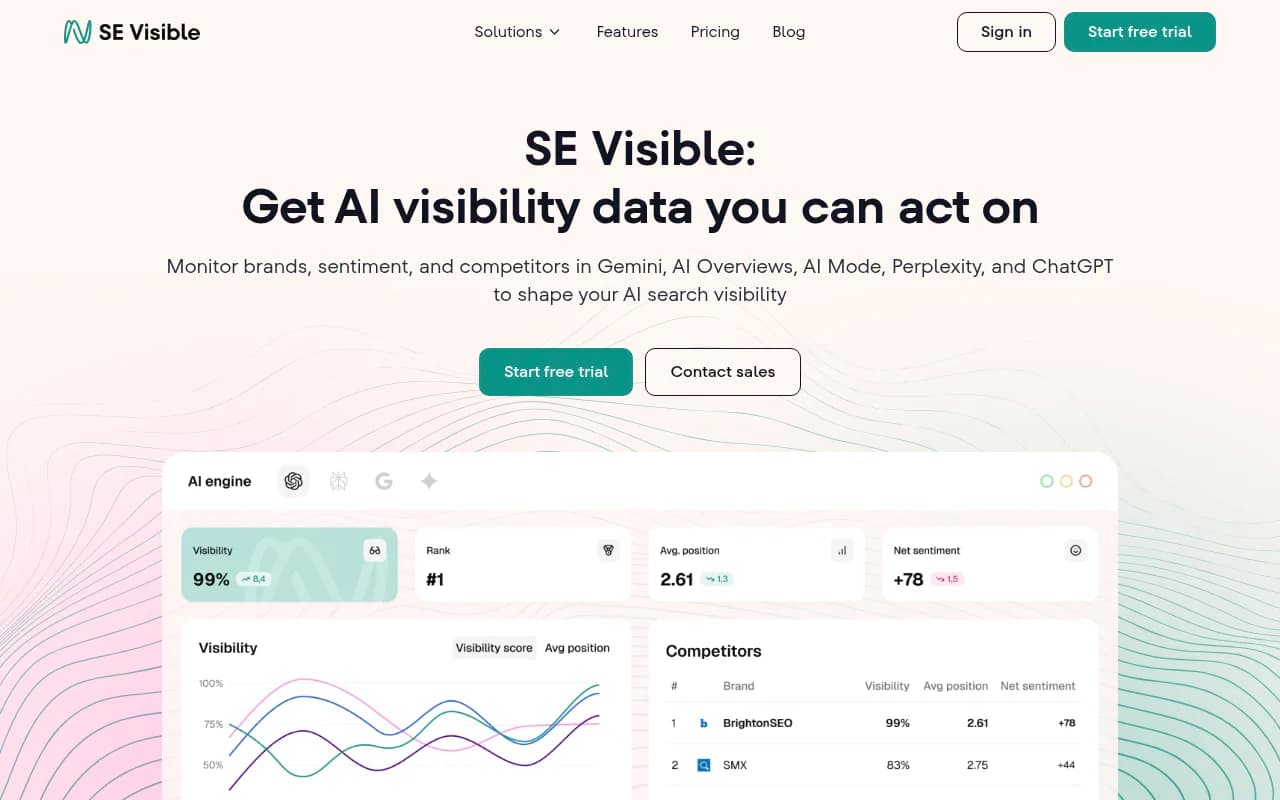
SE Visible focuses on making AI visibility tracking simple for agencies and marketing teams. You get a clean dashboard showing whether your brand appears in AI Mode, how it's positioned, and how competitors compare.
Key features:
- AI Mode visibility tracking across Google AI Mode, AI Overviews, Gemini, ChatGPT, and Perplexity
- Competitor benchmarking with side-by-side comparisons
- Prompt-level analysis showing which queries trigger brand mentions
- Citation tracking with position data
Pricing starts at $189/month. Good fit for agencies managing multiple clients or brands that want straightforward visibility metrics without overwhelming complexity.
Promptwatch
Promptwatch is different from most AI visibility tools because it doesn't just show you data -- it helps you fix gaps. The platform combines monitoring with content optimization and generation.

What makes it stand out: Answer Gap Analysis shows exactly which prompts competitors rank for but you don't. Then the built-in AI writing agent generates citation-worthy content grounded in real prompt data and competitor analysis. You can track results with page-level citation monitoring and traffic attribution.
Promptwatch monitors 10 AI models including Google AI Mode, ChatGPT, Perplexity, Claude, Gemini, and others. It also tracks AI crawler logs (which pages AI bots are reading on your site), Reddit/YouTube discussions that influence AI recommendations, and ChatGPT Shopping mentions.
Pricing: Essential $99/mo (1 site, 50 prompts), Professional $249/mo (2 sites, 150 prompts, crawler logs), Business $579/mo (5 sites, 350 prompts). The Professional tier is the sweet spot for most brands.
Profound AI
Profound positions itself as an enterprise solution with both monitoring and content automation. The "read/write AI model" analyzes how AI systems see your brand, then helps you create optimized content.

Best for large brands that need scale -- multiple sites, hundreds of prompts, automated workflows. The platform integrates with content ops tools and offers API access for custom reporting.
Starts at $99/month but enterprise pricing scales up significantly for larger deployments.
Otterly.AI
Otterly takes a prompt-first approach. You define the queries that matter to your business, and the platform automatically tests them across AI models to see where you appear.

The GEO audit feature is useful -- it analyzes your existing content and suggests optimizations to improve AI visibility. Pricing starts at $29/month, making it one of the more affordable options.
Good for smaller teams or brands just starting with AI visibility tracking. Less robust than Promptwatch or Profound but easier to get started.
Peec AI
Peec focuses on conversational AI visibility with a simple dashboard and competitor benchmarks. It's designed for SaaS, B2B, and ecommerce brands that want quick insights without a steep learning curve.

Multi-language support is a plus if you operate in multiple markets. Pricing starts at €89/month.
Semrush
Semrush added AI Mode tracking to its existing SEO platform. If you're already a Semrush customer, this is convenient -- one dashboard for traditional SEO and AI visibility.
The downside: Semrush uses a fixed set of prompts rather than letting you define custom queries. That limits flexibility compared to dedicated AI visibility tools. But the integration with Semrush's other features (keyword research, site audits, backlink analysis) makes it attractive for teams that want everything in one place.
How to set up AI Mode tracking: Step-by-step
Once you've chosen a tool, here's how to actually implement tracking.
Step 1: Define your prompt set
Start by listing 20-50 queries that matter to your business. These should be questions your target customers actually ask. Think:
- "Best [product category] for [use case]"
- "How to [solve problem]"
- "[Your brand] vs [competitor]"
- "What is [industry term]"
- "[Product category] reviews"
Don't just guess -- pull these from:
- Google Search Console (queries that already drive traffic)
- Customer support tickets (common questions)
- Sales calls (what prospects ask before buying)
- Reddit and forums (how people discuss your category)
Most tools let you import prompts in bulk via CSV. Start with your core set, then expand over time as you identify gaps.
Step 2: Add competitors
Pick 3-5 direct competitors to benchmark against. These should be brands that target the same customers and compete for the same queries.
Enter their domains into your tracking tool. The platform will monitor how often they appear in AI responses vs your brand.
Step 3: Set tracking frequency
How often should the tool check AI responses? Daily is overkill for most brands -- AI Mode results don't change that fast. Weekly or bi-weekly is usually sufficient.
Some tools charge based on tracking frequency, so balance cost vs data freshness.
Step 4: Configure alerts
Set up notifications for:
- Significant drops in citation frequency (e.g. 20% decrease week-over-week)
- New competitor mentions in prompts where you previously dominated
- Negative sentiment shifts
- New prompts where your brand starts appearing
Alerts keep you proactive instead of discovering problems weeks later in a monthly report.
Step 5: Integrate with existing workflows
Most AI visibility tools offer:
- Looker Studio / Google Data Studio connectors for custom dashboards
- API access for pulling data into your BI tools
- Slack/email integrations for team notifications
- CSV exports for manual analysis
Connect your tracking tool to whatever reporting system your team already uses. Don't create a separate silo for AI visibility data.
Interpreting your AI Mode visibility data
You've got data flowing. Now what? Here's how to actually read the reports and decide what to do.
Baseline your current state
First month of tracking is about establishing a baseline. You need to know:
- Your starting citation frequency across all tracked prompts
- Which prompts you're already visible for
- Where competitors are beating you
- Your average citation position
Don't panic if the numbers look bad initially. Most brands discover they're invisible in AI Mode for 60-80% of relevant queries. That's normal. You're measuring the problem so you can fix it.
Identify quick wins
Look for prompts where:
- You rank well in traditional search but don't appear in AI Mode
- You're cited in position 3-5 and could move up with optimization
- Competitors appear but the AI response is weak or outdated
These are your quick wins. Small content improvements can yield fast visibility gains.
Spot concerning trends
Watch for:
- Declining citation frequency over time (means competitors are outpacing you)
- Negative sentiment appearing in AI responses
- Competitors dominating prompts you previously owned
- Your brand being cited less prominently (moving from primary to supporting citation)
These trends require immediate action. Don't wait for them to get worse.
Measure content impact
When you publish new content or optimize existing pages, track the effect on AI visibility. Good tools show page-level citations -- you can see exactly which pages AI models reference.
If a new article doesn't improve visibility within 2-3 weeks, it's either targeting the wrong prompts or not citation-worthy. Iterate.
Optimizing content for AI Mode visibility
Tracking is pointless if you don't act on the data. Here's how to actually improve your visibility.
Build topical clusters
AI models favor sites with deep expertise in specific topics. One great article won't cut it. You need clusters of related content that demonstrate authority.
Example: if you sell project management software, don't just write "Best Project Management Tools." Create a cluster:
- Core pillar: "Complete Guide to Project Management Software"
- Supporting articles: "Agile vs Waterfall Project Management," "How to Choose Project Management Tools for Remote Teams," "Project Management Software Pricing Guide," "Top 10 Project Management Mistakes"
- Comparison pages: "[Your tool] vs Asana," "[Your tool] vs Monday.com"
Link these pages together. AI models crawl the connections and understand you're an authority on the topic.
Structure content for citations
AI models prefer content that's easy to parse and cite. That means:
- Clear headings that answer specific questions
- Short paragraphs (2-3 sentences max)
- Bullet lists for scannable information
- Data and statistics with sources
- Comparison tables
- Step-by-step instructions
Avoid long-winded introductions. Get to the answer fast. AI models excerpt the most relevant section, not your entire article.
Add structured data
Schema markup helps AI models understand your content. Implement:
- FAQ schema for Q&A content
- HowTo schema for tutorials and guides
- Product schema for product pages
- Review schema for comparison content
- Organization schema for brand information
Google's AI Mode pulls heavily from structured data. It's one of the highest-leverage optimizations you can make.
Update existing content
Freshness matters. AI models prioritize recently updated content over stale pages. Go back to your top-performing articles every 3-6 months and:
- Add new data and statistics
- Update outdated information
- Expand sections that are too thin
- Add new examples or case studies
- Refresh the publish date
This signals to AI crawlers that the content is current and trustworthy.
Target competitor gaps
Use your tracking tool's gap analysis to find prompts where competitors appear but you don't. These are your content opportunities.
Create content specifically targeting those prompts. Study the pages competitors are getting cited for -- what format are they using? What information do they include? How can you do it better?
Don't just copy. Add unique data, better examples, clearer explanations, or a different angle. Give AI models a reason to cite you instead.
Common AI Mode tracking mistakes to avoid
Most brands mess this up in predictable ways. Don't be one of them.
Tracking vanity metrics
Citation frequency is meaningless if the prompts don't matter to your business. Appearing in 100 AI responses for irrelevant queries doesn't help.
Focus on prompts that indicate purchase intent or brand consideration. Quality over quantity.
Ignoring sentiment
Your brand could appear in 50% of AI responses but get described negatively every time. That's worse than being invisible.
Track sentiment alongside visibility. If AI models are citing you in a negative context, you have a reputation problem to fix.
Only tracking Google
Google AI Mode is important, but it's not the only AI search engine. ChatGPT, Perplexity, Claude, and others all have significant user bases.
Track visibility across multiple models. Users are platform-hopping. You need to be visible everywhere.
Setting and forgetting
AI visibility isn't a one-time optimization. The landscape changes constantly -- new competitors, new prompts, new AI model updates.
Review your tracking data weekly. Adjust your content strategy monthly. This is ongoing work, not a project you finish.
Obsessing over rankings
Traditional SEO trained us to care about position #1 vs #2 vs #3. AI Mode is different. Being cited at all is the win. Position matters, but not as much.
Don't waste time trying to move from citation #2 to citation #1. Focus on expanding the number of prompts where you're cited at all.
Measuring ROI: Does AI Mode visibility drive business results?
The hard question: does any of this actually matter for revenue?
Here's what we know. AI Mode citations build brand awareness even when users don't click through. Being recommended by Google's AI creates trust and authority. That's valuable, but hard to measure directly.
Some tracking tools (like Promptwatch) offer traffic attribution -- they show you which visitors came from AI search engines. That's a start. You can connect AI visibility to actual traffic and conversions.
But the real value is probably indirect. Users see your brand in AI responses, remember it, then search for you directly later. Or they mention you to colleagues. Or they choose you over competitors when evaluating options.
That's hard to track with traditional attribution models. You might need to accept that AI visibility is a top-of-funnel play. Measure it with brand awareness metrics (direct traffic, branded search volume, survey data) rather than last-click conversions.
For most brands, the ROI case is simple: AI search is growing fast, traditional search is declining, and you can't afford to be invisible in the new paradigm. The cost of tracking and optimization ($100-500/month) is trivial compared to the risk of losing relevance.
What's next: The future of AI search visibility
AI Mode is just the beginning. Here's where this is headed.
More AI models, more fragmentation
Google, OpenAI, Anthropic, Perplexity, Meta, and others are all building search products. Users will spread across platforms. You'll need to track visibility in 10+ AI engines, not just one or two.
The tools that win will be the ones that monitor everything in one dashboard. Platform-specific tracking won't scale.
Voice and multimodal search
AI search is moving beyond text. Voice queries, image search, and video search are all growing. Your brand needs to be visible in AI responses across all modalities.
That means optimizing images with alt text and structured data, creating video content that AI models can reference, and ensuring your brand information is consistent across formats.
AI-generated shopping experiences
ChatGPT Shopping is just the start. AI models will increasingly recommend products directly, bypassing traditional search results entirely.
If you sell products, tracking visibility in AI shopping recommendations will become critical. Tools like Promptwatch already monitor this. Expect more platforms to add shopping-specific tracking.
Personalization at scale
AI responses will become more personalized based on user context, location, and preferences. That makes tracking harder -- you can't just monitor one canonical response per query.
Good tracking tools will need to simulate different user personas and track visibility across segments. Some platforms already do this (Promptwatch, Profound, Conductor). Expect it to become standard.
The citation economy
We're moving toward a world where citations matter more than clicks. Brands will compete to be the authoritative source AI models reference, not the blue link users click.
That changes content strategy, SEO tactics, and how we measure success. The brands that adapt fastest will win.
Getting started today
If you're not tracking AI Mode visibility yet, here's your action plan:
-
Pick a tracking tool. For most brands, Promptwatch at $99-249/mo is the best balance of features, price, and actionability. If you want something simpler, try Otterly.AI or SE Visible.
-
Define 20-50 core prompts that matter to your business. Pull these from Search Console, customer questions, and competitor research.
-
Add 3-5 competitors to benchmark against.
-
Run tracking for 2-4 weeks to establish a baseline.
-
Identify your top 5 content gaps -- prompts where competitors appear but you don't.
-
Create or optimize content targeting those gaps. Focus on citation-worthy formats: data, comparisons, clear explanations, structured content.
-
Track the impact over the next 4-6 weeks. Did your visibility improve? Which pages are getting cited?
-
Repeat the cycle: find gaps, create content, measure results.
This isn't complicated. It's just different from traditional SEO. The brands that figure it out now will dominate AI search for years to come.
Tool comparison: Which AI Mode tracker is right for you?
| Tool | Best for | Key strength | Starting price | AI models tracked |
|---|---|---|---|---|
| Promptwatch | Brands that want action, not just data | Content gap analysis + AI writing agent | $99/mo | 10 (Google AI Mode, ChatGPT, Perplexity, Claude, Gemini, etc.) |
| SE Visible | Agencies managing multiple clients | Clean dashboard, easy reporting | $189/mo | 5 (Google AI Mode, ChatGPT, Perplexity, Gemini, AI Overviews) |
| Profound AI | Enterprise teams needing scale | Automation + API access | $99/mo+ | 8+ |
| Otterly.AI | Small teams on a budget | Affordable prompt testing | $29/mo | 6+ |
| Peec AI | Multi-language brands | Simple interface, global coverage | €89/mo | 5+ |
| Semrush | Existing Semrush customers | All-in-one SEO + AI visibility | Included in plans | Google AI Mode, AI Overviews |
The right choice depends on your budget, team size, and whether you want monitoring-only or optimization tools. Most brands should start with Promptwatch or SE Visible -- they cover the core use cases without overwhelming complexity.