Key takeaways
- ChatGPT ads are cheap to test (the daily budget floor is $25) but the answer sitting next to your ad is built from your organic reputation, which you don't control.
- Audit the prompts you want to bid on before spending anything. If the organic answer is negative or absent, an ad just spotlights the problem.
- Sort every target prompt into three buckets: already cited, within reach, and far off. Only the last two justify ad spend, and only for specific reasons.
- Ads don't reach Plus, Pro, Business, Enterprise, or Edu accounts, so B2B buyers on paid seats are structurally out of reach. Organic citations reach everyone.
- Treat the first 30 days of ads as a learning budget, not a growth budget, and measure with your own data instead of borrowing someone's conversion benchmark.
Why this budget question is different from search
In Google, a paid ad and the organic results below it were separated by pixels and by friction. If something unflattering ranked on page one, the buyer still had to click, load the page and read it. That friction protected a lot of brands.
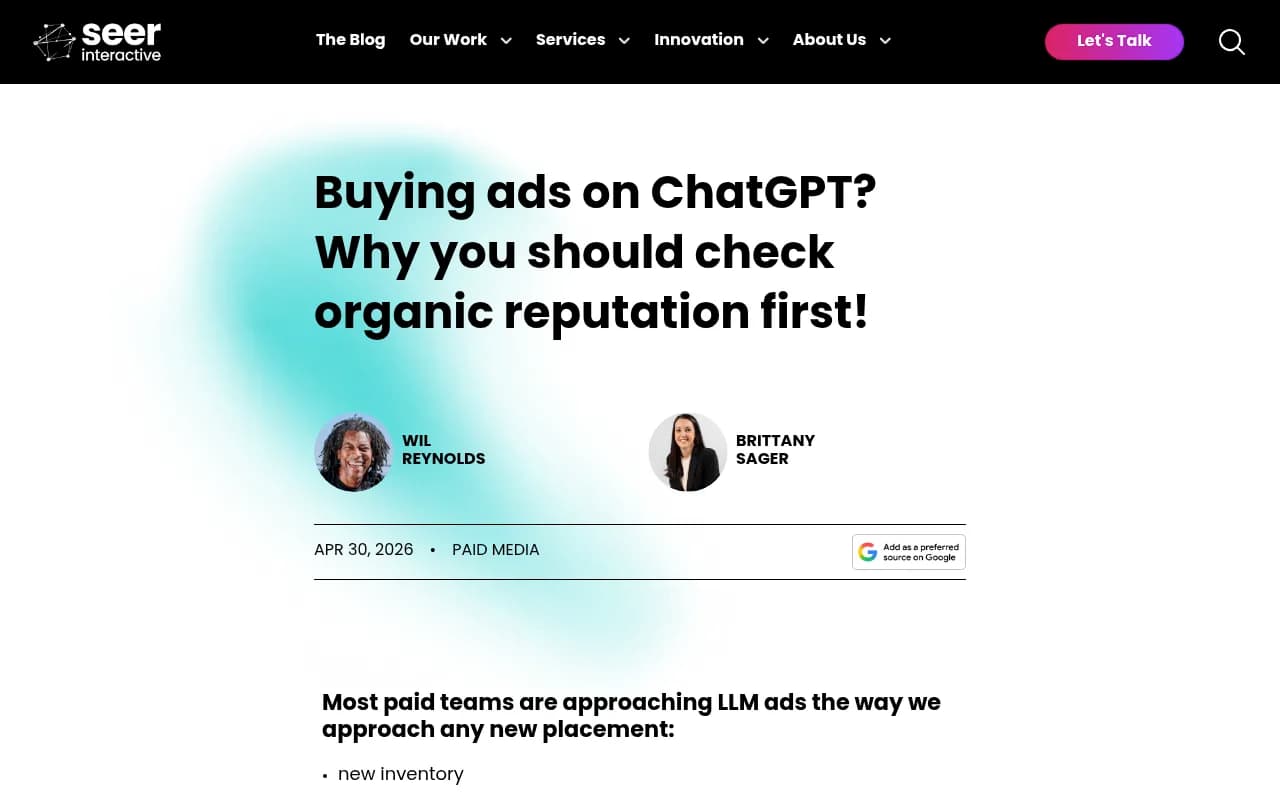
ChatGPT removes both buffers. The answer next to your ad is generated in real time from everything the model understands about your brand, and it is personalized to the person asking. Wil Reynolds and Brittany Sager at Seer Interactive put the risk well: the downside isn't a wasted test budget, it's the ad doing exactly what it should (showing up) while the answer beside it recommends a competitor or surfaces a bad review.
So a budget plan here has two parts. One is the ad line item. The other, which most teams skip, is the organic work that decides whether the ad line item pays back.
What you need to know about ChatGPT ads first
A lot of early advice on this topic is stale. Omnius, in a November 2026 piece, flagged three claims that were true in February and are wrong now: the $200,000 upfront commitment, the $60 CPM, and the idea that European advertisers were locked out. According to that article, self-serve buying is live in 54 countries as of September 2026, with a $25 per day minimum budget. I couldn't verify those two OpenAI help pages myself, so confirm them in the OpenAI Help Center before you commit anything. The same goes for pricing models and targeting options. GEOsnap reports you can buy on CPM, CPC or conversion optimization, with price set by bids and relevance.
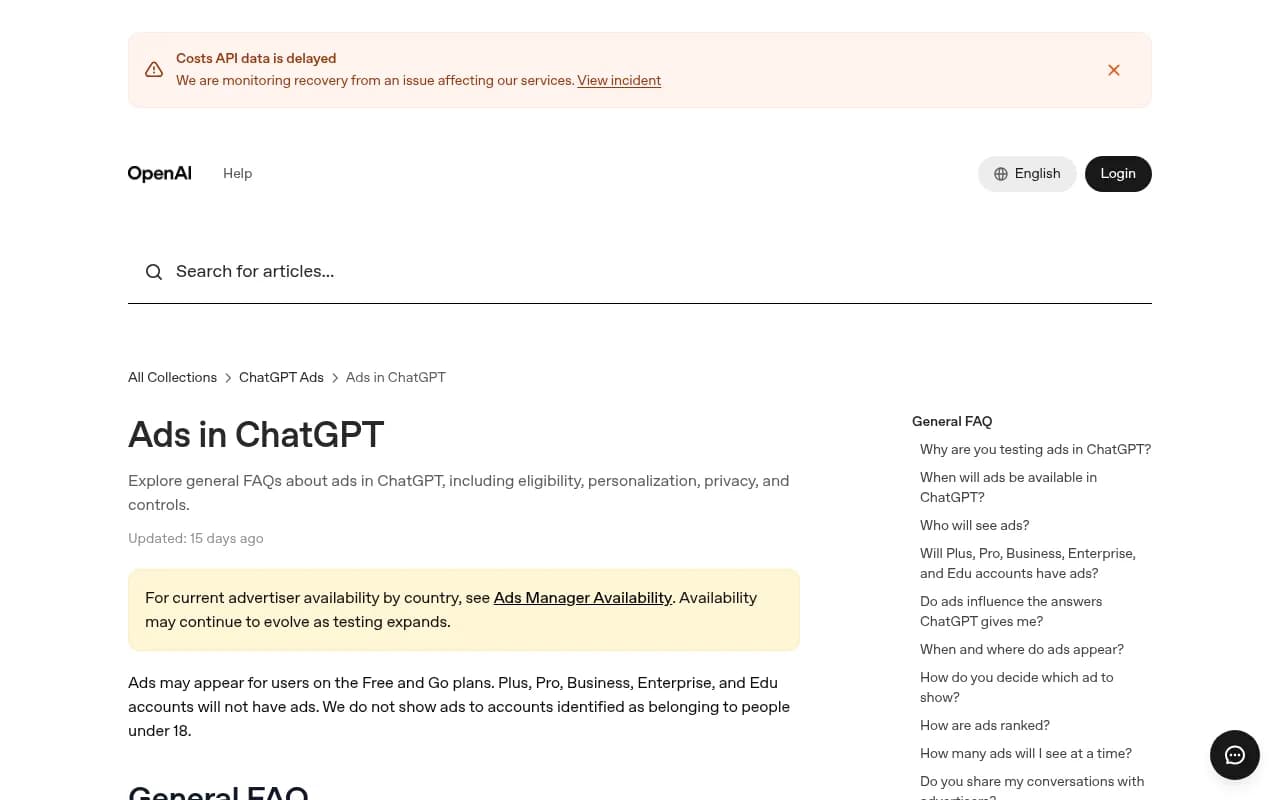
Facts that matter for planning, from OpenAI's own FAQ:
- Ads may appear for users on the Free and Go plans. Plus, Pro, Business, Enterprise and Edu accounts don't see ads.
- Ads appear below a ChatGPT response and are labeled separately.
- OpenAI says ads do not influence the answers ChatGPT gives. Nobody has run an independent test of that, so treat it as a stated policy, not a measured fact.
That second point is the one that rewrites B2B budgets. If your buyers work at companies with paid ChatGPT seats, no amount of bid money gets your ad in front of them. Organic citations appear in the answer itself, on every tier.
How often do ads actually show up?
Promptwatch Data tracked ad frequency over 90 days (May 20 to August 17, 2026). Promptwatch's ChatGPT ads over time report found:
- Ads appeared in an average of 20.1% of ChatGPT responses that ran a web search.
- ChatGPT served no ads until May 27, when the rate was 1.69%. It passed 30% on July 1 and has mostly sat between the low 20s and high 30s since, with a daily peak of 43.9%.
- The latest 7-day average was 32.4%.
- Of ad-bearing responses, 73.3% were organic prompts, 18.0% brand-specific and 8.6% competitor comparisons. That's a mix of monitored prompt volume, not a likelihood of triggering an ad.
The practical read: ad inventory is real and growing, so competitors may already be bidding on your category prompts. Check across several days before drawing conclusions, because a single run can land on an outlier day.

Step 1: List the prompts that matter
Write down the 20 to 50 questions a customer asks before choosing a provider like you. Include a mix:
- Category prompts ("best EOR platform for global teams")
- Comparison prompts ("X vs Y")
- Brand prompts ("is Acme any good?")
- Cost prompts ("how much does ... cost")
Don't invent these from keywords. Pull them from Search Console queries, sales call notes and People Also Ask. Promptwatch's query fan-out research is useful here, because ChatGPT often runs several web searches per response and your content has to match those, not only the original question.
Step 2: Run an organic audit before approving any budget
Go into ChatGPT and run the exact prompts you plan to bid on. Read what comes back. Seer's checklist is a good one:
- Is your brand in the organic answer?
- What is the sentiment?
- Is the response framed the way you'd choose?
- What are competitors credited for that you aren't?
- Ask ChatGPT to evaluate how well your site answers those prompts compared with your top competitors.
Seer ran this on a client who wasn't being recommended. The content gap grid looked like this:
| Content topic | Your brand | Competitor 1 | Competitor 2 |
|---|---|---|---|
| Quantified ROI / business case | Partial | Yes | Yes |
| Pricing transparency | No | Yes | No |
| Use case / industry pages | Yes | Partial | Yes |
| Buyer persona pages | No | Yes | Partial |
| Case studies with outcomes | Partial | Yes | No |
| Comparison / vs. content | No | Yes | Yes |
| Integration pages | Yes | Yes | No |
I like this because it needs no special tooling. You're using the same system that serves the ads to judge whether you belong in the answer. If it won't recommend you in a conversation, an ad below that conversation is a weak bet.
Measure sentiment as a rate, not a feeling
For each prompt, run it about 10 times and note how often the answer about your brand is positive. Seer's rule of thumb: at 80% positive your ad has something to amplify, at 50/50 you're gambling, and if it skews negative you're paying to show more people the problem. Nobody has clean data on how organic sentiment changes LLM ad CTR yet, so treat this as a sensible risk filter, not a proven coefficient.
Doing this by hand across 50 prompts gets old fast. Tools that track mentions, sentiment and citations at scale can run it daily. Promptwatch does this across ChatGPT, Gemini, Perplexity, AI Overviews and others, and its Visibility Score and Share of Voice give you a repeatable baseline. Other options in the category include Profound, Peec AI, Otterly.AI and AthenaHQ.



For more options, the GEO software directory at bestgeosoftware.com lists them side by side.
Step 3: Sort prompts into three buckets
This is the core of the plan. GEOsnap's three-group method works well, and I'd add a budget action to each.
| Bucket | What it means | Ad budget | Organic budget |
|---|---|---|---|
| Already cited | You appear, usually positively | None, except launches, seasonal offers or when a competitor buys ads under answers that recommend you | Maintenance: keep pages fresh, protect the sources AI relies on |
| Within reach | You're close; content or source gaps are fixable | Small bridge budget while organic matures | Main spend: content, comparisons, third-party mentions |
| Far off | Unrealistic to earn a citation soon | Test budget with a measurable goal | Low, revisit quarterly |
One wrinkle on the first bucket. If ChatGPT already recommends you and no competitor advertises on that conversation, an ad mostly pays for attention you already have. If competitors are buying ads under answers that recommend you, an ad defends your position. You can only make that call if you can see the organic answer and the ads together.
Step 4: Decide what to fund based on your situation
Omnius published a useful lookup table. I've condensed and adjusted it:
| Your situation | Start with | Why |
|---|---|---|
| Pre-launch, no organic AI presence | Ads | Tells you whether those prompts convert at all |
| Long B2B cycle, buyers shortlist before contact | GEO | You need to be in the shortlist, not beside it |
| Competitors cited, you aren't | GEO, with ads as a bridge | Ads cover the gap while citations build |
| Enterprise ACV, buyers on paid ChatGPT tiers | GEO only | Ads can't reach them |
| Seasonal or dated offer | Ads | GEO can't hit a date |
| Already invested in SEO and content | GEO | Most assets exist, marginal cost is low |
The stakes for B2B are real. G2 surveyed 1,076 B2B decision makers in March 2026 and found 51% start research with an AI chatbot more often than Google, and 69% said chatbots surfaced information that led them to choose a different vendor. 6Sense found buyers pick from their Day One shortlist 95% of the time. If a model helps assemble that shortlist, a labeled ad beside the answer isn't the same as being named inside it.
Step 5: Understand the verification loop
This is the argument I find most convincing for sequencing organic first. A buyer sees your ad. If they don't know your brand, they do what people do and ask the model: is Acme any good, and what are the alternatives? That follow-up is answered organically. If you're absent, vaguely described, or framed by a competitor's comparison page, you funded an evaluation you lose.
Seer saw a related effect in classic search: when paid ads ran alongside a brand's organic results, organic CTR rose 156%, and pausing the ads didn't get that back. The hypothesis is that the pairing signals legitimacy. Whether ChatGPT ads and citations reinforce each other the same way is unproven, but the direction of the logic holds. Paid makes the signal louder. It can't fix a weak one.
Step 6: Build the organic side with the content ChatGPT actually cites
If the audit says you need to earn your way into answers, aim at formats ChatGPT cites. Promptwatch Data's content type report (Sep 28 to Oct 4, 2026) shows:
| Content type | Share of ChatGPT citations |
|---|---|
| Product pages | 22.4% |
| Landing pages | 16.8% |
| Listicles | 13.6% |
| How-to guides | 8.7% |
| Documentation | 7.5% |
| Comparisons | 5.9% |
| News | 5.7% |
| Reviews | 1.7% |
For commercial prompts, product pages, landing pages, listicles and comparisons make up almost 70% of citations. The takeaways: make product pages comparable with clear pricing, specs and target buyer; get into the best-of roundups ChatGPT cites for your category; collect reviews on trusted sites for branded queries; and keep docs public and crawlable.
Timing matters for planning. Promptwatch's content half-life data shows landing pages and docs stay cited longest, while news lost half its pages within 36 days. Omnius estimates 7 to 30 days to a first citation, which is a rough range, not a guarantee. Either way, GEO decays slowly once earned, while ad exposure ends the moment spend stops.
Also check that AI crawlers can actually read your site. Promptwatch's AI crawler logs show which bots hit which pages and where they fail, which separates an access problem from a content problem. The free Agentic Readiness Check is a quick first pass.
Step 7: Set up the ad test as a learning budget
Omnius's suggestion is sensible: $25 to $50 per day for 30 days, pointed at prompts where you have no organic presence. That's roughly $750 to $1,500 for a month of answers about whether those conversations carry commercial value. Both EMARKETER (via GEOsnap) and Omnius recommend treating this as a structured test, since few benchmarks exist.
Before launching:
- Pick one conversion event and install the pixel.
- Cap budgets and set a stop rule (for example, pause at a fixed spend without a qualified lead).
- Watch which advertisers and landing pages win the slot on your prompts. Promptwatch's Ads Radar tracks sponsored placements by prompt, with ad copy and landing pages.
- Write ad copy that doesn't contradict what the organic answer says about you. Seer's pointed question is whether your copy is oblivious to the answer next to it.
For teams that want paid and organic in one view, Whitebox is aimed at that exact pairing, and Pacvue and StackAdapt fit if ChatGPT is one line in a bigger media plan (neither tracks the organic answer, per Whitebox's comparison, which is a competitor's claim worth verifying).
Step 8: Measure honestly
Don't inherit a conversion multiplier. One published head-to-head found Google Ads converting at 3.71% against ChatGPT Ads at 0.21% for the same advertiser (Search Engine Land, August 2026), while estimates of AI traffic versus organic range from 0.78x to 23x depending on the dataset. That's a single advertiser in one case, so don't generalize it either way.
Attribution is messy on the organic side too. Scrunch AI research (June 2026, clickstream data) found that last-click misses AI exposure because buyers later search your brand and arrive as direct. It also found naive measurement over-counts, since existing customers were already active before the mention. After correcting, a genuine recommendation to a previously unengaged user produced a 4.3-point lift in brand search and 2.4 points in site visits.
So track several signals together:
- Citation and mention rate on your prompt list, weekly
- Sentiment rate on those prompts
- Branded search lift in Search Console
- AI-referred visits and conversions. Note that ChatGPT stopped sending a referrer on October 8, 2026, so tag links with utm_source=chatgpt.com where you can. See Promptwatch's guide to attributing AI traffic.
- Paid events from the ad pixel, kept separate
Attribution platforms like Cometly, Northbeam and Dreamdata can help tie these together if you already run a multi-touch setup.
A sample 90-day allocation
These numbers are illustrative, not benchmarks. Adjust to your market.
| Phase | Ads | Organic GEO | Goal |
|---|---|---|---|
| Days 1 to 14 | $0 | Audit, prompt list, baseline sentiment, crawler check | Know where you stand |
| Days 15 to 45 | $25 to $50/day on far-off prompts only | Fix content gaps on within-reach prompts | Learn if far-off prompts convert; start earning citations |
| Days 46 to 90 | Scale, hold or cut based on the test | Expand to comparisons, third-party mentions, refreshes | Shift spend toward what measurably worked |
If a month of ads yields no qualified leads and the organic audit shows weak sentiment, move the money into content. If ads produce leads and your organic answer is positive, you have a case for scaling.
Common mistakes
- Approving an ad budget before reading the organic answers
- Bidding on prompts where you're already the organic recommendation, with no competitor ad pressure
- Assuming B2B buyers will see ads when they use paid ChatGPT seats
- Copying a single conversion benchmark into the forecast
- Judging ad visibility from one day of checks
- Pausing organic work because ads "are working"
Getting help
If you'd rather hand the audit and execution to specialists, 1001 SEO Media runs GEO and AI search programs for brands, and uses a dedicated visibility platform to baseline and track results. For tool shopping, the AI rank tracking directory at ai-rank-tools.com is a good starting point.
Bottom line
Sequence beats splitting. Run the audit, sort your prompts, put real money behind the ones you can earn, and use a small capped ad budget to learn about the ones you can't. Paid spend doesn't improve your organic standing, but organic standing improves what paid spend returns, because the buyer who clicks your ad will ask the model about you in the same session. Whatever it says next is the part you didn't pay for.