Key takeaways
- All four tools (Hall AI, Rankshift, LLM Pulse, Omnia) focus on monitoring how your brand appears in AI-generated answers, but they differ significantly in model coverage, depth, and price.
- LLM Pulse covers the most AI models (5+) at the lowest starting price and includes sentiment analysis and share of voice tracking out of the box.
- Omnia is the most polished option for share-of-voice analytics and competitive benchmarking, but sits at a higher price point.
- Hall AI and Rankshift are the lightest-weight options -- good for getting started quickly, less suited to teams that need deep data or content optimization.
- None of these four tools offer content generation or AI crawler logs. If you need to act on what you find (not just monitor), you'll want to look at a fuller platform.
The AI visibility tool market has exploded. In 2024 there were maybe a dozen serious options. By mid-2026, there are over 28 platforms competing for your attention, and the differences between them matter a lot depending on what you actually need.
This guide focuses on four tools that tend to come up together in conversations about lightweight, accessible AI visibility monitoring: Hall AI, Rankshift, LLM Pulse, and Omnia. They're all aimed at marketing teams who want to understand how AI search engines like ChatGPT, Perplexity, and Google AI Mode talk about their brand -- without necessarily committing to an enterprise contract.
Here's how they actually compare.
What these tools are trying to solve
Before getting into the specifics, it's worth being clear about what "AI visibility" means in practice. When someone types "best project management software" into ChatGPT or Perplexity, those models generate an answer. That answer might mention your brand, cite your website, or recommend a competitor instead. Traditional SEO tools don't track any of that.
AI visibility tools automate the process of querying these models with the prompts your potential customers are using, then report back on whether you appeared, how prominently, what sentiment surrounded the mention, and which sources got cited.
The four tools in this guide all do some version of that. Where they differ is in how many models they cover, how deep the reporting goes, and what you can do with the data afterward.
Hall AI

Hall AI is one of the more stripped-back options in this category. It's designed for teams that want a quick read on how AI platforms are talking about their brand -- without a steep learning curve or a complex setup process.
The core use case is citation and mention tracking: you set up your brand, define a set of prompts, and Hall monitors how AI models respond to those prompts over time. It's genuinely easy to get started with, which matters if you're a small marketing team without dedicated tooling resources.
Where Hall AI runs into limits is depth. It covers a narrower set of AI models than some competitors, and the reporting is fairly surface-level. You'll see whether you're mentioned, but the analysis around sentiment, share of voice, and competitive positioning is limited compared to what LLM Pulse or Omnia offer. There's also no content optimization layer -- Hall shows you the gap but doesn't help you close it.
Best suited for: solo marketers, small SaaS companies, or anyone who wants a low-friction way to start tracking AI mentions before committing to a more expensive platform.
Rankshift
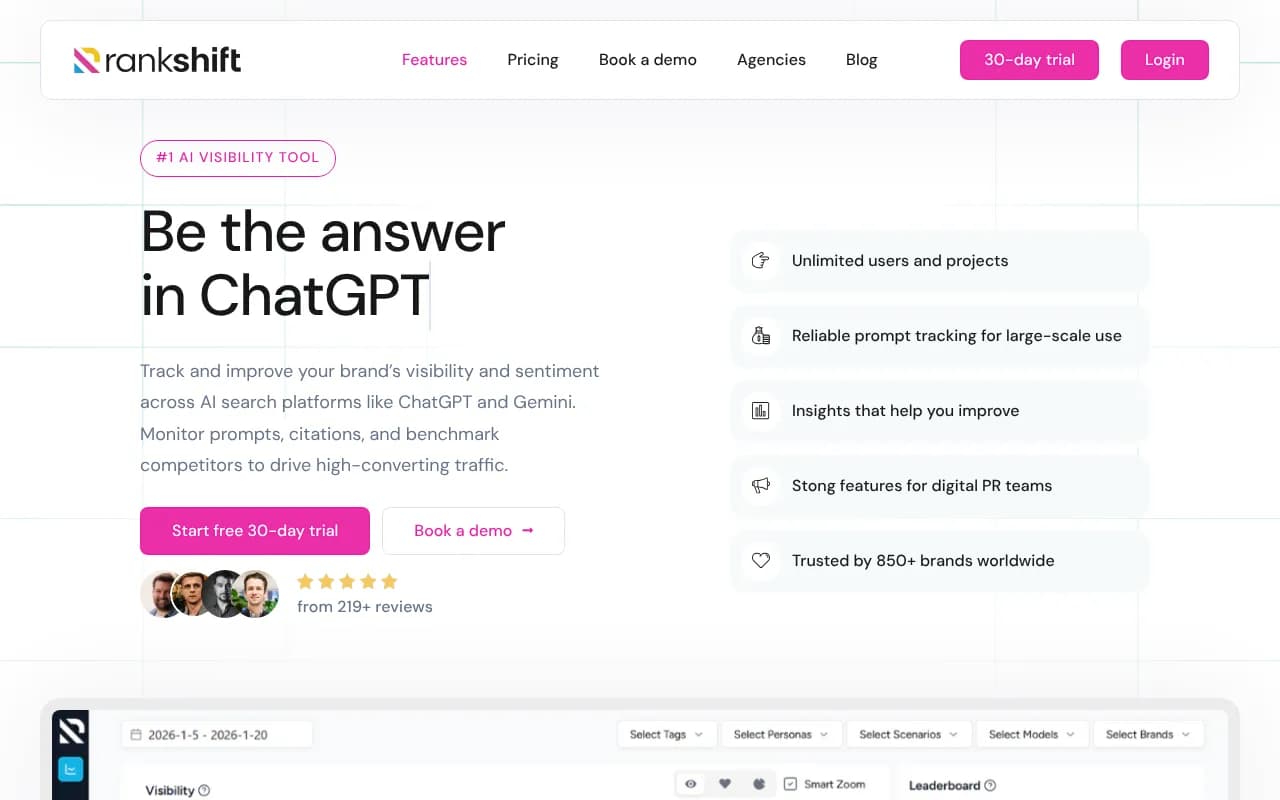
Rankshift positions itself as an LLM tracking tool built specifically for GEO (Generative Engine Optimization) practitioners. It's a bit more technically oriented than Hall AI, and the framing is explicitly around improving your visibility rather than just observing it.
The tool tracks how your brand appears across a handful of AI models and gives you prompt-level data -- which prompts you're winning, which you're losing, and how that changes over time. The GEO framing is useful because it at least acknowledges that monitoring without action is only half the job.
That said, Rankshift's content optimization features are fairly limited. It can tell you where you're underperforming, but the actual work of fixing it still falls to you. It's more of a diagnostic tool than an optimization platform. For teams that already have a content workflow and just need better signal about where to focus, that's fine. For teams hoping the tool will help them create content that ranks in AI, it won't get you all the way there.
Rankshift tends to appeal to SEO professionals who are already comfortable with GEO concepts and want a focused tracking layer rather than an all-in-one suite.
LLM Pulse
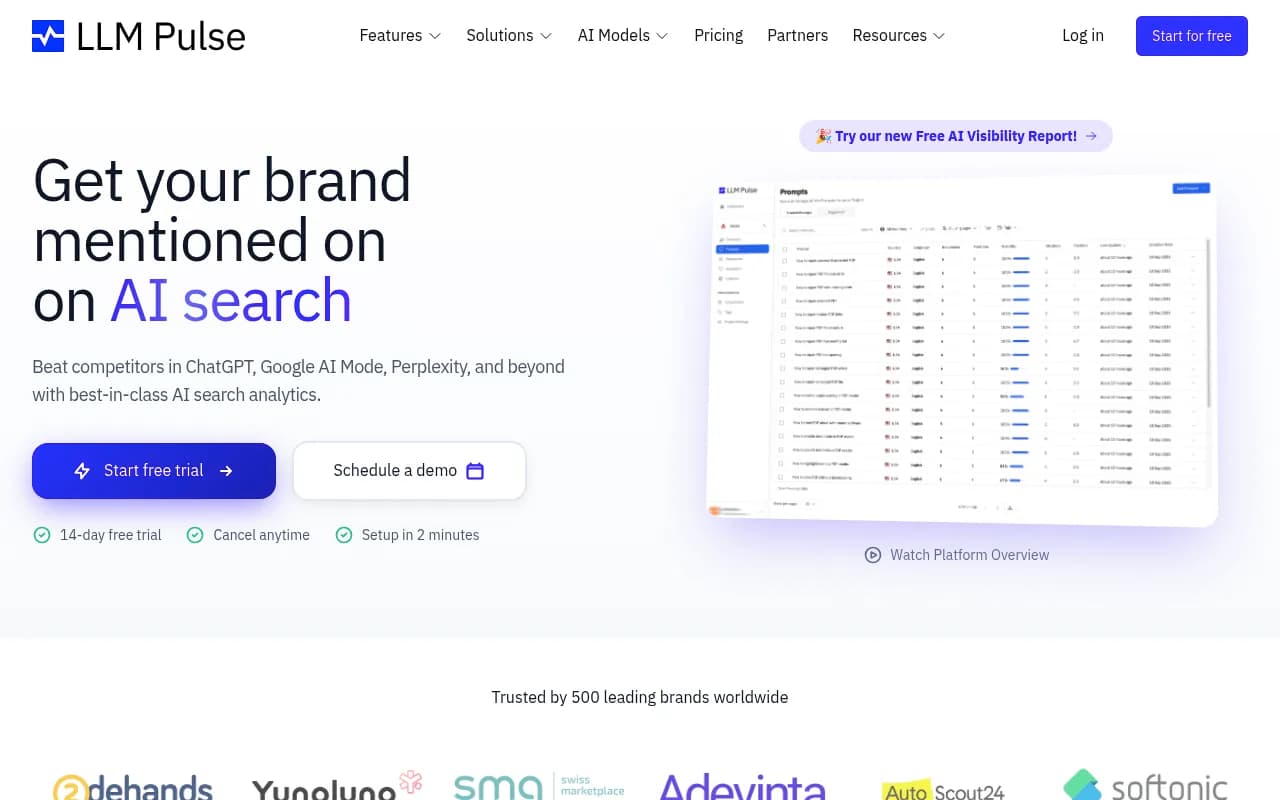
LLM Pulse is the most feature-complete of the four tools in this comparison, and it shows in the pricing -- though it's still competitive at €49/month to start.
The standout is model coverage. LLM Pulse tracks five or more AI models including ChatGPT, Perplexity, Gemini, Google AI Mode, and AI Overviews. That breadth matters because your brand's visibility can vary significantly across models -- you might be well-cited in Perplexity but invisible in ChatGPT, and a tool that only checks one or two models will give you a skewed picture.
Beyond coverage, LLM Pulse includes real-time sentiment analysis, share of voice tracking, and citation reporting. The sentiment layer is genuinely useful: it's not just whether you're mentioned, but whether the AI is recommending you positively, neutrally, or in a negative context. That distinction can be the difference between a mention that drives conversions and one that actively hurts you.
The 14-day free trial makes it easy to evaluate without commitment. The main limitation is the same as the others in this group: LLM Pulse is a monitoring tool. It doesn't generate content, doesn't analyze your crawler logs, and doesn't help you build a strategy for closing the gaps it identifies.
Best suited for: marketing teams that want serious monitoring depth across multiple AI models without paying enterprise prices.
Omnia
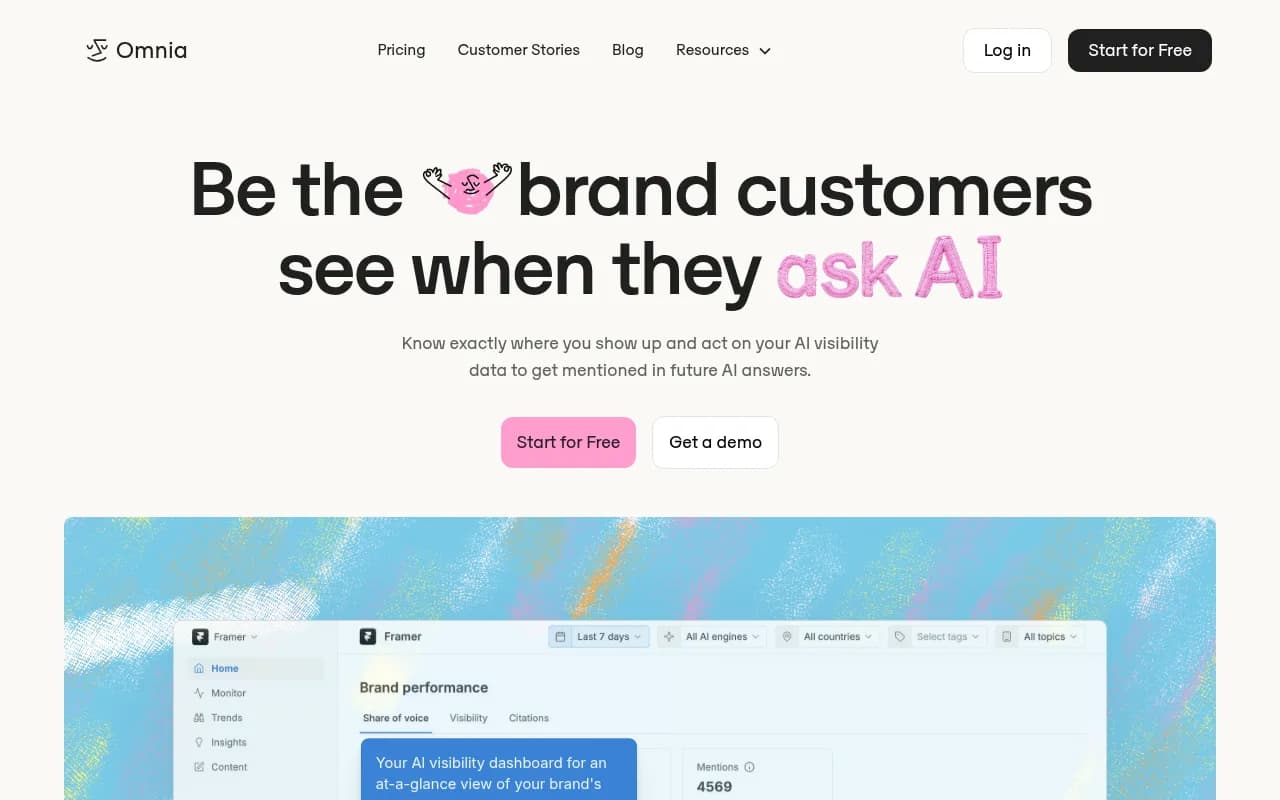
Omnia takes a slightly different angle. Where LLM Pulse leads with model coverage and sentiment, Omnia's strength is in share-of-voice analytics and competitive benchmarking. The interface is built around understanding your position relative to competitors -- not just "are we mentioned?" but "how often are we mentioned compared to the three alternatives AI models tend to recommend instead?"
That competitive framing makes Omnia particularly useful for brands in crowded categories where the AI recommendation landscape is genuinely contested. If you're in a space where ChatGPT consistently recommends two or three alternatives and you're not one of them, Omnia makes that visible in a way that's hard to ignore.
The platform has been active in publishing comparison content (their 28-tool roundup is one of the more comprehensive resources in the category), which suggests a team that understands the space well.
The trade-off is price -- Omnia sits above Hall AI and Rankshift, and closer to LLM Pulse's territory. It's also monitoring-focused, with limited tools for acting on what you discover.
Best suited for: marketing teams in competitive categories who want to benchmark their AI visibility against specific competitors.
Side-by-side comparison
| Hall AI | Rankshift | LLM Pulse | Omnia | |
|---|---|---|---|---|
| AI models tracked | Limited | Limited | 5+ | Multiple |
| Starting price | Low | Low-mid | €49/mo | Mid |
| Free trial | Check site | Check site | 14 days | Yes |
| Sentiment analysis | Basic | Basic | Yes | Partial |
| Share of voice | Limited | Limited | Yes | Yes |
| Citation tracking | Yes | Yes | Yes | Yes |
| Competitor benchmarking | Limited | Limited | Partial | Strong |
| Content generation | No | No | No | No |
| AI crawler logs | No | No | No | No |
| GEO optimization tools | No | Partial | No | No |
| Best for | Quick start | SEO/GEO pros | Monitoring depth | Competitive intel |
The gap none of them fill
Here's the honest reality about all four tools: they're monitoring dashboards. They're good at showing you where you stand. They're not built to help you change where you stand.
If you find out that Perplexity never cites your brand when someone asks about your category, the next question is: what do I do about it? Which content should I create? Which prompts should I target? How do I know when my new content gets crawled and cited?
None of these four tools answer those questions. They show you the problem; they don't help you fix it.
For teams that need the full loop -- find the gaps, create content that closes them, track whether it worked -- a more complete platform is worth considering. Promptwatch is one option that covers that entire cycle, including answer gap analysis, AI-native content generation, and crawler log tracking that shows when AI agents actually visit and start citing your pages.

That's not a knock on the four tools in this guide. For many teams, pure monitoring is exactly what they need right now. But it's worth knowing the ceiling before you commit.
How to choose between the four
The right pick depends less on which tool has the best feature list and more on where you are in your AI visibility journey.
If you're just starting out and want to understand whether AI models are even mentioning your brand, Hall AI is a low-friction entry point. You'll get useful signal without a complex setup.
If you're an SEO professional who already understands GEO and wants a tracking layer with some optimization framing, Rankshift fits that workflow better than the others.
If you want the most complete monitoring picture -- multiple models, sentiment, share of voice, competitive data -- LLM Pulse gives you the most for the price. The 14-day trial makes it easy to verify that before spending anything.
If competitive benchmarking is your primary concern and you want to understand your brand's position relative to specific competitors across AI models, Omnia is built for that use case.
A few things to check before committing
Whichever tool you're evaluating, ask these questions before signing up:
- Which specific AI models does it track? "Multiple models" can mean anything from 2 to 10. The difference matters.
- How often does it run prompts? Daily, weekly, or on-demand tracking gives you very different data freshness.
- Can you customize the prompts? Tools that only track generic category prompts will miss the specific questions your customers are actually asking.
- What does the reporting actually look like? Some tools have beautiful dashboards with shallow data; others have dense data with poor UX. Know which you're getting.
- Is there a free trial? All four tools in this guide offer some form of trial or low-commitment entry point. Use it.
The AI visibility category is still maturing fast. Tools that looked comprehensive six months ago are already being outpaced by newer entrants. Whatever you pick, treat it as a starting point rather than a permanent solution -- and revisit the decision every quarter as the category evolves.