Key takeaways
- Otterly.AI and Peec AI are solid monitoring dashboards, but both stop at showing you data -- neither helps you act on it.
- Goodie AI is a lightweight entry point for brand mention tracking across a handful of LLMs, best suited for solo marketers or early-stage teams.
- Promptwatch is the only tool in this comparison that closes the full loop: find visibility gaps, generate content to fix them, and track the results down to revenue.
- If your team needs to actually improve AI search rankings -- not just watch them -- Promptwatch is the only option here that does that.
The AI search visibility market has exploded. Two years ago, most marketing teams weren't even thinking about whether ChatGPT cited their brand. Now it's a line item in quarterly planning, and there are dozens of tools competing for that budget.
Four names keep coming up in the same conversations: Goodie AI, Promptwatch, Otterly.AI, and Peec AI. They all claim to track your brand in AI search engines. They don't all do the same thing.
This guide breaks down what each tool actually does, where each one falls short, and which is worth paying for depending on what you're trying to accomplish.
What we're actually comparing
Before getting into the tools, it's worth being clear about what "AI visibility" means in practice. When someone asks ChatGPT, Perplexity, or Google's AI Mode a question in your category, three things matter:
- Does your brand appear in the response?
- Is your website cited as a source?
- Can you do something to change the answer if you're not showing up?
Most tools handle the first two. Very few handle the third. That gap is the most important thing to understand when evaluating this category.
Goodie AI
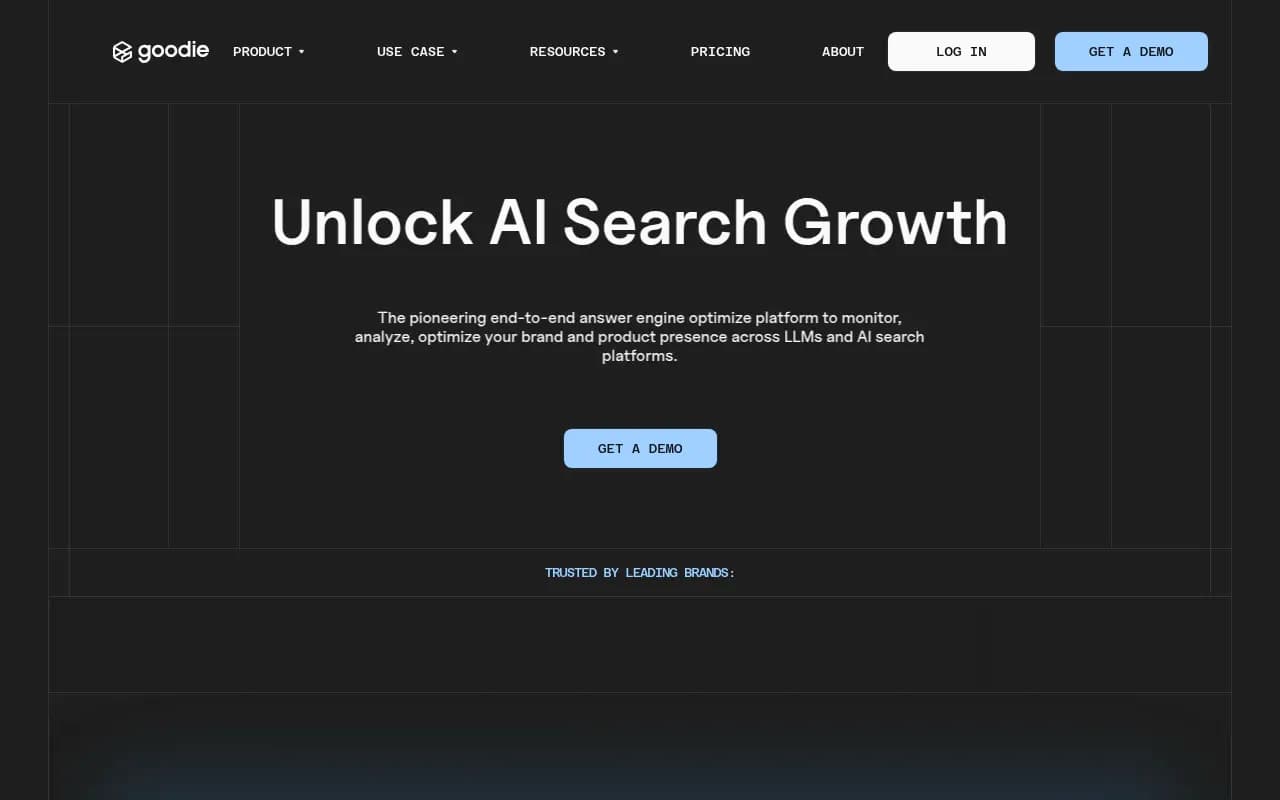
Goodie AI (higoodie.com) is a brand monitoring tool built specifically for AI search. It tracks how your brand appears across major LLMs -- ChatGPT, Perplexity, Claude, Gemini -- and gives you a visibility score based on how often and how positively you're mentioned.
The interface is clean and the setup is fast. You enter your brand, your competitors, and a set of prompts, and Goodie starts pulling data. For someone who's never tracked AI visibility before, it's a genuinely easy starting point.
Where it gets thin: Goodie is primarily a monitoring tool. It shows you your mention rate and sentiment, but it doesn't tell you which specific prompts you're losing, why you're losing them, or what to do about it. There's no content generation, no crawler log analysis, no page-level citation tracking. You can see that you're invisible for a category of prompts -- you just can't fix it from inside the tool.
Pricing is accessible, which makes it reasonable for freelancers or small teams doing early-stage AI visibility research. But teams that need to move from "we know there's a problem" to "we fixed it" will hit the ceiling quickly.
Best for: Solo marketers, small brands, or anyone who wants a quick read on their AI search presence without committing to a full platform.
Otterly.AI

Otterly.AI has built a reputation as the most accessible monitoring tool in the category. It tracks brand mentions across ChatGPT, Perplexity, Gemini, and a few others, with a clean dashboard and competitive comparison features. Pricing starts low enough that it's often the first paid tool teams try.
The experience is genuinely pleasant. The UI is well-designed, the onboarding is fast, and the data is easy to read. For teams that just want to know "are we showing up?" on a weekly basis, Otterly does that job.
The problem is what happens next. Otterly has no action layer. There's no content gap analysis, no content generation, no crawler log data, and no way to connect AI visibility to actual traffic or revenue. You can see your visibility score trend up or down, but Otterly won't tell you why it changed or what to do about it.
One way to think about it: Otterly is a dashboard, not a workflow. It answers the question "what's happening?" but not "why is this happening?" or "what should I do?"
For teams that are still in the "awareness" phase of AI visibility -- just trying to get leadership buy-in or understand the baseline -- Otterly is fine. For teams that need to actually improve their numbers, it's not enough.
Best for: Teams that need a simple, affordable monitoring baseline and aren't yet ready to invest in optimization.
Peec AI

Peec AI has grown fast -- the company raised $29M and has built a more feature-rich product than Otterly. It tracks brand mentions and citations across multiple AI models, offers competitive benchmarking, and has added some prompt suggestion features that nudge you toward prompts where you have a chance to win visibility.
The "smart suggestions" angle is genuinely useful. Rather than just showing you a list of prompts where you're invisible, Peec tries to surface which ones are worth targeting. That's a step toward actionability that Otterly doesn't take.
But Peec still stops short of full optimization. There's no built-in content generation, no AI crawler logs showing you which pages AI engines are reading (or failing to read), and no traffic attribution connecting AI citations to actual visitors or conversions. The suggestion layer tells you where to focus -- it doesn't help you execute.
Peec's pricing starts at $29/month, which makes it one of the more affordable options with meaningful feature depth. Multi-language support is solid, which matters for teams operating across markets.
Best for: Growing teams that want more than basic monitoring and value prompt prioritization, but don't yet need a full content optimization workflow.
Promptwatch
Promptwatch is the most complete platform in this comparison, and the only one that covers the full cycle from discovery to execution to measurement.

The core difference is what happens after you see the data. Promptwatch's Answer Gap Analysis shows you the specific prompts where competitors are being cited and you're not -- not just a general visibility score, but the exact questions AI models are answering without mentioning your brand. From there, Content Agents generate articles, comparisons, and listicles grounded in that prompt data, designed to fill those gaps. Then page-level tracking shows you whether the new content is getting crawled, cited, and driving traffic.
That loop -- find gaps, create content, track results -- is what separates Promptwatch from the other three tools in this comparison. Goodie, Otterly, and Peec all stop at step one.
A few specific capabilities worth calling out:
- AI Crawler Logs: Real-time logs of when ChatGPT, Claude, Perplexity, and other AI crawlers hit your site, which pages they read, and what errors they encounter. This is how you diagnose why you're not being cited even when you have relevant content. None of the other tools here have this.
- Prompt Intelligence: Volume estimates and difficulty scores for each prompt, plus query fan-outs showing how one prompt branches into sub-queries. This lets you prioritize instead of guessing.
- Reddit and YouTube Insights: Surfaces discussions that influence AI recommendations -- a channel the other tools ignore entirely.
- ChatGPT Shopping Tracking: Monitors when your brand appears in ChatGPT's product recommendations and shopping carousels.
- Traffic attribution: Connects AI visibility to actual revenue, not just citation counts.
Promptwatch monitors 10 AI models: ChatGPT, Perplexity, Google AI Overviews, Google AI Mode, Claude, Gemini, Meta/Llama, DeepSeek, Grok, and Mistral.
Pricing starts at $99/month (Essential: 1 site, 50 prompts, 5 articles), $249/month (Professional: 2 sites, 150 prompts, 15 articles, crawler logs), and $579/month (Business: 5 sites, 350 prompts, 30 articles). A free trial is available.
The honest caveat: Promptwatch is more expensive than the other three tools here, and it's more complex to set up. If you genuinely only need to monitor brand mentions and don't have a content team or workflow to act on the data, you're paying for features you won't use. But for any team that's serious about improving AI search visibility -- not just tracking it -- the price difference is justified by what you can actually do with the platform.
Best for: Marketing and SEO teams, digital agencies, and brands that need to move from monitoring to optimization and connect AI visibility to business outcomes.
Side-by-side comparison
| Feature | Goodie AI | Otterly.AI | Peec AI | Promptwatch |
|---|---|---|---|---|
| Brand mention tracking | Yes | Yes | Yes | Yes |
| Competitor benchmarking | Basic | Yes | Yes | Yes |
| Multiple AI models | 4+ | 4+ | 5+ | 10 |
| Prompt prioritization | No | No | Yes (basic) | Yes (volume + difficulty) |
| Answer gap analysis | No | No | No | Yes |
| Content generation | No | No | No | Yes (Content Agents) |
| AI crawler logs | No | No | No | Yes |
| Page-level citation tracking | No | No | No | Yes |
| Traffic attribution | No | No | No | Yes |
| Reddit/YouTube insights | No | No | No | Yes |
| ChatGPT Shopping tracking | No | No | No | Yes |
| Multi-language support | Limited | Limited | Yes | Yes |
| Starting price | Low | ~$19/mo | $29/mo | $99/mo |
| Free trial | Yes | Yes | Yes | Yes |
How to choose
The honest answer is that the right tool depends on where your team is in the AI visibility journey.
If you're just starting out and need to understand whether AI search is even a channel worth investing in, Goodie AI or Otterly.AI will give you that baseline without a large commitment. They're good for building the internal case.
If you've already established that AI visibility matters for your category and you want smarter prioritization, Peec AI is a reasonable step up. The prompt suggestion layer saves time and the pricing is still accessible.
If your team is ready to actually move the needle -- to identify specific content gaps, create content designed to be cited by AI engines, and measure whether it's working -- Promptwatch is the only tool in this comparison that supports that workflow end to end. The other three will tell you that you have a problem. Promptwatch helps you fix it.
One more thing worth saying: the AI search visibility category is moving fast. Tools that were monitoring-only a year ago are adding optimization features. But right now, in mid-2026, the gap between "we track your visibility" and "we help you improve it" is still wide -- and Promptwatch is on the right side of that gap.
Final take
Goodie AI and Otterly.AI are fine for what they are: lightweight, accessible monitoring tools that answer the question "are we showing up?" Peec AI adds some useful prioritization on top of that. But if you're paying for an AI visibility tool in 2026, you should probably be asking whether it can help you improve your visibility, not just measure it.
That's the question that separates Promptwatch from the rest of this field. It's the only platform here with a content generation layer, crawler log analysis, and revenue attribution built in. For teams that are serious about AI search as a growth channel, that's the difference between a dashboard and a strategy.