Key takeaways
- Profound is the deepest prompt-level and compliance-heavy option, but it is sales-led and custom priced. Third-party reviews report it no longer sells self-serve plans.
- Evertune is the odd one out: it measures what base models know through direct API access, plus consumer-app tracking, and it pairs that with a consumer panel. It suits brand and advertising teams more than SEO teams.
- Gauge is the cheapest to start with ($599/month published) and leans toward agents and content production, but its paid plan covers only 3 platforms.
- Most comparisons online are written by one of the three vendors or by a competitor. Treat every number as a claim until you have tested it in a trial.
- If you want monitoring, crawler logs, content generation and traffic attribution in one loop, Promptwatch is worth putting on the shortlist next to these three.
Why this comparison is harder than it looks
I went into this expecting a feature grid. What I found is that the three platforms disagree about what to measure. That matters more than any checkbox.
Gauge and Profound both run prompts through the consumer interfaces of AI engines. Evertune argues that is only half the picture and adds API-level measurement of base models. Profound's camp counters that nobody buys through a raw API call, so real-UI data is what counts.
None of these is obviously wrong. They answer different questions, and the right pick depends on which question your team is being asked by its CMO.
A caveat on sources. The comparisons I could find are mostly vendor-authored (Gauge's own Gauge vs Profound page, Evertune's own Evertune vs Profound post) or written by competitors and affiliates. One source I read even states plainly that it reflects the author's personal views and not Profound's, which tells you how close some of these writers are to the vendors. I have flagged claims below where they come from a vendor.
The three platforms at a glance

| Gauge | Profound | Evertune | |
|---|---|---|---|
| Core idea | Agent-led growth: visibility plus content production | Enterprise answer-engine intelligence with real prompt volumes | Base-model knowledge plus consumer apps, backed by a consumer panel |
| Data collection | Daily prompts through live model UIs | Front-end capture plus server logs | Direct API access to base models plus consumer app tracking |
| Published pricing | Growth $599/month; Enterprise custom | Custom Enterprise; reviewers report a 7-day trial (50 prompts, 3 engines) | Custom, demo-first (one source cites a Pro plan at $800/month, unconfirmed) |
| Engine coverage | 3 on Growth (ChatGPT, Google AI Mode, Copilot); more on Enterprise | Up to 9 on Enterprise, including Claude and DeepSeek | Up to 11 models per one source |
| Content tooling | 18 articles/month on Growth, agent pipeline | Content creation agents, attribution | Content Studio for drafting posts |
| Security | Not verified | SOC 2 and SSO reported | No published SOC 2 Type II per one review |
| Team and maturity | Six-person team per Temso | Large funding rounds, biggest customer base of the three | Panel-backed, Fortune 500 focus |
Treat the table as a starting point for questions, not a verdict. Several cells (Gauge security, Evertune pricing, Profound funding) are unverified or conflict between sources.
Gauge: the cheapest way in, with a narrower footprint
Gauge publishes its pricing, which already sets it apart from the other two. The Chat Growth plan is $599/month and includes 600 prompts run daily (Gauge counts that as roughly 54,000 AI answers per month), 18 publish-ready articles and 3 seats. No sales call is needed.
The limits are real. Growth covers only ChatGPT, Google AI Mode and Microsoft Copilot. Sentiment analysis, exports and recurring strategy sessions are Enterprise-only, according to Gauge's own comparison table.
The company has also repositioned around "Agent-Led Growth." Gauge Agents have a hosted free plan on open models, with Pro and Enterprise tiers adding ongoing Claude Code and Codex runs. That is billed separately from Gauge Chat, which is the visibility and content product. If you are evaluating Gauge, make sure you know which of the two products a given price refers to.
Temso describes Gauge as best for agentic content production at volume, praises that prompts run through live UIs rather than APIs, and notes the downside: a six-person team and a smaller ecosystem. For a Fortune 500 security review, that last point can matter more than any feature.
Gauge's vendor claims about Profound deserve scrutiny:
- It lists itself at $11.09 per 1,000 answers.
- It says several of its customers were quoted over $3,000/month by Profound for fewer tracked prompts.
The second claim is anecdotal and comes from a competitor. It might be true. It is also exactly what a competitor would say.
Profound: the enterprise default
Profound is the incumbent in this group, and most independent roundups put it first for large organizations. Reported strengths:
- Up to nine engines on the Enterprise plan, including Claude, DeepSeek and Exa Search.
- Prompt Volumes and Conversation Explorer, which try to show what real users ask rather than what you guessed.
- Crawler analytics and CDN attribution (Cloudflare, Vercel), plus SOC 2 and SSO for procurement.
- Agents that research, draft and publish content.
The downsides are also consistent across sources. Temso reports Profound no longer sells self-serve plans, so smaller teams cannot just buy it. Canlah points out that each prompt runs once a day per engine, which is a single sample per engine, while Evertune states it runs 100 samples. Whether one daily sample is enough depends on how noisy the answers are, and they are noisy. One source cites 40-60% monthly drift in cited domains across major AI platforms, which is why the number of runs behind any trend line is the first thing to ask a vendor.
Funding figures conflict, too. Canlah reports a $180 million Series D at a $1.8 billion valuation on September 15, 2026, while Menra's page says a $1B valuation. Funding is a weak proxy for product fit anyway, but if vendor stability is on your procurement checklist, verify it directly.
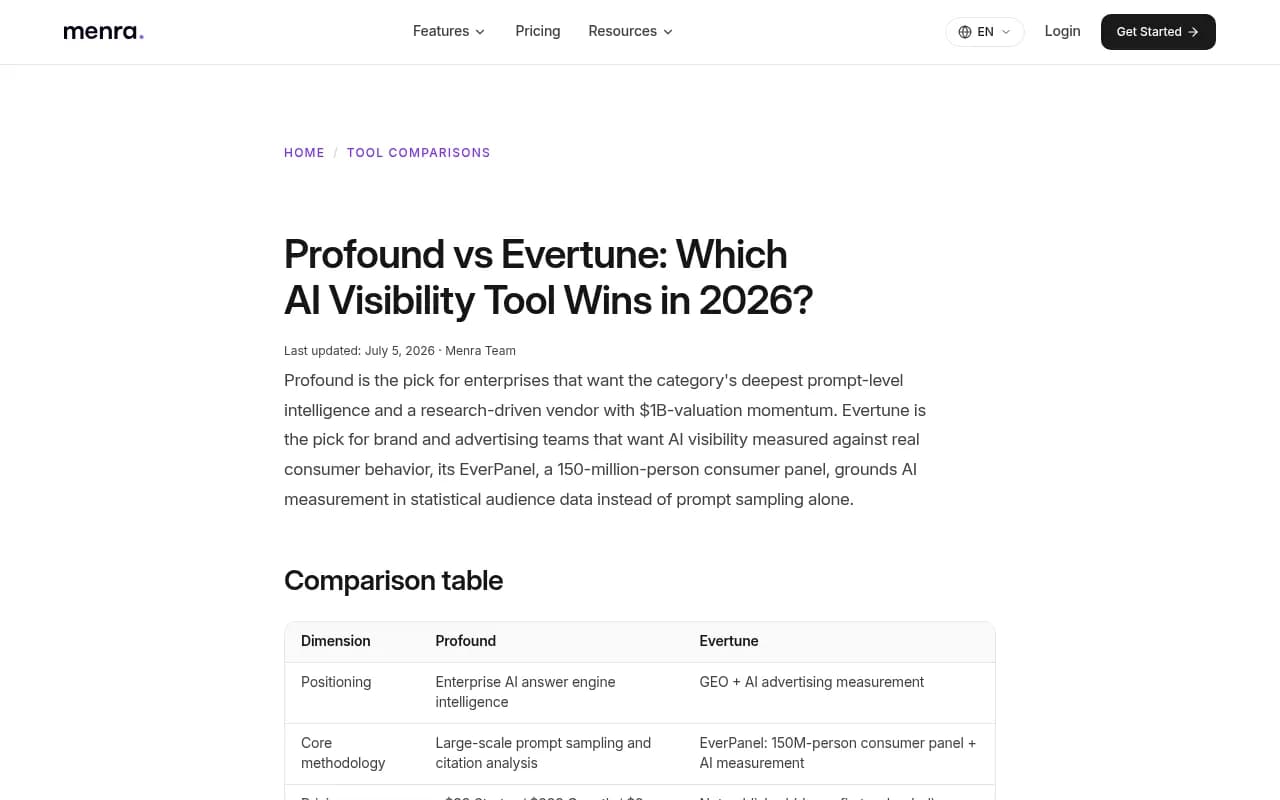
Menra's comparison is one of the clearer independent write-ups. It frames the split as Profound measuring what AI engines say, and Evertune measuring what audiences experience.
Evertune: a different theory of measurement
Evertune's pitch is the most distinctive of the three. Two ideas:
- Base-model measurement. Direct API access to foundation models (ChatGPT, Claude, Gemini, Meta, DeepSeek) shows what a model knows about your brand before any web retrieval. Evertune argues that agents and developer apps are built on those base models, so this layer will matter for agentic commerce.
- A consumer panel. The sources disagree on the size (25 million in one review, 150 million in Menra's), which is itself a reason to ask. Either way, the idea is to weight findings by what real audiences ask, which suits advertising decisions.
The drawbacks reported by reviewers: topic-level clustering rather than prompt-level demand data, no published SOC 2 Type II, only basic CSV exports according to one affiliate comparison, and no public pricing. Evertune does publish free assets such as an AI Brand Index, which is a smart PR move and useful for benchmarking.
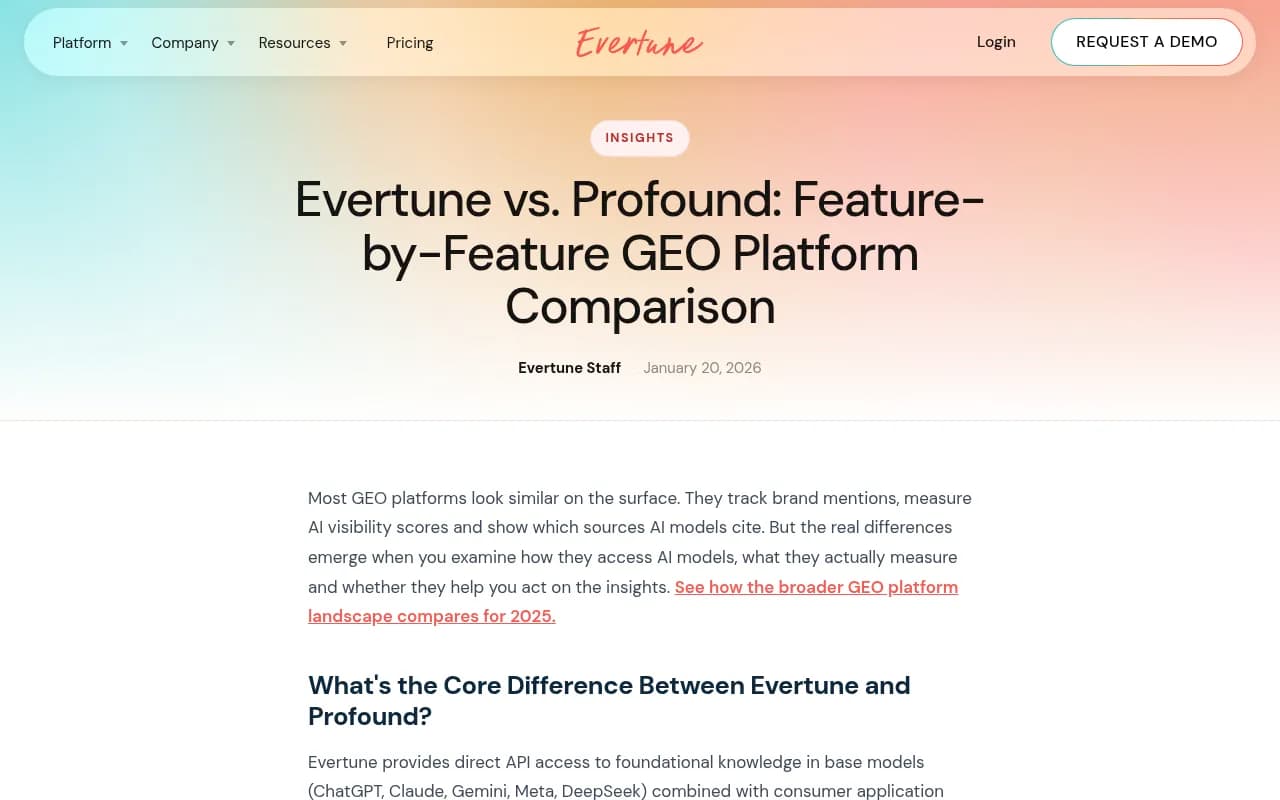
That page is vendor-authored, so read it as Evertune's argument, not a neutral test.
Why the per-engine view matters
Whatever you buy, break visibility out by engine. Promptwatch's Average Sources Per Response report (a live report built on 26B+ data points from real AI interfaces) shows why a blended score misleads:
- ChatGPT cites about 5 sources per web-search answer.
- Google AI Overviews cites about 10, and Perplexity almost exactly 10.
- Copilot's average swung from under 2 to nearly 17 within a few weeks before settling at the low end.
With only about five citation slots in ChatGPT, being sixth is the same as being absent. A platform that tracks three engines on its entry plan (Gauge Growth) gives you a thinner view than one covering nine, but only if the extra engines are ones your buyers actually use. For deeper context on how ChatGPT assembles sources, see Promptwatch's data on unique domains per ChatGPT response.
Which one fits which buyer
| If you are... | Lean toward | Why |
|---|---|---|
| A large enterprise with a security review and a reporting-up mandate | Profound | SOC 2, SSO, nine engines, exec reporting, prompt volumes |
| A brand or media team tying AI visibility to audience and ad spend | Evertune | Panel weighting and base-model view |
| A mid-market team that wants a published price and article output | Gauge | $599/month, 18 articles, agent workflow |
| An SEO team that needs prompt-level diagnostics and crawler data | Profound | Deepest prompt-level and attribution data of the three |
| A team that cares about what agents will recommend without searching | Evertune | API-level knowledge layer |
Questions to ask in every demo
Because so much of the public comparison content is biased, bring your own checklist:
- How many runs sit behind each daily prompt figure, engine by engine?
- Which engines are on my plan, and which are Enterprise-only?
- Is the data collected from the real user interface, an API, or both?
- Can I see SOC 2 Type II documentation and SSO details now, not after signature?
- What is exportable, and is there an API?
- Does the platform track whether AI crawlers can actually read my site?
- Does anything close the loop from a published page to citations to traffic?
- What is the price at my prompt volume, in writing?
The crawler and traffic questions are where these three tend to differ from the rest of the market. A visibility score without crawler access data cannot tell you whether you have a content problem or a technical one.
A fourth option to put on the shortlist
If the thing you want is not just a dashboard but a loop that monitors, finds the content gap, writes and publishes the fix, then checks whether it worked, look at Promptwatch. It tracks ChatGPT, Gemini, Perplexity, Claude, Google AI Overviews, AI Mode, Copilot and others from real interfaces, and adds IP-verified AI crawler logs, visitor analytics for AI-referred traffic, and a Content Agent that publishes to WordPress, Webflow or Framer. Prices are published: Essential $95/month, Professional $245/month and Business $579/month, with agency plans from $199/month (confirm at promptwatch.com/pricing). It is ISO/IEC 27001 certified and GDPR compliant, which helps with enterprise procurement. Business is the first plan with the Content Agent, hourly tracking and Fact Check.

The honest caveat: it does not do a consumer panel the way Evertune does, so if audience-weighted ad measurement is your core need, that gap is real. For most SEO and content teams, the monitor-act-measure loop is the more practical fit. You can compare it head to head on the Promptwatch vs Profound page, or start with the free AI visibility report to see where you stand before any sales call.
If you want to browse more options, the GEO software directory at bestgeosoftware.com lists the wider field.
Final recommendation
Pick by the problem, not the logo.
- Choose Profound if procurement and prompt-level depth decide the purchase and you can handle a sales-led process.
- Choose Evertune if your questions come from brand and advertising leadership and the base-model layer matters to your strategy.
- Choose Gauge if you want a published price and an agent-driven content pipeline, and three engines is enough for now.
- Run a two-to-four week trial of at least two options on the same 50 prompts, and compare how many runs back each number. That test will tell you more than any of the comparison pages above, including this one.