Key takeaways
- Two Microsoft tools, the AI Performance report in Bing Webmaster Tools and the Citations dashboard in Clarity, give you free first-party citation data, including the queries that triggered each citation.
- GA4's AI Assistant channel covers the other half: clicks that actually reach your site. Expect some AI visits to still land in Direct.
- A manual prompt log with 10-20 prompts, run weekly, covers ChatGPT, Perplexity and Google, which the Microsoft tools do not.
- A citation peak or drop only means something once you rule out platform-wide changes. Log citations per response and annotate known model events.
- Paid trackers start around $29-$99 a month. Upgrade when the manual work eats more than a few hours a week.
Why citation peaks are hard to read for free
Everyone wants to know whether AI is citing their site. Few people check regularly. One roundup of this topic puts it at 57% of business owners and SEOs having a vague idea of their AI presence, and only 14% tracking it on a schedule. The reason is mostly money: paid trackers run from about $29 to $700+ a month, and the cheap plans cap the number of prompts.
But cost is only half the problem. The other half is interpretation. A spike in citations could mean your page got better. It could also mean the engine changed how it cites. Free setups have no built-in way to separate those, so you have to build that discipline yourself. I cover how below.
There is also a measurement gap on the click side. Loamly reported that across 446,405 visits in its database, 70.6% of AI-referred traffic arrived without referrer headers, which GA4 files under Direct. And in early May 2026 Google removed the method that let sites identify clicks coming from AI Overviews. So no single free tool gives you the full picture. You stack a few.
The free stack at a glance
| Method | Cost | What it shows | Main limitation |
|---|---|---|---|
| Bing Webmaster Tools, AI Performance | Free | Cited pages and grounding queries for Copilot and Bing AI summaries | Microsoft surfaces only, no competitor data |
| Microsoft Clarity, Citations dashboard | Free | Grounding queries, cited pages, share of authority | Supported Microsoft AI experiences only |
| GA4 AI Assistant channel | Free | Post-click traffic from AI assistants | Misses visits recorded as Direct or Unassigned |
| Manual prompt log | Free | Citations across any engine you test | Answers vary by session, a few hours a week at 20 prompts |
| Free one-off checkers | Free | Snapshot of mentions or cited pages | Limited prompts, no history |
Step 1: Bing Webmaster Tools AI Performance report
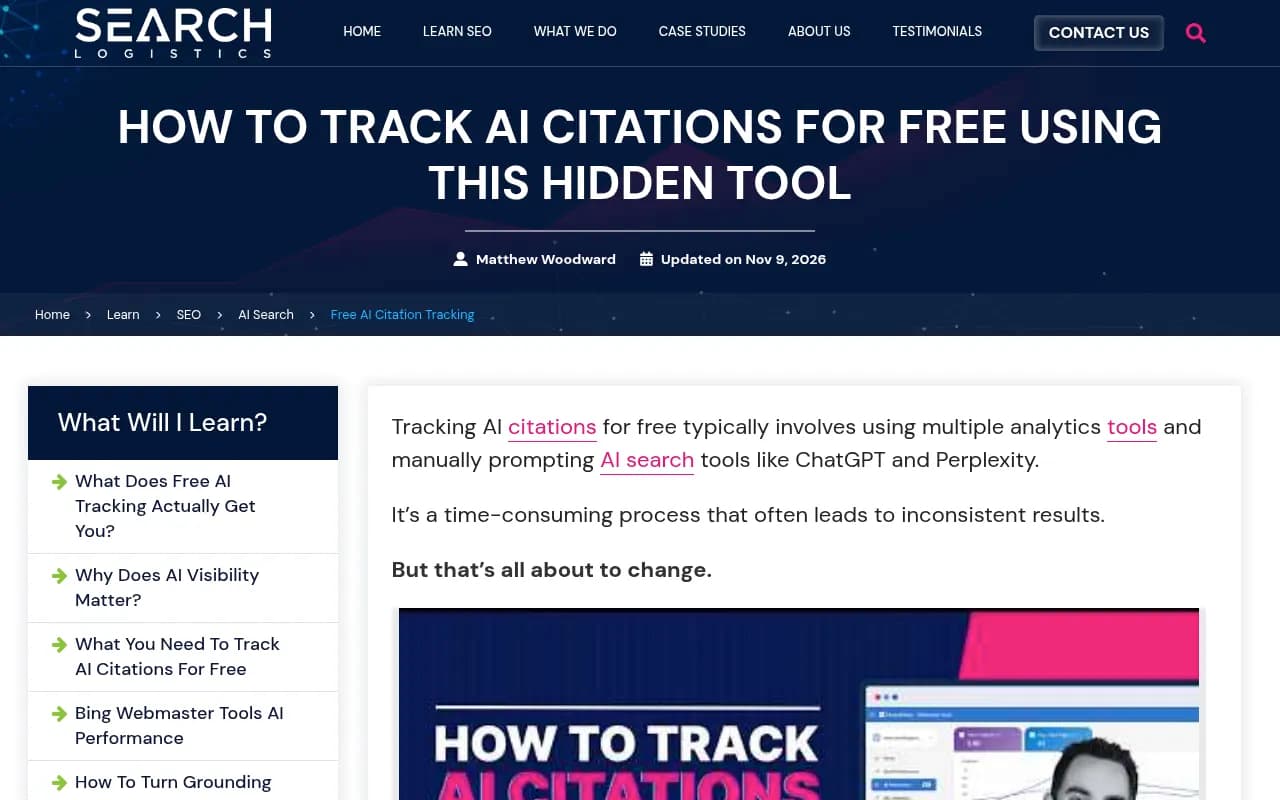
This is the one most people have not opened yet. Inside Bing Webmaster Tools there is an AI Performance report showing which of your pages get cited and which prompts triggered those citations. Matthew Woodward at Search Logistics called it the first time a major AI search platform has handed this kind of data to site owners, and I think that is fair. Every other number you see about AI citations comes from someone sampling the engines from outside.
How to use it for peak tracking:
- Verify your site in Bing Webmaster Tools if you have not (importing from Google Search Console is the fastest route).
- Open the AI Performance report and set a date range of at least 28 days so one noisy day does not dominate.
- Export or screenshot the cited pages list once a week. Bing shows trends, but a dated record is yours to keep and compare.
- Sort by pages with rising citation counts. Those are your peaks. Read the grounding queries next to each one.
The grounding queries are the valuable part. They are the actual retrieval queries the AI system used when it pulled your content, which is closer to real intent than any prompt list you could invent.
The limitation: it covers Copilot and Bing's AI summaries, not ChatGPT, Gemini or Perplexity. And it has no competitor view. Treat it as one engine's ground truth, not the whole market.
Step 2: Microsoft Clarity Citations dashboard
In May 2026 Microsoft moved its Citations dashboard to general availability inside Clarity, under Dashboards > AI Visibility > Citations. Clarity is the free behavioral analytics tool better known for heatmaps and session recordings, so you may already have it installed.
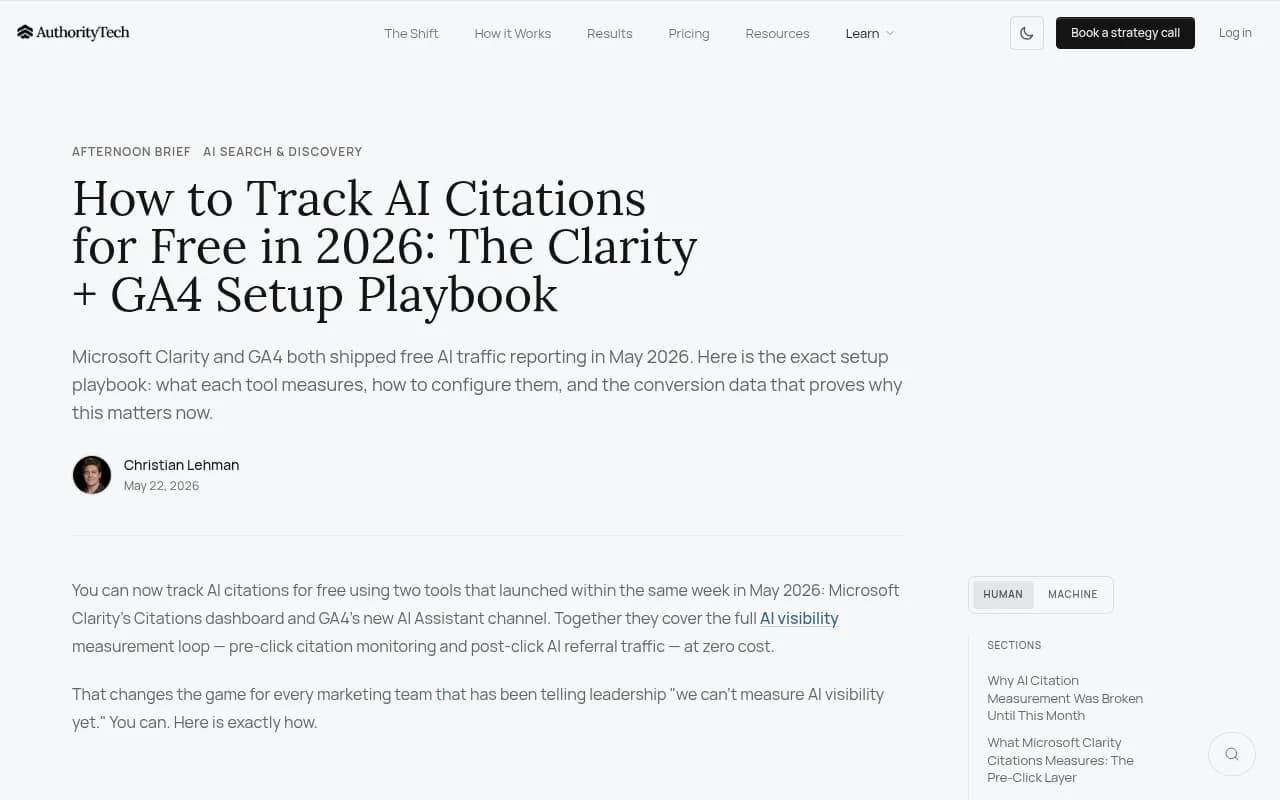
Aubrey Yung, who uses it as one of her two free methods, lists what the dashboard shows: grounding queries, a page-level breakdown of cited URLs with counts and the queries behind each, and share of authority, which compares your domain's citation presence against other domains in the same query set. That last one is the closest thing to competitive context you get for free.
There is a useful side effect here too. Yung points out that tools which run thousands of synthetic prompts can inflate Search Console impressions, and that those prompts are not written by real users. First-party dashboards avoid both problems.
For peak tracking, use Clarity to answer two questions. Which pages gained citations this period? Did your share of authority rise with them, or did every domain in the set rise together? If everyone rose, the shift is probably the platform, not you.
Step 3: GA4's AI Assistant channel for the click side
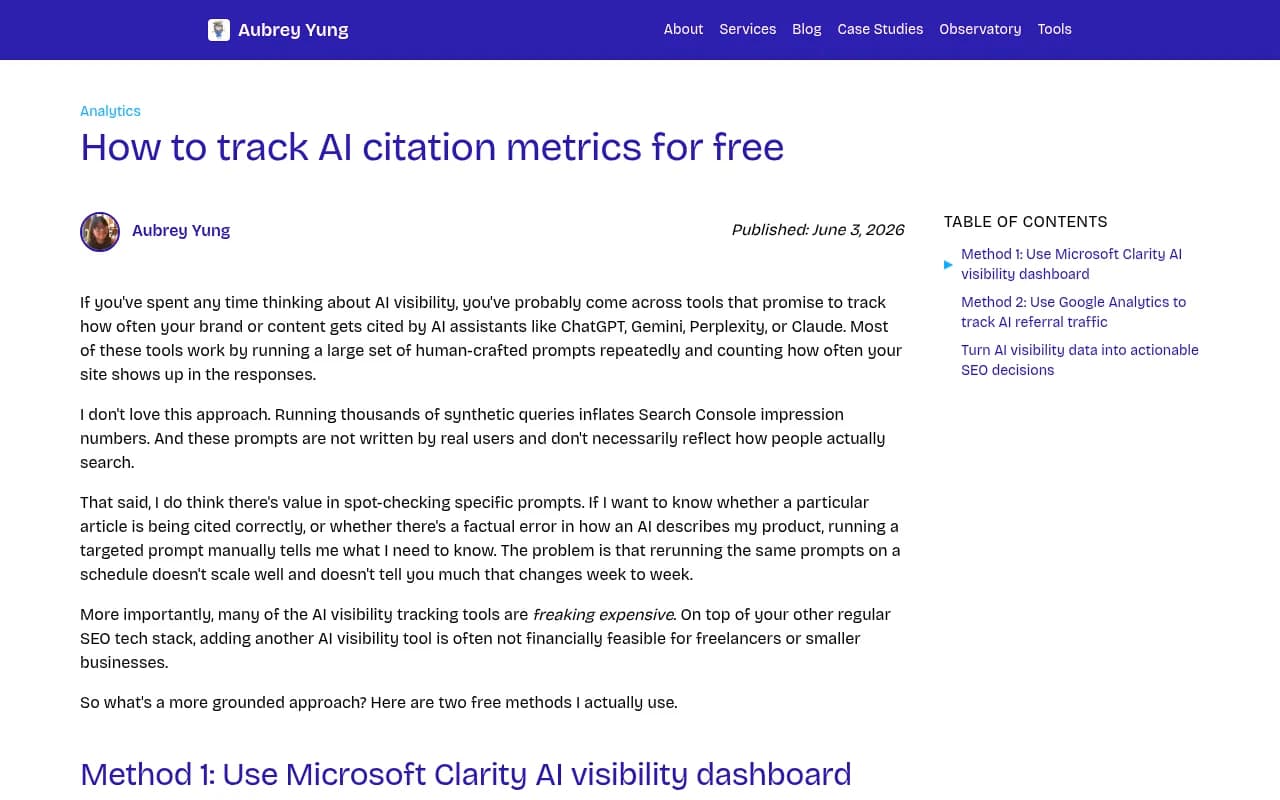
Citations are pre-click. You also want to know whether any of them sent people. GA4 added an AI Assistant channel in May 2026, which groups traffic from assistants like ChatGPT, Perplexity, Gemini and Copilot. Pair it with the citation data and you have the full loop: cited, then clicked, then converted.
Two practical notes:
- Check your Direct and Unassigned traffic for suspicious landing pages. Deep, specific blog URLs getting Direct visits are often AI clicks with no referrer.
- ChatGPT stopped sending a referrer on October 8, 2026. If you can influence how links are tagged, or if you see visits with utm_source=chatgpt.com, build a segment for them so ChatGPT traffic is not buried.
Attribution will never be perfect for free. Settle for a trend line, and compare it to the citation trend week over week.
Step 4: A manual prompt log that covers every engine
The Microsoft tools cannot see ChatGPT, Perplexity or Google. For those, a spreadsheet and some discipline do the job. RankScope's guide and Avita Group's both land on roughly the same recipe, and I agree with it.
- Write 10-20 prompts your buyers would ask, in their words. Try "best [category] for [use case]", "[competitor] alternatives" and "[category] pricing".
- Run each one in the engines you care about: ChatGPT, Perplexity, Google AI Mode and Copilot.
- Record every cited URL, which engine cited it, and whether you or a competitor is listed on that page.
- Repeat weekly with the same prompts and the same engines.
- Act on pages that cite competitors but not you: get listed, pitch the author, or publish the comparison those pages are built from.
Expect a few hours a week at 20 prompts. Pre-built templates exist, such as CiteTrack's free citation tracker spreadsheet, but a plain sheet works fine.
Columns worth adding
| Column | Why it matters |
|---|---|
| Date and engine | Needed for weekly comparison |
| Prompt | Keep wording identical each week |
| Cited URLs (all of them) | Shows who actually owns the answer |
| Your page cited? (Y/N) | Your citation rate over time |
| Total citations in the response | Your baseline for platform-wide shifts |
| Competitors listed | Gap analysis |
| Notes | Model updates, odd answers, errors |
The total citations column is the one people skip. Do not skip it.
Telling a real peak from a platform shift
This is where free setups usually go wrong. You see a jump or a dip, and you credit or blame your content. Check the platform first.
Promptwatch Data has documented several overnight changes that would have looked like content wins or losses in any small tracker:
- ChatGPT's average sources per search-enabled response fell from about 6.4 to roughly 4.7-4.9 around the GPT-5.3 rollout on March 4, 2026, about 27% fewer citation slots, hitting GPT-5.3, GPT-5.4 and GPT-5-Mini at once. See Promptwatch's ChatGPT citation drop report. There was no recovery a month later.
- On August 8, 2026, ChatGPT started using the site: operator at scale, taking it from about 0.4% to about 17% of fanout queries overnight, per Promptwatch's site: operator data.
- reddit.com's share of ChatGPT citations held near 3.83% from July 18 to August 7, then fell below 1% by August 14 and averaged 0.52% for August 14-17, an 86.4% relative drop. Promptwatch flags the size as provisional because a data-collection issue cannot be ruled out. Details are in the Reddit citations report.
Also worth knowing: content type changes how long a citation lasts. Promptwatch's content half-life data found that of pages ChatGPT cited on July 6, 2026, landing pages and docs stayed cited longest, while news lost half its pages within 36 days. A peak on a news-style page may simply fade.
A simple annotation routine
- Keep a second tab in your sheet named Events. Add dated rows for model releases and known behavior changes (March 4, August 8 and August 14, 2026 are three to start with).
- Before you celebrate or panic about a change, look at citations per response across your whole prompt set. If it fell everywhere, the cause is probably the platform.
- Use rolling four-week averages instead of single-day snapshots. Promptwatch makes the same point: single-snapshot audits are unreliable because behavior can change overnight.
- Track engines separately. Reddit's decline in AI Overviews was gradual (2.37% to 2.10%) while ChatGPT's was abrupt, so blending them hides what happened.
Free one-off checkers
These give you a baseline but not a trend.
- RankScope's free AI citation tracker lists cited pages across four engines with no signup, handy for a first look.
- HubSpot's AI Search Grader gives a static evaluation of structure and content signals. It does not track live citations, frequency or share over time, and it needs manual interpretation. It is also in our catalog as [tool:hubspot-aeo-grader]
- Semrush has a free AI Visibility Checker for a quick brand snapshot.
- [tool:falconrank] offers a free instant check of how AI sees your brand.
Use them once a quarter as sanity checks. Do not mistake a grader score for a citation count.
Low-cost paid options when free stops scaling
Signs you have outgrown the free stack: you are spending more than three or four hours a week on prompt runs, you need history across dozens of prompts, or you need competitor citations by URL.
| Tool | Entry price (as listed in research) | Notes |
|---|---|---|
| RankScope | $49/mo ($39/mo annual) | Cited URLs split into yours, competitors' and third-party |
| Otterly.AI | $29/mo Lite | Stores every cited URL plus a domain ranking |
| Peec AI | $95/mo Starter | Three models on self-serve plans, competitor benchmarking |
| Similarweb AEO Intelligence | $99 for one user | Influence score per URL |
| Ahrefs Brand Radar | Custom prompts from $50/mo | Included with paid Ahrefs plans in some form |
Prices move, so confirm on each vendor's page before buying.



For a wider view of budget trackers, browse the AI rank tool directory at ai-rank-tools.com.
When you want tracking and the fix in one place
If your problem has shifted from "are we cited" to "what do we publish and fix next," a fuller platform earns its price. Promptwatch tracks the real interfaces of ChatGPT, Google AI Overviews, Gemini, Perplexity and others, shows IP-verified AI crawler logs so you can tell an access problem from a content problem, and its Action Board and Content Agent turn citation gaps into published pages. Plans start at $95 a month for Essential (confirm at promptwatch.com/pricing), and there is a 7-day free trial plus a free AI visibility report if you want a baseline first.

A weekly routine that takes about an hour
- Monday: export Bing AI Performance and Clarity citation data. Paste the top cited pages and grounding queries into your sheet.
- Monday: run your 10-20 prompt set in ChatGPT, Perplexity and Google AI Mode. Log cited URLs and total citations per response.
- Tuesday: check the GA4 AI Assistant channel and your Direct landing pages for unlabeled AI visits.
- Tuesday: compare against the Events tab. Did a platform change land this week?
- Wednesday: pick one page that gained citations and ask why. Is it fresh, is it a landing page or doc, did the grounding queries shift?
- Wednesday: pick one prompt where a competitor is cited and you are not. Plan a fix: update the page, get listed on the cited third-party page, or write the missing comparison.
Avita Group published its own numbers from the Ahrefs citation index as an example: 50 citations across 12 pages in June 2026, 87 across 15 in July, and 121 across 13 in August. Citations per cited page went from 4.2 to 9.3. That ratio is worth tracking too. It tells you whether growth comes from more pages getting cited or from a few pages doing the heavy lifting.
Using grounding queries to cause the next peak
Tracking is only useful if it changes what you publish.
- Rewrite page headings and intros to match the grounding queries that already pull your page in.
- Keep your top cited pages fresh, because stale pages lose citations first, especially news-style content.
- Find the pages that cite competitors but not you and ask what they have that your site lacks.
- Publish original data or research that others will reference. HubSpot's guide on citation tracking recommends it, and it matches how citations tend to accumulate.
If you would rather hand the strategy and execution to specialists, an SEO and GEO agency such as 1001 SEO Media can run this loop for you. For do-it-yourself readers, the free stack above is enough to start learning what your content does in AI search.
What the free stack will not tell you
Be honest with yourself about the gaps:
- No ChatGPT, Gemini or Perplexity first-party data. Only your manual log covers those.
- No reliable competitor citation share outside Clarity's share of authority.
- Manual prompts are samples, and answers vary by session. Treat each as one data point, not a measurement.
- Attribution is partial. Some AI traffic will always look like Direct.
For everything beyond that, the GEO software directory at bestgeosoftware.com lists the paid options by category. But start with the free stack for a month. By week four you will know which of your pages AI keeps citing, and that is more than most teams can say.