Key takeaways
- Most GEO tools process less personal data than a CRM does, but not none. Prompts, crawler logs, visitor analytics and user accounts can all contain personal data, so a DPA is still required.
- Residency is about where data is processed as well as stored. Ask for exact regions per data category, including backups and logs.
- The EU-US Data Privacy Framework is under appeal, so your DPA should carry SCCs as a fallback.
- Separate the vendor's own security posture (ISO 27001, SOC 2, SSO, audit logs) from what its data pipeline touches (log ingestion, AI model APIs, sub-processors).
- Settle residency requirements before shortlisting, not during procurement.
Why GEO tools need a security review at all
It is tempting to wave a GEO platform through. It tracks what ChatGPT says about your brand, so what personal data could be involved? Quite a lot, once you look at the full product.
A typical enterprise GEO platform has user accounts and SSO identities. It may ingest server or CDN logs that contain IP addresses. It may run visitor analytics that set identifiers on your site. It may connect to Google Search Console, your CMS, Slack, or an API. Some tools push your brand documents and customer-facing facts into an LLM to generate content. Each of those is a data flow your DPO will want mapped.
The core visibility data itself (prompts, AI responses, citations) is mostly non-personal. That is the good news, and it means a clean review is achievable. The work is in confirming it, in writing.
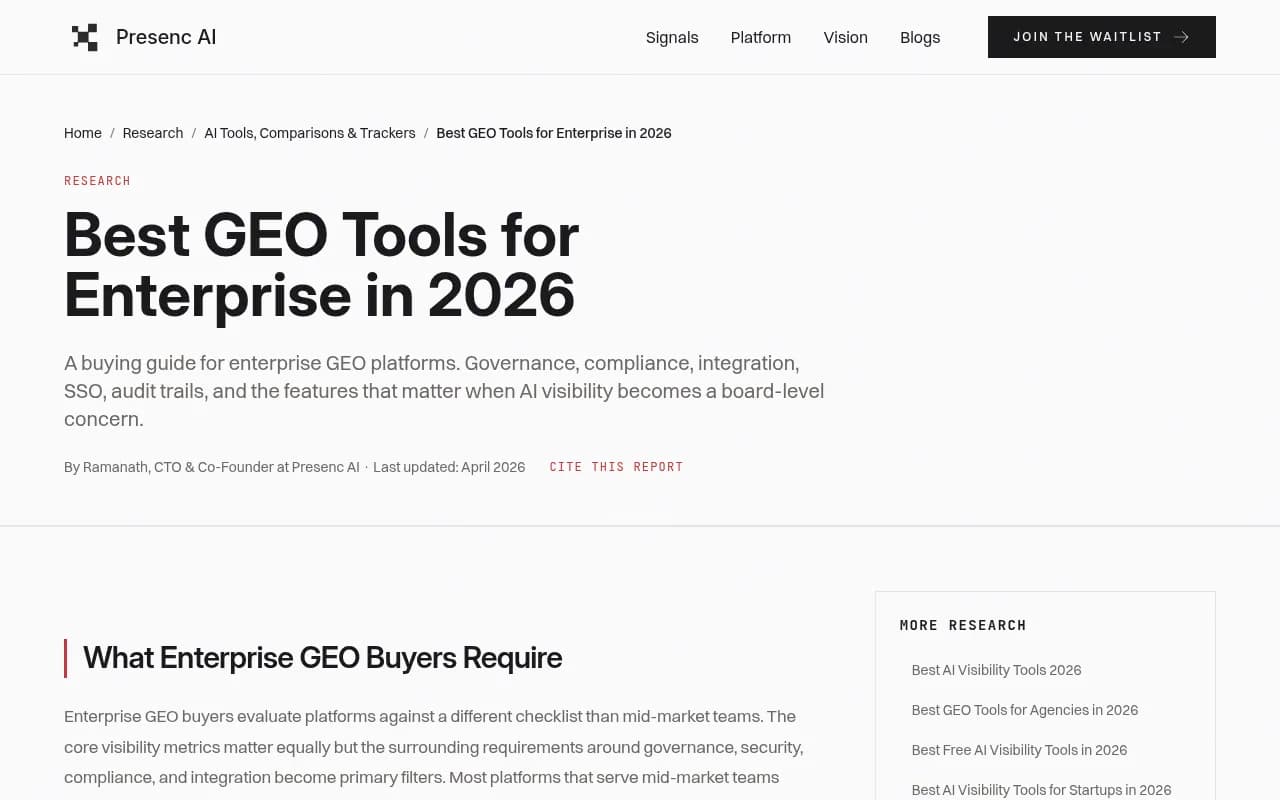
Presenc AI's enterprise buyer's guide lists the same filters most security teams apply: SAML SSO and SCIM, role-based access, audit logs, EU/US/APAC residency options, and negotiated MSA and DPA terms rather than click-wrap. Use that as a baseline, then go deeper using the checklist below.
Step 1: Map what the tool actually processes
Before you send a questionnaire, build a one-page data map. Ask the vendor (and verify in the product) which of these categories apply.
| Data category | Example | Personal data? | Question to ask |
|---|---|---|---|
| Account data | Names, emails, SSO identity | Yes | Where are accounts stored? Is SCIM supported? |
| Prompt and response data | Tracked prompts, AI answers, citations | Usually no | Does any customer-written text get stored verbatim? Is personas data synthetic? |
| Crawler and server logs | Bot requests, user agents, IPs | Often yes (IP addresses) | Are logs filtered to AI bots only? How long are they retained? |
| Visitor analytics | AI-referred sessions, devices, locations | Yes if identifiers are used | Cookieless? What is the lawful basis? |
| Search console and Bing data | Per-page clicks and queries | Rarely | Which scopes are requested? Read-only? |
| Content and brand inputs | Brand book, knowledge base, source docs | Possible | Is it sent to an LLM? Under what retention terms? |
| Integration credentials | CMS tokens, API keys | No, but sensitive | Encrypted? Region-pinned? Scoped? |
The crawler log row deserves attention. Promptwatch Data's AI crawler traffic report is built from raw server and CDN logs, counting only requests whose source IP matches the operator's published ranges. That kind of IP verification is useful for accuracy, but it also means the tool is handling log data that can contain IP addresses. Raise it in the DPA discussion rather than assuming it is harmless.
Step 2: The DPA checklist
A signed Data Processing Agreement is non-negotiable for any vendor that touches personal data on your behalf. Do not accept a generic one without reading these points.
Scope and instructions
- Does the DPA name the actual categories of data and data subjects, or is it boilerplate?
- Does it say the vendor processes only on your documented instructions?
- Is there a clause on use for product improvement or model training? It should say no for your personal data.
AI-specific coverage
This is where older paperwork falls short. A GMI Cloud analysis of enterprise AI data residency notes that many vendor DPAs were written before generative AI and do not address inference data, whether prompt content is used for model improvement, or sub-processor jurisdictions. If a GEO vendor's template predates 2023, ask for an AI addendum.
Confirm the DPA covers:
- Prompt content and any text you upload to a knowledge base or brand book
- Whether content is sent to third-party LLM APIs, and which
- Retention periods at those LLM providers
- Deletion timelines when you terminate
Sub-processors
Get the current sub-processor list with hosting region for each. Ask about the notice period for changes (30 days is common) and your right to object. Truto's guide on MCP and GDPR puts the rule bluntly: if a vendor in the data path can technically read, store or replay personal data, treat it as a sub-processor with its own DPA and transfer assessment. That applies to the GEO vendor's LLM providers, CDNs and analytics subprocessors as much as to MCP servers.
Breach notification and audit rights
- Notification timing to you. GDPR gives you 72 hours to notify the regulator, so the vendor needs to tell you much faster, typically 24 to 48 hours.
- Your right to audit or receive third-party audit reports in lieu.
- Liability and indemnity terms. Enterprise procurement should expect to negotiate these, not accept click-wrap.
Step 3: Data residency, properly defined
GDPR does not require data to stay in the EU. It restricts transfers to countries without adequate protection. Still, many enterprises require EU hosting as a contract term, so confirm what you need before you shortlist.
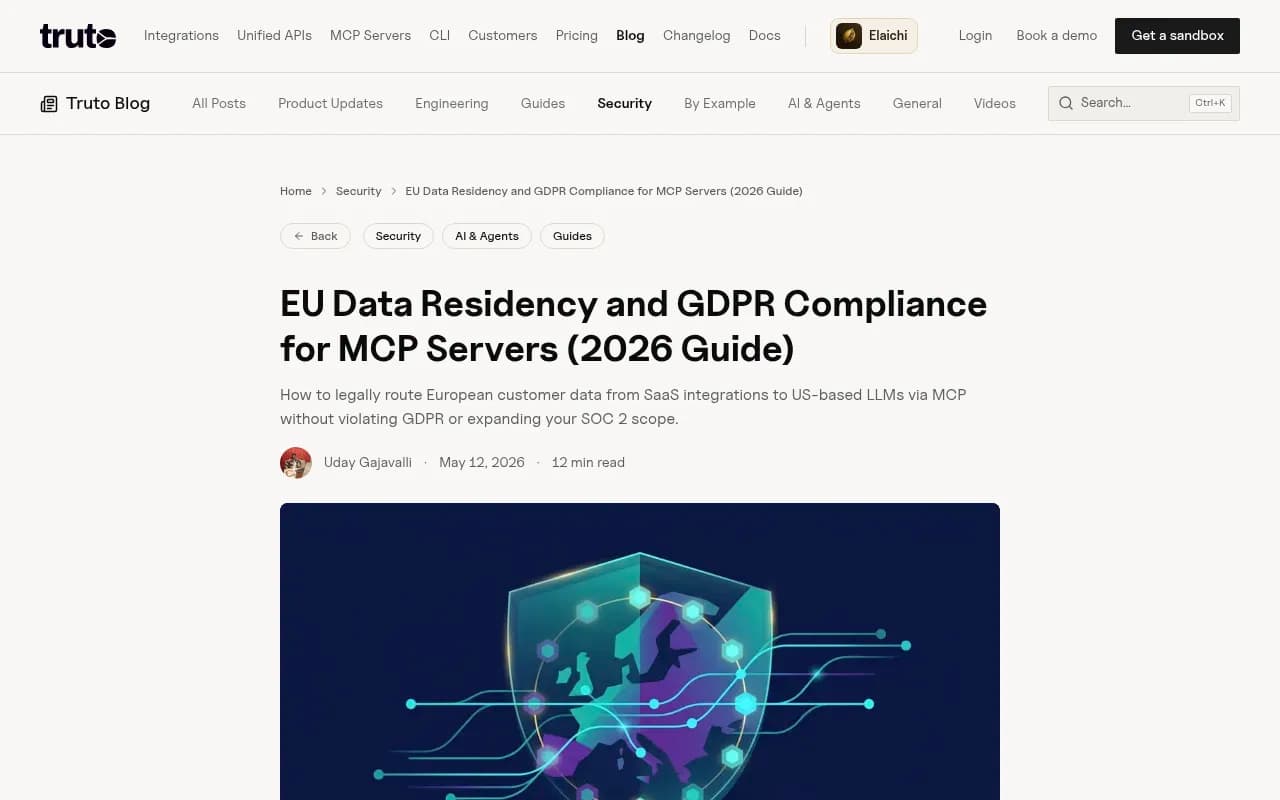
The Truto guide has a useful table of reviewer questions and defensible answers. The same logic works for a GEO vendor: "where is EU personal data processed?" should get a region-specific answer that matches the sub-processor list.
What a good residency answer looks like
- A named cloud region per data category (for example eu-central-1 in Frankfurt), not just "hosted on AWS".
- Coverage of primary storage, read replicas, backups and log archives.
- A clear statement on processing location. A database in Frankfurt means little if a serverless function processing it runs in US-East. That is still a cross-border transfer.
- A statement on remote access. Support staff in a third country viewing your data counts as a transfer.
Ask these questions
- Can my tenant be pinned to an EU region, and is that included in the plan or an add-on?
- Do the AI models used to generate content run in-region?
- Where do the collected AI responses live, and who can access them?
- What leaves the region by default (support tooling, error reporting, analytics)?
One structural caveat. A regional selector does not remove the US CLOUD Act issue for US-headquartered providers, which sits in tension with GDPR Article 48. A vendor headquartered in the EU, with EU-held keys, answers this more cleanly. It does not make US vendors non-compliant, but your legal team should decide how much that matters to you.
Step 4: Transfer mechanisms in 2026
If any data leaves the EEA, you need a lawful mechanism. In mid-2026 the picture is more fragile than it was a year ago.
- The General Court dismissed the Latombe challenge to the EU-US Data Privacy Framework on September 3, 2025 (Case T-553/23). Latombe appealed on October 31, 2025 (Case C-703/25 P). As of July 2026 the appeal was pending with no hearing date announced.
- The General Court judged the position as of July 2023 and did not examine later US developments.
- A US Supreme Court decision on FTC independence (Trump v Slaughter) raises the risk that the adequacy decision is overturned, since it relied partly on the FTC as an independent oversight body. Skadden advises companies to review fallback arrangements.
- noyb sent a letter on June 30 and has said it may bring its own annulment challenge, with proceedings potentially taking 2 to 3 years. Microsoft was admitted in June 2026 as an intervener supporting the Commission.
- If the Court annuls an adequacy decision, the effect is immediate. Schrems I and II set the precedent, with no grace period.
A transfer to a DPF-certified recipient needs no SCCs or TIA, provided the certification is active and covers the data type. But relying on that alone is a bet.
What to put in the contract
- Standard Contractual Clauses included in the DPA as a fallback that applies automatically if the DPF falls away.
- A refreshed Transfer Impact Assessment for each non-EEA recipient.
- Supplementary measures where risk is higher: EU-held encryption keys, pseudonymisation, data minimisation.
- A documented record of each transfer and its legal basis.
Step 5: The vendor's own security posture
The privacy side is half the review. The other half is classic infosec.
| Control | What to ask for | Why it matters |
|---|---|---|
| ISO/IEC 27001 | Current certificate and scope statement | Check the scope covers the product you are buying |
| SOC 2 Type II | Latest report under NDA | Operational evidence over time, not a point in time |
| SSO and SCIM | SAML with Okta, Azure AD, Ping; automated provisioning | Needed for adoption at scale |
| Roles and access | Owner, editor, viewer; project-level access | Agencies and multi-brand teams need separation |
| Audit log | Who changed what, from which channel (UI, API, agent) | Required by most security teams |
| API keys | Scoped, revocable, read-only options | Limits blast radius for integrations |
| Encryption | At rest and in transit; key management | Baseline |
| Incident history | Public or disclosed incidents and response | Past behavior is the best evidence |
Regulated European buyers increasingly ask for ISO 42001 (AI management) too, per Truto's reviewer table. It is not yet standard for GEO vendors, so treat it as a differentiator rather than a blocker.
Step 6: Integrations and agentic features
This is the section that did not exist in 2023 checklists. Modern GEO platforms connect to your CMS, your CDN, Slack, and increasingly expose MCP servers and AI agents that can write and publish.
- Write access. If the tool can publish to your CMS, what scope does it request? Can you limit it to drafts?
- Approval flow. Is there a review inbox, or can the agent publish unattended? Know which you are enabling.
- MCP and API. Are tools scoped per key? Are calls logged? Truto's point on documentation-gated tool exposure is a good model: only explicitly approved endpoints should be reachable.
- LLM retention. OpenAI keeps API abuse-monitoring logs for up to 30 days by default unless you have Zero Data Retention, and EU-resident projects offer in-region handling. Anthropic has ZDR for qualifying API keys. Verify the current terms against official documentation before you rely on them, because they change.
- Log ingestion. Cloudflare, Vercel, Fastly and raw logs all work in practice. Ask whether you can filter to known AI bot user agents at the source so non-bot visitor IPs never leave your infrastructure.
Step 7: Regulatory context to flag for legal
Your counsel will likely raise these. Not all are GEO-specific.
- The EU AI Act's high-risk obligations, with full enforcement cited at August 2, 2026 in the sources I reviewed. A brand-visibility tool is unlikely to be high-risk, but if you feed its output into hiring or credit decisions, ask. I have not independently verified the AI Act timelines, so confirm with counsel.
- US state privacy laws. O'Melveny counts 20 comprehensive state laws as of March 2026, with Indiana, Kentucky and Rhode Island taking effect January 1, 2026. Update DPAs to reflect state-specific transparency and profiling obligations, such as Minnesota's right to a list of specific third parties receiving data.
- Overlapping regimes. If you operate in Japan, China or India, PIPL, APPI and DPDP each impose their own transfer restrictions that must be mapped before you sign.
How shortlisted tools compare on the review criteria
I could not find a reliable public comparison of GEO tools' security postures, so I would not trust any league table claiming one. What follows is a framework for what to verify for each vendor, plus where I can point to published claims.
| Criterion | Where to verify | Notes |
|---|---|---|
| ISO 27001 / SOC 2 | Trust center or certificate | Request the report, not a badge |
| EU hosting option | DPA and sub-processor list | Get the region by name |
| HQ jurisdiction | Company registry | Matters for the CLOUD Act argument |
| SSO and audit log | Plan page and docs | Often gated to top tiers |
| Log ingestion controls | Integration docs | Can you filter to AI bots? |
| Agent write permissions | Docs and demo | Draft-only versus live publish |
On what is published: Promptwatch states it is ISO/IEC 27001 certified and GDPR compliant, with data handled by an EU-based company (Promptwatch B.V., Amsterdam). Its plans have role-based access with owner, editor and viewer roles, scoped API keys, and an audit log that records whether a change came from the dashboard, API, an MCP client or Agent Chat. SSO and a white-label client portal sit on Enterprise. Verify the certificate scope, and get its DPA and sub-processor list, as you would for any vendor.

For the other platforms enterprises commonly shortlist, run the same questionnaire. These are worth a look depending on your stack:


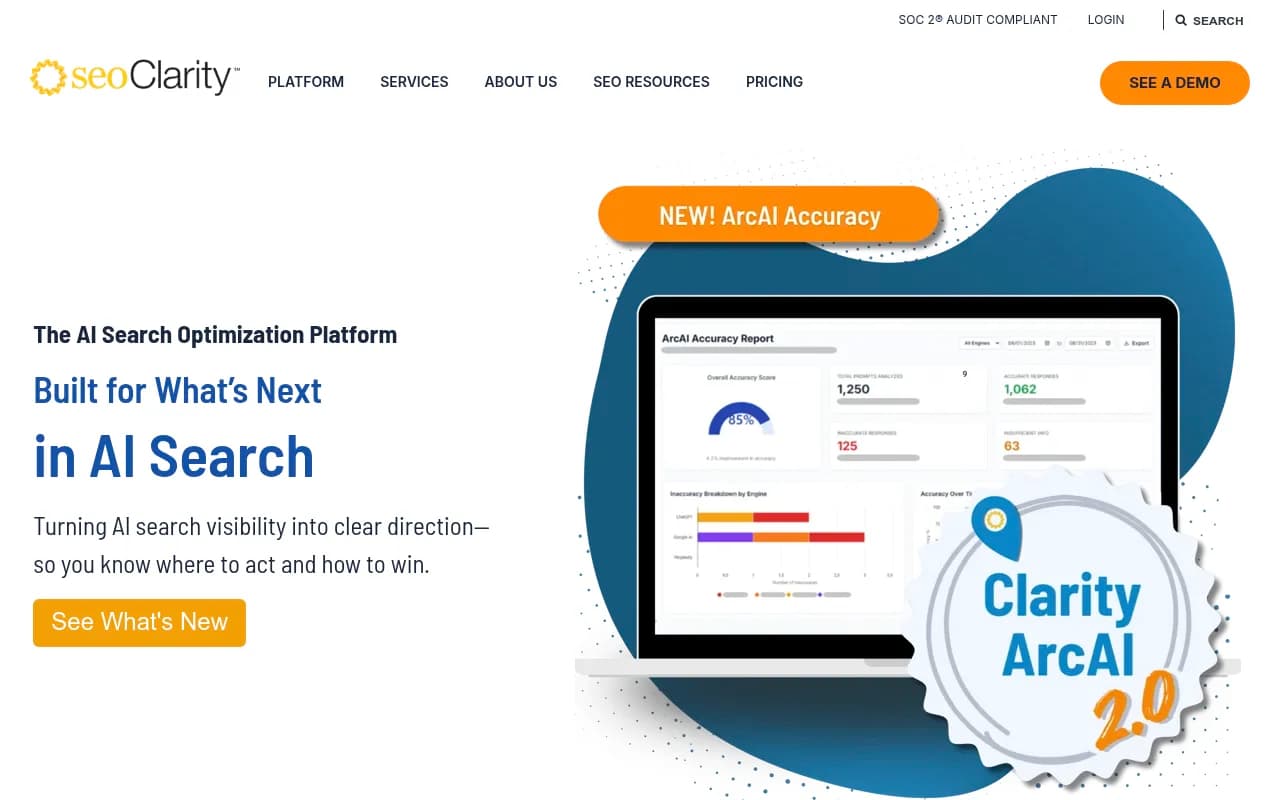
Enterprise SEO suites such as BrightEdge, Conductor, Botify and seoClarity usually have mature procurement and security processes already, since they sell into large organizations. Newer pure-play GEO tools vary much more, so don't assume. To browse more options, the GEO software directory at bestgeosoftware.com is a decent starting point.
A printable questionnaire
Send this to every finalist. It fits on one page and surfaces most problems.
- Provide your DPA, including the current sub-processor list with regions.
- State where our tenant's data is stored and processed, per data category, including backups and logs.
- Do you offer EU-only hosting? Is it contractually guaranteed?
- Which transfer mechanism applies to each non-EEA sub-processor? Are SCCs included as a fallback to the DPF?
- Which LLM providers process our data? Is zero data retention in place? Is our data used for training?
- What personal data do crawler logs and visitor analytics collect, and what are the retention periods?
- Provide your ISO 27001 certificate and latest SOC 2 Type II report.
- Describe SSO, SCIM, role model, audit logging and API key scoping.
- What can your agents write or publish on our systems? Is there an approval step?
- What is your breach notification timeline and your last disclosed incident?
- What happens to our data on termination, and how fast is it deleted?
- Can you export all our data in a standard format at any tier?
On question 12, Presenc AI makes the point that platforms restricting export at enterprise tier are rare and should be avoided. Lock-in is a security and continuity risk, not just a commercial one.
Red flags
- No named region, just a cloud provider.
- A DPA that cannot say whether prompts or uploaded content train models.
- Sub-processor lists that are out of date or absent.
- Click-wrap only, with no willingness to negotiate liability.
- Agent features that publish live with no review option.
- Security claims on a marketing page with no certificate behind them.
Getting help with the review
If your team lacks the bandwidth to run this alongside a vendor bake-off, an agency that already works with these platforms can speed it up. 1001 SEO Media runs GEO programs for brands and can tell you which vendors answered the hard questions in practice, though the legal sign-off stays with your counsel.
Bottom line
A GEO security review is mostly a data-mapping exercise followed by a contract exercise. Map what the tool ingests, get a DPA with AI-specific terms and SCCs as a fallback, pin down regions by name, and check the vendor's certificates rather than its badges. Do it before the shortlist, because a residency requirement discovered at procurement is the single most common reason these deals stall.