Key takeaways
- Product pages are now the single most-cited content format in ChatGPT Search, at 32.8% of all classified citations in July 2026, nearly double the March 2026 average. Google AI Overviews crossed the same threshold that same month, with product pages overtaking listicles for the first time on July 28, 2026.
- ChatGPT only cites about 5 sources per web-search response, roughly half of what Google AI Overviews cites (around 10). That means fewer, more contested slots on ChatGPT and a slightly more forgiving field on Google.
- Structured data has to live in the raw HTML, not be injected by JavaScript after the page loads. Google is explicit about this, and it applies just as much to AI crawlers that don't render scripts the way a browser does.
- Real, detailed reviews still matter more than polished brand copy. AI systems are trained on how people actually talk about products, and that shows up in what gets cited.
- Markdown mirrors of your product pages do almost nothing for AI search citations, HTML accounts for 99.94% of citations across a 1.6 million citation sample. Fix crawlability and rendering before you chase markdown gimmicks.
Why this matters more than it did a year ago
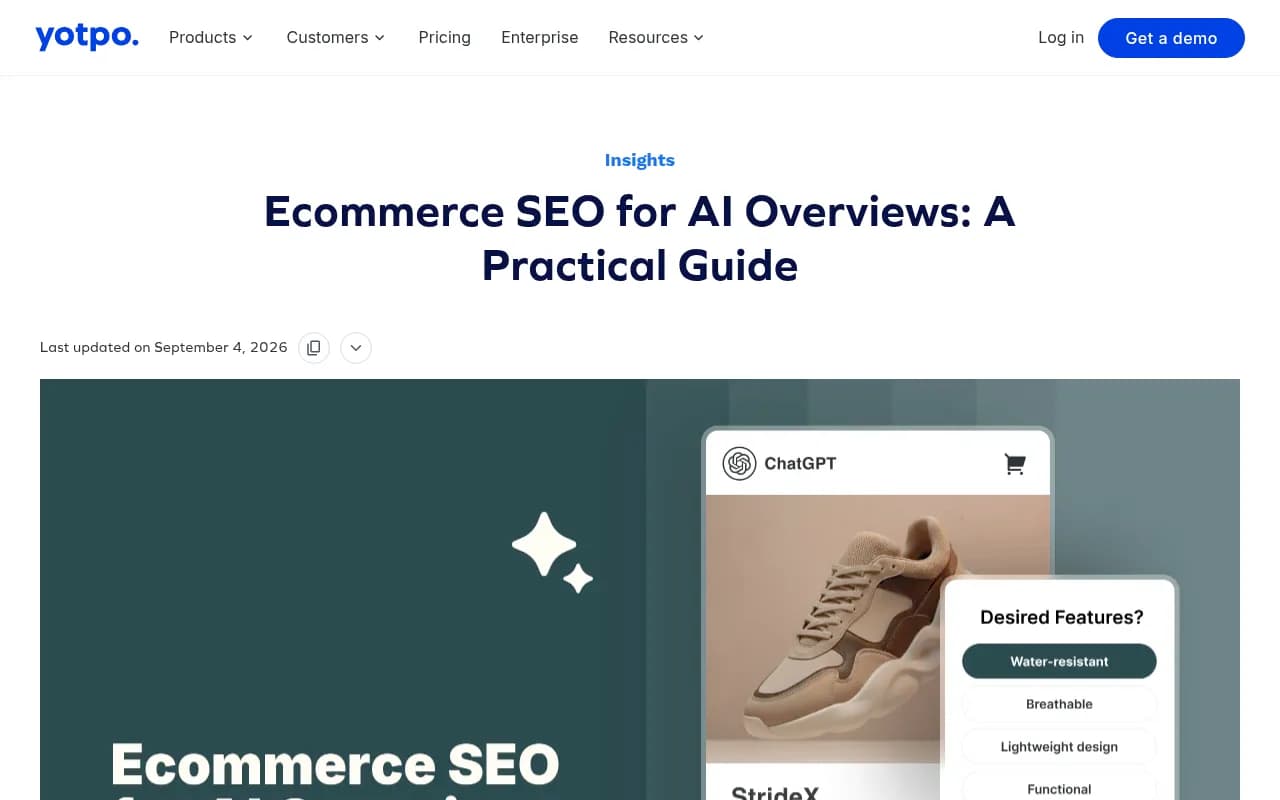
Someone typing "best waterproof hiking boots under $150" into ChatGPT used to get a summary built mostly from review sites and buying guides. Increasingly, they get a summary built from the actual product pages selling those boots. That's a real shift, and it's happening on Google too.
According to Promptwatch's citation-type breakdown, product pages became the most-cited format in ChatGPT Search in July 2026, pulling 32.8% of all classified citations against 9.7% for listicles and 5.2% for news articles. That's not a fluke month. The average product-page share in March 2026 sat around 18%, so it nearly doubled in four months. Google AI Overviews followed the same curve: product pages overtook listicles as the top-cited format starting July 28, 2026, ending the month at 17.9% versus listicles' 16.2%. Product-page citation share on AI Overviews was around 9% back in January.
I don't think this is Google or OpenAI doing anyone a favor. It's more that both systems got better at parsing commercial pages directly, so they stopped needing a third-party article to translate the specs for them. If your product page is the clearest, most complete source of truth for that product, it wins that job. If it isn't, some review site or comparison blog keeps doing the translating, and keeps getting cited instead of you.
The slot math is different on every platform
Here's something a lot of teams miss: the number of sources an AI system cites per answer varies a lot, and it changes how competitive a category feels.
| Platform | Avg. sources per response | What it means for you |
|---|---|---|
| ChatGPT Search | ~5 | Highly contested, fewer citation slots per query |
| Google AI Overviews | ~10 | Roughly double ChatGPT's slots, more room for mid-authority sites |
| Perplexity | ~10 | Consistent and predictable, good for testing GEO changes |
| Microsoft Copilot | Volatile, 2 to 17 | Still being re-architected, treat as unstable |
This is according to Promptwatch's data on average sources per response. If you're only optimizing for ChatGPT, you're fighting over half the real estate compared to AI Overviews. That's worth knowing before you decide where to spend your time first.
It's also worth noting that ChatGPT citation share isn't winner-take-all the way Google rankings used to be. In Promptwatch's June 2026 ChatGPT citation share report, Reddit led all domains at just 3.71% share, down from 6.11% in May, a roughly 40% drop in a single month. Even the top domain overall held under 4%. That's a very different game than ranking #1 on Google, where one domain can hoover up most of the clicks. In AI citations, the pie is split across a lot more sources, which is actually good news for a mid-sized ecommerce brand that can't outspend the big marketplaces.
What structured data actually needs to look like
Google's documentation on this is clearer than most people give it credit for. There are two kinds of product markup: merchant listing markup (for pages where someone can actually buy the thing) and product snippets (for pages that just review a product without a purchase path). Ecommerce product pages should almost always use the merchant listing version.
The required fields are name, image, and offers (with price and priceCurrency). Recommended fields include sku, gtin, brand, description, and aggregateRating. None of this is exotic, most ecommerce platforms generate a version of this automatically. The part teams get wrong is technical: Google states plainly that structured data has to be present in the HTML returned by the server, not injected by JavaScript after the page loads. If your product specs render client-side and your schema does too, an AI crawler that doesn't execute JavaScript the way a browser does may simply never see it.
And the data has to match what a shopper actually sees. Mismatched price, discontinued stock listed as available, or a description that doesn't match the page copy will get your listing rejected from Merchant Center feeds, and probably erodes AI trust signals too, even if there's no formal penalty documented for it.
Crawlability: check who's actually allowed in
Before worrying about content quality, check whether AI crawlers can even reach your product pages. OpenAI's own documentation is specific here: OAI-SearchBot powers ChatGPT's search citations, and sites that disallow it "will not be shown in ChatGPT search answers," though they can still appear as plain navigational links. That's a separate crawler from GPTBot, which only feeds model training, not live search, disallowing GPTBot doesn't hurt your citation eligibility.
OpenAI also has a specific, easy-to-miss instruction for ecommerce: allow OAI-SearchBot to crawl your product image URLs too, not just the HTML page. If your images sit behind a CDN with a restrictive robots rule or hotlink protection, you might be blocking exactly the assets ChatGPT needs to show a product card.
A reasonable allow-list for an ecommerce robots.txt includes GPTBot, OAI-SearchBot, ChatGPT-User, ClaudeBot, anthropic-ai, PerplexityBot, Perplexity-User, Google-Extended, Applebot-Extended, Amazonbot, and Meta-ExternalAgent, while blocking /admin/, /checkout/, /cart/, /account/, and parameterized duplicate URLs. Worth checking your server logs against Promptwatch's AI crawler traffic report, which found OpenAI's crawlers made up 79.8% of verified AI crawler requests the week of September 6, 2026, down from 94.8% in June, meaning Anthropic, Google, Perplexity, and Mistral are all gaining crawl share. If a provider shows up big in that industry mix but never touches your logs, something on your end is probably blocking it.
One thing you can stop worrying about: publishing markdown versions of your product pages "for the AI." Across 1.6 million citations tracked by Promptwatch, HTML accounted for 99.94% of citations and markdown files just 0.05%, per Promptwatch's markdown research. Markdown mirrors matter for coding agents like Claude Code fetching docs, not for consumer AI search. Spend that effort fixing JavaScript-rendered content instead.
Where on the page the answer actually needs to sit
This is the part most teams skip. CXL ran a structured analysis of 100 Google AI Overview citations and found 55% of cited passages came from the first 30% of the source page. Kevin Indig's separate analysis of 18,012 verified ChatGPT citations found almost the same pattern, 44.2% of citations pulled from the first third of a document, with citation likelihood dropping sharply after that. Indig calls it a "ski ramp" effect: a steep cliff after the first third, then a long, slow tail.
For a product page, that means your core spec sheet, price, and the one or two sentences that actually differentiate the product from a competitor need to be near the top, not buried under three paragraphs of brand story. If your best material lives at the 50% mark of the page because you built up to it with narrative, it's sitting in the zone that produced fewer citations in that sample.
The one exception is FAQ sections. Even positioned near the bottom of a page, FAQ blocks got cited because each question-and-answer pair is self-contained. Write them as standalone units, a crisp, complete answer in the first sentence of each answer, not a teaser that requires reading the rest of the page.
Reviews are doing more work than brand copy
Generic marketing copy could describe almost any product in a category. It gives an AI system nothing to differentiate on. Real reviews, on the other hand, contain the specific, first-person detail a model can treat as reliable: how it actually fits, what broke after three months, whether it runs small. 84% of Americans say they trust online product reviews, and 79% read three or more before buying, according to survey data cited by Digital Commerce 360 and eMarketer. It tracks that AI systems trained on how people talk about products online would lean on that same content.
A thin review base with a high star rating isn't the same signal as a steady stream of detailed reviews. If your review platform is Trustpilot, that's worth maintaining actively, Promptwatch's June 2026 data showed Trustpilot's ChatGPT citation share ticking up from 0.18% to 0.22% month over month, a small number but a real, measurable channel.
Ads are now layered on top of citations
One thing worth flagging for anyone budgeting for this work: paid visibility inside ChatGPT is growing fast and now sits alongside organic citations. Ads appeared in an average of 20.1% of ChatGPT Search responses over the trailing 90 days as of mid-August 2026, up from zero before late May 2026, according to Promptwatch's ChatGPT ads tracking. Of ad-bearing responses, 73.3% show up on plain organic prompts, not just brand or competitor searches. Getting cited organically is only half the picture now, some of your competition for the shopper's attention is a paid placement, not another citation.
Shopping-specific features (product cards, price comparisons) are still a small slice of overall ChatGPT responses, but per Promptwatch's shopping feature data, the rate has moved in visible steps, roughly doubling overnight in late May 2026 before settling back down. That volatility suggests OpenAI is actively tuning this rather than letting it grow organically, and the brands that get their product schema and merchant feeds clean now will be harder to displace once the feature matures.
A vertical example worth borrowing from
Automotive is one of the few verticals with public citation-share data that maps closely to general ecommerce. Per Promptwatch's August 2026 automotive citation share report, Autotrader.com led at 5% of citations, Cars.com second at 4.6%, and seven of the top eight domains were marketplaces or review sites. Only one manufacturer site, Chevrolet.com, made the top group, at 2.62%. But a single local dealer site made the top 31 at 0.28% share, proof that a specific, well-structured page on a smaller site can still compete for citations against national players, if the page is built around clear headings and structured specs that make extraction easy.
A practical checklist
- Confirm your Product/merchant listing schema is server-rendered, not injected by JavaScript, and matches what's actually shown on the page
- Allow OAI-SearchBot, ClaudeBot, PerplexityBot, Google-Extended, and the rest of the major AI crawlers in robots.txt, including access to product image URLs
- Move your core spec table, price, and key differentiator into the first third of the page, don't bury it under brand narrative
- Build FAQ sections as standalone answer units, one crisp sentence per question, not a teaser
- Keep a steady flow of detailed, real reviews rather than chasing a high average rating alone
- Skip the markdown mirrors, fix crawlability and rendering instead
How to actually track whether any of this is working
Most of this checklist is invisible unless you're checking regularly which of your product pages get pulled into ChatGPT and AI Overview answers, and which ones lose out to a marketplace or review site instead. Manually running prompts across five different AI platforms every week isn't something most ecommerce teams can sustain.
This is the kind of gap tools like Promptwatch are built for. It tracks citation-level data across ChatGPT, Gemini, Perplexity, Claude, and Google's AI Overviews and AI Mode, including which specific pages on your site are getting cited, AI crawler logs showing exactly when bots hit your product pages and whether they error out, and a ChatGPT Shopping and Ads Radar for tracking product card appearances and competitor ad spend against your own prompts. It also runs content gap analysis against what AI is actually citing in your category, and its Content Agents can draft and publish fixes straight to your CMS rather than leaving you with another report to act on manually.

If you want to compare that kind of platform against other AI visibility and GEO tools before committing, the directory at bestgeosoftware.com is a reasonable place to look across the category.
The short version
Product pages are winning citations they used to lose to third-party content, on both ChatGPT and Google. That's a genuine opportunity for any ecommerce team, but it only pays off if the page is server-rendered, structured correctly, front-loads its real answer, and backs it up with actual review detail instead of brand copy. None of this replaces normal SEO. It's mostly the same technical foundation, applied with more attention to where on the page your best material actually sits.