Summary
- ChatGPT Shopping launched in November 2025 and now processes 50 million product queries daily, making it a critical discovery channel for e-commerce brands
- The shopping experience uses a conversational research process: asking clarifying questions, running fan-out queries to Google Shopping and other sources, then ranking products by relevance (not ads)
- Tracking tools like Promptwatch monitor when your products appear in ChatGPT recommendations and carousels, which queries trigger them, and how you compare to competitors
- Optimization requires a dual focus: your product data in Google Shopping (which ChatGPT queries) and your brand's overall AI visibility across the web
- Most brands are invisible in ChatGPT Shopping because they haven't optimized for the conversational, constraint-based way people actually shop in AI
What ChatGPT Shopping actually is
ChatGPT Shopping isn't a marketplace. It's a research assistant that helps people figure out what to buy by asking questions, narrowing options based on real constraints, and explaining tradeoffs between 4-6 recommended products.
The experience works like this: you tell ChatGPT what you need ("Find the quietest cordless stick vacuum for a small apartment"), it asks clarifying questions about budget and priorities, then researches across the internet to build a personalized buyer's guide. The recommendations are organic and unsponsored -- ranked by relevance to your query, not by who paid to be there.
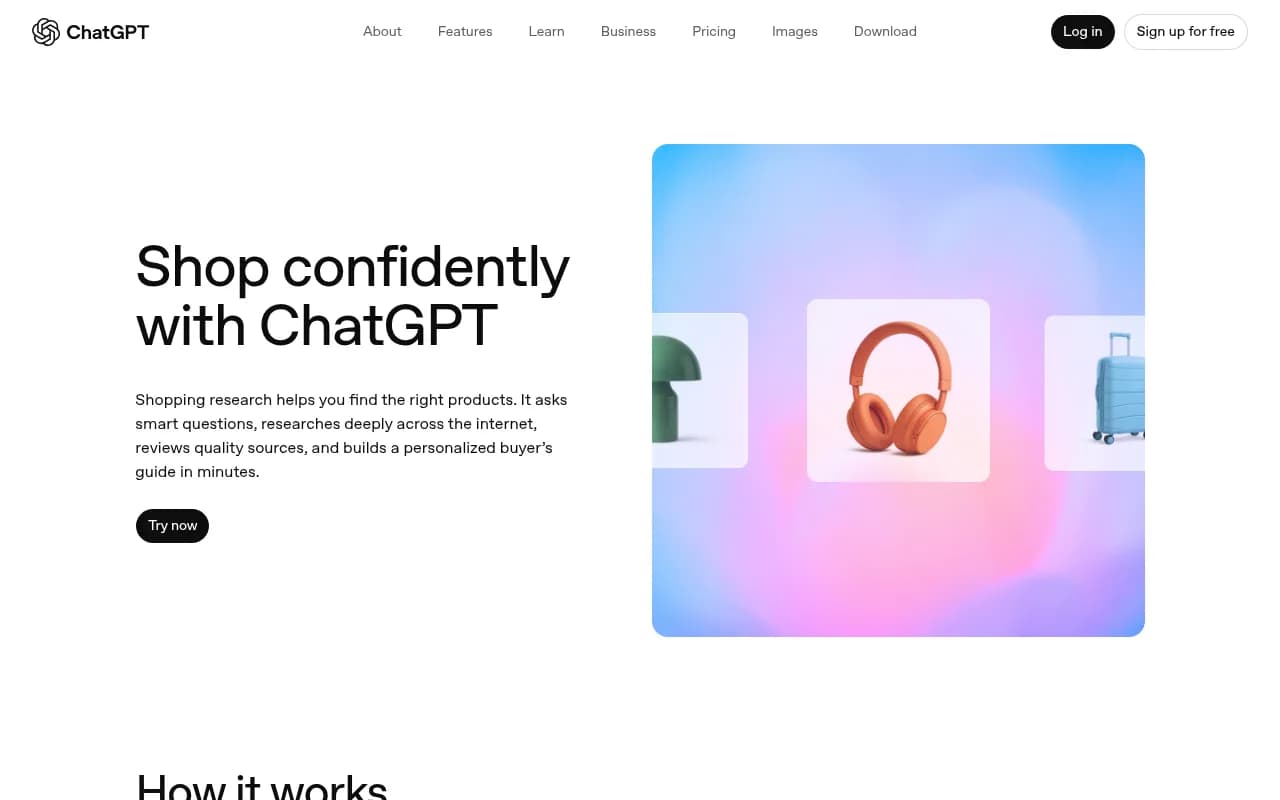
OpenAI rolled this out in November 2025 to all ChatGPT users (Free, Go, Plus, Pro). It's available on mobile and web, with nearly unlimited usage through the holidays. The feature performs best in detail-heavy categories: electronics, beauty, home and garden, kitchen appliances, sports and outdoor.
The scale is significant. ChatGPT Shopping processes 50 million queries per day. For context, that's roughly 10% of Google Shopping's daily volume, achieved in the first few months of launch.
How ChatGPT Shopping works under the hood
ChatGPT Shopping runs a two-stage query process. First, it asks you questions to understand constraints (budget, use case, preferences). Then it runs fan-out queries -- multiple searches to Google Shopping and other sources -- to gather product data.
Semrush analyzed this and found ChatGPT runs two sets of fan-out queries for responses with product carousels. The first set gathers broad product data. The second set narrows based on the constraints you specified in the conversation.
This is why optimizing for ChatGPT Shopping means optimizing for Google Shopping first. ChatGPT doesn't have its own product database. It queries Google Shopping, pulls results, then re-ranks them based on relevance to the conversational context.
The ranking is purely algorithmic. No ads, no sponsored placements. Products appear when they match the query and meet the stated constraints. You pay nothing to be discovered. (If you enable Instant Checkout, you pay a small transaction fee when someone buys, refunded on returns.)
Why tracking ChatGPT Shopping matters
Most brands have no idea if they appear in ChatGPT Shopping recommendations. They don't know which queries trigger their products, how often they're recommended, or how they compare to competitors.
This is a visibility problem. If you're invisible in ChatGPT Shopping, you're missing 50 million daily queries from people actively looking to buy. These aren't casual browsers -- they're asking specific questions about constraints, features, and tradeoffs. High-intent traffic.
Tracking tools solve this by monitoring:
- Which product queries mention your brand or products
- When you appear in recommendation carousels vs competitors
- Which product attributes ChatGPT highlights in its explanations
- How your visibility changes over time as you optimize
Without tracking, you're optimizing blind. You make changes to product data or content, but you don't know if ChatGPT's recommendations improved.
Tools that monitor ChatGPT Shopping
Promptwatch is the only platform that tracks ChatGPT Shopping as a dedicated feature. It monitors when your products appear in ChatGPT's recommendations and carousels, which queries trigger them, and how you rank against competitors.

Promptwatch's ChatGPT Shopping tracking shows:
- Product carousel appearances: when your products show up in ChatGPT's 4-6 item recommendations
- Query coverage: which shopping queries you're visible for vs competitors
- Recommendation context: what ChatGPT says about your product (features, tradeoffs, use cases)
- Visibility trends: how your presence in shopping results changes over time
The platform runs on real prompt data -- 880M+ citations analyzed across ChatGPT, Perplexity, Claude, Gemini, and other AI models. For shopping specifically, it tracks ChatGPT's product recommendations and ties them back to the underlying queries and constraints.
Other AI visibility platforms like Otterly.AI, Peec AI, and AthenaHQ focus on general brand mentions in AI responses but don't have dedicated ChatGPT Shopping tracking. They'll catch some shopping-related queries if you're mentioned, but they won't show you the full carousel, competitor products, or how ChatGPT explains tradeoffs.



| Tool | ChatGPT Shopping tracking | Product carousel monitoring | Competitor comparison | Pricing |
|---|---|---|---|---|
| Promptwatch | Yes (dedicated feature) | Yes | Yes | $99-579/mo |
| Otterly.AI | No (general mentions only) | No | Limited | $49-299/mo |
| Peec AI | No (general mentions only) | No | Yes | $99-499/mo |
| AthenaHQ | No (general mentions only) | No | Yes | $199-999/mo |
If you're serious about e-commerce visibility in AI, you need a tool that tracks shopping-specific features. General brand monitoring won't show you the product-level details that matter for optimization.
What to track in ChatGPT Shopping
Tracking ChatGPT Shopping isn't just about counting mentions. You need to understand the full context of how your products appear and what ChatGPT says about them.
Product carousel appearances
ChatGPT typically recommends 4-6 products per query. Track how often you appear in these carousels, in what position, and for which queries. Position matters -- the first product gets more attention than the sixth.
Query coverage vs competitors
Which shopping queries do competitors appear for that you don't? This is the gap analysis that tells you what's missing. If a competitor shows up for "best budget noise-canceling headphones" and you don't, you need to figure out why.
Promptwatch's Answer Gap Analysis does this automatically. It shows you the specific queries where competitors are visible but you're not, then helps you create content to close the gap.
Recommendation context and explanations
ChatGPT doesn't just list products. It explains why it's recommending them, what tradeoffs exist, and which product fits which use case. Track what ChatGPT says about your product:
- Which features does it highlight?
- What constraints does it say your product meets (budget, size, noise level)?
- How does it compare you to competitors?
This context reveals what signals ChatGPT is picking up from your product data and content. If it's highlighting the wrong features or missing key differentiators, you know what to fix.
Source attribution
ChatGPT pulls product data from multiple sources: Google Shopping, your website, reviews, Reddit discussions, YouTube videos. Track which sources it cites when recommending your product. If it's not citing your official product pages, that's a signal your on-site content isn't authoritative enough.
Visibility trends over time
Track how your ChatGPT Shopping visibility changes as you optimize. Did improving your Google Shopping feed increase carousel appearances? Did publishing a detailed comparison guide get you cited more often? Trends show what's working.
How to optimize for ChatGPT Shopping
Optimization happens in two layers: your product data (what ChatGPT queries) and your brand content (what ChatGPT reads to understand context).
Layer 1: Optimize your Google Shopping feed
ChatGPT queries Google Shopping to find products. If your Google Shopping data is incomplete or poorly structured, you won't appear in ChatGPT's results.
Key optimizations:
- Complete product titles: Include brand, product type, key features, and constraints ("Sony WH-1000XM5 Wireless Noise-Canceling Headphones, 30hr Battery, Black")
- Detailed descriptions: ChatGPT reads these to understand what your product does and who it's for. Write for humans, not keyword stuffing.
- Accurate attributes: Fill in every attribute Google Shopping supports (color, size, material, features). ChatGPT uses these to filter by constraints.
- High-quality images: ChatGPT shows product images in carousels. Clear, professional photos matter.
- Pricing and availability: Keep these updated. Out-of-stock or mispriced products hurt your relevance.
Semrush's analysis confirms this: ChatGPT's fan-out queries hit Google Shopping first. If your product data there is weak, you're invisible before ChatGPT even starts ranking.
Layer 2: Build authoritative content around your products
ChatGPT doesn't just query Google Shopping. It also reads your website, reviews, Reddit discussions, and other sources to understand context and tradeoffs.
Create content that helps ChatGPT explain your product:
- Detailed product pages: Go deep on features, use cases, and constraints your product solves. Don't just list specs -- explain what they mean for the buyer.
- Comparison guides: Write guides comparing your product to competitors. ChatGPT loves these because they directly answer "which product is best for X" queries.
- Use case content: Publish articles about specific use cases ("Best headphones for small apartments", "Quietest vacuums for hardwood floors"). ChatGPT cites these when someone asks a constraint-based question.
- FAQ pages: Answer common questions about your product. ChatGPT pulls from FAQs to explain tradeoffs.
Promptwatch's AI writing agent generates this content automatically, grounded in real citation data and competitor analysis. It's not generic SEO filler -- it's content engineered to get cited by ChatGPT and other AI models.
Layer 3: Monitor and iterate
Optimization is a loop. Make changes, track the results, refine. Use a tool like Promptwatch to see:
- Did your carousel appearances increase after updating product data?
- Are you now visible for queries you were missing before?
- Did publishing a comparison guide get you cited more often?
Most brands optimize once and never check the results. The ones winning in ChatGPT Shopping are running this loop continuously.
The Instant Checkout opportunity
ChatGPT also offers Instant Checkout, powered by the Agentic Commerce Protocol (ACP) built by OpenAI and Stripe. This lets shoppers buy directly inside ChatGPT without leaving the conversation.
Here's how it works:
- Shopper asks ChatGPT for product recommendations
- ChatGPT shows a carousel with your product
- Shopper clicks "Buy" and checks out via Stripe (Apple Pay, Google Pay, Link)
- Order goes directly to you -- you're the merchant of record
You stay in control of orders, payments, fulfillment, and customer relationships. ChatGPT doesn't own the transaction. You pay a small fee when a purchase is made (refunded on returns).
Instant Checkout is free to enable. You only pay when someone buys. No upfront cost, no monthly fees to be discoverable.
The catch: you need to be visible in ChatGPT Shopping first. Instant Checkout only matters if shoppers see your product in the carousel. That's why tracking and optimization come first.
Common mistakes brands make
Most brands approach ChatGPT Shopping the same way they approach Google Shopping: optimize the feed, hope for the best. That's not enough.
Mistake 1: Ignoring conversational context
ChatGPT Shopping is conversational. People don't search for "Sony WH-1000XM5" -- they ask "What are the quietest headphones for under $300?" If your product data and content don't address constraints (budget, noise level, use case), you won't appear.
Mistake 2: Thin product pages
ChatGPT reads your product pages to understand what your product does and who it's for. If your pages are just a list of specs with no explanation, ChatGPT has nothing to work with. It can't explain tradeoffs or recommend your product for specific use cases.
Mistake 3: No competitor context
ChatGPT's job is to compare products and explain tradeoffs. If you don't publish comparison content, ChatGPT will cite your competitors' comparisons instead. You lose control of the narrative.
Mistake 4: Optimizing blind
You can't optimize what you don't measure. Most brands make changes to product data or content without tracking whether it improved their ChatGPT Shopping visibility. Use a tool like Promptwatch to close the loop.
Mistake 5: Treating ChatGPT Shopping like ads
ChatGPT Shopping is organic. There are no sponsored placements, no bidding, no pay-to-play. The ranking is purely algorithmic, based on relevance to the query. Brands that try to game it with keyword stuffing or fake reviews get filtered out. The ones that win are the ones that genuinely match what the shopper asked for.
What's next for ChatGPT Shopping
ChatGPT Shopping is three months old and already processing 50 million queries per day. OpenAI is iterating fast. Expect:
- More categories: Right now it works best for electronics, beauty, home goods, and outdoor gear. OpenAI will expand to more verticals.
- Deeper integrations: Instant Checkout is just the start. Expect order tracking, returns, and post-purchase support inside ChatGPT.
- Personalization: ChatGPT already uses memory to tailor recommendations (if it knows you're into gaming, it factors that in). This will get more sophisticated.
- International expansion: ChatGPT Shopping launched in the US. It'll roll out globally, with localized product data and multi-language support.
The brands that start tracking and optimizing now will have a visibility advantage when ChatGPT Shopping scales to 100 million or 200 million daily queries.
Getting started with ChatGPT Shopping tracking
If you're selling products online, you need to know if you're visible in ChatGPT Shopping. Here's how to start:
- Audit your current visibility: Use Promptwatch to see if you're appearing in ChatGPT Shopping carousels. Check which queries trigger your products and how you compare to competitors.
- Optimize your Google Shopping feed: Make sure product titles, descriptions, attributes, and images are complete and accurate. This is the data ChatGPT queries.
- Publish constraint-based content: Write product pages, comparison guides, and use case articles that address the specific constraints shoppers ask about (budget, size, noise level, durability).
- Track the results: Monitor how your visibility changes over time. See which optimizations move the needle.
- Enable Instant Checkout: Once you're visible, enable Instant Checkout so shoppers can buy directly from ChatGPT.
ChatGPT Shopping is the new discovery channel. The brands that figure out tracking and optimization first will own the next wave of e-commerce traffic.