Key takeaways
- Searchable's self-serve plans only track three AI engines (ChatGPT, Google AI Overviews, Perplexity) out of the box; Claude, Copilot, Grok, and DeepSeek sit behind add-ons or the Custom tier, and its own Agency Partner tier starts around $250/month for five projects.
- The agencies that get the most value pick a platform based on how it prices multi-client volume: per-project (Peec AI, Finseo), per-client-workspace add-on (Profound), or flat pooled-credit pricing (Rankscale, Trakkr).
- "White label" means very different things across vendors. Some give you a full branded client login portal with a custom domain; others just hand you an exportable PDF or a cloned Looker Studio template. Otterly.AI, for example, has no native white-label option at all.
- If your agency also delivers business-data dashboards (not just AI-search or marketing reports), that's a separate category entirely, and tools like DashboardFox solve a different problem than Searchable ever tried to.
- For most agencies tracking AI search visibility across 5-25+ clients, Promptwatch is worth a serious look because it pairs multi-model monitoring with content generation and CMS publishing, not just a dashboard you have to act on manually.
Why agencies are looking past Searchable in 2026
I've looked at a lot of these AI-visibility platforms over the past year, and Searchable is a decent product with an awkward pricing structure for agencies. The Pro plan ($125/month) and Scale plan ($400/month) look reasonable until you notice they only track ChatGPT, Google AI Overviews, and Perplexity by default. Claude, Copilot, Grok, and DeepSeek cost extra until you hit the Custom tier. Profound's independent review of Searchable found the same gap on the agency side: the Agency tier starts at $250/month for five projects, still gated to those three base engines, with no persona segmentation beyond location and no side-by-side multi-LLM comparison view. Their review also flagged the in-platform AI agent as buggy and slow during testing.
None of that makes Searchable bad. It makes it incomplete for an agency that needs to report Claude and Copilot visibility to a client who specifically asked about it, without calling the account manager first.
So this guide walks through what actually matters when evaluating alternatives, then compares the realistic contenders on the three things agencies care about most: how many clients you can run without the bill exploding, how convincing the white-label experience is, and how the seat or credit math plays out at 10, 25, and 50+ clients.
What actually matters for agency-grade AI visibility tools
Before the comparison, a framework. Most of these platforms get reviewed on raw feature count, which misses the point for agency buyers. Here's what to check instead.
Engine coverage without add-on surprises. Verify which AI engines are included at the tier you're actually paying for, not the tier in the marketing page hero image. Searchable, Semrush, and several others advertise broad coverage that's gated behind their top or custom tier.
Pricing unit and how it scales with client count. Some platforms charge per project, some per pooled credit across all clients, some per client workspace as an add-on fee. A flat $999/month for unlimited projects is a very different deal from $99 base plus $399 per client.
What "white label" actually includes. A branded login portal with a custom domain is a different deliverable than an exportable PDF or a cloned Looker Studio dashboard. Otterly.AI is explicit in its own help docs that it has no native white-label interface at all; agencies route around this with external Looker Studio exports. Worth knowing before you promise a client a branded portal you can't deliver.
Pitch workspaces. The better agency tiers (Peec AI, Finseo, ReachLLM) include a free or time-boxed audit environment for prospects that doesn't eat into your paying-client prompt budget. Useful for sales calls, and a feature Searchable's self-serve tiers don't really replicate.
Prompt-set bias. This one isn't about the vendor, it's about how you use the tool. It is extremely easy to get a meaningless visibility report if you accept every AI-generated prompt suggestion at setup without editing. A prompt set skewed toward the client's own brand name inflates share of voice and hides real competitive gaps. No tool gives you "absolute" visibility; every report is only as good as the prompt list behind it.
How agency AI-visibility platforms compare in 2026
| Platform | Agency pricing | Engines included at that tier | White-label depth | Seat/client model |
|---|---|---|---|---|
| Searchable | $250/mo (5 projects, apply-based) | 3 base; Claude/Copilot add-ons | Full branded platform via Partner Programme | Unlimited seats, per-project |
| Peec AI | $245-$795/mo (Essential to Scale) | Model-dependent, add-on cost per extra model | Shareable client dashboards, cloned Looker templates | Credit-pooled; team vs. client seats |
| Profound | $99 base + $399/client workspace | 3 (ChatGPT, Perplexity, AI Overviews) at that tier; up to 9 on Enterprise | Enterprise-grade, custom pricing | Per-client workspace add-on |
| Rankscale | $385/mo (Growth) | ChatGPT, Gemini, Perplexity | White-label dashboards included | Unlimited seats, pooled credits |
| Otterly.AI | $189-$489/mo + partner boost | ChatGPT, AI Overviews, Perplexity, Copilot | None native; export to Looker Studio | Unlimited workspaces |
| Finseo | EUR349-599/mo (Solo/Studio) | Google AI Mode + AI Overviews focus | White-label Report Builder, pitch decks | Per-client project, pooled answers |
| Trakkr | $417/mo (10 brands) + $50/brand | 8+ engines incl. Claude, Gemini | Full custom domain, branded | Unlimited seats |
| Promptwatch | $245/mo Professional (2 sites) to $579/mo Business (5 sites); Agency tiers from $199/mo | ChatGPT, Gemini, Claude, Perplexity, Grok, DeepSeek, Copilot, Mistral, AI Overviews, AI Mode | Custom reports, client portal, white-label dashboard | 10 seats on agency tiers, unlimited projects/prompts |
Figures above reflect the tiers and features as described by each vendor's public pricing or an independent review cited in the research; confirm current pricing on each vendor's page before quoting a client, since these platforms change tiers often.
Profile: the realistic Searchable alternatives
Peec AI — best if you're running 3-25 clients and want flexible credit pooling

Peec AI's agency tiers are explicit about who they're for: Essential at $245/month is positioned for agencies landing their first clients, Growth at $495/month for boutique shops managing 3-10 clients, and Scale at $795/month for agencies running 11-25+. What stands out is the separation between "Team users" (your internal staff) and "Client users" (view-only seats for the client), plus free pitch projects with a capped prompt allowance that don't burn into paying-client capacity. The tradeoff is that additional AI models outside the bundled set cost roughly EUR30-140 per month depending on tier, and there's no formal wholesale or referral program the way some competitors offer.
Profound — best if you need deep engine coverage and enterprise trust signals

Profound's Enterprise tier covers up to nine answer engines including Claude, Copilot, DeepSeek, and Exa Search, plus SOC 2 and SSO/SAML, which matters if you're pitching regulated clients. The catch for agencies is the pricing structure: a $99/month base plus $399/month per client workspace adds up fast past five or six clients, and the self-serve Agency Growth tier only tracks three engines. It's a strong tool, just not the cheapest way to scale past a handful of accounts.
Otterly.AI — cheapest entry point, but check the white-label gap first

Otterly's Lite plan at $29/month is the lowest sticker price in this comparison by a wide margin, and its Agency Partner Program boosts prompt allowances at the same price points. But its own help documentation states plainly that there's no native white-label option: no custom branding, no custom URL. If a branded client portal is part of your pitch, you'll be exporting to Looker Studio instead, which is a workable fallback but a materially different deliverable than what Finseo, Rankscale, or Trakkr ship natively.
Rankscale — best pooled-credit model for agencies that hate per-seat math
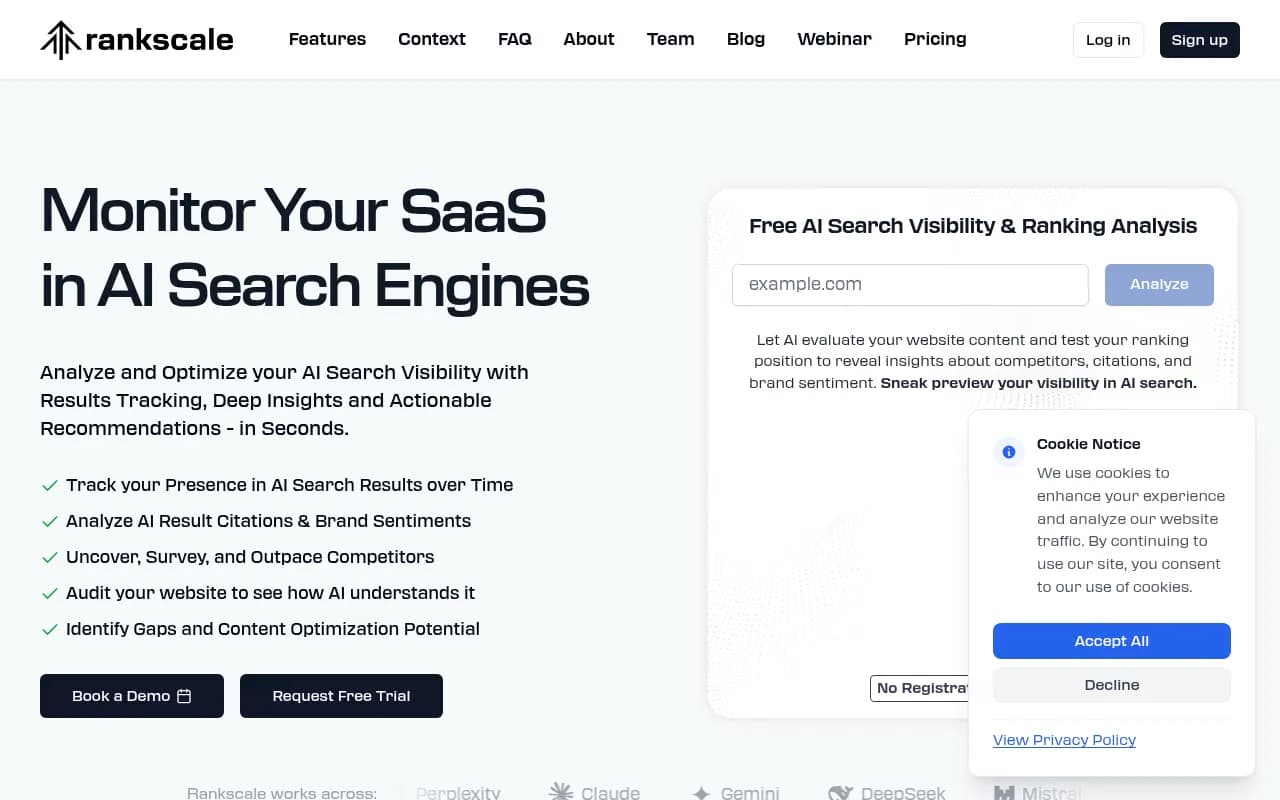
Rankscale's Growth tier at $385/month includes 5,500 credits (roughly 22,000 responses), 50 client dashboards, 200 page audits, white-label dashboards, and unlimited seats. No per-seat penalty for adding team members is a real advantage if your account team grows faster than your client count.
Finseo — best for agencies specifically chasing Google AI Mode and AI Overviews visibility
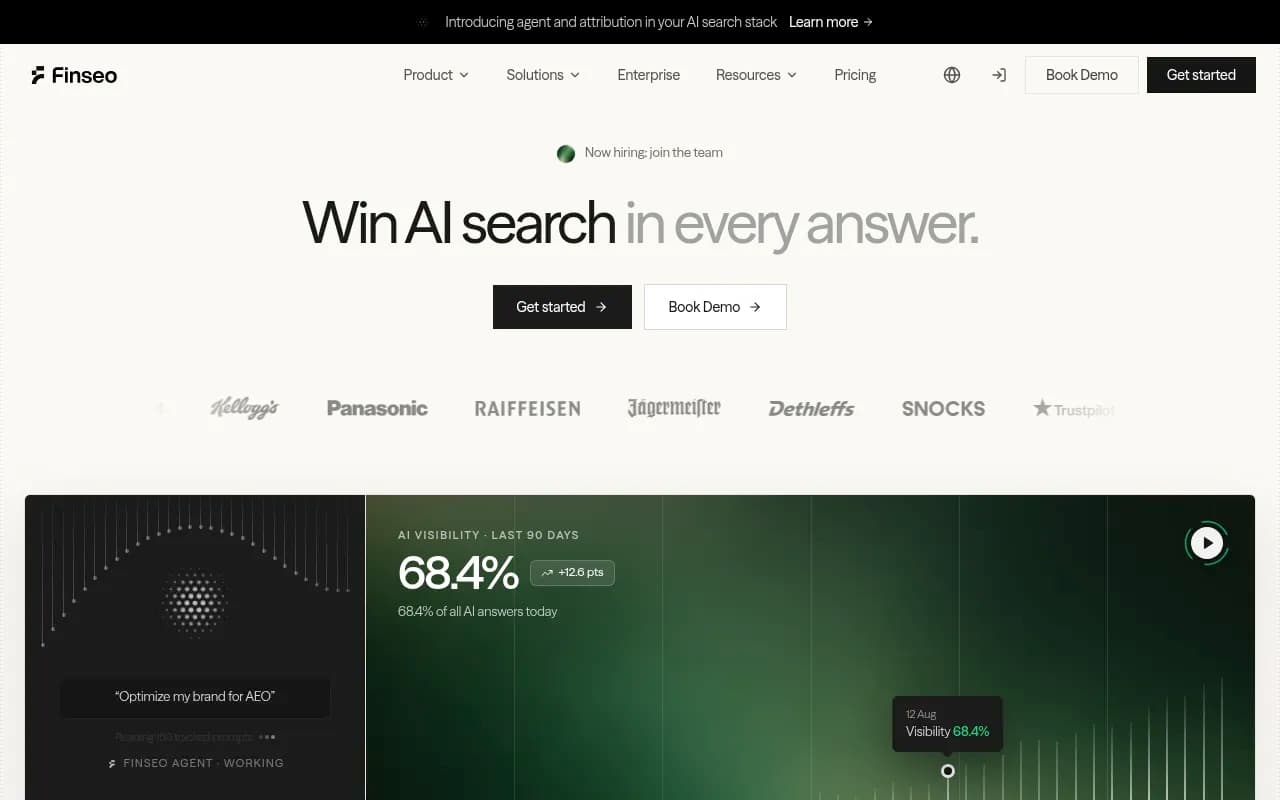
Finseo splits agency pricing from brand pricing cleanly: Solo at EUR349/month covers 5 client projects and 20,000 AI answers, Studio at EUR599/month covers 10 projects and 40,000 answers. Every partner tier includes a multi-project dashboard, a white-label Report Builder, public API access, and free 14-day pitch projects with white-label pitch decks built in, useful if your sales process leans on polished prospect materials.
Promptwatch — best if the deliverable needs to go beyond monitoring into actual content work

Most of the tools above answer one question well: was my client's brand mentioned, and by whom. Promptwatch is built to answer a different question: what should we do about it, and can the platform help us do it. It tracks ChatGPT, Gemini, Claude, Perplexity, Grok, DeepSeek, Mistral, Microsoft Copilot, Google AI Overviews, Google AI Mode, and AI coding assistants like Claude Code, with crawler logs showing exactly when AI bots visit a client's pages and whether they hit errors, visitor analytics tying AI traffic to actual conversions, and Content Agents that plan, write, and publish GEO-optimized content straight to a client's CMS on Webflow, Framer, or WordPress.
For agencies specifically, that last part matters because it closes the loop a pure monitoring dashboard leaves open. A Scrunch or Peec dashboard tells you a client dropped out of AI Overviews citations this month; Promptwatch's Unified Actions generates a prioritized to-do list explaining why and its Content Agent can start fixing it. Monks, the agency behind work for Netflix, BMW, and Asana, uses Promptwatch's Answer Gap Report and Visibility Score to build content roadmaps for enterprise clients, and Crisp saw 2x higher conversion rates from AI traffic versus traditional channels after scaling to 5-10 published articles per day through the platform. It's rated 4.7/5 on G2 across 1,840+ customers.
Agency pricing runs from a $199/month Kick-off tier up to $799/month Scale, all with unlimited projects and prompts and 10 seats, which sidesteps the per-client-workspace fee structure that makes Profound expensive at scale. If you want the full comparison against 20 other GEO platforms, Promptwatch's own research breaks it down at promptwatch.com/best-geo-and-ai-visibility-platforms-compared-2026.
What the citation data tells agencies about what to actually report
It's worth grounding reporting decisions in real citation behavior rather than guessing at what clients should care about. Promptwatch's data on ChatGPT citation types in August 2026 found product pages still led at roughly 28.7% of citations, while how-to content more than doubled its share from 4.3% to 9.1% over the month. That's a concrete signal for what content types to prioritize in a client's GEO roadmap. The same dataset showed social post citations collapsed from 4.4% to under 1% after August 14, coinciding with a broader drop in Reddit's citation share across ChatGPT, from roughly 4% down to 0.5% in a single day, as documented in Promptwatch's Reddit citation tracking. Agencies reporting "Reddit visibility" to clients as a stable metric should know that number moved almost overnight.
On domain authority, Promptwatch's citation-share-by-domain-rank data for August 2026 found mid-authority sites (DR 46-75) captured about 46% of all ChatGPT citations, while top-tier DR 91-100 domains shrank from 7% to 3% over the same period. That's a useful talking point when a client assumes only the biggest competitors get cited. They don't, necessarily.
A quick note on business-data dashboards versus AI-search reporting
It's worth separating two categories agencies sometimes conflate. Everything above deals with AI-search visibility: tracking brand mentions and citations inside ChatGPT, Perplexity, and similar tools. A different category covers white-label BI dashboards connected to a client's actual business data, SQL databases, ERPs, CRMs. If that's what you need, tools like DashboardFox solve that problem with MAU-based pricing instead of per-seat billing, which matters because most client logins happen once a month, not daily. It's not a Searchable alternative in the strict sense, but agencies running both AI-visibility reporting and operational BI dashboards for the same clients often end up needing both categories side by side.
Picking the right one for your agency
If you're under 10 clients and price-sensitive, start with Otterly.AI or Peec AI's Essential tier, just be upfront with clients about what "white label" means in each case. If you're running 10-25 clients and want pooled credits without per-seat penalties, Rankscale or Trakkr fit better. If your clients specifically need Claude, Copilot, or DeepSeek coverage and enterprise trust signals like SOC 2, Profound's Enterprise tier is worth the per-workspace cost. And if the deliverable needs to move past "here's your citation report" into actually fixing the gap, generating content, and publishing it, Promptwatch is the platform built around that workflow rather than treating it as an afterthought.
For agencies still mapping out the broader GEO software landscape, the directory at bestgeosoftware.com is a reasonable place to keep browsing options beyond this list, and ai-rank-tools.com covers the narrower AI rank-tracking category if that's the specific slice you need.