Key takeaways
- Country and language are two separate settings. The country tells the AI engine where the user is, and the language controls how the question is asked and answered. Each market needs both set correctly.
- Tools differ on three points: how the country is set, which AI engines return country-specific answers, and which plan includes more than one market.
- Most coverage numbers (80+ countries, 140+ countries, 220+ countries) are self-reported by vendors, so test them on your own markets before you buy.
- Promptwatch runs one monitor per country and language on every plan from $95/month. Profound, Scrunch, Evertune, Peec AI, Semrush and SE Ranking are the other serious options.
- A single prompt tells you little. Build a prompt set per market and measure across all of it.
Why one global visibility score hides the problem
A French buyer asking ChatGPT a question in French sees different brands and different sources than a US buyer asking the same thing in English. That is the core claim in Promptwatch's own write-up on multi-country tracking, and it matches what most teams find once they start checking. One blended number averages the markets where you lead with the ones where a local competitor owns the answer.
So multi-market support becomes one of the first filters when you shortlist a tool. I would put it ahead of dashboard polish, because a tool that sets the country badly gives you clean charts of the wrong data.
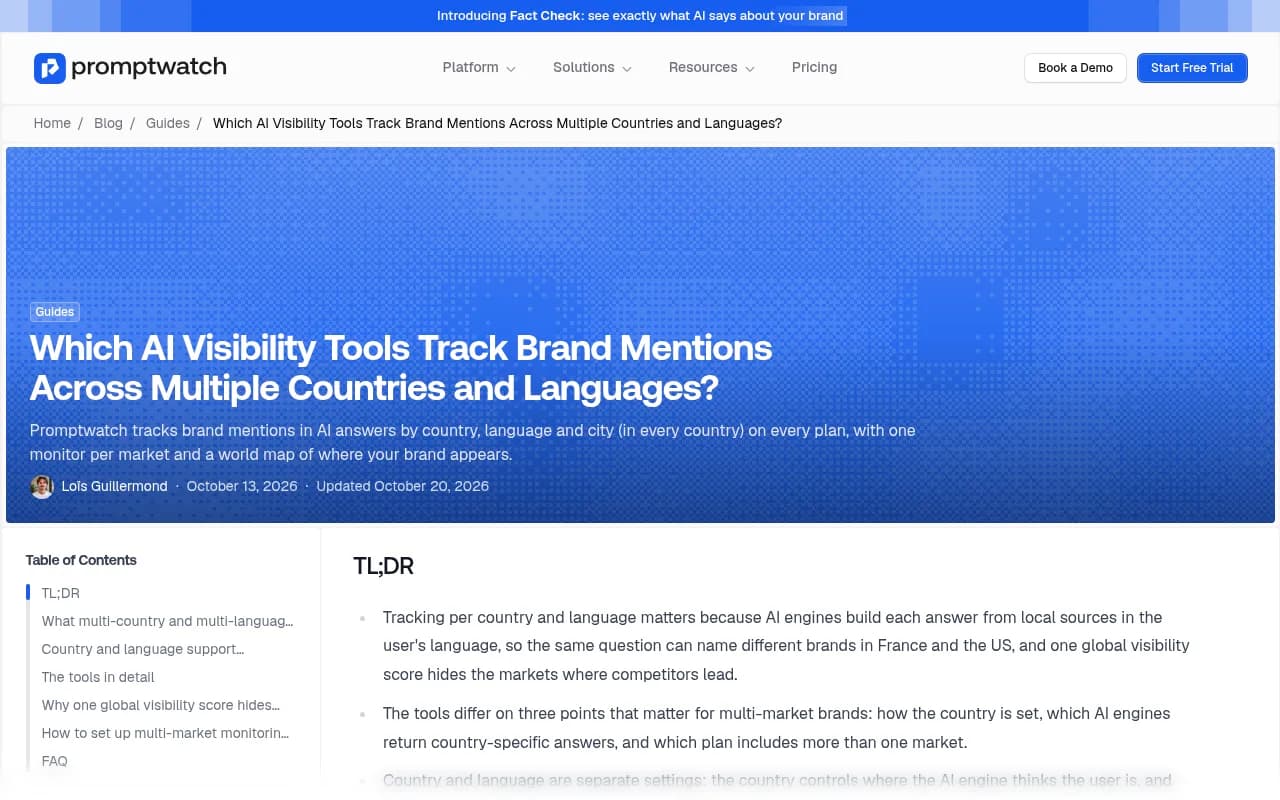
A caveat on sources. I could not find a public Promptwatch Data report that splits citations by country or language, so the claim about different brands per market rests on that blog post and on common practice, not on a dataset. For the general mechanics of how AI answers are built, Promptwatch Data is the best first-party reference.
What multi-country and multi-language tracking actually means
It means running the same set of prompts as if users in different countries asked them, in the language they would use, and keeping each market's answers separate. Brands, competitors, citations and sentiment are then measured per market.
Country: where the AI engine thinks the user is
The country setting tells the engine where the request comes from. Tools do this in different ways: geo-distributed servers, residential proxies with a matched locale and timezone, or by naming the country or city inside the prompt itself. The third method is the weakest, since you are testing how the model reads a sentence, not how it treats a real user in that place.
Language: how the question is asked
Language is separate. A Belgian brand may need French (Belgium), Dutch (Belgium) and German, each with its own prompts. Translating your English prompts word for word is a trap. Real buyers phrase things differently in every language, so write or source native prompts where you can.
Regional variants and cities
Some tools stop at the country. Others let you pin a city or US state, which matters for local queries and multi-location brands. Check this early if you run stores, franchises or regional offices.
Comparison of country and language support
The figures below come from vendor pages and listicles, not independent testing. Treat them as claims to verify.
| Tool | Countries | Prompt languages | How the country is set | Multi-market plan |
|---|---|---|---|---|
| Promptwatch | One monitor per country, optional city or US state | Per monitor, including regional variants such as French (Belgium) | Live interface, residential proxy with matched locale and timezone for city and state | Every plan, from $95/mo |
| Profound | 80+ | Not specified | Geo-distributed servers and proxy networks | Enterprise with custom regions; trial includes one region |
| Scrunch | 88 for the primary country, any country per prompt | Any language | Primary country, persona country, or city named in the prompt | Not specified, plans from $250/mo |
| Semrush AI Visibility Toolkit | 220+ countries and territories | Not specified | Not specified | $99/mo for 25 prompts |
| SE Ranking (SE Visible) | 7 | 5 | Not specified | From $99/mo |
| AthenaHQ | Single region on Starter, multiple on Enterprise | Single language on Starter, multiple on Enterprise | Not specified | Enterprise, custom |
| Evertune | 140+ | 33 | Not specified | Enterprise |
| Peec AI | Multi-country on Advanced | Multi-language | Not specified | Advanced at $495/mo, 350 prompts (per a SitePoint article, date unchecked) |
The tools in detail
Promptwatch
Promptwatch is the option I would start with for most multi-market brands, mainly because the market structure is built into how it works. You create a monitor per country and language, and a monitor's language and location are fixed once created, so markets never mix. You can add a city in any country or a US state, and a world map shows where your brand appears and which markets you are not tracking yet.
That is available on every plan from $95/month, which is unusual. Several competitors gate multiple regions behind enterprise contracts. It collects answers from the real interfaces of ChatGPT, Google AI Overviews, Google AI Mode, Gemini, Perplexity, Copilot, Meta AI and others, because user-facing answers and citations can differ from API output. Tracking prompts daily is standard, and Business and Agency Scale plans can run every 12, 6 or 1 hours.
Beyond tracking, it covers the work that follows: the Action Board, the Content Agent that writes and publishes to WordPress, Webflow or Framer, IP-verified AI crawler logs, and visitor analytics. For local brands, Business and above can pin a monitor to exact coordinates. Pricing is on promptwatch.com/pricing and there is a 7-day free trial on monthly plans, plus a free AI visibility report.

Agencies running many client markets should look at the Kick-off ($199/mo), Growth ($399/mo) and Scale ($799/mo) plans, which have unlimited projects and country, state and city tracking. The agency page explains the setup. For a direct comparison, see Promptwatch vs Profound.
Profound
Profound claims 80+ countries through servers and proxy networks, and it is strong on monitoring. The catch is access: the trial includes one region, and custom regions sit on Enterprise. If you need five markets from day one, expect a sales conversation.

Scrunch
Scrunch is flexible on language, with any language supported and any country settable per prompt. Its country method is the one I would probe. Setting country by naming a city inside the prompt is not the same as geo-locating the request, so ask how they handle it. Plans start from $250/mo.
Semrush AI Visibility Toolkit
Semrush advertises 220+ countries and territories for Prompt Tracking, at $99/mo for 25 prompts. That prompt count goes fast once you multiply it by markets. Twenty-five prompts across four countries is about six prompts each, which is thin. It suits teams already living in Semrush who want a first look.
SE Ranking (SE Visible)
SE Visible covers 7 countries and 5 languages from $99/mo. That is a narrow footprint, but it is friendly and cheap if your markets fall inside it.
Evertune
Evertune reports 140+ countries and 33 languages, including regional variants like Portuguese (Brazil) and Chinese (Simplified and Traditional). It is aimed at Fortune 500 brands, so expect enterprise pricing and process.
Peec AI
Peec AI is positioned around multi-language tracking. A SitePoint article lists its Advanced plan at $495/mo with 350 prompts, multi-country tracking and the Looker Studio connector. I could not confirm that article's date, so check current pricing.

AthenaHQ
AthenaHQ limits Starter to a single region and language. Multiple countries and languages arrive with Enterprise, custom priced. Fine for a one-market brand, awkward for a global one.
How to choose
A short checklist beats a long feature list here.
- Ask how the country is set. Real geo-located requests beat country names typed into a prompt.
- Check whether language and country are independent settings, so you can run French in Belgium, France and Canada separately.
- Find the cheapest plan that includes your actual number of markets, not the headline plan.
- Multiply prompts by markets. A 150-prompt plan across five markets is 30 prompts each.
- Test with a trial on two markets where you know the competitors, and see whether the results feel right.
If you are comparing several tools at once, the GEO software directory lists more options than I can cover here.
Building a prompt set per market
The tool is half of it. The prompt set decides whether the data is useful.
Promptwatch Data found that 47.6% of ChatGPT responses cite 10 or more unique domains (Sep 28 to Oct 4, 2026), and the share is 52.5% for organic prompts. See the unique domains report. Answers draw on many sources, so one prompt is an anecdote. Measure across many prompts in each market and track which competitors share the answer.
Brand-specific prompts behave differently: only 21.3% cite 10 or more domains, and 5 is the most common count. That means branded prompts are less noisy and fine for a quick sanity check, while organic and competitor comparison prompts need volume.
A practical structure per market:
- 10 to 20 organic category prompts written natively, not translated
- A handful of competitor comparison prompts using the local competitors, which often differ from your global ones
- A few branded prompts using your local brand name and any local spelling
- Personas that match local buyers
Query fan-outs also matter. Promptwatch's ChatGPT query fan-out data shows ChatGPT runs web searches behind each answer, and the page does not say whether those searches are localized for non-English prompts. Treat that as an open question and inspect the fan-outs per market in your tool, since they reveal which local sources feed the answer.
Mistakes I see with multi-market setups
- Translating English prompts literally and calling it localized.
- Tracking only the US and assuming the rest follows.
- Mixing languages inside one monitor, which muddies every average.
- Ignoring local competitors because they are not in your global set.
- Reading a visibility score without checking Position and citations. Low Share of Voice is a coverage problem, late Position is a prominence problem.
Once you see where you lose, you need to fix it market by market. Local landing pages, local-language content and local third-party mentions are usually the levers, and a platform that closes the loop from tracking to publishing saves the manual handoff.
More tools in this category are listed at the AI rank tracking directory.
Bottom line
If you need several markets without an enterprise contract, Promptwatch is the cleanest fit: per-market monitors on every plan, real-interface data, and the content and crawler tooling to act on what you find. Profound and Evertune make sense for large enterprises with custom regions in mind. Semrush and SE Ranking suit teams that want a cheap start in a handful of markets. Whatever you pick, run a two-market trial with prompts you wrote natively before committing.